

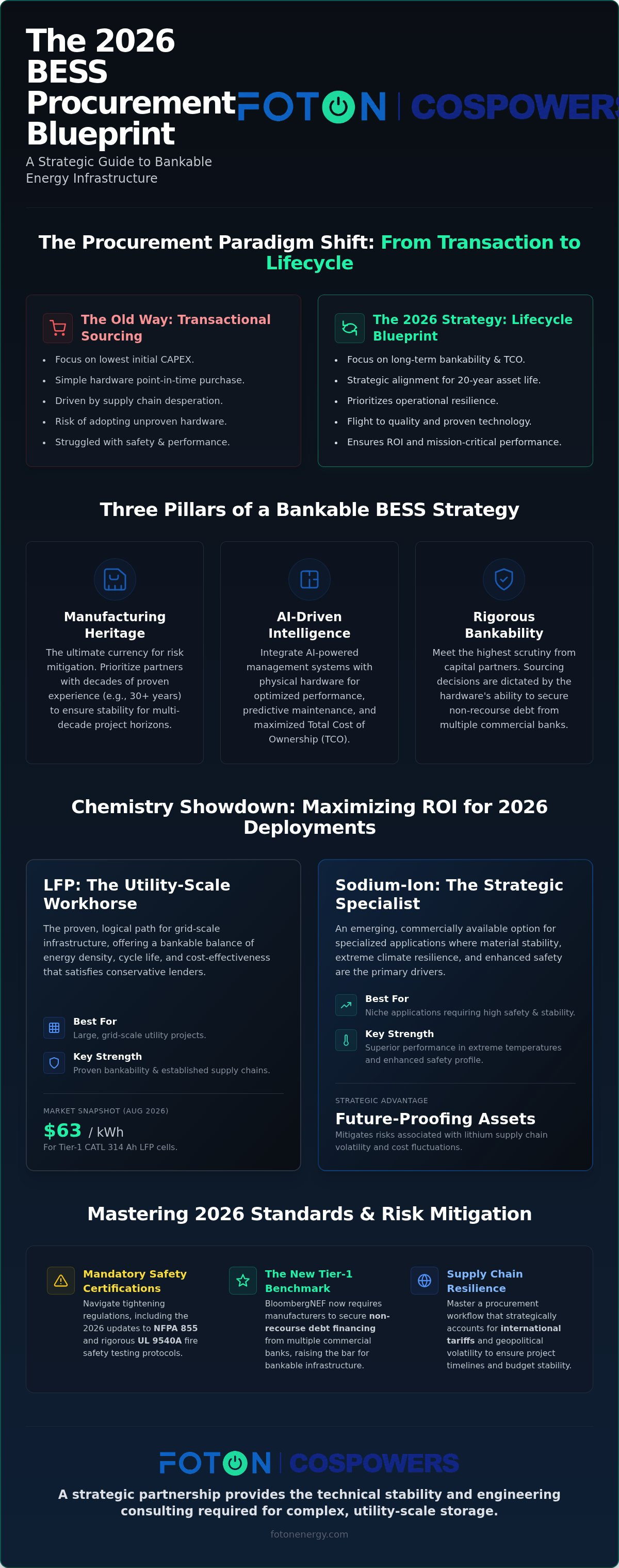
In 2026, a successful bess procurement strategy is no longer a simple hardware transaction. It has evolved into a high-stakes strategic alignment of manufacturing heritage, AI-driven intelligence, and rigorous bankability standards. As the global energy landscape shifts, the difference between a commissioned project and a stalled investment often comes down to the depth of your supplier vetting process.
You understand that supply chain volatility and tightening safety regulations, such as the 2026 updates to NFPA 855 and UL 9540A, have made project financing more complex than ever. Relying on hardware that lacks a proven track record is a risk your capital partners won't accept. With the BloombergNEF Tier-1 definition now requiring non-recourse debt financing from multiple commercial banks, the threshold for bankable infrastructure has reached a new peak of scrutiny.
This guide provides a comprehensive framework to master these complexities and secure long-term asset performance. You will learn to evaluate the ROI of Sodium-ion versus LFP chemistries for 2026 deployments and discover how to integrate AI-driven management systems with physical hardware. We invite you to explore a strategic approach that transforms procurement from a logistical hurdle into a foundational pillar of your energy infrastructure.
Key Takeaways
- Transition from a transactional mindset to a lifecycle-oriented bess procurement strategy that prioritizes long-term asset bankability and operational resilience.
- Assess the strategic trade-offs between LFP and the emerging commercial availability of Sodium-ion systems to maximize ROI for 2026 project cycles.
- Identify the critical benchmarks for Tier-1 status in 2026, focusing on manufacturing heritage, R&D depth, and the ability to secure non-recourse debt financing.
- Mitigate supply chain risks by mastering a procurement workflow that accounts for updated international tariffs and rigorous safety certifications like NFPA 855.
- Discover how a strategic partnership with a global manufacturer provides the technical stability and engineering consulting required for complex utility-scale storage.
What is a BESS Procurement Strategy in 2026?
In 2026, a high-performance bess procurement strategy functions as a lifecycle blueprint rather than a simple point-in-time purchase. The industry has moved past the experimental phase where securing any available capacity at any cost was the standard. Today, large-scale investors and technical partners prioritize bankable assurance above all else. This shift means that sourcing decisions are now dictated by the long-term financial viability of the hardware and its ability to secure non-recourse debt. To understand the foundational technology, one might ask What is a BESS in the context of modern grid stability; it's a complex asset that requires alignment between front-of-the-meter utility needs and behind the meter BESS for C&I applications. The procurement manager acts as the central architect in this process, bridging the gap between engineering specifications, financial modeling, and long-term operational maintenance to ensure the asset performs throughout its entire 20-year lifespan.
The Evolution of Energy Storage Sourcing
The 2026 market is defined by a flight to quality. Early-2020s procurement often suffered from supply chain desperation, leading to the adoption of unproven hardware that struggled to meet rigorous safety standards. We've entered an era where manufacturing heritage is the ultimate currency for risk mitigation. Selecting a partner with over 30 years of experience, such as Cospowers, provides the stability required for multi-decade project horizons. A modern bess procurement strategy is the systematic alignment of technical compliance, financial bankability, and supply chain resilience. This approach ensures that every megawatt-hour deployed is backed by rigorous testing, international certifications, and a legacy of operational excellence that satisfies even the most conservative lenders.
Core Objectives: Reliability, Safety, and ROI
Reliability and safety are the non-negotiables of 2026 sourcing. While initial CAPEX remains a factor, sophisticated buyers now focus on total cost of ownership by evaluating high-quality thermal management and AI-driven optimization. For industrial partners, the primary driver is often reducing demand charges through peak shaving, which requires high-performance systems capable of rapid, reliable response. In sectors like data centers and telecommunications, mission-critical performance isn't a buzzword; it's a requirement for 100% uptime. High-quality systems ensure that safety standards, including the latest NFPA 855 requirements, are met without compromising the projected ROI. By focusing on these core objectives, procurement teams can build a portfolio of resilient assets that deliver consistent value in an increasingly volatile energy market.
Chemistry-Specific Sourcing: LFP vs. Sodium-Ion Strategies
Selecting the appropriate cell chemistry is a foundational decision in any modern bess procurement strategy. For years, the market focused almost exclusively on Lithium Iron Phosphate (LFP) due to its safety and established supply chains. In 2026, the landscape has expanded significantly. We now see a clear strategic division between high-density utility projects and specialized applications where safety, climate resilience, or material stability are the primary drivers. A sophisticated procurement framework must now evaluate these chemistries based on specific site conditions and financial objectives rather than simply choosing the lowest initial cost.
LFP: The Utility-Scale Workhorse
Standardizing on high-capacity LFP modules remains the logical path for grid-scale energy storage infrastructure. LFP technology offers a proven balance of energy density and cycle life that satisfies the most conservative project lenders. As of August 2026, the market has seen increased accessibility for medium-scale integrators, with CATL offering 314 Ah LFP cells at $63 per kWh through direct-sales platforms. This pricing stability allows procurement managers to focus on long-term performance metrics like depth-of-discharge (DoD) and thermal management efficiency. To secure project financing, it's essential to source from Tier-1 manufacturers who meet the latest BloombergNEF criteria, ensuring the hardware is backed by non-recourse debt. Adhering to established Supply Chain Risk Management Guidance during the bidding process helps mitigate technical and geopolitical shocks that could stall large-scale deployments.
Sodium-Ion: The New Frontier for Data Centers and Telco
Sodium-ion technology represents a paradigm shift for safety-critical and climate-challenged infrastructure. The most significant development this year is the verified sodium-ion battery commercial availability, highlighted by the August 2026 commercial sale of a Cospowers 100kW / 200kWh system in Australia. Implementing a sodium-ion battery for data centers has become a leading procurement trend to meet the intense power demands of AI while ensuring non-flammable operation. These systems excel in extreme temperatures where LFP might require expensive climate control. While LFP provides higher density, sodium-ion offers superior material stability; sodium carbonate prices remained stable at approximately $300 per ton in early 2026, providing a hedge against lithium price volatility. If you're exploring how these emerging chemistries fit your portfolio, our engineering consulting team can help bridge the gap between technical potential and operational reality.
The Bankability Framework: Tier-1 and Certification Standards
Bankability is the ultimate filter in any modern bess procurement strategy. In 2026, a Tier-1 rating is merely the entry point for large-scale infrastructure. The BloombergNEF Tier-1 criteria now require manufacturers to have supplied own-brand products to at least six different projects of 10MW or 10MWh in the last two years; these projects must also be financed with non-recourse debt from at least two commercial banks. Financiers demand a comprehensive due diligence package that includes third-party verification from entities like DNV or Intertek. These reports serve as a technical guarantee, confirming that performance claims are grounded in rigorous testing. Beyond the cells, your procurement plan must evaluate the "balance of plant" components. Inverters, HVAC systems, and fire suppression units must be integrated seamlessly to prevent operational bottlenecks. To navigate these technical hurdles, leveraging BESS engineering consulting services is essential for ensuring hardware meets specific grid-code requirements without delaying project timelines.
Certifications and Safety Architecture
Safety is a prerequisite for project debt and long-term asset security. The 2026 edition of NFPA 855 now mandates a Hazard Mitigation Analysis (HMA) as the default requirement for most BESS installations, removing previous energy-based thresholds. Your strategy must prioritize hardware that complies with the 6th Edition of UL 9540A, published on March 13, 2026, which formalizes requirements for large-scale fire testing. This "safety-by-design" approach doesn't just protect the asset; it significantly reduces insurance premiums for large-scale BESS. Look for integrated fire suppression and liquid-cooled thermal management systems that maintain cell health while meeting international safety standards like IEC 62619. Systems that fail to meet these rigorous benchmarks risk stalling during the permitting phase, leading to costly delays.
Manufacturer Heritage and Financial Stability
Heritage provides the stability that venture-backed startups cannot offer. When you evaluate suppliers, a 30-year manufacturing history, such as that of Cospowers, serves as a vital proof point for long-term warranty support. Bankability depends on the supplier's "ability to pay" and their capacity to provide spare parts a decade from now. For projects in specific regions, the value of an Australian-based engineering arm shouldn't be overlooked. It ensures that global manufacturing excellence is translated into local grid-scale energy storage infrastructure that complies with national standards and operational nuances. Partner with entities that offer this dual-layered protection of global scale and local technical expertise to ensure your investment remains resilient against shifting market conditions.
Supply Chain Management and Contract Negotiation
Supply chain management is the operational engine of any successful bess procurement strategy. In 2026, the process is no longer a linear purchase but a multi-dimensional risk management exercise. Negotiating a wholesale battery storage procurement agreement requires a workflow that begins with a deep dive into geopolitical and economic variables. You must account for the Section 301 tariff increase on Chinese-imported cells, which rose to 25% in January 2026. This shift necessitates contract structures that protect against pricing volatility while ensuring strict adherence to commissioning timelines. Performance guarantees and liquidated damages (LDs) must be defined with extreme precision to shield your investment from delays. Upstream traceability is also a critical requirement; institutional lenders now demand verified documentation of ethical sourcing for raw materials like Cobalt and Lithium to satisfy international ESG standards.
Mitigating Market and Logistics Risks
Market volatility demands a proactive approach to price stabilization. Locking in raw material costs through forward-looking supply agreements helps shield your project from the price swings often seen in the lithium carbonate market. Utilizing containerized energy storage systems significantly reduces on-site installation time and complexity, shifting the primary integration risk back to a controlled factory environment. By leveraging a global distribution network that spans over 70 countries, you can bypass regional supply bottlenecks and ensure reliable delivery. If you're ready to secure your 2026 project pipeline, consult with our procurement experts to align your delivery timeline with our global manufacturing schedule.
The Software Clause: Procuring for Intelligence
Hardware alone cannot deliver the ROI required in a modern energy market. An AI driven energy management system must be integrated directly into the procurement contract to maximize long-term asset value. This software layer manages critical functions, including predictive maintenance and grid-optimization, ensuring the system responds intelligently to real-time market signals. It's essential to define the EMS integration responsibilities between the supplier and the EPC during the initial negotiation phase. Procuring for intelligence means securing licenses that allow for continuous software updates, keeping your infrastructure relevant as grid requirements evolve. This strategic foresight transforms a static hardware installation into a dynamic, revenue-generating asset capable of navigating complex merchant markets.
Executing Your Strategy with Foton and Cospowers
Executing a world-class bess procurement strategy requires more than just capital; it demands a partner who can bridge the gap between global manufacturing and local project execution. Foton Energy serves as the exclusive global strategic partner for Cospowers, a manufacturer with over 30 years of heritage and Tier-1 status. This partnership eliminates the friction often found in direct-to-factory sourcing by providing a dedicated engineering layer that understands specific regional grid requirements. By choosing a partner with a global network spanning 70 countries, you gain the reliability of a foundational industry pillar combined with the agility of specialized technical support.
The Foton-Cospowers Strategic Partnership
The partnership provides direct access to three decades of energy storage innovation and manufacturing scale. While many suppliers focus on volume, the Cospowers-Foton alliance prioritizes bankability. This ensures that every system is designed to satisfy the rigorous non-recourse debt requirements of commercial banks in 2026. You aren't just buying hardware; you're securing a long-term strategic asset with a steady ability to pay regarding warranty support. Our team facilitates wholesale hardware procurement that emphasizes performance metrics like depth-of-discharge and thermal stability, all supported by an Australian-based engineering arm that manages the complexities of local deployment.
Consultation and Project Feasibility
Success begins long before the first container arrives on site. Engaging our engineering consulting services during the feasibility phase ensures that your system design aligns with grid-code compliance and specific ROI targets. We specialize in customizing BESS architecture for data centers, telcos, and utility grids, ensuring that the hardware integrates perfectly with our intelligent EMS. Foton acts as the steady, guiding hand for elite energy storage investors, ensuring that visionary clean energy goals are grounded in operational excellence. In August 2026, we achieved a significant milestone with the first commercial sale of a Cospowers 100kW / 200kWh sodium-ion BESS in Australia, proving that our strategy translates into real-world results. Moving from a feasibility study to hardware commissioning requires a methodical, organized workflow that prioritizes safety and performance. We invite you to participate in a shared vision of a cleaner future, backed by the security and progress that only 30 years of manufacturing heritage can provide.
Building the Foundation for Bankable Energy Infrastructure
The 2026 energy landscape demands a shift from simple hardware acquisition to a rigorous lifecycle approach. You've seen that bankability is no longer optional; it's the baseline for securing project financing and ensuring multi-decade performance. By balancing the proven reliability of LFP with the emerging resilience of Sodium-ion technology, you can tailor your infrastructure to meet the specific demands of the grid or mission-critical data centers.
A successful bess procurement strategy relies on the interconnectedness of manufacturing heritage and intelligent software optimization. As the exclusive global partner of Tier-1 Cospowers, Foton Energy provides the strategic bridge between 30 years of manufacturing excellence and your local project requirements. We specialize in deploying both LFP and Sodium-ion infrastructure that meets the highest international safety standards.
Take the next step in securing your project's future. Consult with our BESS procurement experts today to align your technical vision with a bankable, high-performance solution. We look forward to building a resilient energy future together.
Frequently Asked Questions
What are the key elements of a BESS procurement strategy in 2026?
A comprehensive bess procurement strategy in 2026 must prioritize bankability, technical compliance, and supply chain resilience. You need to align engineering specifications with financial requirements to secure non-recourse debt. Key elements include selecting the right chemistry for your site, ensuring compliance with the latest NFPA 855 safety standards, and integrating AI-driven management systems. This approach shifts the focus from initial capital expenditure to the total cost of ownership over the asset's twenty-year lifespan.
How do I evaluate the bankability of a BESS manufacturer?
Bankability is evaluated through a manufacturer's financial stability and project track record. You should verify their Tier-1 status according to the 2026 BloombergNEF criteria, which require evidence of non-recourse debt financing from multiple commercial banks. Third-party reports from DNV or Intertek provide the technical assurance lenders demand. Additionally, a manufacturer's heritage, such as Cospowers' thirty-year history, serves as a vital indicator of their ability to honor long-term warranties and provide ongoing technical support.
Is Sodium-ion battery storage commercially available for large-scale projects?
Commercial availability for Sodium-ion systems is a reality in 2026. Foton announced the first commercial sale of a Cospowers 100kW / 200kWh Sodium-ion system in Australia in August 2026. These systems are particularly valuable for projects in extreme cold climates or safety-critical environments where non-flammable characteristics are paramount. While LFP remains the utility-scale workhorse, Sodium-ion offers a stable alternative that hedges against lithium price volatility and simplifies thermal management requirements in harsh conditions.
What is the difference between Tier-1 and Tier-2 BESS suppliers?
The primary difference lies in documented financial reliability and project scale. Tier-1 suppliers must have provided own-brand products to at least six projects over 10MW in the last two years, with financing from at least two different commercial banks. Tier-2 suppliers often lack this level of institutional trust. For your bess procurement strategy, choosing a Tier-1 partner like Cospowers ensures that your hardware is recognized as a bankable asset, significantly smoothing the path to project debt.
How does an AI-driven EMS impact BESS procurement decisions?
An AI-driven EMS is critical for maximizing ROI and ensuring operational resilience. It shouldn't be an afterthought in procurement; it's the intelligence that manages cell health and grid interaction. By including an EMS like Foton's in your contract, you enable predictive maintenance and real-time optimization for merchant market participation. This integration ensures the system remains compliant with evolving grid codes and can adapt to shifting energy prices throughout its operational life.
What safety certifications are required for utility-scale battery storage?
Utility-scale projects must adhere to a rigorous suite of safety benchmarks. The 2026 edition of NFPA 855 is now the default standard, requiring a Hazard Mitigation Analysis for almost all installations. You must also ensure hardware complies with the 6th Edition of UL 9540A for large-scale fire testing and IEC 62619 for secondary lithium cells. Meeting these standards is essential for securing insurance coverage and satisfying the safety requirements of local permitting authorities and grid operators.
How can I mitigate supply chain risks for BESS projects in Australia?
Mitigating risk in the Australian market requires a combination of local expertise and global scale. You should partner with a supplier that maintains an Australian-based engineering arm to navigate specific grid-code nuances. It's also vital to account for the 25% tariff on imported cells and utilize containerized solutions to reduce on-site installation risks. Leveraging a global distribution network allows you to bypass regional supply bottlenecks and ensures that your project stays on its commissioning timeline.
Why is manufacturing heritage important for energy storage procurement?
Heritage is the ultimate proof point for long-term stability. In an industry where many companies are less than a decade old, a thirty-year manufacturing history provides the "ability to pay" that lenders require for multi-decade projects. This longevity ensures that spare parts, technical expertise, and warranty support will be available fifteen or twenty years from now. Choosing a partner with deep roots, like Cospowers, protects your investment against the risk of supplier insolvency or technical obsolescence.


