
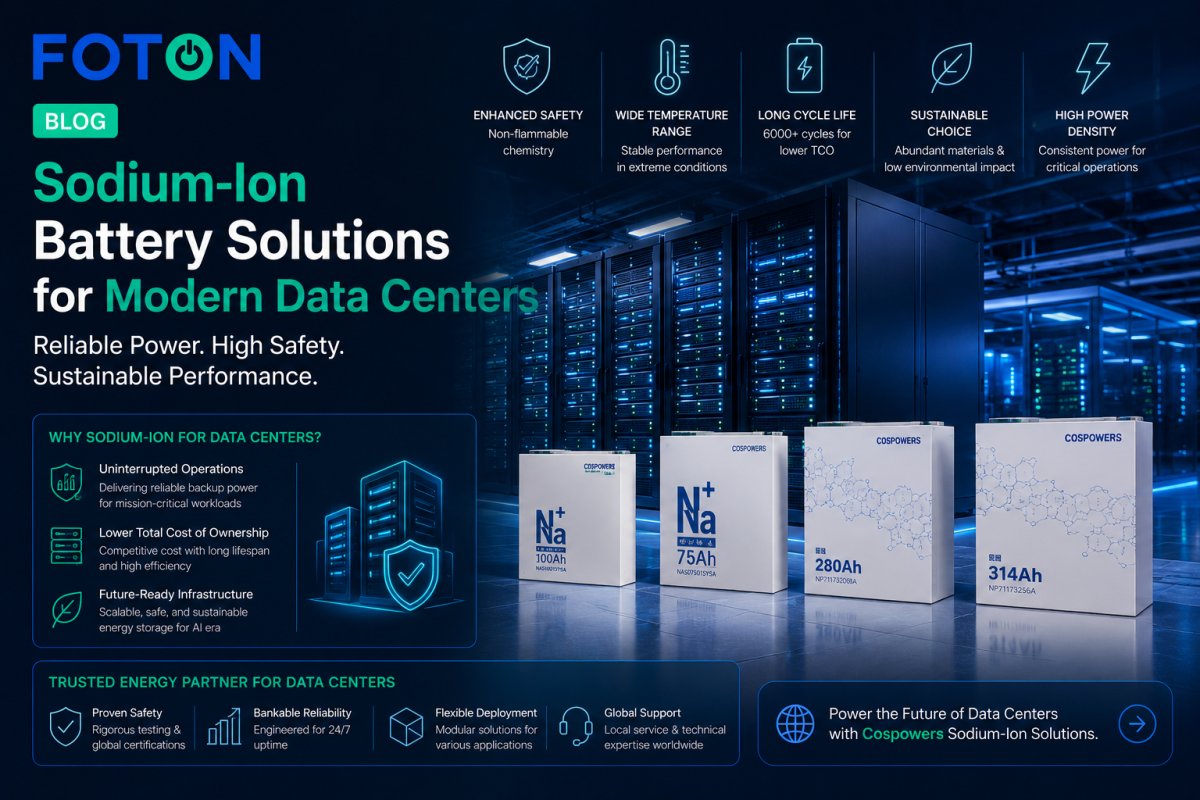
The very AI models designed to optimize the world are currently destabilizing the power grids that house them. You've likely experienced the operational strain of unpredictable power spikes and the escalating safety requirements for energy storage in dense urban environments. As the industry reaches a critical juncture, the adoption of a sodium-ion battery for data centers is emerging as the definitive architectural response to this 2026 power crunch. We understand that stability is your highest priority, and traditional lithium-based systems are increasingly burdened by supply chain volatility and thermal risks.
This article explores how sodium-ion technology provides a safer, non-flammable energy storage solution that's engineered for high-volatility AI workloads. We'll demonstrate how these systems deliver a lower total cost of ownership over a 15-year horizon while ensuring reliability during sharp fluctuations. You'll gain insights into the technical integration of these batteries, the impact of the 2025 "One Big Beautiful Bill Act" on domestic content bonuses, and how intelligent energy management systems optimize performance. It's time to build a more resilient, future-ready foundation for your mission-critical infrastructure.
Key Takeaways
- Identify why the high-volatility power spikes inherent in 2026 AI training workloads necessitate a pivot away from traditional VRLA and LFP storage.
- Analyze the strategic benefits of a sodium-ion battery for data centers, focusing on high power density and the ability to maintain performance during rapid discharge cycles.
- Utilize a professional decision framework to compare safety, cost, and resilience across competing battery chemistries for mission-critical urban infrastructure.
- Explore how modular sodium-ion designs simplify electrical architectures within containerized and powered shell data center environments.
- Discover how Foton’s AI-driven Energy Management System (EMS) leverages extensive manufacturing heritage to maximize the long-term value and reliability of your energy assets.
The AI Power Crunch: Why Data Centers are Pivoting to Sodium-Ion Batteries
The 2026 data center landscape is no longer defined by steady, predictable baseloads. AI training and inference models create massive, instantaneous power spikes that can destabilize traditional backup systems. Operators are now forced to transition from managing steady grid loads to navigating highly dynamic compute loads. This shift has made the search for a robust sodium-ion battery for data centers a top priority for infrastructure leads who value both resilience and long-term stability. As AI clusters expand, the ability to absorb and discharge high-intensity power bursts without degrading the storage asset has become the new benchmark for operational excellence.
The Limits of Conventional UPS and LFP Systems
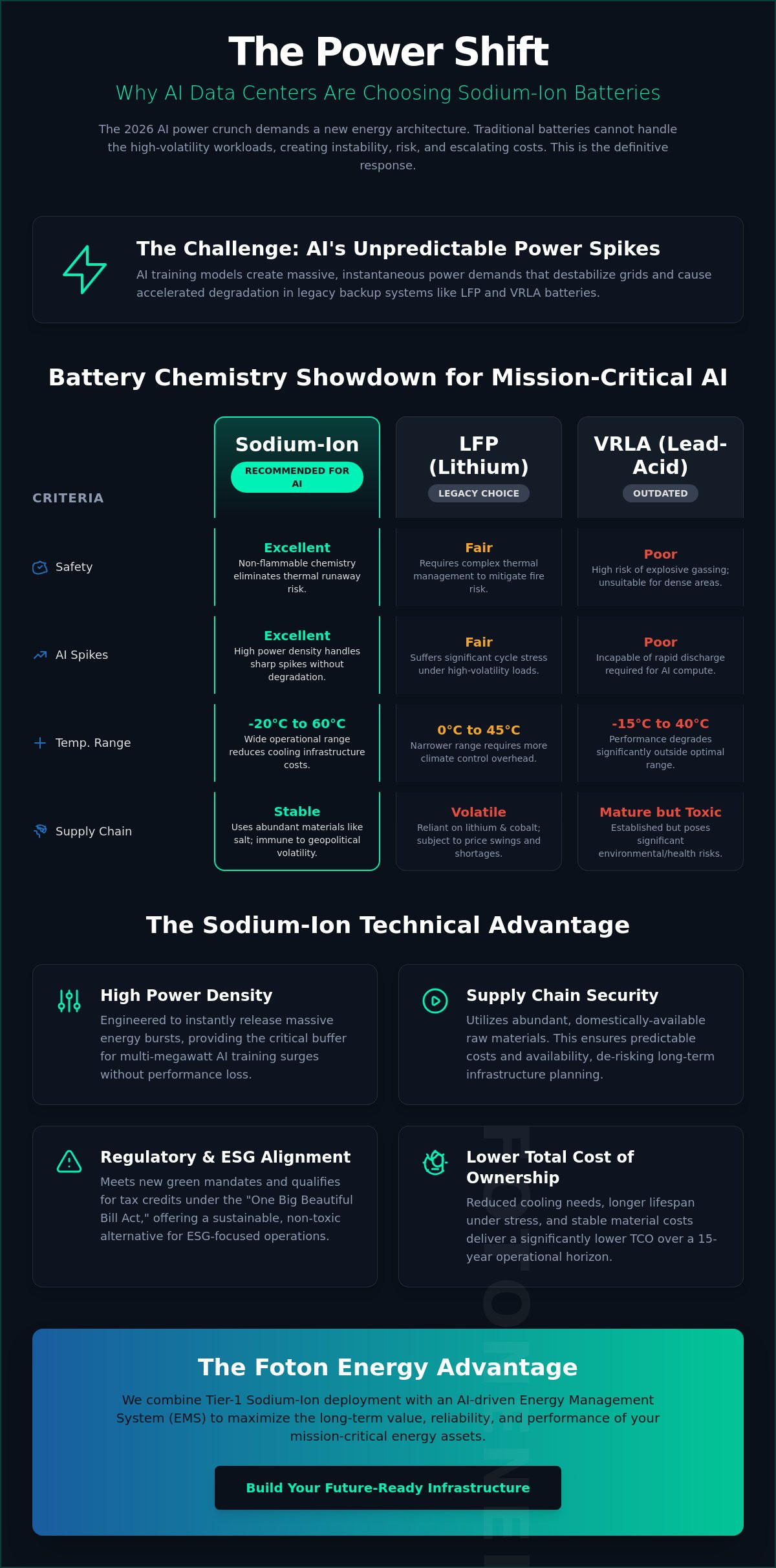
Standard lithium iron phosphate (LFP) batteries often encounter significant cycle stress when they're subjected to the rapid, repetitive power demands of modern AI hardware. While LFP remains a strong choice for steady-state discharge, its performance can fluctuate under the high-volatility discharge patterns required by dense GPU clusters. Legacy VRLA systems present even greater risks. Their high maintenance requirements, short lifespans, and environmental toxicity make them incompatible with the efficiency goals of a modern facility. As Power Usage Effectiveness (PUE) targets become more stringent in 2026, the thermal management overhead required for older chemistries is becoming an operational liability that few can afford to ignore.
Why 2026 is the Tipping Point for Sodium-Ion
Several factors have converged to make this year the definitive moment for wide-scale adoption. Tier-1 manufacturing has reached a level of maturity that ensures stable supply and bankable performance for large-scale infrastructure. Unlike lithium, which remains susceptible to geopolitical volatility and supply chain bottlenecks, Sodium-ion battery technology utilizes abundant raw materials like common salt. This provides a level of supply chain security that lithium and cobalt simply cannot match. It's a critical advantage for operators who need to project costs and availability years into the future.
Additionally, the regulatory environment has shifted. New green mandates and the 2025 "One Big Beautiful Bill Act" are pushing operators away from rare-earth minerals and toward sustainable, domestic supply chains. A sodium-ion battery for data centers offers a more sustainable, non-flammable alternative that aligns with global ESG standards while qualifying for significant investment tax credits. We're seeing a fundamental move toward chemistries that offer safety in dense urban environments and reliability during sharp power fluctuations. It's a pragmatic choice for those building the next generation of AI-ready infrastructure.
Technical Superiority: How Sodium-Ion Chemistry Solves High-Volatility Compute Loads
The technical architecture of a sodium-ion battery for data centers is specifically engineered to handle the aggressive charge and discharge profiles of the 2026 AI era. While lithium-ion has historically focused on energy density for mobile applications, sodium-ion prioritizes power density. This distinction is vital. High power density allows the battery to release massive amounts of energy instantaneously, providing the necessary buffer for the AI power crunch where training clusters can demand multi-megawatt surges in milliseconds. Because sodium ions move through the electrolyte with high mobility, the system can sustain these "sharp spikes" without the accelerated degradation that plagues traditional chemistries.
Operational efficiency is further enhanced by the chemistry's performance across a wide temperature spectrum. Sodium-ion systems typically operate reliably between -20°C and 60°C, a range far broader than that of LFP or NMC. For data center operators, this resilience translates directly into reduced cooling infrastructure costs. You can maintain higher ambient temperatures in the battery room, significantly lowering the facility's overall Power Usage Effectiveness (PUE) and simplifying the mechanical design of the "powered shell."
Thermal Management and Safety Architecture
Safety is not merely a feature; it's a foundational requirement for dense urban data centers. Sodium-ion batteries are inherently non-flammable and do not utilize the volatile materials that lead to catastrophic failures. Thermal runaway is a self-sustaining state of uncontrollable heating within a battery cell that often results in fire or explosion; sodium-ion chemistry effectively eliminates this risk through its stable internal structure. By removing the threat of thermal runaway, you can simplify fire suppression requirements and reduce the insurance premiums associated with high-density energy storage. If you're evaluating how these safety protocols fit into your specific facility, our team offers engineering consulting to help align your infrastructure with these advanced standards.
Cycle Life and Degradation Resilience
The long-term value of sodium-ion technology is found in its exceptional durability and depth of discharge. While standard chemistries often require a restricted State of Charge (SoC) to prevent damage, sodium-ion can be discharged to 100% without harming the cell's health. This allows for greater operational flexibility and higher usable capacity per rack. Consider these performance benchmarks:
- Extended Cycle Life: High-quality sodium-ion cells demonstrate a potential for 10,000+ cycles, significantly outperforming lead-acid and rivaling the best LFP systems.
- Deep Discharge Capability: The ability to discharge to 0% SoC provides a critical safety net during prolonged grid outages.
- Resilient Asset Management: Lower degradation rates mean fewer replacement cycles over a 15-year period, reducing your total cost of ownership.
By integrating a sodium-ion battery for data centers, you aren't just buying a backup solution. You're investing in a resilient power asset designed for the sustained intensity of high-density compute. This transition ensures that your facility remains reliable, safe, and cost-effective as AI demands continue to scale.
Sodium-Ion vs. LFP vs. VRLA: A Strategic Comparison for Mission-Critical Power
Mission-critical power requires a balance of three distinct pillars: safety, performance, and financial stability. For decades, Valve-Regulated Lead-Acid (VRLA) was the baseline, and Lithium Iron Phosphate (LFP) became the high-efficiency upgrade. Today, the sodium-ion battery for data centers offers a unique intersection of these priorities, specifically tailored for the high-discharge demands of AI. Choosing the right chemistry is no longer just about capacity; it's about how that capacity survives the volatile duty cycles of a modern facility.
A common objection to sodium-ion technology is its lower energy density compared to LFP. In the electric vehicle market, this is a valid constraint. However, in a rack-integrated UPS environment, the primary requirement is high power density, the ability to discharge large amounts of energy over short durations. Sodium-ion excels here. Since data center racks are often power-constrained rather than space-constrained, the slightly larger footprint of sodium-ion cells is offset by their superior ability to handle rapid C-rates without the thermal stress that degrades lithium-based alternatives.
Total Cost of Ownership (TCO) analysis over a 15-year facility lifespan reveals the true value of this pivot. While LFP prices in early 2026 sit around $70 to $80 per kWh, sodium-ion raw materials are fundamentally more stable. Sodium carbonate costs approximately $300 per ton, while lithium carbonate has historically fluctuated between $13,000 and over $80,000. By choosing a sodium-ion battery for data centers, operators insulate their long-term expansion plans from the price shocks of the lithium market while benefiting from a chemistry that requires less active cooling and fewer replacement cycles.
Performance Metrics for Data Center Backup
When seconds count, discharge characteristics are everything. Sodium-ion systems provide nearly instantaneous response times, maintaining voltage stability even during the sharpest power draws. Recharge speeds are equally impressive; these systems can often recover to a safe state of charge much faster than VRLA after a grid outage, ensuring the facility is ready for back-to-back events. From an environmental perspective, the "cradle-to-gate" emissions are lower than both LFP and VRLA due to the abundance of sodium and the elimination of cobalt and copper in many cell designs.
The 'Bankability' Factor for EPCs and Financiers
What makes an energy storage system 'bankable' in 2026 is a combination of rigorous certification and manufacturing heritage. Investors and Engineering, Procurement, and Construction (EPC) firms prioritize partners with proven scale. This is why our strategic alignment with Cospowers, a manufacturer with over 30 years of excellence, is so critical. We provide the stability of a global leader with the innovation of a tier-1 partner. Understanding these nuances is essential when evaluating commercial and industrial BESS solutions for your next infrastructure project. We help you move beyond the "pilot phase" and into large-scale, dependable deployments that meet international safety standards and operational requirements.
Architecture and Safety: Integrating Sodium-Ion into Modern Data Center Infrastructure
The 2026 data center is no longer a static building; it's a modular, evolving ecosystem. Integrating a sodium-ion battery for data centers into this environment requires an architectural shift toward flexibility and decentralized power. Unlike traditional monolithic UPS systems that demand an extensive footprint and complex cooling, sodium-ion modules allow for a simplified electrical design. This streamlined approach reduces the number of intermediate power conversion stages, minimizing energy loss and improving overall system efficiency. By adopting a "powered shell" strategy, operators can scale their energy storage in lockstep with their AI compute clusters.
Reliability is anchored in rigorous global standards. When evaluating these systems, infrastructure leads must prioritize certifications such as UL 1973 for battery units and UL 9540A for fire safety testing. These benchmarks, along with IEC standards, ensure that your energy storage assets meet the highest safety and performance criteria. Beyond mere backup, these resilient systems enable data centers to become grid-interactive assets. By using sodium-ion storage for frequency regulation and demand response, facilities can transform a traditional cost center into a revenue-generating component of the local energy grid.
Containerized vs. Rack-Mounted Deployment
Hyperscale expansions often favor modular containerized BESS solutions because they can be deployed rapidly in outdoor environments, freeing up premium indoor space for high-density server racks. Conversely, urban data centers with limited footprints benefit from integrating sodium-ion modules directly into server rack architectures. This proximity to the load reduces DC distribution losses and allows for more granular control over power delivery. Both strategies leverage the high power density of sodium-ion to optimize space without compromising on the rapid discharge capabilities required for AI inference workloads.
Safety Protocols and Fire Code Compliance
Compliance with NFPA 855 standards is significantly simplified when utilizing non-flammable chemistries. Sodium-ion technology inherently resists thermal runaway, which allows for closer spacing of battery racks and reduced requirements for complex fire suppression systems. This safety profile is a powerful lever for reducing insurance premiums and securing permits in strictly regulated urban zones. Sodium-ion batteries can be completely discharged and shipped at zero volts, which effectively eliminates the safety risks typically associated with transporting "live" energy storage systems. To ensure your facility meets these evolving safety and integration standards, we invite you to explore our Data Centre & Telco Backup solutions designed for the next generation of mission-critical power.
The Foton Advantage: Tier-1 Sodium-Ion Deployment and AI-Driven Optimization
Foton serves as the definitive link between elite manufacturing heritage and large-scale infrastructure execution. As the exclusive global partner for Cospowers, we leverage over 30 years of manufacturing excellence to deliver a bankable sodium-ion battery for data centers. This strategic alignment ensures that our clients receive Tier-1 hardware that has undergone rigorous international testing and certification. In an era where supply chain resilience is as vital as technical performance, our ability to procure and deploy systems across 70+ countries provides the stability that institutional investors and EPC firms require. We don't just provide components; we offer a foundational pillar for the next generation of global digital infrastructure.
Our approach is rooted in visionary pragmatism. We understand that a successful energy storage deployment requires more than just innovative chemistry. It necessitates a partner who can provide end-to-end Engineering Consulting to navigate the complexities of high-density power architectures. By combining our manufacturing depth with a supportive, collaborative partnership model, we help operators move from conceptual design to operational excellence with total confidence. This interconnectedness ensures that every deployment is optimized for long-term value, safety, and performance.
AI-Driven Energy Management (EMS)
Operational excellence in 2026 requires intelligence at every layer of the power stack. Our Intelligent EMS utilizes advanced algorithms to predict compute-load spikes, allowing the system to pre-emptively manage the discharge of the sodium-ion battery for data centers. This proactive approach ensures that the facility can handle the volatile power demands of AI training and inference without compromising voltage stability or asset health. By integrating real-time monitoring and predictive maintenance, we help operators maintain 99.999% uptime. Our EMS also facilitates the seamless integration of on-site renewables, enabling facilities to achieve their "green" mandates while maintaining the high-power response needed for modern compute clusters.
Partnering for Scalable Infrastructure
Building for the AI era requires a collaborative approach that spans from initial design to long-term asset management. Foton acts as the strategic navigator for EPCs and data center developers, providing the technical support necessary for successful commissioning and ongoing optimization. Our global reach ensures that Tier-1 hardware is available when and where it's needed, insulating your project from the localized supply shocks that often delay infrastructure expansion. We're committed to being a steady, guiding hand as you scale your mission-critical power systems. If you're ready to secure your facility's power future, we invite you to Consult with Foton Energy on your Data Center BESS strategy and discover how our expertise can drive your long-term success.
Secure Your Infrastructure for the AI-Powered Decade
Adopting a sodium-ion battery for data centers is a strategic move toward operational resilience and financial stability. The transition from steady-state grid loads to the high-volatility demands of AI training requires a chemistry that's both thermally stable and supply-chain secure. By prioritizing high power density and non-flammable safety architectures, you can effectively insulate your facility from the risks of thermal runaway and the price fluctuations of the lithium market. This technology isn't just an alternative; it's the specific foundation needed for 2026 and beyond.
Foton stands ready to guide this transition as the exclusive global partner of Cospowers, backed by a Tier-1 manufacturing heritage that dates back to 1993. Our systems are optimized by an AI-driven EMS, ensuring that your mission-critical power is as intelligent as the workloads it supports. We invite you to scale your data center with Tier-1 Sodium-Ion BESS from Foton Energy. Together, we can build a more secure, efficient, and bankable future for your digital infrastructure. Let's start the conversation today.
Frequently Asked Questions
Are sodium-ion batteries safer than lithium-ion for data centers?
Sodium-ion batteries are inherently safer than lithium-ion because they utilize a non-flammable chemistry that resists thermal runaway. This allows them to be deployed in dense urban environments where fire safety codes are exceptionally strict. They effectively eliminate the catastrophic fire risks often associated with traditional lithium-based systems.
What is the energy density of sodium-ion batteries compared to LFP in 2026?
As of early 2026, the energy density of sodium-ion batteries typically ranges between 100 and 175 Wh/kg. This is lower than LFP batteries, which generally sit between 150 and 210 Wh/kg. However, for a sodium-ion battery for data centers, high power density and rapid discharge rates are more critical than energy density for backup applications.
Can sodium-ion batteries be used in existing data center UPS systems?
Yes, sodium-ion modules can be integrated into modern data center architectures. While they're compatible with many "powered shell" designs, we recommend a strategic review of your existing UPS infrastructure to ensure the Energy Management System (EMS) is optimized for sodium-ion discharge profiles. This ensures seamless performance during high-volatility AI compute loads.
How do sodium-ion batteries perform in high-temperature data center environments?
These batteries excel in high-temperature environments, maintaining stable performance at temperatures up to 60°C. This wide operating range allows data center operators to reduce their reliance on aggressive and expensive cooling systems. It's a pragmatic way to lower overall facility PUE while maintaining mission-critical reliability.
What is the typical lifespan and cycle count of a sodium-ion battery?
High-quality sodium-ion cells demonstrate a potential cycle life exceeding 10,000 cycles. This exceptional durability ensures the system can handle the frequent, sharp power spikes characteristic of AI training without the rapid degradation seen in legacy chemistries. They're specifically designed to align with a 15-year operational facility horizon.
Is the supply chain for sodium-ion batteries more stable than lithium-ion?
The supply chain is significantly more resilient because sodium carbonate is abundant and price-stable at approximately $300 per ton. Lithium carbonate prices have historically fluctuated between $13,000 and over $80,000 per ton. This stability makes a sodium-ion battery for data centers a bankable choice for long-term infrastructure planning and risk mitigation.
What certifications are required for sodium-ion batteries in data centers?
Data center deployments require several key safety and performance certifications. You should prioritize systems that meet UL 1973 for battery units and UL 9540A for fire safety testing. International IEC standards also provide an essential benchmark for reliability and bankability in large-scale global infrastructure projects.
How does the Total Cost of Ownership (TCO) of sodium-ion compare to VRLA?
While initial costs are currently comparable to LFP, the TCO of sodium-ion is significantly lower than VRLA over a 15-year period. You'll benefit from reduced maintenance overhead, fewer replacement cycles, and lower thermal management requirements. These operational savings make it a more cost-effective solution for the high-density compute facilities of the AI era.


