
What if the battery chemistry you select today determines whether your project remains bankable or becomes a stranded asset by the end of the decade? Developers and investors are feeling the intense pressure of shifting 2026 regulations, from the 55% non-FEOC content threshold for ITC eligibility to the rigorous new safety mandates of NFPA 855. You likely recognize that successful utility scale BESS procurement requires more than just comparing hardware specifications. It demands a sophisticated understanding of long-term degradation, supply chain volatility, and complex grid-code compliance.
We've designed this guide to help you master the technical and commercial essentials needed to ensure project bankability and long-term grid resilience. You'll discover how to navigate the transition from LFP to Sodium-ion, identify the core components of a bankable BESS architecture, and align your project design with 2026 grid stability requirements. Let's explore the strategic framework necessary to build a high-performance energy future that's both technologically advanced and commercially stable.
Key Takeaways
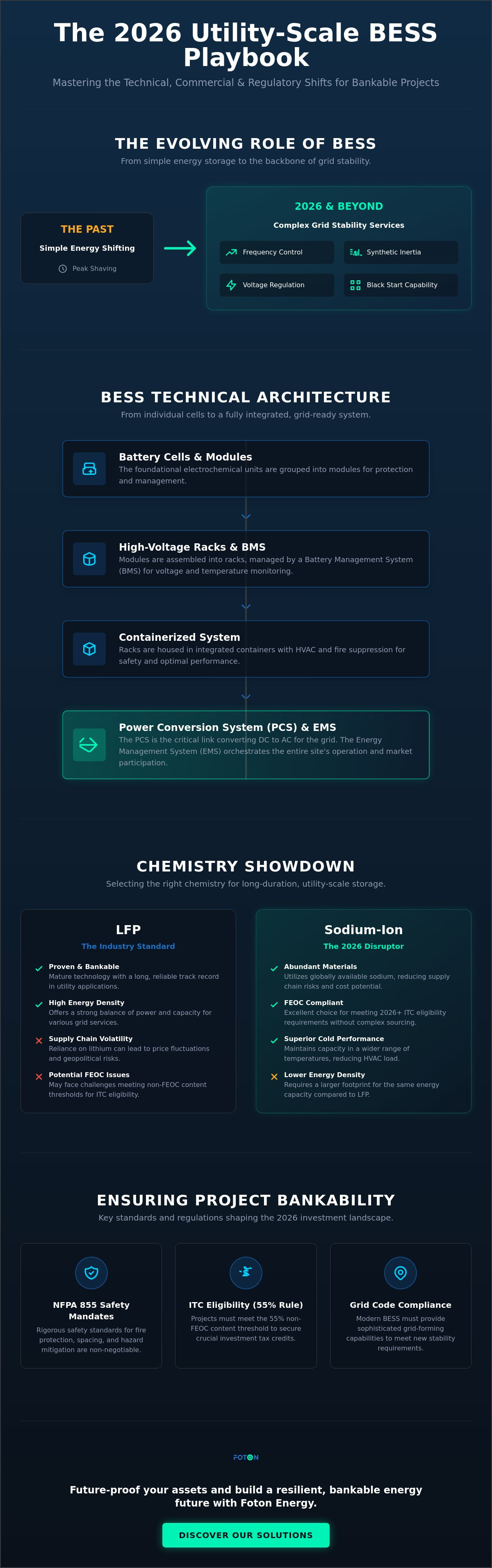
- Learn why modern utility scale BESS procurement is shifting from simple peak shaving to complex frequency control and synthetic inertia.
- Understand the technical hierarchy from battery cells to Power Conversion Systems (PCS) that ensures seamless DC-to-AC integration.
- Evaluate the performance trade-offs between industry-standard LFP and the 2026 disruptor, Sodium-Ion, to optimize for long-duration storage.
- Identify the critical safety certifications and engineering standards that determine the long-term bankability of your infrastructure investment.
- Discover how to future-proof your assets by transitioning toward hybrid solar-plus-storage configurations and 'Energy as a Service' models.
What is Utility-Scale Battery Energy Storage? Defining the 2026 Grid Backbone
Let's define the parameters of bankable storage. Utility-scale storage is the cornerstone of the modern energy transition. By definition, these high-capacity systems exceed 10MW and connect directly to transmission or distribution networks. To understand the baseline, one might ask: What is a Battery Energy Storage System (BESS)? Fundamentally, it's a reservoir of flexibility that balances the inherent volatility of a renewable-heavy grid. Modern utility scale BESS procurement processes prioritize grid-forming capabilities that ensure long-term stability rather than simple hardware acquisition.
We must recognize that operational requirements have moved beyond simple energy shifting. While early deployments focused on basic peak shaving, 2026 systems provide complex frequency control and synthetic inertia. This transition is driven by aggressive decarbonization mandates and the rapid rise of intermittent renewables. We're seeing a move toward intelligent, multi-functional infrastructure that reacts to grid disturbances in milliseconds, providing the stability once offered by traditional spinning reserves.
To better understand the technical and commercial complexities of these systems, watch this expert discussion:
The Strategic Role of BESS in Grid Stability
Grid stability depends on reactive flexibility. BESS serves as a critical buffer against the "duck curve," where solar generation peaks during midday while demand spikes in the evening. By shifting this energy, utility-scale assets prevent curtailment and reduce reliance on gas-fired peaker plants. Beyond energy shifting, these systems provide vital ancillary services. This includes frequency response, voltage regulation, and black start capabilities, which allow the grid to restart independently after a total blackout. As extreme weather events become more frequent, these storage blocks offer a layer of regional resilience that traditional infrastructure simply cannot match.
Front of the Meter vs. Behind the Meter at Scale
Front of the meter assets offer superior commercial scalability. The primary vehicle for grid-scale deployment is front of the meter battery storage. Unlike behind-the-meter systems that serve individual facilities, FTM assets are situated on the utility side of the interconnection. This positioning allows for sophisticated revenue stacking. Owners can participate in wholesale energy markets while simultaneously collecting payments for grid stability services. Navigating the regulatory frameworks for these connections requires deep technical expertise; grid codes in 2026 demand higher levels of transparency and performance than ever before.
Technical Architecture: From Battery Modules to Containerised Systems
Engineering a bankable project requires a granular understanding of the hardware hierarchy. We begin at the electrochemical cell level, where performance is established, before aggregating these into modules and high-voltage racks. These components are ultimately housed within integrated containers. A central piece of this infrastructure is the Power Conversion System (PCS). It serves as the critical link between the DC storage environment and the AC grid, managing four-quadrant power flow with high precision. During utility scale BESS procurement, the seamless integration between these hardware layers and the software controls determines the project's long-term financial viability.
We must distinguish between the Battery Management System (BMS) and the Energy Management System (EMS). The BMS operates at the rack level to monitor voltage and temperature, while the EMS orchestrates the entire site's market participation and dispatch. For a rigorous framework on these technical evaluations, refer to the Utility BESS Handbook. Thermal management has also seen a significant shift. While air cooling remains viable for some lower-density applications, 2026 deployments favor active liquid cooling for high-density racks. This method ensures uniform temperature across every cell, which is essential for maintaining state-of-health over a twenty-year operational life.
Modular and Containerised Architecture
Efficiency in deployment is paramount for large-scale projects. Many developers now prioritize containerized energy storage systems for their plug-and-play capability. These units utilize standardized 20ft and 40ft ISO container configurations, simplifying global shipping and reducing on-site installation time significantly. Effective utility scale BESS procurement strategies leverage this modularity to scale capacity by adding parallel units without requiring a full system redesign. It's a pragmatic approach to infrastructure that matches capital expenditure with actual grid demand.
The Intelligence Layer: AI-Driven EMS
The real differentiator in modern storage is the intelligence layer. An AI-driven EMS provides real-time monitoring and predictive maintenance, identifying potential faults before they cause downtime. These algorithms optimize the state-of-charge (SoC) and state-of-health (SoH) to maximize revenue while respecting physical degradation limits. By integrating with grid-operator signals, the system offers automated, high-speed responses to market fluctuations. This software layer transforms a passive battery into an active, grid-forming asset. If you're looking to optimize your asset's performance, our team provides comprehensive engineering consulting to align your technical architecture with market requirements.
LFP vs. Sodium-Ion: Selecting the Right Chemistry for Scale
Lithium Iron Phosphate (LFP) remains the global benchmark for utility scale BESS procurement due to its established energy density and cost-efficiency. Through 2024 and 2025, LFP chemistry accounted for nearly 95% of new utility-scale awards globally, driven by its superior safety profile compared to nickel-based alternatives. However, the 2026 market is no longer a single-chemistry landscape. Sodium-Ion (Na-Ion) has emerged as a formidable disruptor, particularly for projects where long-duration storage and supply chain security are paramount. While LFP offers higher energy density for space-constrained sites, Sodium-Ion provides a more resilient alternative that avoids the volatility of lithium markets.
Choosing between these chemistries requires a rigorous analysis of cycle life and thermal stability. LFP cells currently range between $55 and $75 per kWh, offering a proven track record of performance. Sodium-Ion, while carrying a slight premium at an average of $59 per kWh in 2025, is rapidly closing the price gap as production scales toward an expected 400 GWh by 2030. Its non-flammable nature and ability to be transported at zero volts make it an attractive option for safety-critical installations. We're seeing a strategic shift where developers prioritize Na-Ion for 6-8 hour duration projects while retaining LFP for high-power, 2-4 hour applications.
Optimising LFP for Utility Projects
Maximize your investment by optimising LFP battery cycle life for utilities. It's not just about the hardware; it's about operational strategy. Managing the depth of discharge (DoD) is essential to extending the asset's lifespan beyond 15 years. We recommend sourcing exclusively from Tier-1 manufacturers to ensure cell consistency and long-term bankability. This level of diligence ensures that your utility scale BESS procurement strategy survives the scrutiny of project financiers and delivers the projected internal rate of return.
The Rise of Sodium-Ion in Grid Applications
Sodium-Ion is gaining momentum because of its operational versatility in harsh environments. It performs exceptionally well in extreme temperatures, maintaining efficiency in sub-zero cold and high heat without the need for energy-intensive cooling systems. This chemistry significantly reduces dependence on critical minerals like lithium, cobalt, and nickel, creating a more stable supply chain for 2026 and beyond. When preparing your technical specifications, consult the DOE's BESS Procurement Checklist to ensure all safety requirements are met. Sodium-Ion's zero-volt transport capability further simplifies logistics, making it a pragmatic choice for remote grid applications where safety and reliability are non-negotiable.
Ensuring Bankability: Safety, Certifications, and Engineering
Bankability is the bridge between technical excellence and financial security. In the context of utility scale BESS procurement, it signifies a project's ability to attract low-cost capital through verified performance and comprehensive risk mitigation. Financiers in 2026 demand more than just a standard warranty; they require a transparent record of manufacturing heritage. Partnering with suppliers who demonstrate a long-standing history in power electronics and battery production provides that essential foundation of trust. This approach transforms a complex infrastructure project into a stable, predictable asset that's built on decades of proven operational excellence.
Safety architecture is the first line of defense in protecting that long-term investment. A robust strategy for utility scale BESS procurement must include multi-layered fire suppression, explosion venting, and advanced gas detection to align with the 2026 edition of NFPA 855. These aren't optional features but fundamental requirements for insurance coverage and local permitting. Navigating international standards like UL9540A for thermal runaway testing and IEC 62619 for safety requirements ensures your project meets the highest global benchmarks. Compliance with IEEE 1547 further guarantees that the system interacts safely and reliably with the distribution grid, protecting both the asset and the network.
Grid-Connected Engineering and Compliance
Success starts with rigorous grid connected energy storage engineering. This process ensures the system meets stringent grid-code requirements for frequency and voltage support, which are vital for maintaining grid resilience. Third-party performance testing and DNV verification serve as essential trust signals for project stakeholders. They provide the empirical evidence needed to confirm that the system will deliver its promised ancillary services under real-world conditions over its entire twenty-year lifespan.
Feasibility and Site Selection
Strategic site selection is equally critical to project success. We conduct comprehensive BESS project feasibility studies that include detailed interconnection analysis and environmental impact assessments. Proximity to substations significantly impacts interconnection costs and project timelines; identifying these variables early mitigates the risk of unforeseen infrastructure expenses. By aligning site characteristics with technical requirements, we ensure the project remains viable from inception to commissioning. If you're ready to secure your project's future, our team offers comprehensive engineering consulting to guide you through every stage of the development lifecycle.
Future-Proofing Your Utility-Scale Investment
Strategic foresight is the hallmark of successful infrastructure. The transition from standalone BESS to hybrid solar-plus-storage or wind-plus-storage configurations is already well underway. By 2026, co-location isn't just an efficiency play; it's often a regulatory requirement for grid interconnection. As we look toward the 2030 grid, long-duration energy storage (LDES) requirements will dictate the next phase of utility scale BESS procurement. Preparing for these shifts now prevents technical obsolescence and ensures your assets remain competitive as 'Energy as a Service' (EaaS) models redefine utility revenue streams.
Supply chain volatility remains a primary risk for project timelines. Strategic partnerships with global Tier-1 distributors are essential to mitigate these disruptions. By aligning with partners who have an established manufacturing heritage, developers secure priority access to critical components even during market surges. This interconnectedness between manufacturing and distribution creates a buffer against geopolitical shifts and material shortages, ensuring your project remains on schedule and within budget.
The Strategic Advantage of Cospowers and Foton
Reliability is built through experience. We leverage 30 years of manufacturing excellence to provide long-term asset security for our partners. Our global reach extends to over 70 countries, supported by an established network that ensures Tier-1 hardware is deployed and maintained to the highest standards. We offer end-to-end support that spans from initial engineering consulting to final commissioning and long-term asset management. This holistic approach ensures every project component is optimized for maximum performance and grid resilience, providing a steady, guiding hand through the complexities of large-scale deployment.
Next Steps for Energy Developers
The window for 2026 project planning is narrowing. Developers should immediately evaluate their current portfolios for storage integration and revenue stacking opportunities. Defining precise system specifications with an experienced engineering partner is the most effective way to navigate the complexities of modern utility scale BESS procurement. We invite you to partner with Foton for your next utility-scale BESS project to ensure your infrastructure is ready for the challenges of the next decade. Let's build a resilient, high-performance future together.
Securing Your Position in the 2026 Energy Market
The 2026 grid requires more than just storage; it demands intelligent, bankable infrastructure. We've explored how transitioning toward Sodium-ion and leveraging AI-driven EMS for real-time asset optimisation are now essential strategies for long-term project success. These technical decisions ensure your architecture meets the latest safety standards and regulatory content thresholds. It's clear that a strategic approach to utility scale BESS procurement is the only way to safeguard your investment against supply chain volatility and evolving grid-code requirements.
As the exclusive global partner of Cospowers, we bring over 30 years of energy storage manufacturing heritage to every partnership. We invite you to Request a Technical Consultation for Your Utility-Scale Project to align your technical architecture with international bankability standards. Our team is ready to provide the stable, guiding hand your large-scale infrastructure investments deserve. Let's build a resilient energy future that's grounded in proven experience and visionary pragmatism.
Frequently Asked Questions
What is the typical lifespan of a utility-scale battery energy storage system?
A utility-scale BESS typically operates for 15 to 20 years. This duration depends heavily on the battery chemistry and the depth of discharge (DoD) managed by the system's EMS. While LFP cells are often rated for 6,000 to 8,000 cycles, maintaining optimal thermal conditions and avoiding extreme states of charge can extend the asset's functional life significantly. Regular augmentation, where new battery modules are added to compensate for natural degradation, is a standard strategy to maintain the system's nameplate capacity over two decades.
How do utility-scale batteries differ from residential or C&I storage?
The primary differences lie in scale, interconnection, and purpose. Utility-scale systems are generally larger than 10MW and connect directly to the transmission or distribution grid as "Front of the Meter" (FTM) assets. Unlike residential or C&I systems that focus on local backup or peak shaving for a single facility, utility-scale projects provide bulk services like frequency regulation and synthetic inertia for the entire network. The engineering requirements for these projects are far more rigorous, demanding high-voltage protection and sophisticated grid-operator integration.
Is sodium-ion battery technology ready for utility-scale deployment in 2026?
Yes, 2026 marks the first wave of commercial-scale deployments for Sodium-ion technology. This chemistry has transitioned from pilot phases to utility-grade applications, driven by its abundance of raw materials and resilience to supply chain shocks. While LFP remains the market leader, Sodium-ion is proving to be a bankable alternative for long-duration storage and projects in extreme climates. Its ability to operate safely across a wide temperature range without intensive cooling makes it a pragmatic choice for diversifying large-scale storage portfolios.
What are the primary revenue streams for grid-scale BESS projects?
Successful projects rely on "revenue stacking," which combines multiple income sources to maximize returns. Investors typically look for a mix of energy arbitrage, where energy is bought low and sold high, and ancillary services such as frequency response and voltage control. In many markets, capacity payments also provide a steady floor of income for ensuring the system is available during peak demand events. Integrating these streams into your utility scale BESS procurement strategy is essential for achieving the required internal rate of return (IRR).
How does a BESS help with renewable energy curtailment?
A BESS acts as a massive energy buffer that captures excess renewable generation that would otherwise be wasted. When solar or wind production exceeds grid demand or transmission capacity, the system stores that energy instead of curtailing the generators. This stored energy is then released back into the grid during periods of high demand or low renewable output. This process not only increases the project's overall yield but also helps stabilize the grid by smoothing out the inherent intermittency of green energy sources.
What safety measures are required for large-scale containerised battery systems?
Modern safety protocols require a multi-layered defense strategy centered on NFPA 855 standards. This includes mandatory hazard mitigation analysis, advanced gas detection, and automated fire suppression systems designed to prevent thermal runaway. Explosion venting and deflagration protection are also critical components of current containerised designs. Beyond hardware, 2026 safety standards emphasize the role of the BMS in monitoring individual cell temperatures in real-time, allowing for a proactive shutdown before a thermal event can escalate.
How much space is required for a 100MW utility-scale BESS installation?
A 100MW system typically requires between one and three acres of land, though this varies based on the storage duration and the energy density of the containers. High-density LFP systems using liquid cooling allow for tighter packing, which reduces the overall footprint compared to older air-cooled designs. When planning your utility scale BESS procurement, you must also account for mandatory clearances between containers, access roads for emergency vehicles, and the footprint of the required substation and Power Conversion System (PCS) equipment.
What is the difference between power-intensive and energy-intensive BESS applications?
The difference is defined by the discharge duration and the primary goal of the system. Power-intensive applications focus on delivering high bursts of energy for short periods, typically under an hour, to manage frequency response or voltage spikes. Energy-intensive applications are designed for long-duration storage, often four to eight hours, to shift bulk energy from day to night. Selecting the right battery chemistry and inverter sizing depends entirely on which of these profiles your project intends to serve in the wholesale market.


