

In 2026, a Battery Energy Storage System (BESS) without an integrated AI core is no longer a strategic asset; it's a stranded one. As grid instability increases and regulatory frameworks like the EU AI Act and NIST's Trustworthy AI Profile redefine operational standards, simply storing power is insufficient. You likely recognize that manual oversight can't keep pace with millisecond price spikes or the rigorous reporting requirements of the NIS2 Directive. Integrating a sophisticated AI driven energy management system is the only way to bridge the gap between Tier-1 hardware and the volatile reality of modern energy markets.
We understand the pressure to maintain grid-code compliance while driving down the total cost of ownership for large-scale deployments. This guide explores how AI-driven EMS transforms your storage from a passive reserve into a proactive, grid-aware powerhouse capable of delivering 15 to 30 percent energy cost savings. We'll examine the technical architecture of Edge AI, the move toward autonomous industrial microgrids, and the specific strategies required to maximize peak shaving efficiency. Let's explore the roadmap to making your BESS infrastructure both bankable and resilient for the long term.
Key Takeaways
- Transition from reactive, rule-based logic to proactive neural network forecasting to anticipate demand before it impacts your meter.
- Leverage dynamic price arbitrage with millisecond precision to buy low and sell high, significantly enhancing the profitability of commercial and utility-scale projects.
- Understand how an AI driven energy management system secures asset bankability by providing the transparent, data-driven reporting required by modern infrastructure financiers.
- Scale your operations efficiently by moving beyond manual site management to autonomous, fleet-wide orchestration of global BESS assets.
- Optimize performance across diverse chemistries by integrating intelligent software with Tier-1 manufacturing standards, specifically tuned for LFP and sodium-ion systems.
What is an AI Driven Energy Management System in 2026?
An AI driven energy management system in 2026 is far more than a simple monitoring interface. It's a sophisticated, multi-layered software architecture that leverages machine learning to predict, manage, and optimize energy flows with surgical precision. In a year defined by extreme grid volatility and the rapid expansion of a Battery Energy Storage System (BESS), legacy platforms are struggling to keep up. These modern systems integrate IoT sensor arrays and automated control loops to ensure that energy is dispatched exactly when it provides the highest value.
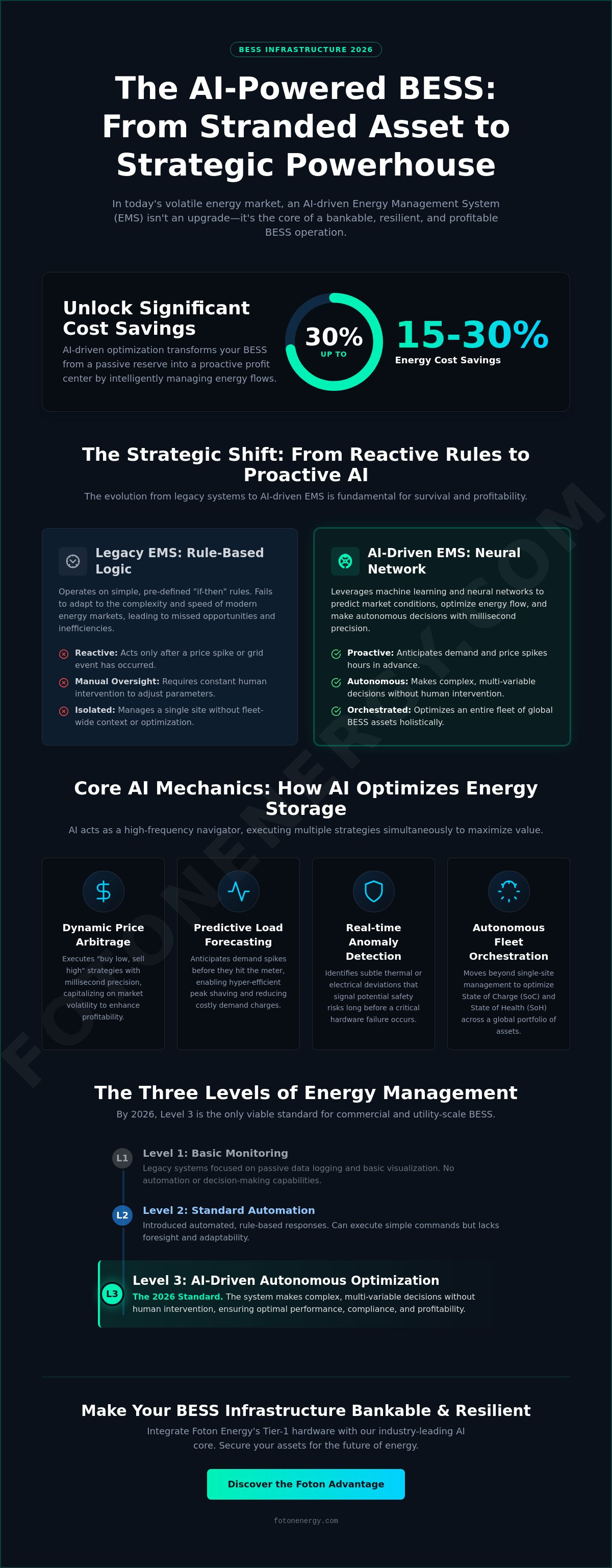
The fundamental shift we're seeing involves the move from reactive, rule-based logic to proactive neural network forecasting. Instead of waiting for a price spike to occur, the system anticipates market movements hours in advance. It analyzes thousands of data points, from local weather patterns to global energy commodity prices, to secure your operational resilience. This proactive stance is the only way to navigate the 2026 grid, where complexity has reached a point that manual oversight is no longer viable.
To better understand this technological leap, watch this overview of the modern EMS landscape:
From Automation to Intelligence: The Evolution of EMS
We categorize the evolution of energy management into three distinct tiers. Level 1 represents legacy systems focused on basic monitoring and data logging. Level 2 introduced standard automated rule-based responses, such as "if price exceeds threshold, then discharge." By 2026, the industry standard has reached Level 3. This is AI-driven autonomous optimization, where the system makes complex, multi-variable decisions without human intervention. This level of intelligence is essential for managing the grid connection regulations issued by FERC and the cybersecurity requirements of the NIS2 Directive.
The Role of Machine Learning in Energy Storage
Machine learning serves as the engine for this transition. Neural networks process historical consumption data alongside real-time inputs to create hyper-accurate load forecasts. Beyond economic optimization, these systems provide real-time anomaly detection. They identify subtle thermal or electrical deviations that suggest a potential safety risk long before hardware failure occurs. An AI-driven EMS is the digital brain of modern BESS infrastructure. By centralizing intelligence at the edge, these systems ensure that commercial and utility-scale projects remain both safe and profitable in an increasingly complex energy ecosystem.
The Core Mechanics: How AI Optimises Energy Storage
Precision is the new currency of energy storage. An AI driven energy management system acts as a high-frequency navigator, processing massive datasets to execute decisions with millisecond precision. This level of control is vital for dynamic price arbitrage, where the system identifies opportunities to buy energy during low-demand troughs and sell it back to the grid during peak-price surges. By integrating with distributed energy resources like solar and wind, the software ensures that every kilowatt-hour is utilized at its maximum economic potential.
Recent studies into AI-Based Centralized Energy Management highlight how these systems move beyond simple automation to provide a holistic view of the energy ecosystem. This centralized intelligence allows for the seamless orchestration of multiple assets, ensuring that State of Charge (SoC) and State of Health (SoH) are balanced across the entire fleet. It's not just about storage anymore; it's about the intelligent deployment of a strategic resource.
Predictive Analytics and Load Forecasting
Predictive load forecasting allows industrial operators to anticipate demand spikes before they ever hit the meter. By creating digital twins of facility energy consumption, AI models simulate thousands of scenarios to identify the most efficient peak shaving strategies. This reduces heavy demand charges and protects the bottom line. To achieve this, operators must utilize advanced BESS performance monitoring tools that feed high-fidelity data back into the AI engine. These tools provide the granular visibility needed to maintain a high-performance profile across global deployments.
AI-Enhanced Thermal and Safety Management
Safety and longevity are non-negotiable for large-scale infrastructure. AI models now provide unparalleled precision in monitoring cell-level micro-fluctuations, allowing for the early detection of conditions that might lead to thermal runaway. By optimizing cooling cycles based on predictive thermal patterns, the system extends the operational life of LFP and sodium-ion chemistries. This synergy between Tier-1 safety architecture and intelligent software creates a bankable asset that financiers can trust. If you're looking to maximize your ROI, consider integrating these intelligent systems into your infrastructure to ensure long-term resilience and performance.
Legacy EMS vs. AI-Driven Systems: A Strategic Comparison
Legacy systems often rely on rigid, rule-based logic that struggles with the high-frequency demands of the 2026 energy market. While a traditional EMS might manage a single site using siloed spreadsheets and manual data entry, an AI driven energy management system utilizes unified data models to orchestrate entire global fleets of BESS containers. This transition represents a fundamental shift from reactive repair to AI-powered predictive maintenance. It ensures that assets remain operational and optimized without the need for constant human intervention, providing a level of reliability that legacy software simply can't match.
Data utilization in older systems is often fragmented. Information remains trapped in disconnected silos, making it nearly impossible to gain a real-time view of asset performance across a portfolio. Modern AI models ingest data from every sensor in the fleet to create a single source of truth. This interconnectedness allows for strategic alignment across multiple service sectors, reinforcing the stability of large-scale infrastructure investments and ensuring long-term value for stakeholders.
Operational Efficiency and Time-to-Action
Speed is the defining factor in modern grid services. Frequency control services require millisecond response times that manual oversight or simple rule-based automation cannot achieve. By adopting an AI-Enhanced Energy Management for Microgrids, operators can transition to exception-based management. This means your engineering teams only intervene when the AI identifies a high-level strategic shift or a physical anomaly that requires expert attention. This level of autonomy also aids in reducing scope 1 and 2 emissions by ensuring smarter energy cycling that prioritizes the use of stored renewable power over carbon-intensive grid draw.
The Cost of Inaction: Risks of Legacy Software
Sticking with outdated software carries significant financial and operational risks. Non-optimized cycling leads to increased battery degradation, which directly shortens the lifespan of expensive hardware and inflates the total cost of ownership. Manual grid-code compliance reporting also incurs high labor costs, as teams must manually sift through historical data to meet evolving standards like the NIST framework or the EU AI Act. Perhaps most critically, legacy systems often miss out on high-value revenue streams. Participation in lucrative markets like Frequency Control Ancillary Services (FCAS) requires the precision and speed that only an AI driven energy management system can provide. In 2026, the gap between the technologically advanced and the technologically stagnant is no longer just a matter of efficiency; it's a matter of market viability.
Driving ROI: Economic Benefits of Intelligent Management
Economic viability in the energy sector now depends on the ability to navigate complex market signals with absolute certainty. An AI driven energy management system serves as the primary driver of ROI for commercial and utility-scale projects by converting raw storage capacity into a high-performance financial asset. While hardware costs have stabilized, the real competitive advantage lies in software that can extract maximum value from every cycle. By 2026, businesses utilizing these intelligent systems are reporting average energy cost savings of 15 to 30 percent, with typical investment payback periods ranging between 8 and 18 months.
Financiers and stakeholders increasingly demand "bankability" before committing to large-scale infrastructure. This requires more than just high-quality LFP cells; it requires a transparent, data-driven audit trail that proves how an asset will perform over a 10 to 15-year horizon. AI provides this by offering granular, verifiable reporting on degradation rates and revenue performance. We believe that a robust digital core is the most effective way to secure long-term capital and ensure the stability of your energy investments.
Revenue Stacking and Market Participation
The most profitable BESS deployments in 2026 don't rely on a single use case. Instead, they utilize revenue stacking to engage in energy arbitrage, Frequency Control Ancillary Services (FCAS), and peak shaving simultaneously. AI manages these competing priorities by determining the most lucrative action at any given second while respecting the physical limits of the battery. This is particularly vital for assets participating in Virtual Power Plants (VPP), where coordinated dispatch across multiple sites is required. AI ensures BESS bankability by reducing operational uncertainty and guaranteeing that the system always prioritizes the highest-value revenue stream.
Compliance and Regulatory Reporting
Regulatory burdens have intensified, making manual reporting an expensive and risky endeavor. Automated renewable energy grid code compliance is now a standard requirement for avoiding heavy penalties and ensuring seamless grid integration. An AI driven energy management system generates these performance reports automatically, meeting 2026 ESG mandates with verifiable emissions tracking. This automation reduces labor costs and eliminates human error, allowing your team to focus on strategic growth rather than paperwork. To see how these economic benefits can be applied to your specific project, consult with our engineering experts to develop a tailored optimization roadmap.
The Foton Advantage: Integrating Tier-1 Hardware with AI
Reliability in energy storage isn't achieved through software alone. It requires a deep, physical understanding of the battery cells themselves. At Foton, we provide a unified solution where Tier-1 manufacturing meets digital innovation. Through our exclusive partnership with Cospowers, we ensure that every AI driven energy management system we deploy is perfectly synchronized with the underlying hardware. This vertical integration eliminates the compatibility gaps that often plague third-party software installations, providing a seamless operational experience for utility-scale and commercial projects.
Our intelligent EMS is specifically tuned to manage the unique performance characteristics of Lithium Iron Phosphate (LFP) and sodium-ion chemistries. While LFP remains the dominant choice for grid-scale storage, sodium-ion is rapidly emerging as a critical alternative for high-demand applications. We optimize discharge rates, thermal cycles, and state-of-health monitoring based on the specific molecular behavior of these cells. This technical precision has allowed us to successfully deploy intelligent BESS solutions across more than 70 countries, supporting a diverse range of industrial ecosystems with a steady, guiding hand.
Bespoke EMS for Mission-Critical Infrastructure
Data centers and telecommunications networks require a level of uptime that leaves no room for error. We tailor our AI algorithms to meet the specific backup requirements of these mission-critical facilities, ensuring that power is always available when the grid falters. This level of customization is particularly relevant when deploying a sodium-ion battery for data centers, where managing the AI power crunch of 2026 requires predictive intelligence. Our engineering consulting teams provide end-to-end support for system integrators, from initial design to final grid connection, ensuring that every custom microgrid is optimized for both resilience and performance.
Resilience Through Strategic Partnership
Large-scale infrastructure investments demand a partner with proven longevity. Foton brings a 30-year manufacturing heritage to the table, providing a foundation of stability that newer, software-only firms cannot replicate. This experience allows us to act as a foundational pillar for investors and technical partners, grounding high-level sustainability goals in rigorous testing and operational excellence. We don't just provide technology; we provide a bankable assurance that your assets will perform exactly as promised throughout their lifecycle. To secure the future of your energy infrastructure, partner with Foton Energy for bankable, AI-driven energy storage solutions that lead the industry in quality and innovation.
Securing Your Position in the 2026 Energy Landscape
Strategic success in the modern energy market requires a move away from passive storage toward proactive, grid-aware orchestration. We've seen how the transition from reactive rule-based logic to neural network forecasting allows operators to capture high-value revenue streams while maintaining rigorous grid-code compliance. Implementing an AI driven energy management system is the most effective way to ensure long-term asset bankability and operational resilience in an increasingly volatile grid ecosystem. Precision is no longer optional; it's the foundation of every profitable energy deployment.
As a foundational pillar of the industry, Foton Energy provides the stability and technical expertise needed for large-scale infrastructure investments. Our exclusive Tier-1 partnership with Cospowers, backed by over 30 years of manufacturing heritage and a global network spanning 70+ countries, ensures your project is built on a legacy of excellence. We invite you to Explore Foton’s AI-Driven EMS Solutions for Utility-Scale BESS and discover how we can optimize your energy future together. The path to a cleaner, more efficient grid is within reach, and we're ready to guide you every step of the way.
Frequently Asked Questions
What is the difference between a standard EMS and an AI-driven EMS?
Standard systems follow rigid "if-then" rules that only react to current conditions. An AI driven energy management system uses neural networks to predict future load and price movements hours in advance. This allows the system to prepare the battery for events before they occur, rather than reacting after a price spike has already hit. This foresight is critical for maximizing asset value in volatile 2026 markets where manual responses are too slow.
How does AI-driven energy management improve BESS battery life?
AI improves battery life by optimizing charging cycles and thermal management to minimize chemical degradation. It monitors cell-level data to avoid unnecessary stress and prevent micro-fluctuations that lead to premature aging. By maintaining the battery within ideal operational parameters and predicting cooling needs, the software extends the State of Health (SoH) and protects the long-term bankability of your infrastructure investment.
Can AI-driven EMS help with grid code compliance in Australia?
AI-driven systems are designed to automate compliance with complex grid codes, including those set by the Australian Energy Market Operator (AEMO). These systems manage frequency control and voltage regulation requirements with millisecond precision. This automation ensures that your BESS remains compliant with local standards like AS/NZS 4777.2 without requiring constant manual oversight or risking expensive non-compliance penalties from the regulator.
Is AI-driven energy management secure against cyber threats?
Modern AI systems prioritize cybersecurity by utilizing Edge AI to process data locally, which reduces exposure to external networks. They align with global standards such as the NIS2 Directive and NIST frameworks to provide robust protection against unauthorized access. This multi-layered security approach ensures that your energy infrastructure remains resilient against evolving cyber threats while maintaining continuous, safe operations for mission-critical facilities.
Does an AI-driven EMS work with both LFP and sodium-ion batteries?
Yes, our system is specifically engineered to support both Lithium Iron Phosphate (LFP) and emerging sodium-ion chemistries. Since each chemistry has distinct thermal and discharge profiles, the AI adapts its control logic to match the physical requirements of the specific cells. This versatility allows operators to utilize the most cost-effective hardware for their particular application while maintaining a unified, intelligent management interface across the entire fleet.
How much can a business save by using AI for peak shaving?
Businesses typically report energy cost savings between 15 and 30 percent when using AI for peak shaving. By accurately predicting demand spikes, the system discharges stored energy to lower the facility's peak draw from the grid. This significantly reduces demand charges on utility bills and often leads to an investment payback period of 8 to 18 months, depending on local tariff structures and energy consumption patterns.
What data does an AI-driven EMS need to function effectively?
The system requires high-fidelity data from IoT sensor arrays, historical consumption patterns, and real-time weather forecasts. It also integrates with energy market pricing feeds to identify arbitrage opportunities. This variety of data allows the AI driven energy management system to build a comprehensive digital twin of your facility, ensuring that every dispatch decision is grounded in accurate, real-world information and predictive modeling.
Is AI-driven EMS necessary for small-scale commercial BESS?
AI is highly beneficial for small-scale commercial BESS because it accelerates ROI through more efficient energy use and asset protection. While large utility projects see the biggest scale benefits, smaller sites face the same grid volatility and price spikes. Implementing intelligent management ensures that even smaller assets are protected from degradation and are positioned to participate in lucrative demand response programs that would otherwise be inaccessible with manual software.


