

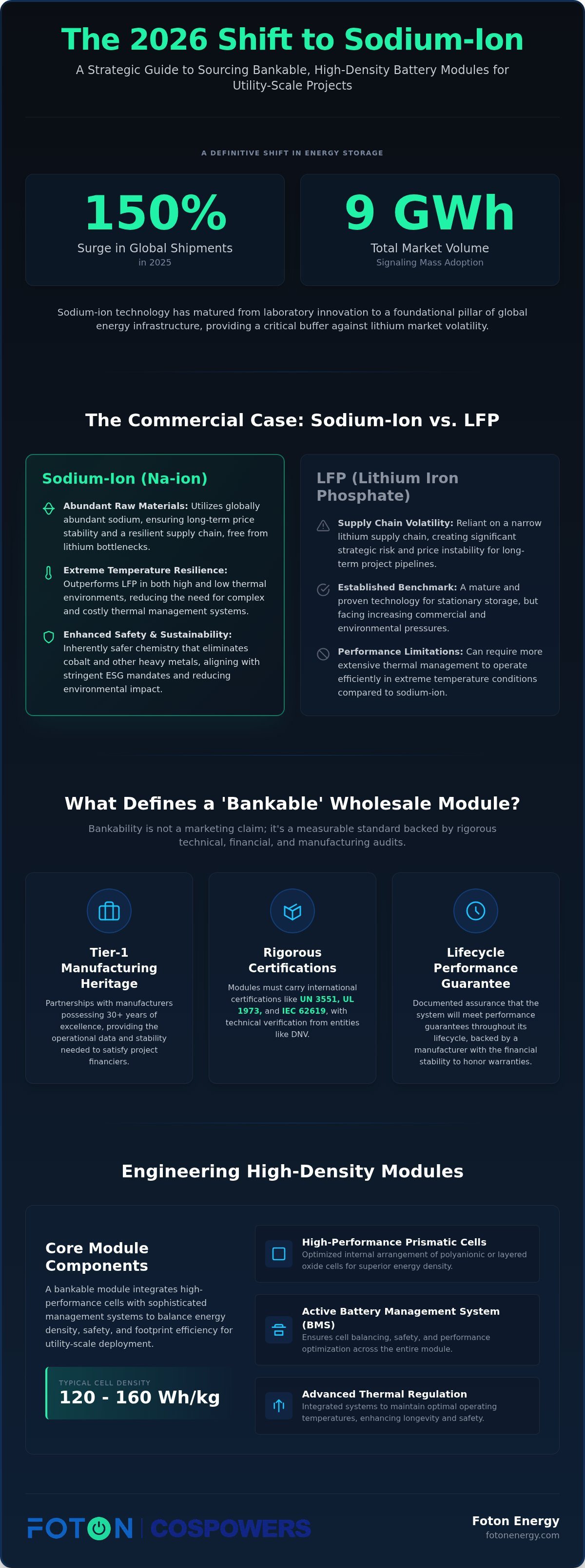
Global sodium-ion battery shipments surged by 150% in 2025, reaching 9 GWh and signaling a definitive shift in the global energy storage landscape. For EPCs and utility-scale developers, the challenge isn't just finding alternative chemistry; it's securing a supply chain that won't evaporate under market pressure. You're likely managing the tension of the lithium supply crunch while demanding hardware that performs in extreme temperatures and meets strict safety standards. Procuring wholesale sodium-ion battery modules requires more than just a purchase order. It demands a strategic partnership with a manufacturer that possesses a proven heritage and the bankability to satisfy project financiers.
This guide provides a comprehensive roadmap for sourcing industrial-grade sodium-ion modules that meet rigorous 2026 international safety standards like UN 3551. We'll examine how to evaluate Tier-1 manufacturing credentials, compare real-world performance against LFP benchmarks, and leverage AI-driven energy management to optimize long-term value. By the end of this article, you'll have the technical and commercial framework needed to integrate these resilient systems into your 2026 project pipeline with absolute confidence.
Key Takeaways
- Understand the transition of sodium-ion technology from laboratory innovation to a bankable, utility-scale infrastructure staple in the 2026 energy market.
- Evaluate the technical architecture of wholesale sodium-ion battery modules to ensure high-density energy storage and footprint efficiency for your next project.
- Identify the specific commercial and environmental conditions where sodium-ion chemistry outperforms LFP, particularly in applications requiring resilience in extreme temperatures.
- Master a strategic sourcing framework that prioritizes Tier-1 manufacturing heritage and rigorous bankability audits to safeguard your long-term procurement strategy.
- De-risk large-scale energy investments by aligning with global partnerships that combine 30 years of manufacturing excellence with AI-driven grid optimization.
The 2026 Shift: Why Wholesale Sodium-Ion Battery Modules are Now Bankable
2026 represents the year sodium-ion technology matured from laboratory promise into a foundational pillar of global energy infrastructure. While the early 2020s focused on pilot projects, the current market is defined by the mass availability of wholesale sodium-ion battery modules designed for 100MWh+ pipelines. This transition provides a critical buffer against the inherent volatility of the lithium-ion market, offering EPCs a diversified procurement strategy that doesn't compromise on performance or safety. The era of experimental testing has ended; we've entered the phase of industrial-grade deployment where reliability is the primary currency for large-scale energy infrastructure.
Understanding the fundamental chemistry of sodium-ion battery technology is essential for technical due diligence, as it highlights why these systems are inherently more resilient in volatile thermal environments than traditional LFP. By shifting focus toward sodium-based architectures, developers can mitigate the risks associated with mineral scarcity while securing hardware that's engineered for the rigors of the grid.
To better understand the scale of this industrial shift, watch this overview of the world's first mass-produced sodium-ion platform:
Drivers of Industrial Sodium-Ion Adoption
Global energy markets demand mineral independence. Relying on a narrow lithium supply chain is a strategic risk that 2026 developers can't afford. Sodium-ion modules leverage abundant raw materials, ensuring long-term price stability for multi-year infrastructure rollouts. This diversification is essential for creating a resilient energy ecosystem that remains unaffected by regional lithium shortages. ESG mandates also drive this transition. Sodium-based chemistries offer a superior sustainability profile, significantly reducing the environmental impact of utility-scale BESS installations by eliminating the need for cobalt and heavy mining impacts. Finally, cost-performance parity has arrived for stationary storage. In applications where safety and thermal stability are paramount, wholesale sodium-ion battery modules now compete directly with LFP on a total cost of ownership basis.
What Defines a 'Bankable' Wholesale Module?
Bankability isn't a marketing claim; it's a measurable standard backed by rigorous technical audits. For 2026 procurements, modules must carry recognized international certifications such as UL 1973 and IEC 62619, alongside technical verification from entities like DNV. These certifications ensure that the hardware can withstand the operational stresses of utility-scale cycling. A manufacturer's heritage is equally vital. Hardware from partners like Cospowers, who bring 30 years of manufacturing excellence, provides the operational data and manufacturing stability needed to satisfy project financiers. In the context of 2026 energy storage procurement, bankability is the documented assurance that a battery system will meet its performance guarantees throughout its lifecycle, backed by a manufacturer with the financial stability to honor its warranties.
Technical Architecture: Engineering High-Density Sodium-Ion Modules
Engineering wholesale sodium-ion battery modules for utility-scale deployment requires a sophisticated approach to technical architecture. It isn't enough to simply cluster cells; a bankable module must integrate high-performance prismatic cells with an active Battery Management System (BMS) and advanced thermal regulation. By optimizing the internal arrangement of polyanionic or layered oxide cells, manufacturers achieve a balance between energy density and footprint efficiency. While current cell densities typically range between 120-160 Wh/kg, the modular design ensures that the system-level footprint remains competitive for C&I and utility applications.
As the global sodium-ion supply chain matures, the integration of AI-driven Energy Management Systems (EMS) has become a standard requirement for grid optimization. These intelligent systems monitor cell health in real-time, predicting maintenance needs and balancing loads to maximize cycle life. This level of technical depth is what allows 2026 infrastructure projects to transition from experimental setups to resilient, long-term assets.
Thermal Management and Environmental Resilience
High-capacity modules typically utilize either forced air-cooling or advanced liquid-cooling systems. Liquid cooling offers superior temperature uniformity, which is critical for maintaining the longevity of sodium-ion chemistries during high-rate discharge cycles. These modules exhibit remarkable stability in extreme environments, maintaining operational integrity in temperatures where lithium-ion performance typically degrades. You can see our guide on sodium-ion battery discharge rates for climate-specific data that illustrates this resilience.
Safety Standards and Fire Suppression
Safety is engineered into the module's core. Industrial modules feature internal fire suppression technology that provides localized protection within containerized systems. Compliance with global sodium-ion battery safety standards, including the latest 2026 shipping regulations like UN 3551, is mandatory for mission-critical sites. One of the most significant logistical advantages is the 'Zero-Volt' shipping capability. Unlike lithium-ion, sodium-ion modules can be discharged to zero volts for transport, drastically reducing the risk of thermal events during the movement of wholesale sodium-ion battery modules. Developers looking to de-risk their projects should consult with our engineering team to review the full safety specifications of our 2026 hardware.
The Commercial Case: Sodium-Ion vs. LFP for Bulk Procurement
Selecting the right chemistry for a multi-megawatt pipeline involves balancing immediate capital expenditure against long-term operational resilience. While LFP remains the incumbent for high-density requirements, wholesale sodium-ion battery modules offer a compelling commercial alternative for projects where thermal stability and cost-predictability are paramount. In 2026, LFP cells typically offer 160 to 200 Wh/kg, whereas sodium-ion has matured to provide 120 to 160 Wh/kg, with premium tiered oxide cells reaching 175 Wh/kg. This narrow density gap is often offset by sodium-ion's superior performance in sub-zero temperatures and its ability to maintain high cycle life at 100% depth of discharge.
According to the global sodium-ion battery market outlook, the commercial viability of these systems is increasingly driven by supply chain security. For a 20-year project horizon, the Total Cost of Ownership (TCO) for sodium-ion becomes highly attractive when considering reduced HVAC energy consumption and the elimination of fire suppression complexities required for lithium-based chemistries. We invite developers to perform a side-by-side TCO analysis to see how these advantages scale across their specific 2026 pipelines.
Performance Trade-offs in 2026
Choosing between chemistries requires an analysis of specific load profiles. Sodium-ion excels in high-power applications due to its excellent C-rate capabilities, making it ideal for frequency regulation and data center UPS systems where rapid discharge is mandatory. While LFP is lighter, the volumetric efficiency of modern sodium-ion modules has improved to the point where the footprint difference for stationary C&I storage is negligible. Developers must also consider the Depth of Discharge (DoD) impact; sodium-ion modules can typically cycle 4,000 to 8,000 times without the accelerated capacity fade often seen in lithium chemistries when pushed to their limits.
Wholesale Price Stability and Mineral Exposure
The primary commercial driver for bulk procurement is the decoupling from lithium and cobalt markets. Sodium is abundant and geographically distributed, which allows manufacturers like Cospowers to offer more stable, long-term pricing structures for wholesale sodium-ion battery modules. This mineral independence protects EPCs from the price spikes that have historically plagued the lithium supply chain. By securing long-term procurement contracts for sodium-based hardware, developers can lock in project costs years in advance, providing a level of financial certainty that is difficult to achieve with traditional chemistries. Localized manufacturing hubs are reducing global distribution costs, making sodium-ion the strategic choice for diversifying large-scale energy storage portfolios.
Strategic Sourcing: Navigating the Global Sodium-Ion Supply Chain
Procurement at the gigawatt-hour scale requires a departure from transactional sourcing. For 2026 infrastructure, the sourcing process for wholesale sodium-ion battery modules must follow a rigorous five-step framework to ensure project viability. It begins with identifying Tier-1 manufacturers who possess validated production capacity. Technical due diligence then moves beyond spec sheets to encompass 'bankability' audits, where financiers evaluate the manufacturer's long-term stability and warranty backing. Partners like Cospowers, with 30 years of manufacturing heritage, provide the operational data needed to satisfy these high-level financial requirements.
Logistics and transport optimization represent the third critical step. The 2026 implementation of international shipping standards UN 3551 and UN 3552 has streamlined the movement of sodium-based hardware. Sodium-ion's unique 'Zero-Volt' transport capability allows modules to be shipped at a 0% state of charge, which virtually eliminates thermal runaway risks during transit and significantly lowers insurance costs for bulk sea freight. Finally, the process concludes with engineering integration for grid-code compliance and the establishment of a commissioning plan that includes long-term asset management. This methodical approach ensures that every module contributes to a resilient and high-performing energy asset.
The Role of the Strategic Distributor
Strategic distributors act as the essential bridge between Tier-1 manufacturing facilities and local project execution. Sourcing through a partner like Foton Energy reduces execution risk by managing the complex 'last mile' of utility scale BESS procurement. This relationship provides EPCs with more than just hardware; it offers access to local engineering support and a dedicated supply chain that can adapt to shifting project timelines. By leveraging a global network that spans over 70 countries, Foton ensures that high-density modules are delivered with the technical documentation required for local grid approval.
Procurement Checklists for EPCs
A comprehensive procurement checklist is mandatory for de-risking large-scale investments. EPCs must demand standardized certifications, specifically UL 1973 and IEC 62619, to verify safety and performance under stress. It's equally important to ensure that the hardware is natively compatible with advanced AI driven energy management systems for real-time grid optimization. Before signing a master supply agreement, verify the OEM's financial stability and manufacturing track record. A 20-year performance guarantee is only valuable if the manufacturer has the heritage to stand behind it. To secure your 2026 equipment allocation, connect with our strategic sourcing experts today.
Foton & Cospowers: Accelerating High-Density Sodium-Ion Deployment
Foton Energy serves as the exclusive global interface for Cospowers, a Tier-1 manufacturer with more than 30 years of industrial heritage. This partnership provides a stable, bankable foundation for developers looking to secure wholesale sodium-ion battery modules for large-scale infrastructure. By combining Cospowers' massive production capacity with Foton's global network across 70+ countries, we ensure that high-performance hardware is matched with local execution expertise. Our support extends far beyond the point of sale, encompassing comprehensive BESS engineering consulting to navigate the complexities of grid integration and project feasibility.
Operational success in 2026 is already visible through our deployment of sodium-ion modules in mission-critical environments. In data centers and telecom backup sites, our hardware provides the high-rate discharge and thermal stability required to maintain uptime in volatile conditions. These real-world applications demonstrate that sodium-ion is no longer a future prospect; it's a current, reliable solution for diversifying the energy storage mix. We provide the technical proof points and manufacturing stability that financiers demand before approving utility-scale capital expenditures.
Beyond Hardware: The Foton Ecosystem
Strategic value is found in the integration of hardware and intelligence. Every module we deploy is supported by an AI-driven EMS that provides real-time monitoring and predictive maintenance, ensuring that your assets operate at peak efficiency throughout their lifecycle. We don't just deliver containers; we provide a full suite of engineering services for microgrid and utility-scale design. Our team assists with grid-code compliance and technical project feasibility, acting as a supportive partner that navigates regulatory hurdles alongside your technical team. This interconnected approach ensures that wholesale sodium-ion battery modules are optimized for the specific demands of your local grid.
Future-Proofing Your Energy Infrastructure
Investing in energy storage requires a roadmap that accounts for technological evolution. Foton is committed to the long-term performance of your assets, offering a clear development path for next-generation, high-density sodium-ion modules. Our visionary pragmatism ensures that while we innovate with higher energy densities, every advancement is grounded in rigorous testing and international certifications. We provide the steady, guiding hand needed to transform ambitious infrastructure goals into operational excellence, backed by a manufacturing heritage that spans three decades. Contact Foton Energy for wholesale sodium-ion procurement and engineering support to begin your 2026 project planning.
Securing Your Position in the 2026 Energy Transition
The shift toward sodium-ion technology is no longer a speculative trend; it is a strategic necessity for resilient energy infrastructure. By integrating wholesale sodium-ion battery modules into your procurement pipeline, you mitigate the risks of mineral scarcity while gaining superior thermal stability and safety. Bankability in 2026 is defined by the intersection of advanced chemistry and established manufacturing excellence. This guide has outlined the technical, commercial, and logistical frameworks required to de-risk your utility-scale and C&I projects through methodical due diligence and strategic alignment.
As the exclusive global partner of Cospowers, Foton Energy provides the 30+ years of manufacturing heritage and Tier-1 bankability standards essential for securing project financing. Our hardware meets rigorous DNV verification, ensuring that your investment remains stable and productive over its entire lifecycle. We invite you to join a collaborative vision for a more diverse and secure energy landscape. It's time to transition from observation to execution with a partner who understands the rigors of industrial-scale deployment.
Partner with Foton for Tier-1 Sodium-Ion Wholesale Procurement to access the engineering expertise and hardware reliability your next project demands. The future of energy storage is here, and it's built on a foundation of proven industrial excellence.
Frequently Asked Questions
What is the typical lead time for wholesale sodium-ion battery modules in 2026?
Lead times for wholesale sodium-ion battery modules in 2026 typically range from 16 to 24 weeks depending on the project scale and manufacturing cycle. Larger utility-scale orders may require earlier slot reservations to ensure alignment with project commissioning dates. By partnering with an exclusive global distributor, EPCs can often secure prioritized production slots, reducing the risk of project delays caused by global supply chain fluctuations.
Are sodium-ion modules compatible with standard LFP inverters and EMS?
Most industrial-grade sodium-ion modules are fully compatible with standard LFP inverters and energy management systems. They utilize industry-standard communication protocols, such as CANbus and RS485, which allow for seamless integration into existing balance-of-plant architectures. Developers don't need to invest in proprietary power conversion hardware or specialized monitoring software. This flexibility is essential for diversifying technology in 2026 storage pipelines without increasing integration costs or technical complexity.
How does the 'Zero-Volt' state of sodium-ion batteries improve wholesale logistics?
The 'Zero-Volt' capability allows these batteries to be discharged to a 0% state of charge for transport, which is a significant safety advantage. This state eliminates the risk of thermal runaway during transit, making them safer than lithium-ion alternatives. It simplifies compliance with the 2026 UN 3551 shipping regulations. Lower insurance costs and less restrictive shipping requirements make the movement of wholesale sodium-ion battery modules more efficient for global developers.
What certifications are required for grid-scale sodium-ion deployment in Australia and the US?
Grid-scale deployment requires modules to meet UL 1973 and IEC 62619 safety standards. In the United States, adherence to NFPA 855 is critical for stationary storage installations. Projects in Australia must comply with AS/NZS 5139 to ensure grid-code alignment. Procuring hardware that already possesses these international certifications is a prerequisite for passing technical due diligence and securing the necessary permits for large-scale energy infrastructure projects in these regions.
Can sodium-ion modules be used for high-rate discharge applications like data center UPS?
Sodium-ion modules are excellent for high-rate discharge applications like data center UPS systems. Their chemistry allows for rapid power delivery without the significant heat generation often seen in other chemistries. This makes them ideal for mission-critical backup where immediate response is necessary. Their inherent thermal stability ensures that they can handle frequent, high-intensity cycling while maintaining the long-term reliability required for sensitive digital infrastructure and grid frequency regulation.
What is the expected cycle life of a Tier-1 manufactured sodium-ion module?
A Tier-1 manufactured module typically offers a cycle life between 4,000 and 8,000 cycles at standard depth of discharge. Some advanced platforms are now reaching up to 10,000 cycles under optimized conditions. This performance profile ensures that the modules can support a 15 to 20 year operational life. This longevity is comparable to LFP technology, making sodium-ion a stable, long-term asset for commercial and industrial energy storage portfolios.
How do sodium-ion wholesale prices compare to LFP for large-scale projects?
Wholesale prices for sodium-ion are rapidly approaching parity with LFP in 2026. While LFP remains a highly efficient incumbent, sodium-ion benefits from a more stable raw material supply chain that is less prone to lithium price spikes. For large-scale projects, the total cost of ownership is often lower because sodium-ion requires less intensive HVAC support and exhibits better performance in extreme temperatures, reducing overall operational expenses.
Is sodium-ion technology considered 'bankable' by major project financiers?
Major financiers consider sodium-ion technology bankable when it's produced by a manufacturer with an extensive industrial heritage. Success depends on providing DNV-verified performance data and holding all necessary international safety certifications. The partnership between Foton and Cospowers provides this level of assurance. It's the manufacturing stability and technical proof points that lenders require to approve capital for multi-megawatt energy storage projects and grid-scale infrastructure across the globe.


