

Cooling isn’t a standalone equipment choice. It’s a system design decision. Industrial battery thermal management influences how a storage system handles heat, supports dependable performance, and operates within the limits set by its chemistry and manufacturer.
If you’re comparing air, liquid, or other cooling approaches, efficiency and complexity matter. So do operating conditions, site environment, safety architecture, controls, and maintenance requirements. A design that suits one project may not suit another.
This practical guide explains the main functions and components of thermal management, how temperature can affect battery performance and service life, and which trade-offs to assess before deployment. It also outlines the design, commissioning, and monitoring questions to raise with suppliers, including how to verify system-specific limits and requirements. Use the chemistry, duty cycle, site conditions, and operating objectives to evaluate thermal management as part of an integrated battery and controls design.
Key Takeaways
- Understand how industrial battery thermal management helps keep temperature and temperature variation within manufacturer-defined operating limits.
- Trace how sensing, control decisions, and heat transfer work together, and identify which Battery Management System functions to verify.
- Compare air- and liquid-based cooling by their design dependencies and operational considerations, rather than assuming one approach fits every project.
- Use a practical review sequence to define chemistry, power profile, site conditions, and operating objectives before assessing proposals.
- Include thermal design in the wider battery, controls, safety, and site-engineering review, and ask for project-specific evidence to support performance claims.
What Industrial Battery Thermal Management Controls: Why It Matters
Definition: Industrial battery thermal management is the coordinated design and control of heat generation, temperature sensing, heat transfer, and heat rejection to keep battery cells within manufacturer-defined operating limits and manage temperature variation across the system. Cell-level temperature control is one part of this work. Whole-system thermal design also considers modules, enclosures, controls, site conditions, and interfaces with safety equipment.
That distinction matters. Temperature can influence a battery’s electrochemical performance, degradation, and permitted operating conditions. The effect depends on chemistry, cell design, operating profile, and manufacturer specifications, so universal temperature thresholds aren’t a sound basis for project decisions. Request the applicable temperature limits and supporting documentation for the proposed system.
How temperature affects industrial battery operation
Temperature variation deserves attention alongside average temperature. Cells or modules operating under different conditions may not respond identically during charging, discharging, or periods of rest. The thermal design should account for how heat moves through the battery assembly and whether the monitoring approach can reveal meaningful differences. Ask suppliers what is measured, where sensors are located, and how readings are assessed against manufacturer-defined limits.
Thermal management is more than cooling
Cooling is only one possible response to heat. A complete design considers heat generation, transfer from cells to surrounding components, monitoring, control logic, and heat rejection. The objective isn’t to maximize cooling at all times. It’s to maintain suitable operating conditions while accounting for system demands and design constraints. Depending on the system, the Battery Management System (BMS) may provide information used in thermal monitoring or control. Confirm its role and capabilities for the specific design. A foundational overview of the Battery management system (BMS) explains how BMS functions relate to battery monitoring and thermal management.
Thermal management also isn’t interchangeable with fire detection or suppression. Thermal controls manage operating heat and temperatures; fire-safety functions are intended to detect or respond to hazardous events. They should be designed to work together, but effective temperature control doesn’t replace fire protection, and fire-safety equipment doesn’t regulate routine cell temperatures.
Nor should a project assume that site HVAC and battery thermal management do the same job. Facility heating, ventilation, or air conditioning may condition the surrounding space, while battery thermal design addresses conditions within the battery system. Confirm how these systems interact, which equipment is responsible for each function, and what evidence supports the proposed performance for the project’s chemistry and operating conditions.
How Industrial Battery Thermal Management Works Across the System
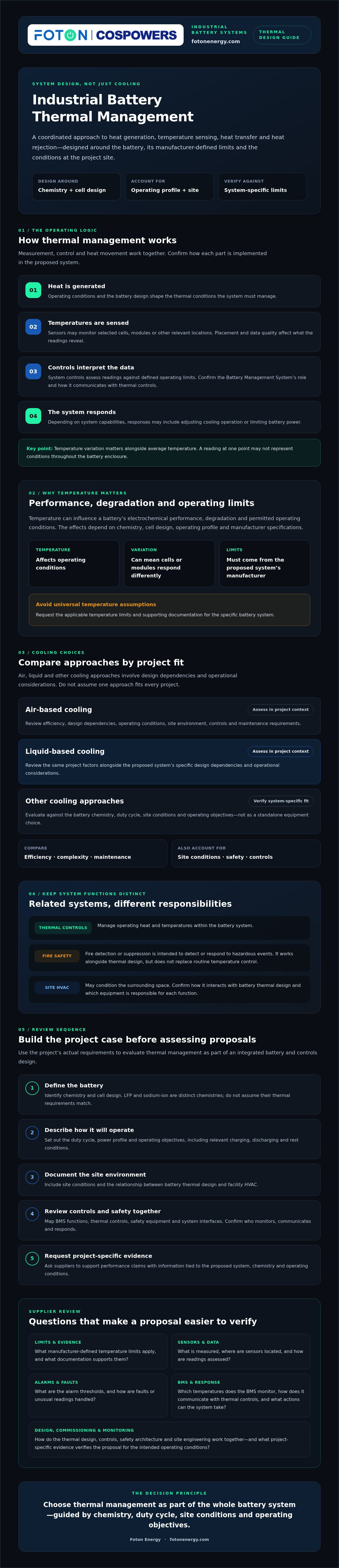
Thermal management links measurement, control, and heat transfer. Sensors provide temperature data, system controls interpret that data against defined operating limits, and the design manages heat transfer or removal in response to operating conditions. This sequence is a useful way to assess industrial battery thermal management, but its exact implementation depends on the battery and system architecture.
From cell and module temperatures to system response
Sensors may measure temperatures at selected cells, modules, or other relevant locations. Their readings can inform control responses, such as adjusting cooling operation or limiting battery power, where the system supports those functions. Don’t assume every BMS performs the same role. Confirm which temperatures it monitors, how it communicates with thermal controls, and what actions the system can take.
Sensor location and data quality matter. A reading from one point may not represent conditions throughout a battery enclosure, so suppliers should explain the sensor layout, measurement accuracy, alarm thresholds, and how faults or unusual readings are handled. Review these details against the manufacturer’s requirements and the project’s operating profile.
How chemistry and operating profile influence thermal requirements
LFP and sodium-ion batteries are distinct chemistries, and their thermal requirements shouldn’t be assumed to match. For either, ask the manufacturer for the relevant operating limits and performance documentation. Then assess how charging and discharging patterns, power levels, ambient conditions, and duty cycle shape heat generation and the system’s response. A battery used for sustained high-power operation may present different design demands from one used intermittently, but project data and system documentation must support that assessment.
The thermal design also needs to coordinate with adjacent systems. Power conversion equipment can affect operating patterns and the heat present in the broader installation. Site HVAC may condition the surrounding space, but its interface with battery-level thermal controls should be clearly defined. An energy management system can schedule or optimize operation; confirm whether and how its instructions interact with BMS limits and thermal controls. Foton Energy offers AI-driven energy management for monitoring and grid optimization. Verify the specific functionality for each project.
These interfaces support a wider safety and reliability strategy. Sandia National Laboratories’ work on advancing safety and reliability provides context on energy-storage safety research, including thermal runaway and testing. For project teams, the practical step is to document how monitoring, alarms, control responses, and safety functions coordinate, then validate the design against manufacturer information.
To align chemistry, site conditions, controls, and operating objectives, consider a project-specific engineering consulting review before finalizing system requirements.
Comparing Industrial Battery Cooling Approaches and Their Trade-Offs
No cooling approach is universally best. Air-based and liquid-based systems differ in heat-transfer design, space requirements, service needs, and integration with the battery. Suitability depends on the system’s chemistry and layout, operating profile, site environment, and manufacturer-validated limits. Compare actual designs, not broad claims about a technology category.
Air-based and liquid-based cooling: questions to compare
Air-based designs move heat using airflow, while liquid-based designs transfer heat through a circulating liquid and associated components. These descriptions alone don’t establish how evenly temperatures are managed or how much energy a system uses. Request evidence for the specific battery configuration, including validated operating envelopes, auxiliary-load data, and maintenance documentation.
| Approach | Heat-transfer approach | Design dependencies | Operational considerations | Questions to verify |
|---|---|---|---|---|
| Air-based | Moves heat through airflow around or within the battery system. | Air paths, enclosure layout, site conditions, and equipment placement. | Consider fan or other auxiliary loads, noise constraints, filter or component access where applicable, and how airflow is monitored. | What operating conditions has the design been validated for? What are its auxiliary loads and maintenance requirements? |
| Liquid-based | Transfers heat through a liquid circuit and its connected components. | Circuit arrangement, interfaces, available space, and the battery’s specific design. | Review auxiliary energy, inspection and service access, monitoring, and the implications of maintaining additional components. | What does the supplier document about operating limits, service tasks, and system-specific performance? |
Immersion cooling can also be investigated where project requirements and supplier evidence support it. Don’t assume it is suitable or superior based on the approach name alone. Request design documentation, operating data, and maintenance requirements for the proposed system.
How to assess cooling trade-offs for a project
Start with the site: ambient conditions, enclosure arrangement, available space, noise constraints, and safe access for inspection or service. Then map how cooling components affect monitoring, redundancy, and planned system availability. For example, identify which components need periodic attention and how the system responds if a monitored component is unavailable. Confirm the answers against supplier documentation rather than assuming identical provisions across designs.
Before ranking options, list the assumptions behind each proposal. Ask suppliers to identify evidence gaps, explain how performance was assessed for the project’s duty cycle, and separate measured data from estimates. This gives the team a defensible comparison of industrial battery thermal management options, based on project conditions rather than unsupported generalizations.
A Practical Checklist for Specifying and Reviewing Battery Thermal Management
Compare proposals against a defined project brief, not assumptions about which cooling approach should perform best. Use this checklist to connect the battery’s requirements with supplier evidence, controls, commissioning, and ongoing operations.
- Define the application. Record the battery chemistry, charge and discharge patterns, power profile, expected duty cycle, and operating objectives. Identify the performance and availability requirements the system must support.
- Document site conditions. Set out expected ambient conditions, enclosure location and layout, available space, environmental exposure, access constraints, and any noise considerations that may affect system design.
- Request design evidence. Ask for system-specific thermal design documents and manufacturer-validated operating limits. Confirm that the proposed architecture addresses the project’s expected operating scenarios rather than relying on generic claims.
- Review monitoring and controls. Request a clear description of sensors, measurement locations, alarm thresholds, control responses, and auxiliary energy use. Confirm how thermal monitoring communicates with the Battery Management System (BMS) and site energy management system, and which functions each system is responsible for.
- Plan commissioning checks. Confirm that procedures cover sensor readings, alarms, control responses, communications, and operation against documented limits. Agree how results will be recorded and how any deviations from design expectations will be resolved.
- Assign operational responsibilities. Establish who reviews thermal trends, how exceptions are escalated, and where monitoring records are retained. Check supplier documentation for maintenance tasks, service intervals, access requirements, and spare-parts needs.
Questions to ask before selecting a system
Ask suppliers to explain how the proposed design maintains required conditions across expected ambient and operating scenarios. Request evidence for temperature limits, alarms, control responses, and auxiliary loads. If a response depends on a particular operating mode or system interface, ask for that dependency to be stated clearly.
Commissioning and long-term operations
Commissioning should establish that the installed monitoring and control functions behave as documented. Before handover, confirm the operating limits, alarm-handling process, maintenance records, and responsibilities for reviewing trends. These details help ensure the design remains understandable and manageable after the project enters service.
For a project-specific engineering review that aligns chemistry, site conditions, and operating objectives, discuss your project requirements with Foton.
Integrating Thermal Management into a Bankable Industrial Battery System
Thermal design earns confidence through integration and evidence. It needs to align with the battery chemistry, controls, safety architecture, site engineering, and operating plan. A cooling proposal alone can’t establish whether the full system will meet project requirements. Ask suppliers to support performance claims with manufacturer documentation and evidence relevant to the proposed configuration and site.
What an integrated project review should connect
Bring the battery’s chemistry and duty cycle together with site conditions, system configuration, and operating objectives. Then map interfaces among the Battery Management System, Energy Management System, power conversion equipment, and safety architecture. The review should make clear which system monitors each condition, which controls can respond, and how safety functions relate to routine thermal operation.
Document assumptions and responsibilities, not just conclusions. Record the source of operating limits, which design conditions have been assessed, who owns each interface, and what questions remain open. If a performance claim depends on a particular operating profile or site condition, identify that dependency and request validation for the project. This creates a traceable basis for procurement and technical review without treating general claims as project-specific proof.
How Foton Energy (Foton Pty Ltd) supports project teams
Foton Energy (Foton Pty Ltd) provides engineering consulting for project feasibility, system design, and grid-code compliance. Its relevant capabilities include industrial battery thermal management, safety architecture, and AI-driven energy management. Confirm the scope and functions against the specific project rather than assuming them from a capability description.
Foton Energy (Foton Pty Ltd) supplies industrial and utility-scale storage systems, including LFP and sodium-ion systems. This background provides context on engineering and manufacturing capabilities, but it isn’t a substitute for validating thermal limits, cooling methods, monitoring functions, or performance claims against documentation for the proposed system.
Project teams can use Foton Energy (Foton Pty Ltd)’s engineering consulting for battery projects to review how requirements connect across design and operations. For wider context as you develop a project brief, explore a commercial and industrial BESS solutions guide and a BESS engineering consulting guide. Confirm that any resource you use reflects the project’s jurisdiction and system requirements.
Bring together the chemistry, duty cycle, site conditions, and unresolved design questions before the next supplier discussion. Discuss an industrial battery project with Foton Energy (Foton Pty Ltd) to explore project requirements and potential system alignment.
Turn Thermal Requirements into a Stronger Project Plan
Make thermal design part of the full system review, not a late-stage equipment decision. Align chemistry, site conditions, operating objectives, controls, and safety architecture, then confirm that key limits and performance claims are supported by manufacturer documentation. This gives your team a clear basis for comparing proposals and resolving design questions.
Industrial battery thermal management works best as part of an integrated approach to system performance and project readiness. Foton provides engineering consulting for feasibility, system design, and grid-code compliance, alongside thermal management, safety architecture, and AI-driven energy management capabilities. Confirm the scope and suitability of these capabilities for your project.
Ready to bring your requirements into focus? Discuss your industrial battery project with Foton. A well-grounded review can help your team move forward with clarity and confidence.
Frequently Asked Questions
What is industrial battery thermal management?
Industrial battery thermal management is the coordinated monitoring and control of battery temperatures, temperature variation, and heat transfer to keep the system within manufacturer-defined operating limits. It includes more than cooling: sensing, control logic, heat movement, and heat rejection all contribute. The design may also need to account for modules, enclosures, site conditions, and interfaces with the Battery Management System and other safety functions.
Why is thermal management important in industrial battery systems?
Temperature can affect battery performance, degradation, and permitted operating conditions, with the impact depending on chemistry and system design. Managing temperature and differences across cells or modules helps the system operate within the limits specified by its manufacturer. Thermal management is one part of safe system operation, not a substitute for fire detection, suppression, or other safety measures. Ask suppliers to support performance claims with system-specific evidence.
What is the difference between air and liquid cooling for batteries?
Air-based designs move heat using airflow, while liquid-based designs transfer heat through a circulating liquid and connected components. These categories describe different approaches, but don’t establish which system will perform better for a particular project. Compare the proposed design’s operating envelope, auxiliary energy use, monitoring, maintenance tasks, access needs, and site requirements. Request comparable evidence for the specific battery configuration before selecting an approach.
Does battery thermal management prevent thermal runaway?
No. Thermal management can monitor and manage operating temperatures, but it can’t guarantee that thermal runaway will be prevented. It should be integrated with appropriate battery controls and the project’s fire-safety architecture, including detection and response functions. Ask suppliers to explain how thermal alarms and control actions interact with safety systems, and to provide supporting documentation for the proposed configuration. Confirm applicable requirements with qualified project professionals in the relevant jurisdiction.
How does battery chemistry affect thermal management requirements?
Chemistry influences battery operating limits and thermal design requirements, so specifications for one chemistry shouldn’t automatically be applied to another. For example, LFP and sodium-ion systems need to be assessed using the documentation for the specific cells and system proposed. Share the expected charge and discharge patterns, power profile, ambient conditions, and duty cycle with suppliers, then verify temperature limits and performance claims against manufacturer information.
What should I ask a supplier about battery thermal management?
Ask for the thermal design documents, manufacturer-defined operating limits, sensor locations, alarm thresholds, control descriptions, and evidence for expected operating scenarios. Clarify auxiliary energy use, maintenance tasks, service access, and spare-parts requirements. Also ask how monitoring interfaces with the Battery Management System and site Energy Management System, which system owns each response, and what assumptions or evidence gaps remain for your project.
How is battery thermal management assessed during commissioning?
Commissioning should verify that the installed thermal monitoring and controls match the approved design and supplier procedures. Confirm that sensors report as expected, alarms activate under the specified test conditions, and control responses and system communications operate as documented. Check that operating limits and escalation steps are recorded for handover. The commissioning plan should identify test responsibilities, evidence to retain, and how any discrepancies will be addressed.


