

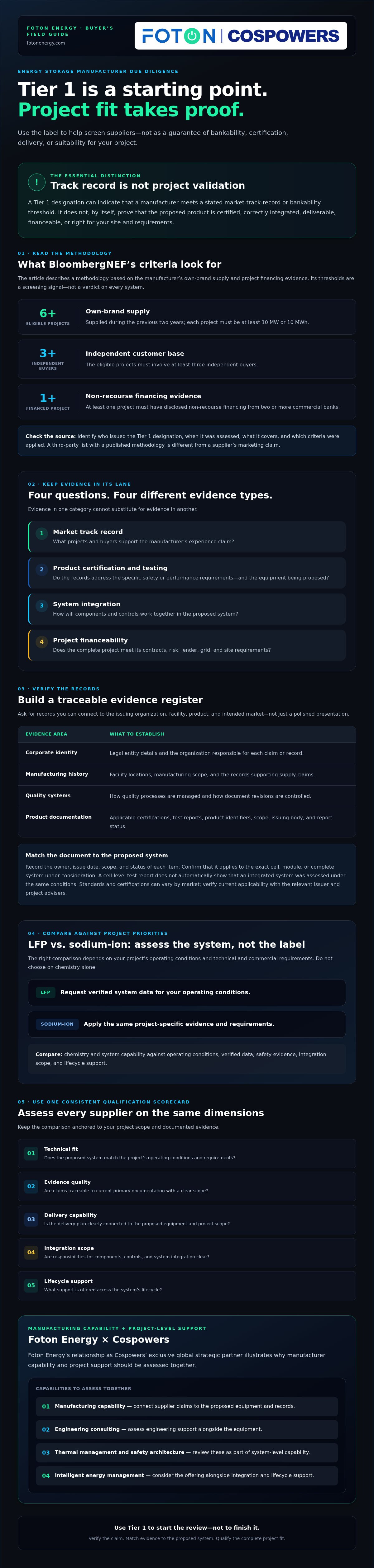
A Tier 1 label is a starting point for due diligence, not a guarantee of bankability. If you’re comparing tier 1 energy storage manufacturers, the distinction matters: BloombergNEF’s August 15, 2026 methodology looks for own-brand supply to at least six eligible projects in the previous two years, across three or more independent buyers, with at least one project financed on a non-recourse basis by two commercial banks. That signals market track record and financing evidence, but it doesn’t prove a supplier will meet your project’s needs.
It’s reasonable to want confidence in a manufacturer’s credentials. But credentials alone don’t tell you whether the battery chemistry, system integration, safety evidence, delivery plan and lifecycle support fit your technical and commercial requirements.
This guide explains how to verify claims, distinguish independent evidence from marketing language, and compare LFP and sodium-ion options against project priorities. You’ll also learn what to check in safety documentation, engineering capability and supply arrangements before selecting a partner. Foton Energy’s relationship as Cospowers’ exclusive global strategic partner, together with its engineering consulting and intelligent energy management offerings, illustrates why manufacturer capability and project-level support should be assessed together.
Key Takeaways
- Check which organization defines a manufacturer’s Tier 1 status and what evidence its criteria require before relying on the label.
- Ask for traceable corporate, manufacturing, quality, certification and test documentation. Confirm that it applies to the system under consideration.
- Compare LFP and sodium-ion against your project’s operating conditions, and request verified system data rather than choosing on chemistry alone.
- Assess tier 1 energy storage manufacturers using a consistent scorecard for technical fit, evidence quality, delivery capability, integration scope and lifecycle support.
- Understand how Foton’s strategic partnership with Cospowers connects manufacturing capability with engineering consulting, thermal management, safety architecture and intelligent energy management.
What Does Tier 1 Mean for Energy Storage Manufacturers?
Tier 1 is a designation defined by a particular source. It signals that a manufacturer has met specified market track record or bankability criteria, not that its products are universally certified or suitable for every project. Start by identifying the organization behind the label and the methodology it used. For foundational context on the equipment being assessed, see this overview of a Battery energy storage system (BESS).
For example, BloombergNEF’s methodology updated on August 15, 2026, requires a manufacturer to have supplied its own-brand products to at least six eligible projects of 10 MW or 10 MWh or larger during the previous two years. The projects must involve at least three independent buyers, and at least one must have disclosed non-recourse financing from two or more commercial banks. These criteria provide a defined screening signal. They don’t establish that every system from that manufacturer is certified, correctly integrated or financeable for your project.
Keep the evidence categories distinct. A manufacturer’s project history indicates experience. Product certifications and test reports address specific safety or performance requirements. System integration concerns how components and controls work together. Project financeability depends on the complete project, its contracts, risk profile and lender requirements. Evidence in one category cannot substitute for evidence in another.
Is Tier 1 a universal energy storage certification?
No. Confirm who issued the designation, when it was assessed, what the assessment covers and which criteria were applied. A third-party list with a published methodology is different from a manufacturer describing itself as Tier 1 in marketing materials. Check the claim against current primary documentation, including the issuer’s methodology and the manufacturer’s supporting records. Don’t assume a past listing or general statement covers the product or project you’re evaluating.
What does a Tier 1 designation tell a buyer?
Used carefully, the designation can help narrow an initial supplier shortlist by identifying manufacturers that meet a stated track record threshold. It doesn’t independently validate a specific product configuration, confirm delivery commitments or demonstrate that a project meets lender, grid or site requirements. Treat it as one input, then compare the evidence with your project scope.
As you compare tier 1 energy storage manufacturers, ask for documentation that connects the company’s claims to the proposed equipment and delivery plan. Examine corporate identity, manufacturing history, quality systems and product records. Then compare chemistry and system capability against operating needs, and clarify integration responsibilities and lifecycle support. This keeps the decision focused on verifiable fit, not a label alone.
Which Evidence Should Tier 1 Energy Storage Manufacturers Provide?
A credible supplier should be able to connect its claims to identifiable records. When assessing tier 1 energy storage manufacturers, review four areas: corporate identity, manufacturing history, quality systems and product documentation. A polished presentation is not enough. Ask for documents you can trace to the issuing organization, facility, product and intended market.
Build a document register that records the owner, issue date, scope and status of each item. Check that the evidence covers the exact cell, module or complete system proposed for your project. A cell-level test report, for example, doesn’t automatically show that an integrated system has been assessed under the same conditions. Standards and certifications can also vary by market, so verify current applicability with the relevant issuer and project advisers.
How can buyers verify manufacturing and quality claims?
Request the manufacturer’s legal entity details, facility locations, manufacturing scope and an explanation of its quality processes. Ask who owns each document and how revisions are controlled. For certifications and test reports, compare the issuing body, report date, model or component identifiers and scope with the proposed equipment. UL Solutions outlines its energy storage testing and certification work. Use relevant standards and certification records as items to verify, not as assumptions about a supplier’s products.
Where a claim matters to procurement or financing, seek confirmation directly from the issuing organization or an independent technical adviser. Resolve mismatches before evaluation proceeds, especially if a report covers a different model, configuration or deployment context.
Which project and delivery records strengthen supplier diligence?
Ask for references that resemble your intended application, operating conditions and system configuration. A reference is most useful when the supplier can explain what equipment was deployed, the role it performed and whether the project can be independently confirmed. Confidential details can remain protected, but an untraceable case study is not equivalent to verified operating history.
Next, examine how the supply plan will work in practice. Request clear assumptions for production planning, component sourcing, delivery milestones and responsibilities if inputs change. Confirm which party handles technical questions, issue escalation and lifecycle documentation, including the records your project team will receive. These checks help distinguish general capacity claims from a supply plan tailored to your project.
Keep open items visible in your decision record: missing documents, scope limitations, unresolved delivery assumptions and the person responsible for follow-up. Project teams seeking to connect supplier evidence with technical requirements can also explore energy storage engineering consulting from Foton Energy.
How to Compare LFP and Sodium-Ion Manufacturer Capabilities
Compare the complete system, not just the cell chemistry. When assessing tier 1 energy storage manufacturers, ask how the proposed battery, power conversion equipment, controls, thermal management and safety architecture work together under your project’s operating conditions. LFP is a more established stationary-storage chemistry, while sodium-ion is an emerging option. Neither label alone proves that a system suits your use case.
Ask each supplier the same questions, then compare its documented answers with your requirements:
| Comparison area | LFP | Sodium-ion | Evidence to request |
|---|---|---|---|
| Chemistry and maturity | Established technology with a more mature supply chain. | Emerging technology with potential tied to more abundant raw materials. | Cell and system documentation, manufacturing scope, and relevant project references. |
| Application fit | Assess against the project’s capacity, space, duty cycle, and operating requirements. | Assess against the same requirements, without assuming chemistry-level advantages guarantee system suitability. | Model-specific performance assumptions and operating limits for the intended application. |
| Operating profile | Confirm performance under the expected site conditions and usage profile. | Confirm performance under those same conditions using system-level evidence. | Test reports, thermal-management details, safety architecture, and stated operating envelope. |
| Integration | Clarify how battery, controls, and other system components are coordinated. | Confirm the same interfaces and responsibilities for the proposed configuration. | System architecture, EMS scope, integration responsibilities, and commissioning requirements. |
How should buyers assess LFP energy storage systems?
Request documented operating limits and performance assumptions for the specific model and configuration. Compare them with the project’s duty cycle and site conditions. Review how thermal management and safety architecture apply to the integrated system, and clarify which party coordinates the components and controls. Avoid broad lifespan or performance promises unless the supplier can support them with model-specific evidence relevant to your intended use.
When should sodium-ion be included in the evaluation?
Include sodium-ion when its potential characteristics align with project priorities and the manufacturer can provide evidence for the intended application. Request documentation comparable to what you would request for LFP, including system-level validation, operating limits and integration scope. For more context, read this sodium-ion commercial availability analysis. If you’re assessing critical backup, see the sodium-ion data centre guide.
Make the choice based on project evidence, not chemistry headlines. A consistent comparison shows whether each supplier can support the required operating profile, safety approach and system integration, and highlights what still needs verification before qualification.
How to Qualify a Tier 1 Manufacturer for Your Project
Turn supplier claims into a project-specific decision. A structured qualification process helps you compare tier 1 energy storage manufacturers against the same requirements and identify unresolved risks before procurement or contract milestones.
- Define the project brief. Document the application, site conditions, operating profile, required system functions and technical or commercial constraints. Separate mandatory requirements from preferences.
- Issue consistent RFI or RFP questions. Ask each supplier for a proposed system configuration, supporting technical documents and the assumptions behind its response. Request clarification when the evidence doesn’t match the proposed equipment or application.
- Map responsibilities. Set out the boundaries among manufacturer, distributor, EPC and owner. Name the party responsible for equipment supply, integration, commissioning, training and technical support. Don’t leave interface ownership implicit.
- Score each response. Use a shared scale, such as 1 to 5, for technical fit, evidence quality, delivery capability, integration scope and after-sales support. Define what each score means before evaluating suppliers, and record the supporting evidence beside every rating.
- Document the decision and open risks. Assign an owner and resolution date to each material gap. Record why the selected supplier meets the project’s needs, what assumptions remain and which items must be resolved before the next procurement or contract milestone.
What questions should an RFI or RFP ask manufacturers?
Request the configuration proposed for your site, the documents that support its operating assumptions and a clear list of included and excluded scope. Ask who owns each interface, who coordinates commissioning and training, and how technical questions will be handled. For broader project considerations, consult this bankable BESS strategic guide.
How should buyers assess integration and lifecycle support?
Map the connections among the batteries, power conversion system, controls, energy management system and site requirements. Confirm what information and actions pass between systems, who is accountable for integration, and what testing or handover records will be provided. Then review proposed monitoring, maintenance responsibilities, software update processes and escalation arrangements. The AI-driven energy management guide offers further prompts for controls diligence.
Bring engineering, operations, procurement and finance stakeholders into the review early. Clarify their decision rights, especially where a technical exception could affect delivery, integration or project risk. For support aligning system requirements with engineering considerations, discuss your project requirements with Foton Energy.
How Foton Connects Buyers With Cospowers Energy Storage Manufacturing
Choosing among tier 1 energy storage manufacturers is only part of supplier diligence. Project teams also need to understand how manufacturing capability connects with system requirements, engineering and ongoing support. Foton Energy, an Australian energy storage infrastructure company, is Cospowers’ exclusive global strategic partner. Cospowers is the manufacturer and has more than 30 years of manufacturing heritage; Foton does not manufacture its equipment.
The partnership brings together energy storage hardware and project-facing capabilities. Foton offers LFP and sodium-ion systems, engineering consulting, thermal management, safety architecture and intelligent energy management. Assess these elements as part of the proposed project scope: clarify which system components are included, how they work together and who is responsible for each integration interface. Chemistry alone doesn’t establish suitability, so verify the applicable technical evidence for the specific configuration under consideration.
What role does Foton play in the manufacturer relationship?
Foton connects buyers with Cospowers’ manufacturing capabilities and supports project requirements through its energy storage and engineering offering. Its role is strategic and commercial, not manufacturing. For each opportunity, confirm the current partnership scope, supply responsibilities, applicable documentation and points of contact with the relevant parties. This clarifies responsibilities before procurement decisions are made.
A manufacturer’s records, a partner’s engineering scope and a project’s integration plan are related, but they are not interchangeable. Ask who provides each document, who answers technical questions and how the proposed thermal management, safety architecture and intelligent energy management align with the application. For broader development context, see this guide to BESS engineering consulting.
When should project teams contact Foton?
Commercial, industrial, utility, data centre and telecom project teams, as well as qualified channel partners, can start by outlining the use case and unresolved questions. Share the application, site conditions, desired system functions, integration interfaces and partner requirements. This gives the discussion a practical foundation without assuming a particular chemistry or configuration will fit before technical review.
Bring key diligence questions forward: what evidence supports the proposed system, which party owns integration, and what engineering input does the project require? Foton’s engineering consulting and intelligent energy management are offered alongside its energy storage hardware, connecting supplier capability with project-level needs.
Build Confidence Around Project-Specific Evidence
Use a Tier 1 designation to begin supplier diligence, not finish it. The strongest fit is the manufacturer and project partner whose evidence matches your application, whose system capabilities meet defined requirements, and whose delivery, integration and lifecycle responsibilities are clear.
Compare LFP and sodium-ion using verified system-level information rather than broad chemistry claims. Confirm that certifications and test records apply to the proposed equipment, then document technical fit, evidence gaps, delivery assumptions and decision ownership before procurement milestones.
Foton Energy is Cospowers’ exclusive global strategic partner, connecting access to storage hardware with engineering consulting and intelligent energy management. Cospowers has more than 30 years of manufacturing heritage. As with any supplier, assess the partnership scope and manufacturing history as part of your project diligence.
For project teams and channel partners assessing storage requirements, discuss your energy storage project with Foton.
Frequently Asked Questions
What does Tier 1 mean for an energy storage manufacturer?
Tier 1 describes a manufacturer that meets criteria set by a particular organization, often based on market presence, project history or financing evidence. The precise meaning depends on the issuer and its methodology. For buyers comparing tier 1 energy storage manufacturers, treat the designation as an initial screening signal, then check whether the specific equipment, technical evidence, delivery plan and project requirements align.
Is Tier 1 an official certification for battery manufacturers?
No. Tier 1 is not a universal product certification or technical safety standard. It’s a designation defined by the organization applying its own criteria, so identify the issuer and review its current methodology. Product certifications and test reports are separate forms of evidence. Confirm their scope, issuing body, relevant model or system, and applicability to the market where the equipment will be used.
How do I verify a Tier 1 energy storage manufacturer's claims?
Start by asking who made the Tier 1 designation, when it was issued and which published criteria were applied. Check the claim against the issuer’s current records rather than relying only on supplier marketing materials. Then verify related company, manufacturing, project and product claims using traceable documentation. Match report identifiers, dates and scope to the exact equipment configuration proposed for your project.
Does a Tier 1 manufacturer guarantee a bankable BESS project?
No. A manufacturer designation may indicate a qualifying track record under a particular methodology, but it doesn’t guarantee that a project will secure financing. Lenders and investors assess the complete project, including its technical design, contracts, risk allocation, delivery assumptions and supporting evidence. Confirm the requirements of your project’s financing parties, and assess the proposed system and supplier against those requirements before making a procurement decision.
How should buyers compare LFP and sodium-ion storage manufacturers?
Compare both chemistries against the same project conditions, including the intended application, operating environment, duty cycle, space constraints and integration needs. Ask each manufacturer for model-specific operating limits, performance assumptions, safety information, thermal-management details and system-level validation. LFP is a more established stationary-storage chemistry, while sodium-ion is an emerging option. Neither chemistry is automatically the better fit without evidence tied to the proposed system.
What documents should a battery energy storage manufacturer provide?
Request corporate and facility information, a description of manufacturing scope, quality-system documentation, applicable certifications, test reports, product specifications and project references relevant to your application. Check who issued each document, its date, scope, model identifiers and revision status. Evidence should cover the proposed equipment, from cell or module through the integrated system where relevant. Confirm market-specific requirements with qualified project advisers.
What is the difference between a battery manufacturer and a BESS integrator?
A battery manufacturer produces cells, modules or other battery equipment. A BESS integrator combines storage components with elements such as power conversion equipment, controls, thermal management and safety architecture to create a coordinated system. Some companies may perform both roles, while others specialize in one. During procurement, confirm exactly what each party supplies, which interfaces it manages, and who is accountable for integration and technical documentation.


