
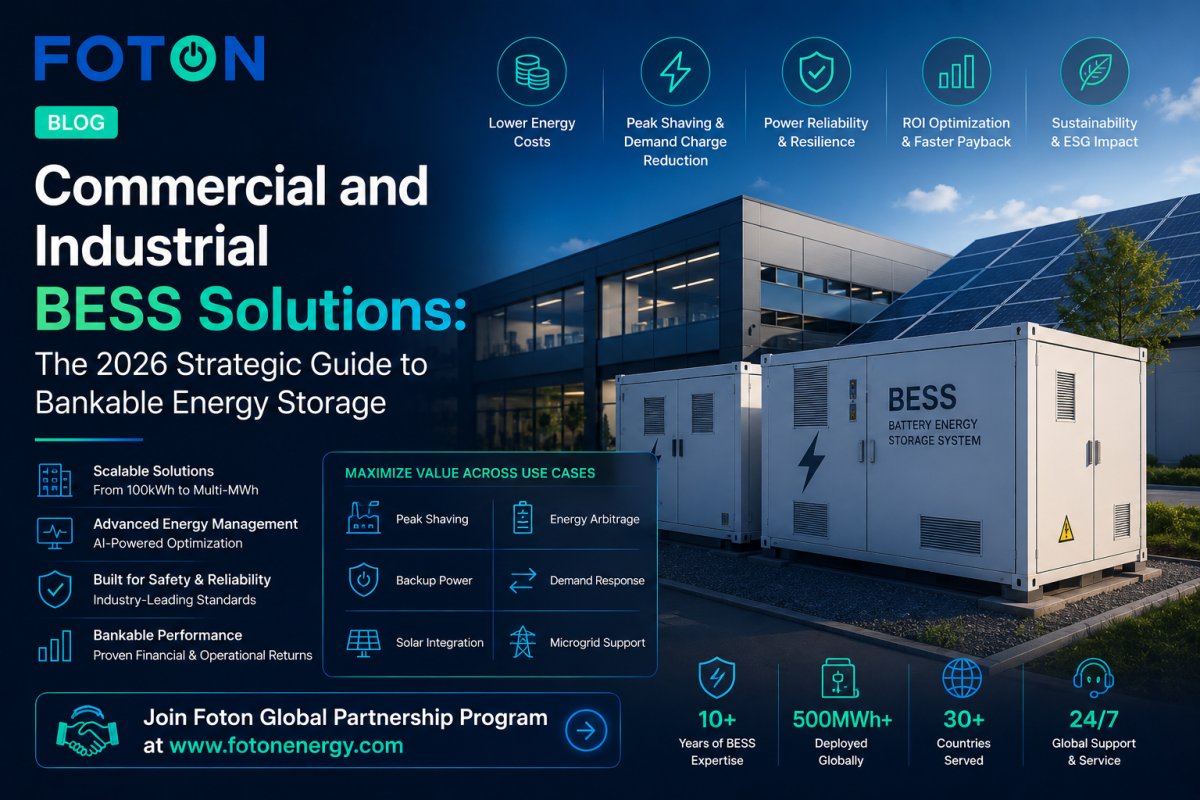
Demand charges now account for up to 50% of a commercial facility's monthly energy bill. This financial pressure, combined with the rigorous requirements of the UL 9540A 6th Edition safety standards published on March 13, 2026, has transformed energy management into a critical strategic priority. You recognize that simply adding capacity isn't sufficient. To secure long-term industrial resilience, you require commercial and industrial BESS solutions that integrate Tier-1 reliability with sophisticated, grid-compliant intelligence.
We'll provide the roadmap to master these complex technical and regulatory frameworks, turning your energy storage into a bankable, high-yield asset. This guide examines how to navigate the FERC Order 2222 market implementations arriving in late 2026 and how to utilize the 30% federal investment tax credit to optimize your capital expenditure. You'll gain a clear understanding of the transition toward liquid-cooled LFP architectures and the AI-driven EMS strategies that ensure your facility remains competitive, compliant, and fully operational through the next decade of grid evolution.
Key Takeaways
- Transform your energy infrastructure by moving beyond passive backup toward a proactive "Energy-as-a-Strategy" model for long-term industrial resilience.
- Analyze the performance metrics of Lithium Iron Phosphate versus emerging Sodium-Ion chemistries to select the optimal architecture for your specific operational requirements.
- Optimize financial performance through AI-driven Intelligent EMS that transforms commercial and industrial BESS solutions into high-yield assets via automated demand charge reduction.
- Secure project financing by identifying essential bankability standards, including Tier-1 manufacturing heritage and rigorous DNV verification protocols.
- Streamline your deployment timeline by leveraging end-to-end engineering consulting and hardware integration through a unified global strategic partnership.
The Strategic Role of C&I BESS in Modern Energy Infrastructure
Energy is no longer a passive utility expense. It's a strategic lever for industrial performance. While traditional uninterruptible power supplies (UPS) were designed for short-term emergency survival, modern commercial and industrial BESS solutions operate as dynamic, behind-the-meter assets. To understand the foundational technology, one might ask What is a Battery Energy Storage System (BESS) and how does it differ from legacy backup? The answer lies in the transition from passive protection to active energy management. These systems don't just wait for a blackout. They actively mitigate grid volatility and support high-intensity loads like EV charging hubs and hyperscale data centers. This evolution represents a fundamental shift toward "Energy-as-a-Strategy," where decarbonization and resilience are integrated directly into the corporate balance sheet.
From Backup Power to Revenue Generation
Shift your perspective from emergency standby to active load shifting. A bankable BESS allows you to store energy when rates are low and discharge during peak demand. This process, often called revenue stacking, enables facilities to participate in grid services and demand response programs. You can transform a dormant backup system into a primary driver of profitability. When selecting a partner, manufacturing heritage is non-negotiable. Our 30 years of manufacturing experience ensures that every cell and rack meets the durability standards required for decades of operational life. Reliability isn't just a claim. It's the foundation of a high-yield industrial asset that delivers consistent returns through complex market cycles.
The 2026 Market Landscape for Industrial Storage
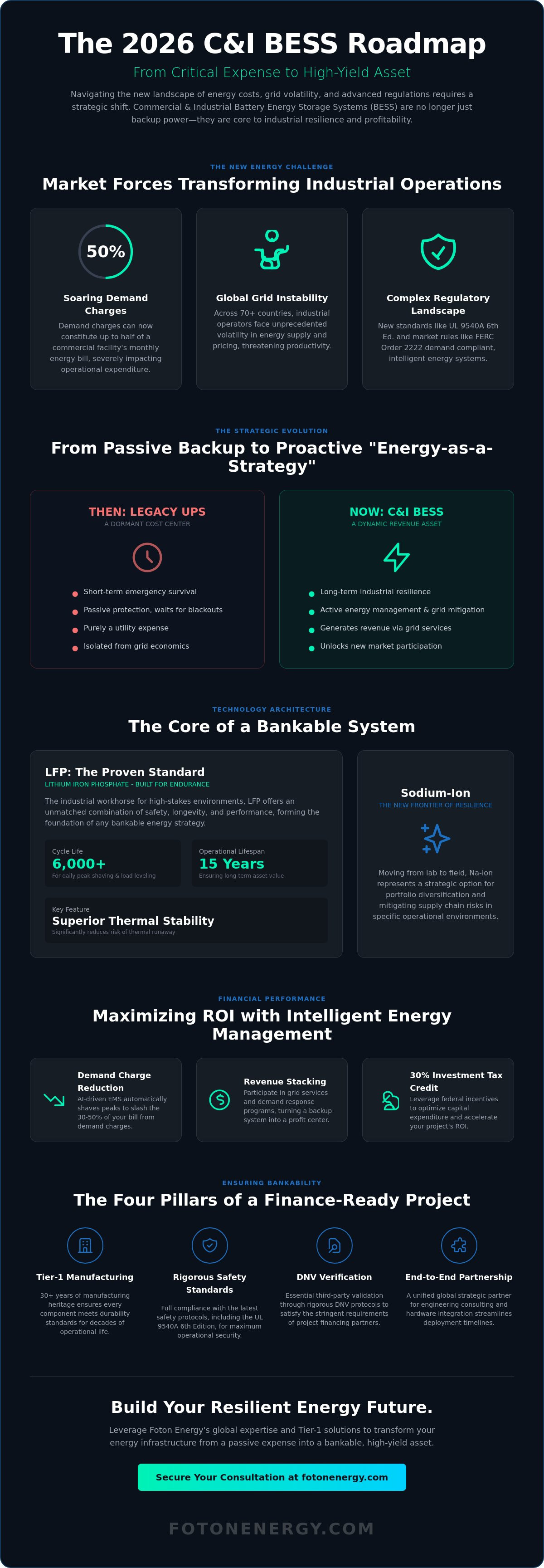
Grid instability has become a global constant in 2026. Across more than 70 countries, industrial operators face unprecedented volatility in supply and pricing. Demand charges now frequently account for 30% to 50% of a commercial facility's monthly energy bill, creating a significant drain on operational expenditure (OPEX). Manufacturing plants, data centers, and telecommunications hubs are leading the adoption of commercial and industrial BESS solutions to regain control; high-tech innovators like Ethernetics are further enabling this shift by providing advanced energy-saving solutions to decarbonise these sectors. With the full implementation of FERC Order 2222 across major ISOs like NYISO and PJM in 2026, the opportunity for behind-the-meter assets to participate in wholesale markets is no longer a future concept. It's a present reality. By deploying intelligent storage, you decouple productivity from grid fluctuations and unlock new revenue streams that weren't accessible a year ago.
Decoding BESS Architecture: LFP vs. Sodium-Ion for Industrial Use
Technical architecture dictates long-term bankability. For most commercial and industrial BESS solutions, Lithium Iron Phosphate (LFP) remains the dominant standard due to its established safety record and high cycle life. However, the 2026 market is no longer a mono-chemistry environment. Diversifying your storage portfolio to include emerging chemistries is becoming a standard risk-mitigation strategy. This shift reflects the broader strategic role of BESS in energy infrastructure as grid demands become more specialized and geographically diverse. Choosing the right chemistry isn't just about capacity. It's about matching the physical properties of the battery to your specific operational environment.
LFP: The Proven Standard for High Cycle Life
LFP is the industrial workhorse for a reason. It offers superior thermal stability compared to cobalt-based lithium-ion alternatives, which significantly reduces the risk of thermal runaway in high-stakes industrial environments. For heavy-cycle applications like daily peak shaving and load leveling, LFP provides the durability required for a 15-year operational lifespan. By utilizing advanced liquid-cooling systems and proprietary thermal management, these systems can achieve 6000+ cycles while maintaining high round-trip efficiency. This reliability makes LFP the foundation of any bankable energy strategy, especially for facilities that prioritize safety and proven performance over a long asset life.
Sodium-Ion: The New Frontier of Resilience
Sodium-ion (Na-ion) technology has moved from the laboratory to the field, with the global market projected to increase from 70 GWh in 2026 to approximately 400 GWh by 2030. While LFP excels in energy density, sodium-ion offers unmatched performance in extreme environments. It maintains high discharge capacity in temperatures as low as -20°C and remains stable in high-heat scenarios where other chemistries might struggle. This makes it an ideal fit for remote telecom towers and data centers that require rapid, high-power discharge without the cost of complex HVAC support. Because sodium uses abundant raw materials, it also provides a hedge against the supply chain instability of critical minerals like lithium.
Selecting the right architecture requires a balance of safety, density, and cost. High-density urban installations often favor the safety profile of LFP, while remote industrial sites might benefit from the ruggedness of sodium-ion. If you're unsure which chemistry fits your facility's load profile, our team offers specialized engineering consulting to help you design a future-proof system. Diversifying your hardware partner to include Tier-1 manufacturers who support both chemistries ensures that your project remains on schedule, regardless of global material shortages.
Economic Performance: Maximizing ROI Through Intelligent EMS
Hardware is the physical foundation, but intelligence is the engine of profitability. To extract maximum value from commercial and industrial BESS solutions, you must move beyond simple energy storage. An Intelligent EMS acts as the central nervous system of your facility, orchestrating real-time responses to fluctuating energy prices and grid demands. By integrating BESS with existing on-site renewables like solar or wind, you create a self-sustaining energy ecosystem that prioritizes self-consumption when market rates peak. This integration doesn't just lower your carbon footprint; it provides the operational autonomy required to thrive in a volatile energy market.
Peak Shaving and Demand Charge Management
Flatten your consumption profile to protect your bottom line. For many industrial sites, demand charges account for 30% to 50% of the total monthly energy bill. Peak shaving is the strategic discharge of stored energy during periods of maximum grid demand to artificially lower a facility's metered power peaks and reduce associated utility penalties. By smoothing these spikes, you don't just reduce monthly OPEX; you extend the life of your local electrical infrastructure. Our specialized engineering consulting helps you calculate the precise ROI based on your specific load profile and local utility tariff structures, ensuring your system is sized for maximum financial impact.
AI-Driven Monitoring and Grid Services
Visibility creates value. Foton's Intelligent EMS provides the granular data necessary to participate in Frequency Control Ancillary Services (FCAS) and other grid-balancing markets. This revenue stacking transforms your storage from a cost center into a profit-generating participant in the 2026 energy market. Predictive analytics play a critical role in maintaining this performance. By monitoring health at the module level, the system identifies potential thermal or voltage irregularities before they lead to downtime. This proactive approach keeps annual O&M costs within the $15 to $25 per kW range, ensuring your investment remains bankable for its entire lifecycle. Real-time visibility across multi-site industrial portfolios allows for centralized optimization, ensuring every asset performs at its peak potential regardless of its geographic location. This focus on control and transparency can also be applied to the physical environment with switchable glass technology; read more.
Ensuring Bankability: Certifications, Safety, and Engineering
Bankability is the cornerstone of large-scale energy infrastructure. In the 2026 market, project financiers and EPC partners no longer accept surface-level performance claims. They require a rigorous combination of technical certifications, documented manufacturing heritage, and independent verification. To secure the 30% to 40% federal investment tax credit available for standalone BESS projects, your system must meet stringent compliance standards that guarantee long-term operational stability. True bankability for commercial and industrial BESS solutions means your asset is insurable, financeable, and capable of delivering projected returns for its entire 15 to 20-year lifecycle.
Tier-1 Standards and Global Certifications
Tier-1 status is more than a label; it's a reflection of supply chain security and manufacturing excellence. Foton Energy's commitment to robust manufacturing processes and a secure supply chain provides the level of stability that financiers demand for multi-megawatt deployments. Compliance with the latest international standards, including UL 9540 and IEC 62619, is non-negotiable. Of particular importance is the UL 9540A 6th Edition, published on March 13, 2026, which introduces large-scale fire testing (LSFT) requirements. These certifications, backed by DNV verification, ensure that your hardware meets the highest global benchmarks for safety and performance, effectively de-risking the investment for all stakeholders involved.
Engineering Consulting and Project Feasibility
Successful deployment begins long before the hardware arrives on-site. Technical consulting is essential for navigating the complexities of grid-code compliance and utility interconnection. Every site has unique load profiles and thermal constraints that require custom engineering. We address the primary industry concern-fire risk-through an advanced safety architecture that includes multi-level fire suppression and intelligent thermal management. These systems don't just react to incidents; they use granular sensor data to prevent the conditions that lead to thermal runaway. By integrating professional engineering consulting into the design phase, you ensure that your system is perfectly sized for your facility's needs while maintaining the highest possible safety profile. This proactive approach to asset management continues through commissioning and long-term O&M, providing EPC partners with a steady, guiding hand from initial feasibility to full-scale operation.
The Foton Advantage: Global Reach and Engineering Excellence
Execution is the final bridge between a strategic energy vision and a high-yield industrial asset. While hardware specifications and economic modeling are vital, the success of your deployment depends on the strength of your global partner. Foton Energy serves as the exclusive global strategic partner for Cospowers, a relationship that integrates thirty years of manufacturing heritage with modern technical agility. We don't just supply components; we deliver comprehensive end-to-end commercial and industrial BESS solutions. This holistic approach covers everything from hardware procurement and site-specific engineering to the deployment of our Intelligent EMS. By unifying these stages, we eliminate the friction often found in complex infrastructure projects, ensuring that your transition to resilient energy is both seamless and bankable.
Global Supply Chain and Strategic Partnerships
Stability in the supply chain is a prerequisite for project success in 2026. Global demand for high-capacity battery modules continues to challenge project timelines, making strategic procurement a critical advantage. We leverage a marketing and support network that spans more than 70 countries, providing the local expertise necessary for successful project delivery. Our wholesale procurement model gives our partners a distinct advantage, ensuring access to Tier-1 components even during periods of market constraint. This global reach doesn't just provide hardware; it offers a reliable link to the manufacturing floor, allowing us to secure the high-performance modules required for large-scale industrial and utility-scale storage projects.
Partnering for a Resilient Energy Future
Collaboration drives the global energy transition. Our Channel Partner Program is designed to support a robust ecosystem of resellers, installers, and EPCs who require more than just a vendor. We provide the technical backbone for your local projects, offering specialized engineering consulting to assist with system sizing, grid-code compliance, and commissioning. This partnership model ensures that even the most complex industrial installations benefit from our deep manufacturing experience and AI-driven optimization tools. Whether you're managing a single high-demand manufacturing site or a diverse portfolio of telecommunications towers, we provide the steady, guiding hand needed to navigate the evolving energy landscape. It's time to transform your facility into a pillar of grid stability. Consult with Foton Energy on your next C&I BESS project to discover how our integrated approach to commercial and industrial BESS solutions can secure your operational future.
Securing Your Industrial Energy Future
The transition to a decentralized and intelligent grid is no longer a future possibility; it's a current operational mandate for every large-scale enterprise. You've explored how integrating commercial and industrial BESS solutions allows your facility to pivot from passive consumption to active market participation. By leveraging the established durability of LFP or the specialized resilience of Sodium-Ion, you can effectively mitigate rising demand charges and navigate 2026 grid volatility with confidence. True bankability requires a synergy of Tier-1 certified hardware and the sophisticated optimization of an AI-driven EMS to ensure your energy storage remains a high-yield, resilient asset.
Foton Energy stands ready to guide this strategic transition. As the exclusive global strategic partner for Cospowers, we bring over 30 years of manufacturing heritage and proven engineering excellence to every project. We invite you to Partner with Foton Energy for Tier-1 C&I BESS Infrastructure and transform your energy strategy into a competitive advantage. Let's build a reliable, future-proof energy ecosystem that supports your industrial growth and drives sustainable progress for decades to come.
Frequently Asked Questions
What is the typical lifespan of a commercial LFP BESS system?
A standard Lithium Iron Phosphate (LFP) system typically operates for 15 to 20 years. This longevity is based on the chemistry's ability to handle over 6,000 cycles at 80% depth of discharge while maintaining high round-trip efficiency. Actual lifespan depends on the quality of the thermal management architecture and the frequency of heavy-cycle applications like daily peak shaving. Proper maintenance and a Tier-1 manufacturing heritage are essential for ensuring the system reaches its full operational potential.
Is sodium-ion battery storage safe for indoor industrial installations?
Yes, sodium-ion technology is exceptionally safe for indoor industrial environments due to its superior thermal stability. It's inherently non-flammable and doesn't suffer from the same thermal runaway risks as traditional cobalt-based chemistries. These systems maintain high performance in extreme temperatures and can be transported or stored at zero volts, which adds an extra layer of safety. This makes them a rugged and reliable alternative for facilities with strict fire safety protocols.
How does a BESS help reduce industrial demand charges?
Energy storage reduces demand charges by discharging power during your facility's highest periods of consumption, a process known as peak shaving. Since demand charges can account for 30% to 50% of a monthly utility bill, flattening these spikes significantly lowers operational expenditure. By using commercial and industrial BESS solutions, you effectively cap the amount of power drawn from the grid during peak windows, ensuring your metered peak remains within a lower, more cost-effective bracket.
Can C&I BESS solutions be integrated with existing solar PV arrays?
Yes, storage systems are designed for seamless integration with existing on-site renewables through either AC or DC coupling. This setup allows you to store excess solar generation during the day for use during expensive evening peaks or to provide resilience during grid outages. Our engineering consulting team assists in the technical sizing and configuration required to ensure the BESS and solar array work in harmony to maximize your facility's energy autonomy and financial ROI.
What certifications are required for a BESS to be considered bankable?
Bankability requires a comprehensive suite of international certifications, including UL 9540, IEC 62619, and the updated UL 9540A 6th Edition published in March 2026. These standards verify the system's safety, fire suppression capabilities, and overall reliability. Financiers also look for DNV verification and a Tier-1 manufacturing status to ensure the project is a low-risk, long-term investment. Compliance with these rigorous benchmarks is essential for securing project insurance and federal tax credits.
What is the difference between front-of-the-meter and behind-the-meter storage?
Front-of-the-meter (FTM) systems are connected directly to the utility grid and are usually managed by power producers for grid stabilization. Behind-the-meter (BTM) storage is installed on the customer's side of the utility meter, specifically serving the needs of a commercial or industrial facility. Most commercial and industrial BESS solutions are BTM installations, as they focus on reducing facility-specific costs, managing local loads, and providing onsite backup power during grid interruptions.
How does an AI-driven EMS improve BESS performance?
An AI-driven Energy Management System (EMS) optimizes performance by using predictive analytics to forecast load patterns and energy prices. It identifies module-level irregularities before they lead to system downtime, which keeps annual O&M costs low. Additionally, the EMS facilitates revenue stacking by automatically participating in grid services like frequency control. This level of intelligence ensures the battery is always operating in the most profitable mode, whether that's storing cheap energy or discharging for peak shaving.
Does Foton Energy provide installation services for residential customers?
Foton Energy does not provide direct residential installation services or retail consumer sales. While we sell high-performance Residential Storage Systems to our global network of partners, our focus remains on hardware manufacturing, engineering consulting, and large-scale infrastructure deployment. We recommend that homeowners contact a certified local installer to manage the physical installation of their systems. Our role is to support those installers and EPCs with Tier-1 hardware and technical expertise.


