

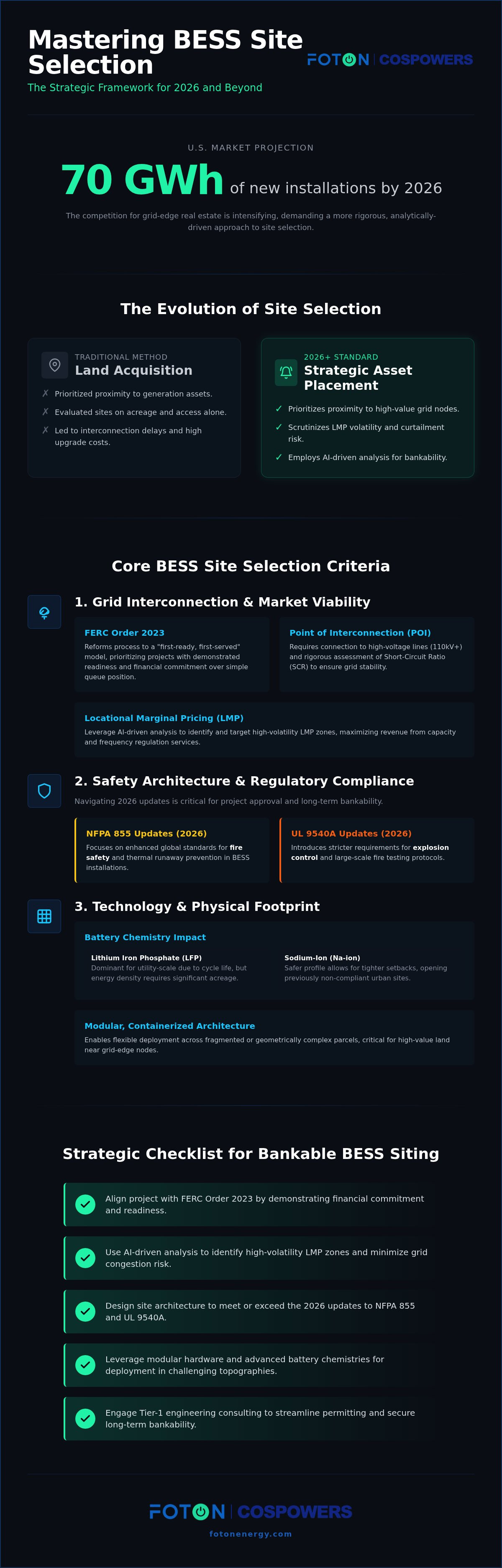
With the U.S. BESS market projected to reach 70 GWh of new installations in 2026, the competition for grid-edge real estate has reached a fever pitch. You likely recognize that the era of simple land acquisition is over, replaced by a complex landscape where technical viability and financial security are inseparable. Securing a project's future requires a rigorous approach to bess site selection criteria that accounts for everything from shifting thermal runaway standards to the new first-ready, first-served interconnection models.
We understand the pressure of navigating high interconnection costs and the volatility of locational marginal pricing. This guide provides a strategic framework to help you master the variables required for high-yield, low-risk utility-scale projects. You'll gain clarity on the 2026 updates to NFPA 855 and UL 9540A, learn how to leverage FERC Order 2023 for faster queue processing, and discover how AI-driven modeling can optimize your ROI. Let's build a foundation for bankable energy infrastructure that stands the test of time.
Key Takeaways
- Learn how FERC Order 2023 reforms the interconnection process by prioritizing project readiness and financial commitment over simple queue position.
- Master the essential bess site selection criteria required to identify high-volatility LMP zones while minimizing grid congestion and interconnection risks.
- Navigate the 2026 updates to NFPA 855 and UL 9540A to ensure your site architecture meets the latest global fire safety and explosion control standards.
- Discover how modular, containerized hardware and AI-driven energy management systems allow for deployment in challenging topographies without sacrificing performance.
- Understand the role of Tier-1 engineering consulting in streamlining local permitting and securing long-term bankability for utility-scale investments.
The Evolution of BESS Site Selection in 2026
The rules of grid-scale siting have fundamentally changed. What once resembled a straightforward land acquisition exercise has evolved into a discipline of high-precision asset placement, where the margin between a bankable project and a stranded investment is measured in interconnection queue position, local grid topology, and regulatory alignment. Understanding what constitutes a viable battery energy storage system (BESS) site in 2026 demands a far more rigorous analytical lens than previous market cycles required.
Grid congestion is accelerating this complexity. As renewable penetration deepens across major markets, transmission infrastructure is struggling to absorb the resulting power flows. Traditional siting methods that prioritized proximity to generation assets are now routinely producing projects that face years of interconnection delay and punishing network upgrade costs. The grid itself has become the primary constraint, not the land.
Bankability has emerged as the decisive filter. Lenders and tax equity partners are no longer evaluating sites on acreage and access alone. They're scrutinizing locational marginal price volatility, curtailment risk, and the depth of technical due diligence behind each project. Applying rigorous bess site selection criteria from the earliest feasibility stage is no longer a best practice; it's a prerequisite for financing.
From Land Acquisition to Strategic Asset Placement
Proximity to generation has given way to proximity to value. The highest-performing sites in 2026 are positioned near high-demand grid-edge industrial nodes, data centre corridors, and constrained load pockets where frequency regulation and capacity services command premium compensation. These locations offer a structural revenue advantage that raw acreage near a solar farm simply cannot replicate. The calculus now balances land cost against the long-term premium of a high-value interconnection point, and that premium consistently justifies a more selective, analytically driven site search.
The Impact of Battery Chemistry on Site Footprints
Chemistry selection is reshaping the physical parameters of viable sites. Lithium iron phosphate (LFP) systems continue to dominate utility-scale deployments due to their proven cycle life and thermal stability, but their energy density dictates meaningful acreage commitments. Sodium-ion technology, advancing rapidly toward commercial scale, offers a safer electrochemical profile that regulators in several jurisdictions are beginning to permit at tighter setback distances, opening urban and peri-urban sites that were previously non-compliant.
Modular, containerized architecture addresses the irregular plot problem directly. Rather than requiring a single contiguous footprint, containerized BESS units can be configured across fragmented parcels or stacked within constrained industrial zones. This flexibility is a critical enabler for the next generation of bess site selection criteria, particularly as high-value land near grid-edge nodes becomes increasingly scarce and geometrically complex.
Grid Interconnection and Locational Marginal Pricing (LMP)
Interconnection is the heartbeat of utility-scale storage. A site's physical attributes mean little if the Point of Interconnection (POI) lacks the capacity or stability to support the asset's discharge requirements. Evaluating these nodes requires a sophisticated understanding of bess site selection criteria that balances upfront infrastructure costs against long-term operational revenue. We must look beyond the land and into the copper that connects it to the wider market.
Optimizing the Point of Interconnection (POI)
Technical requirements for connecting to high-voltage transmission lines (typically 110kV or higher) are rigorous. Let's evaluate the trade-off between land cost and infrastructure spend. Developers often face a choice: pay a premium for land adjacent to a substation or invest in multi-mile line extensions. Grid stability is equally critical. Assessing the Short-Circuit Ratio (SCR) at a potential POI reveals whether the local grid can handle the rapid-response characteristics of a battery without triggering instability. Precise alignment in Utility-Scale BESS Procurement ensures hardware specifications match these grid-code requirements. With the legal affirmation of FERC Order 2023, selecting a POI with demonstrated readiness is now a prerequisite for moving through the cluster study process effectively.
AI-Driven Market Analysis for Siting
Locational Marginal Pricing (LMP) represents the actual cost of delivering energy to a specific node, accounting for system-wide energy prices, local congestion, and line losses. In the 2026 market, increased renewable penetration has made LMP volatility the primary driver of BESS arbitrage returns. Static models are no longer sufficient for bankability. Advanced developers now use AI to simulate thousands of grid scenarios, predicting where future congestion will occur and how it will impact curtailment risks over a 10-year horizon.
This foresight is enhanced by AI driven energy management systems that optimize bidding strategies for ancillary services like Frequency Control Ancillary Services (FCAS). By modeling these geographic-specific revenue streams, we can identify the exact grid nodes where price spreads are widest and competition is lowest. In markets like ERCOT, where batteries already supply over 60% of ramping requirements, this locational intelligence is the difference between a high-yield asset and an underperforming one. If you're managing complex grid-code negotiations, our engineering consulting team can help bridge the gap between technical requirements and financial bankability.
Environmental Resilience and Safety Architecture Requirements
Environmental resilience is no longer a secondary consideration. In the 2026 market, a site's ability to withstand extreme weather and meet stringent safety standards is a core component of its financial viability. We must evaluate geological and topographical factors with the same rigor applied to grid interconnection. If a location can't survive a 100-year flood or satisfy local fire marshals, it's not a bankable asset.
Soil stability, seismic activity, and flood risk are the non-negotiable physical filters of bess site selection criteria. For utility-scale projects, the cost of specialized foundations or elevation can erode ROI quickly. Similarly, acoustic constraints play a major role in semi-urban C&I applications. Noise mitigation measures, such as sound-dampening enclosures or strategic layout planning, are essential to pass local permitting. Water access also remains a critical variable, as both fire suppression systems and certain cooling architectures require reliable on-site supply.
Fire Safety and Exclusion Zones
The regulatory landscape has shifted significantly with the publication of the 6th edition of UL 9540A on March 13, 2026. This update, now tightly aligned with the 2026 edition of NFPA 855, mandates rigorous, system-level fire and explosion testing. Tier-1 hardware that provides documented large-scale fire testing data allows us to reduce required safety setbacks. This is a game-changer for high-density areas. By proving that thermal runaway is contained at the module or string level, we can secure locations that would otherwise be rejected due to proximity to existing infrastructure. Early community engagement remains vital; transparently sharing safety architecture data is the most effective way to streamline the permitting process.
Thermal Management and Climate Adaptation
Climate variability requires a tailored approach to hardware selection. For sites in high-ambient temperature regions, liquid cooling is the industry standard for maintaining performance and preventing degradation. It ensures the internal cell temperature remains within the optimal window even during extreme heat events. In contrast, northern hemisphere projects are increasingly looking at sodium-ion systems. Sodium-ion chemistry maintains superior discharge performance in cold climates compared to legacy LFP, which can significantly reduce the heating load and energy footprint of the HVAC system. This adaptability allows us to expand the geographic reach of energy storage into environments previously considered too harsh for efficient operation. Our engineering consulting services help you match these hardware capabilities to the specific climate profile of your chosen site.
A Strategic Checklist for Bankable BESS Siting
Bankability isn't a single metric; it's a convergence. To move from a speculative site to a commissioned asset, developers must audit five core pillars of bess site selection criteria. This checklist ensures that technical feasibility aligns with economic reality. Each point represents a potential "go/no-go" decision in the development cycle. We recommend a phased approach where the most capital-intensive studies are reserved for sites that pass these initial filters.
- Interconnection: Confirm POI capacity, Short-Circuit Ratio (SCR) stability, and the total distance for line extensions.
- Market: Validate long-term LMP spreads, ancillary service potential, and use AI revenue modeling to stress-test your business case.
- Safety: Audit NFPA 855 compliance, fire suppression architecture, and emergency responder access routes.
- Logistics: Verify heavy haulage routes, road load capacities, and construction staging area acreage.
- Regulatory: Secure appropriate land use zoning, complete environmental impact statements, and ensure grid-code compliance.
Logistics and Construction Feasibility
Delivery of multi-ton containerized BESS units requires specialized heavy transport logistics. We must evaluate road load capacities and bridge ratings along the final mile to the site. If the local infrastructure can't support 40-foot containers, the site isn't viable without massive civil upgrades. Proximity to global supply chain hubs also plays a role in reducing lead times and shipping costs. Additionally, the availability of local skilled labor for commissioning is a critical factor. Without a qualified workforce nearby, mobilization costs can balloon, threatening the project's initial ROI. We recommend assessing labor pools within a 100-kilometer radius of any prospective site to ensure operational readiness.
Regulatory and Permitting Hurdles
Navigating the 'Grid Code' maze is a significant barrier for utility-scale projects. In Australia, AEMO's requirements are notoriously stringent, demanding precise modeling of inverter-based resources. Environmental impact statements (EIS) and cultural heritage assessments must be initiated early to avoid project rejection. We've found that using Tier-1 hardware with international certifications can significantly accelerate the permitting timeline. Local authorities are more likely to approve designs backed by rigorous, third-party safety testing. If you're facing complex regulatory roadblocks, our engineering consulting team can provide the technical due diligence required to secure project approval. This proactive approach reduces the risk of rejection and ensures your project moves toward a final investment decision with confidence.
Engineering for Bankability: The Foton-Cospowers Advantage
Bankability is the ultimate validator of grid-scale success. While the physical and regulatory aspects of bess site selection criteria provide the foundation, the choice of technology partner determines the long-term viability of the investment. We bridge the gap between speculative siting and operational excellence by combining Tier-1 manufacturing heritage with sophisticated engineering oversight. Our partnership with Cospowers, a leader in battery innovation since 1993, ensures that every asset is built on a foundation of proven reliability and global performance standards.
Securing project financing in 2026 requires more than just a viable location. Lenders demand a transparent supply chain and hardware that exceeds the latest safety benchmarks. By integrating Cospowers' advanced LFP and sodium-ion cells with our AI-driven Energy Management Systems (EMS), we provide a vertically integrated solution that optimizes performance at the specific grid node identified during the siting process. This synergy allows for precise revenue modeling and risk mitigation, ensuring that your project remains a high-yield asset throughout its lifecycle.
Feasibility Studies and System Design
We believe that site-specific optimization begins long before the first container arrives. Leveraging Foton's BESS engineering consulting services allows developers to validate ROI through rigorous technical due diligence. We don't just provide hardware; we customize thermal management systems and safety architectures to meet the unique environmental constraints of your chosen site. Whether you're navigating the tight setbacks of an urban industrial zone or the extreme temperatures of a remote desert, our consulting team ensures your system design is both grid-code compliant and financially optimized. This level of technical precision is a primary driver of bankability, giving investors the confidence that the asset will perform as modeled under real-world conditions.
Global Reach, Local Expertise
Strategic siting is rarely a localized challenge. With a global network spanning 70+ countries, we provide the local regulatory intelligence required to navigate complex permitting landscapes in Australia and beyond. Our exclusive partnership with Cospowers guarantees supply chain security, shielding your project from the volatility that often plagues large-scale infrastructure builds. We provide end-to-end support, moving seamlessly from initial feasibility studies to the final, grid-code compliant commissioning of the asset. This comprehensive approach reduces the risk of project rejection and ensures a faster timeline to commercial operation. If you are ready to secure your position in the 2026 energy market, partner with Foton Energy for your next utility-scale BESS deployment and build with the assurance of Tier-1 excellence.
Securing Your Position in the 2026 Energy Infrastructure Landscape
The transition to a high-precision siting model marks a new chapter for utility-scale energy storage. Success in this environment requires more than just land; it demands an integrated understanding of grid-code compliance, localized price volatility, and the latest safety standards. By applying these updated bess site selection criteria, you can navigate the complexities of the current interconnection landscape and ensure your project achieves long-term financial viability. We've moved beyond speculative development into an era where technical due diligence is the primary driver of ROI.
We're here to help you bridge the gap between technical feasibility and investor confidence. Leveraging our Tier-1 Cospowers strategic partnership and over 30 years of manufacturing heritage, we provide the stability your infrastructure demands. Our AI-driven energy management systems ensure your asset is optimized for the specific challenges of your chosen grid node, maximizing performance and safety simultaneously. Let's work together to build a resilient, high-performance future for the global energy transition. Secure Your Project's Future with Foton's Strategic BESS Consulting and move forward with the assurance of global expertise.
Frequently Asked Questions
What is the most critical factor in BESS site selection?
Grid proximity and interconnection capacity are the most critical factors. A site with low land costs is useless if the grid connection costs are prohibitive or the queue wait exceeds project timelines. In 2026, assessing the Short-Circuit Ratio (SCR) at the Point of Interconnection is non-negotiable. This technical readiness directly influences bankability, as lenders prioritize locations where grid-code compliance is technically assured and financially manageable from day one.
How much land is typically required for a 100MW BESS project?
A typical 100MW/400MWh BESS project usually requires between 1.5 to 3 acres depending on the energy density of the hardware. Modern high-density LFP containers allow for tighter configurations, but you must account for spacing mandated by fire safety codes. Additional acreage is necessary for substations, access roads, and staging areas during construction. It's vital to calculate these setbacks early to ensure the physical plot matches the required system capacity.
Does battery chemistry (LFP vs. Sodium-Ion) change site selection criteria?
Yes, battery chemistry fundamentally shifts bess site selection criteria. Lithium Iron Phosphate (LFP) remains the standard for energy density but requires specific thermal management in extreme heat. Sodium-ion is gaining traction for sites in colder climates because it maintains superior discharge performance without heavy heating loads. Additionally, sodium-ion's safety profile can potentially reduce required setback distances from existing infrastructure, making it a strategic choice for constrained industrial or urban locations.
What are the common grid interconnection challenges for utility-scale storage?
The primary challenges are grid congestion and evolving regulatory queues. Under FERC Order 2023, projects must demonstrate commercial readiness to move through the "first-ready, first-served" cluster study model. Technical hurdles include maintaining grid stability and meeting stringent grid-code requirements, particularly in markets with high renewable penetration. High costs for network upgrades or long distances to the nearest substation often disqualify sites that otherwise seem geographically ideal for utility-scale energy storage.
How do fire safety regulations like NFPA 855 affect BESS siting?
The 2026 edition of NFPA 855 mandates stricter explosion control and intentional ignition testing. These regulations dictate the minimum distance between battery containers and property lines or adjacent structures. Meeting these safety standards requires hardware with UL 9540A 6th Edition data, which allows for reduced exclusion zones. If a site cannot accommodate these safety setbacks while maintaining the necessary energy capacity, it will likely face rejection during the local permitting phase.
What is Locational Marginal Pricing (LMP) and why does it matter for BESS?
Locational Marginal Pricing (LMP) is the wholesale market price of electricity at a specific grid node, reflecting energy costs, congestion, and line losses. For BESS, LMP matters because high price volatility creates arbitrage opportunities. Sites located in congestion-prone nodes often see wider price spreads, which directly increases potential revenue. Understanding these localized trends through AI modeling is essential for identifying the most profitable locations for utility-scale battery deployments in 2026.
Can BESS be sited in urban or industrial areas?
Yes, BESS can be sited in urban or industrial areas using modular, containerized architecture. These locations are often high-value "grid-edge" nodes near significant load centers. However, siting in these zones requires advanced fire suppression and acoustic mitigation to meet local zoning laws. Sodium-ion systems or high-density LFP with integrated liquid cooling are often preferred here, as they maximize energy capacity within the small, irregular footprints typical of developed industrial land.
How does a feasibility study impact BESS site bankability?
A comprehensive feasibility study is the cornerstone of project bankability. It validates the technical, regulatory, and economic assumptions of a site before significant capital is committed. By auditing bess site selection criteria like SCR stability and long-term LMP trends, the study reduces the risk of project failure. Lenders and tax equity partners require this level of due diligence to ensure the asset can meet its projected revenue targets and grid-code obligations.


