

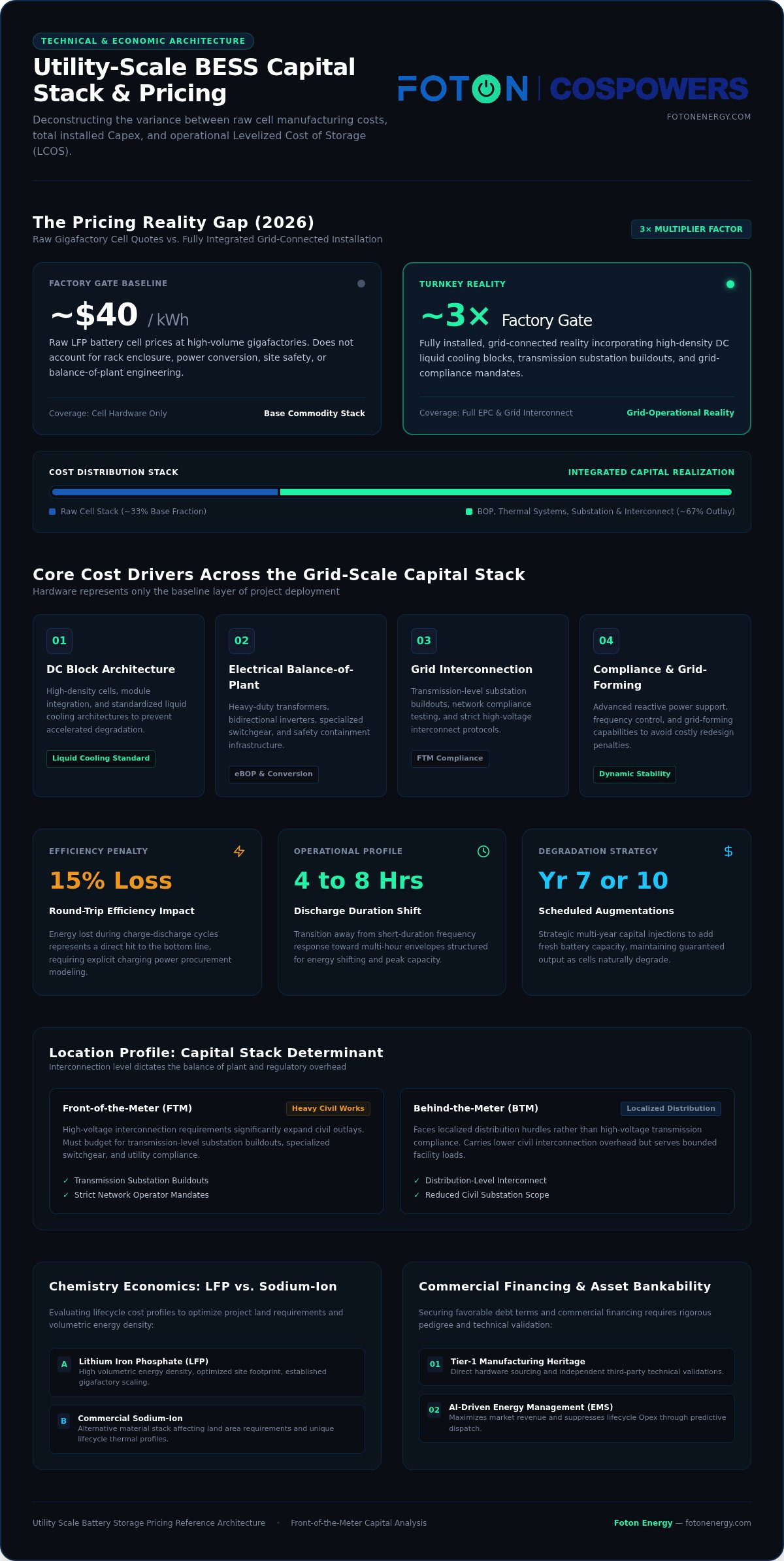
In 2026, raw LFP battery cell prices at high-volume gigafactories have reached near $40/kWh, yet the fully installed, grid-connected reality often commands triple that figure. This discrepancy highlights why mastering utility scale battery storage pricing requires looking far beyond the raw material stack. You likely recognize that while hardware costs are falling, the complexity of balance-of-plant requirements and stringent grid compliance standards continues to squeeze project margins. We understand that navigating the gap between cell-level quotes and fully integrated, containerized project costs is a persistent challenge for modern developers.
This guide provides the clarity you need to master the core Capex, Opex, and bankability dynamics that govern today's energy infrastructure economics. We'll explore how to accurately benchmark Levelized Cost of Storage across different discharge durations and evaluate how emerging chemistries impact long-term asset value. You'll gain a strategic framework to de-risk procurement through Tier-1 manufacturing partnerships and verified performance metrics, ensuring your project remains resilient in a shifting market. From understanding the complete capital stack to modeling long-term degradation, we provide the technical proof points required for operational excellence.
Key Takeaways
- Master the total capital stack by distinguishing between raw cell costs and fully integrated utility scale battery storage pricing, including electrical balance-of-plant and grid-connection outlays.
- Benchmark the Levelized Cost of Storage (LCOS) across different discharge durations to accurately model long-term profitability and asset degradation.
- Evaluate the lifecycle cost profiles of Lithium Iron Phosphate against commercial sodium-ion chemistries to optimize project land requirements and volumetric energy density.
- Secure favorable debt terms and commercial financing by prioritizing Tier-1 manufacturing heritage and independent third-party technical validations.
- Maximize market revenue and suppress lifecycle Opex through direct hardware sourcing and the deployment of AI-driven Energy Management Systems.
Decoding Utility Scale Battery Storage Pricing: Capex, Opex, and LCOS Fundamentals
Headline prices deceive. Many developers focus on cell-level quotes, yet these figures represent only a fraction of a project's total capital commitment. True utility scale battery storage pricing is a comprehensive metric that accounts for every megawatt-hour delivered over the asset's entire operational life. While lithium iron phosphate (LFP) cell prices have reached historic lows near $40/kWh at the factory gate, the fully integrated, grid-connected reality is far more complex. A sophisticated Battery Energy Storage System (BESS) requires a holistic view of expenditure that spans initial procurement, civil works, and multi-year maintenance cycles.
Modern grid support assets are no longer just short-duration frequency response tools. We're seeing a decisive shift toward four-to-eight-hour discharge envelopes designed for energy shifting and peak capacity. This evolution demands a rigorous baseline operational envelope. It's not just about the hardware; it's about the engineering pedigree required to ensure the system survives thousands of cycles without premature capacity fade. If your financial model doesn't account for the divergence between module costs and turnkey EPC (Engineering, Procurement, and Construction) contracts, your projected internal rate of return is likely at risk.
The Levelized Cost of Storage Framework
Success in large-scale infrastructure depends on the Levelized Cost of Storage (LCOS). This formula amortizes the initial capital outlay against the total cumulative energy discharged over the system's life. You must factor in charging power procurement costs and round-trip efficiency losses directly. If a system loses 15% of its energy during the charge-discharge cycle, that's a direct hit to your bottom line. We also incorporate scheduled augmentations into our multi-year models. Adding fresh battery capacity in year seven or ten isn't a failure; it's a strategic necessity to maintain guaranteed energy output as cells naturally degrade.
Front-of-the-Meter vs. Behind-the-Meter Cost Profiles
Location dictates the capital stack. Front-of-the-meter (FTM) projects face high-voltage grid interconnection requirements that significantly expand civil outlays. You'll need to budget for transmission-level substation buildouts, heavy-duty transformers, and specialized switchgear that aren't present in smaller commercial setups. Behind-the-meter assets often deal with localized distribution hurdles, but they don't carry the same weight of transmission-level regulatory compliance. Each jurisdictional network operator has strict mandates for grid-forming capabilities and reactive power support. Failing to meet these standards early in the design phase leads to expensive engineering redesign penalties that can derail utility scale battery storage pricing benchmarks.
Core Cost Drivers Across the Grid-Scale BESS Capital Stack
Hardware represents the foundation, yet it's only the beginning of the financial narrative. To accurately forecast utility scale battery storage pricing, you must account for the entire capital stack, ranging from high-density DC blocks to the complex civil engineering required for site safety. Many developers underestimate the "balance of system" costs, which can represent a significant portion of the total investment. We view the capital stack as a hierarchical structure where manufacturing quality directly dictates long-term bankability. For a deeper look at how to structure these investments, explore our utility scale BESS procurement guide for comprehensive sourcing strategies.
DC Block Architecture and Thermal Systems
The DC block is the project's core, comprising cells, racks, and sophisticated thermal management. In 2026, liquid cooling integration has become the industry standard for high-density deployments. While liquid cooling increases baseline manufacturing outlays, it provides the thermal stability necessary to prevent accelerated degradation. Safety containment is another non-negotiable expense. You'll need enclosures that comply with rigorous fire suppression codes and rack-level structural integrity designed to withstand harsh outdoor ambient environments. These integrated architectures ensure that the physical asset remains resilient across its intended 20-year lifespan.
Power Conversion and Balance of Plant
Moving from DC to AC requires a robust power conversion system (PCS). Your choice between central inverter stations and distributed string inverter topologies will fundamentally shift your electrical balance-of-plant outlays. Centralized systems often offer better economies of scale for massive grid-tie projects, while string architectures provide higher redundancy. You must also budget for medium-to-high-voltage step-up transformers and specialized switchgear to meet grid requirements. According to NREL's cost projections for utility-scale storage, these electrical components, along with grounding grids and lightning mitigation networks, form a critical part of the capital commitment that cell-only quotes ignore.
Soft Costs, Permitting, and Grid Studies
The "invisible" costs often pose the greatest risk to project timelines. Dynamic grid-code connection studies are technically demanding and require significant investment to ensure compliance with local network operators. You'll also face expenditure for local council development permitting, environmental impact assessments, and site-specific zoning requirements. These soft costs, combined with EPC margins, can fluctuate based on regional labor markets and regulatory complexity. We recommend you review our BESS engineering consulting services to ensure your feasibility planning accounts for these variables early in the development cycle. If you're ready to optimize your infrastructure, consider a partnership with Foton Energy to align your technical architecture with global bankability standards.
Chemistry Economics: Evaluating LFP vs. Sodium-Ion Lifecycle Cost Profiles
Chemistry selection is the most significant lever for optimizing utility scale battery storage pricing over a twenty-year horizon. While lithium iron phosphate (LFP) dominates the current landscape, the emergence of commercial sodium-ion introduces a new set of economic variables that sophisticated developers must navigate. You shouldn't evaluate these technologies solely on upfront Capex. Instead, analyze how specific degradation curves and thermal characteristics influence lifecycle Opex and total energy throughput. As a strategic partner of Cospowers, we leverage three decades of manufacturing heritage to deliver Tier-1 certified architectures in both chemistries, ensuring project bankability regardless of the chosen cell technology.
Lithium Iron Phosphate: The Utility Benchmark
LFP remains the global standard, accounting for nearly 95% of new utility-scale awards through late 2025. Its mature supply chain, sustained by massive gigafactory production, provides the bankable assurance that large-scale infrastructure investors demand. According to International Energy Agency battery cost data, regional price variations remain significant, yet LFP's multi-thousand-cycle durability across standard daily cycling regimes is unmatched. The stability of lithium carbonate and iron phosphate precursors allows for highly predictable multi-year supply agreements, which is essential for de-risking large capital commitments.
Commercial Sodium-Ion: The Scaling Alternative
Sodium-ion offers a lower theoretical cost floor because it relies on abundant sodium precursors rather than lithium. While 2025 data showed sodium-ion cells at approximately $59/kWh compared to LFP's $52/kWh, the gap is closing as production scales toward parity. Sodium-ion excels in thermal stability, which directly lowers auxiliary HVAC parasitic loads in extreme climates. Its zero-volt discharge capability also optimizes long-distance transit safety and freight costs, as these batteries can be shipped without the fire risks associated with partially charged lithium cells. For a detailed breakdown, examine our strategic review on sodium-ion battery commercial availability for utility assets.
Application-Specific Chemistry Selection
Matching the right chemistry to the specific duty-cycle is essential for suppressing utility scale battery storage pricing across the asset lifetime. LFP is the superior choice for high-density containerized architectures where land acquisition costs drive the project budget. Its higher volumetric energy density allows for more capacity in a smaller physical footprint. Conversely, you should consider sodium-ion for frequency regulation or deployment sites in extreme temperatures where its resilience provides a clear operational advantage. We help you calculate these footprint expansion trade-offs to ensure your chemistry choice aligns with your long-term financial models.
Bankability Factors and Risk Premiums That Shape Commercial Financing
Bankability dictates the real-world cost of capital. While cell costs are highly visible, the invisible risk premiums applied by institutional lenders often define the ultimate success of a grid-scale project. Utility scale battery storage pricing is inextricably linked to how a bank views the long-term reliability of your hardware. If a manufacturer lacks a proven track record, lenders will demand higher interest margins to offset the perceived risk of asset failure or company insolvency. Securing favorable debt terms requires a strategic alignment between technical specifications and commercial stability.
Tier-1 Manufacturing Pedigree and Lending Terms
Lenders prioritize Tier-1 manufacturing pedigree because it represents a decade-long history of operational data that can be rigorously modeled. We leverage our exclusive partnership with Cospowers, a Tier-1 manufacturer with over 30 years of engineering pedigree, to provide the stability that modern debt facilities require. This heritage isn't just a badge of honor; it's a financial tool that suppresses project risk premiums. Lenders look for balance-sheet strength that can support multi-decade warranties, ensuring that a system commissioned today will still have a solvent guarantor in year fifteen. Without this manufacturing heritage, your project may face prohibitive loan margins that erode your expected returns.
Warranty Structuring and Performance Guarantees
A robust warranty package is your primary defense against financial underperformance. It's essential to differentiate between calendar-life warranties, which cover time-based aging, and cumulative energy throughput obligations, which cover actual usage. If your system cycles twice daily for energy arbitrage, a simple ten-year calendar warranty won't protect your internal rate of return if the cells hit their degradation floor early. We recommend structuring capacity maintenance agreements that include transparent liquidated damages clauses. These clauses tie financial penalties to asset availability targets, ensuring the manufacturer remains accountable for the system's uptime and energy delivery.
Insurance premiums are the final piece of the bankability puzzle. Compliance with UL 9540 and UL 9540A large-scale fire safety testing is mandatory for securing affordable coverage in today's market. Without these third-party technical validations, such as DNV verification, your insurance costs can skyrocket, eroding the margins gained from competitive utility scale battery storage pricing. These certifications prove to underwriters that your thermal management and fire suppression systems are capable of preventing thermal runaway at scale. To ensure your project meets these stringent institutional requirements, consult with our engineering team to align your procurement strategy with global bankability standards.
Optimizing Asset Economics: Procurement and Integration Architecture with Foton
Direct access translates to bankable performance. While previous sections detailed the technical and financial variables of utility scale battery storage pricing, the final optimization lever lies in how you source and manage the asset. We act as the strategic conduit between Tier-1 manufacturing scale and project-level execution. By bypassing intermediary distributor margin markups, we ensure that your capital expenditure is directed toward high-performance hardware rather than secondary brokerage fees. This direct-to-factory model provides an unbroken chain of custody, which is essential for maintaining rigorous factory acceptance testing standards and multi-decade reliability.
Direct Tier-1 Procurement Channel Advantages
Strategic procurement is about more than just finding the lowest price; it's about securing supply line integrity. Through our exclusive global partnership with Cospowers, we provide direct access to high-capacity LFP and sodium-ion modular containers. This relationship eliminates the inflationary pressure of secondary market markups that often skew utility scale battery storage pricing models. You gain verified supply lines that have been tested across energy infrastructure in more than 70 countries. This global footprint ensures that every containerized solution arrives with documented engineering pedigree, ready for rapid site integration without the risk of undocumented component substitutions common in broker-led sourcing.
Revenue Optimization Through Intelligent EMS
Hardware is the foundation, but intelligence dictates the lifecycle yield. We deploy proprietary AI-driven algorithms to maximize market revenue while strictly preserving cycle life. A standard battery management system simply monitors safety; our AI driven energy management systems actively optimize for real-time wholesale energy price arbitrage. These predictive models analyze grid demand signals to participate in ancillary services without triggering premature, warranty-voiding degradation. By managing depth-of-discharge and auxiliary thermal management consumption through intelligent environmental controls, we suppress Opex and extend the productive life of the asset.
Collaborative Project Delivery and Asset Commissioning
Grid interconnection is the most common point of failure for utility-scale timelines and budgets. We integrate comprehensive engineering consulting to streamline this process, moving your project from initial feasibility to commissioning without expensive redesign penalties. Our dedicated engineering teams ensure that every deployment meets strict grid-code compliance standards from day one. We don't just sell components; we partner with you to build bankable, resilient utility storage infrastructure. This end-to-end involvement allows us to synthesize technical architecture with commercial reality, ensuring your investment delivers on its promise for decades to come.
Strategic Resilience Through Bankable Infrastructure
Mastering utility scale battery storage pricing requires a shift from viewing batteries as simple hardware to treating them as complex, multi-decade energy infrastructure. We've explored how the total capital stack, ranging from high-voltage balance-of-plant to intelligent thermal management, dictates your project's true economic viability. You now understand that bankability isn't just a buzzword; it's a financial necessity driven by Tier-1 manufacturing heritage and rigorous technical validation. Whether you deploy high-density LFP or advanced sodium-ion solutions, your success depends on bridging the gap between factory-gate costs and long-term levelized performance.
We stand ready to support your vision with an exclusive global partnership with Cospowers, offering over 30 years of manufacturing excellence. Our comprehensive portfolio of containerized solutions, paired with proprietary AI-driven EMS and end-to-end engineering support, has already empowered deployments across 70 countries. Don't leave your project's lifecycle economics to chance. Partner with Foton Energy for Bankable Utility Storage and secure a resilient, high-performance future for your energy assets. We look forward to building a cleaner, more stable grid together.
Frequently Asked Questions
What is the difference between DC block pricing and total turn-key EPC pricing?
DC block pricing covers the battery modules, racks, and internal thermal management systems. Turn-key EPC pricing includes the full balance of plant, civil engineering, grid interconnection, and labor costs. The difference often accounts for an additional $50/kWh to $100/kWh in total project expenditure. EPC contracts provide a wrapped risk profile, whereas DC-only quotes leave the developer responsible for the complex integration of power conversion and site infrastructure.
How do balance-of-plant requirements influence overall utility-scale battery expenditure?
Balance-of-plant requirements include bi-directional inverters, transformers, and switchgear. These components represent the critical bridge between the battery and the utility grid. High-voltage interconnection outlays can significantly increase utility scale battery storage pricing due to the need for specialized substation equipment. Civil works, such as grounding and lightning mitigation, also add to the capital stack. These elements ensure the site meets utility-grade safety standards and operational reliability across its entire lifecycle.
What factors determine Levelized Cost of Storage for grid-scale batteries?
Levelized Cost of Storage is determined by the initial capital outlay, round-trip efficiency, and total cumulative energy discharged. You must factor in charging costs and scheduled capacity augmentations to maintain output. A system's LCOS is also heavily influenced by its discharge duration and operational depth of discharge. Efficient thermal management and AI-driven optimization help lower this metric by maximizing energy throughput and minimizing energy losses over the asset's functional life.
How does battery degradation affect long-term project financial performance?
Battery degradation directly reduces the total energy a system can discharge, which erodes revenue over time. If a project hits its degradation floor earlier than modeled, the internal rate of return suffers significantly. Scheduled augmentations or overbuilding the initial capacity are common strategies to mitigate this risk. Maintaining cells within optimal temperature ranges through advanced thermal management is essential. This preserves the asset's long-term financial performance and ensures warranty compliance throughout the operational period.
Why do financiers require Tier-1 battery manufacturing certification for utility projects?
Financiers require Tier-1 certification to ensure the manufacturer has the balance-sheet strength to honor multi-decade warranties. This status is based on a proven track record of hardware used in projects financed by non-recourse debt. We leverage Cospowers' 30-year engineering pedigree to provide this bankable assurance. Using Tier-1 hardware reduces the risk premiums applied by lenders. This leads to lower interest margins and more favorable debt terms for large-scale infrastructure investments.
Can sodium-ion battery storage offer lower lifecycle costs than LFP in utility applications?
Sodium-ion can offer lower lifecycle costs in specific applications due to its superior thermal stability and zero-volt discharge capability. While LFP is currently the benchmark for energy density, sodium-ion's lower raw material cost floor and reduced HVAC parasitic loads make it highly competitive for frequency regulation. Choosing between them involves calculating footprint expansion trade-offs against the operational resilience required. It's about matching the chemistry to the specific duty-cycle and environmental conditions of the site.
What impact does an AI-driven energy management system have on project economics?
An AI-driven energy management system acts as a value multiplier by automating grid optimization and revenue stacking. It analyzes real-time wholesale energy prices to execute arbitrage trades while ensuring the system operates within its warranty-safe degradation limits. This intelligent control reduces auxiliary power consumption and prevents premature capacity loss. Consequently, it significantly improves utility scale battery storage pricing dynamics by increasing the total lifetime revenue generated by the asset compared to manual dispatch.


