

The "Tesla Premium" is no longer a prerequisite for project bankability. In the 2026 energy landscape, strategic resilience depends on your ability to diversify beyond a single provider ecosystem. You've likely faced the challenge of multi-year lead times and rigid integration requirements that often accompany the industry's most famous name. It's frustrating to see your project timelines and CAPEX dictated by a single manufacturer's production queue, especially when your margins depend on operational speed and flexibility.
This strategic evaluation provides a rigorous technical and commercial framework for identifying Tesla Megapack alternatives that offer Tier-1 reliability without the brand-driven bottlenecks. You'll gain the tools to verify manufacturing standards and secure project financing for high-performance assets that ensure long-term supply chain security. We'll explore how AI-driven Energy Management Systems and localized engineering support are reducing the Total Cost of Ownership while maintaining the elite performance your grid-scale investments require. From DNV-verified bankability to the rise of high-density LFP stacks and Sodium-ion technology, this guide redefines the standard for modern energy storage procurement.
Key Takeaways
- Identify the strategic shift from brand-centric procurement to supply chain diversification to mitigate multi-year lead times and CAPEX inflation.
- Compare Tier-1 Tesla Megapack alternatives using a technical framework that evaluates energy density, 15,000-cycle lifespans, and zero-degradation performance.
- Master the role of AI-driven Energy Management Systems (EMS) in optimizing revenue stacking and ensuring real-time grid-code compliance.
- Establish project bankability through rigorous DNV verification and independent engineer reports that validate manufacturing heritage and operational stability.
- Streamline project deployment by integrating localized engineering consulting with end-to-end support from feasibility through to commissioning.
Beyond the Brand: Why 2026 Developers are Diversifying from Tesla Megapack
The era of brand-driven energy procurement has reached a critical inflection point. In 2026, the global supply chain for a battery energy storage system (BESS) is no longer defined by a single manufacturer's output, but by the strategic necessity of diversification. Developers and EPCs are moving away from the "single-source" model to avoid the catastrophic bottlenecks that have historically stalled utility-scale projects. While the Tesla Megapack has long been the default choice, the 2026 market demands more than just a recognizable logo; it requires supply chain resilience and CAPEX efficiency.
The Supply Chain Bottleneck and Project Viability
Reliance on a single vendor creates systemic risk that can jeopardize project financing. Multi-year waitlists for a Megapack don't just delay commissioning; they erode the Internal Rate of Return (IRR) as high-interest environments punish stagnant capital. Diversification is the primary risk mitigation strategy for modern EPCs. By evaluating Tesla Megapack alternatives, developers can secure delivery windows that align with 2026 grid-connection milestones rather than waiting for 2028 production slots. This is particularly vital for commercial and industrial BESS solutions where mid-market applications require faster turnaround times to meet corporate decarbonization targets. Meeting domestic content requirements and navigating 2026 tariffs also necessitates a broader vendor pool to ensure compliance and cost-stability.
Cost of Ownership: Moving Beyond CAPEX
Strategic procurement looks past the initial sticker price to evaluate the Total Cost of Ownership (TCO). The "Tesla Premium" often reflects brand equity rather than technical superiority in specific use cases. Modular BESS architectures often provide superior serviceability compared to fully integrated, proprietary systems. When a single module requires maintenance, modular systems allow the rest of the array to remain operational, preserving revenue streams. You must weigh the value of localized technical support against the distant assurance of a global brand. True bankability is found in Tier-1 manufacturing heritage and DNV-verified performance standards, not marketing presence. Selecting Tesla Megapack alternatives with proven 30-year heritages allows for a more granular approach to maintenance and long-term ROI. Reliability is built on rigorous testing and rapid onsite response, ensuring your infrastructure remains a high-performance asset for its entire 20-year lifecycle. If you are also looking for high-capacity LFP solutions for smaller-scale applications, you can discover Texas Lithium Batteries for home and marine energy storage.
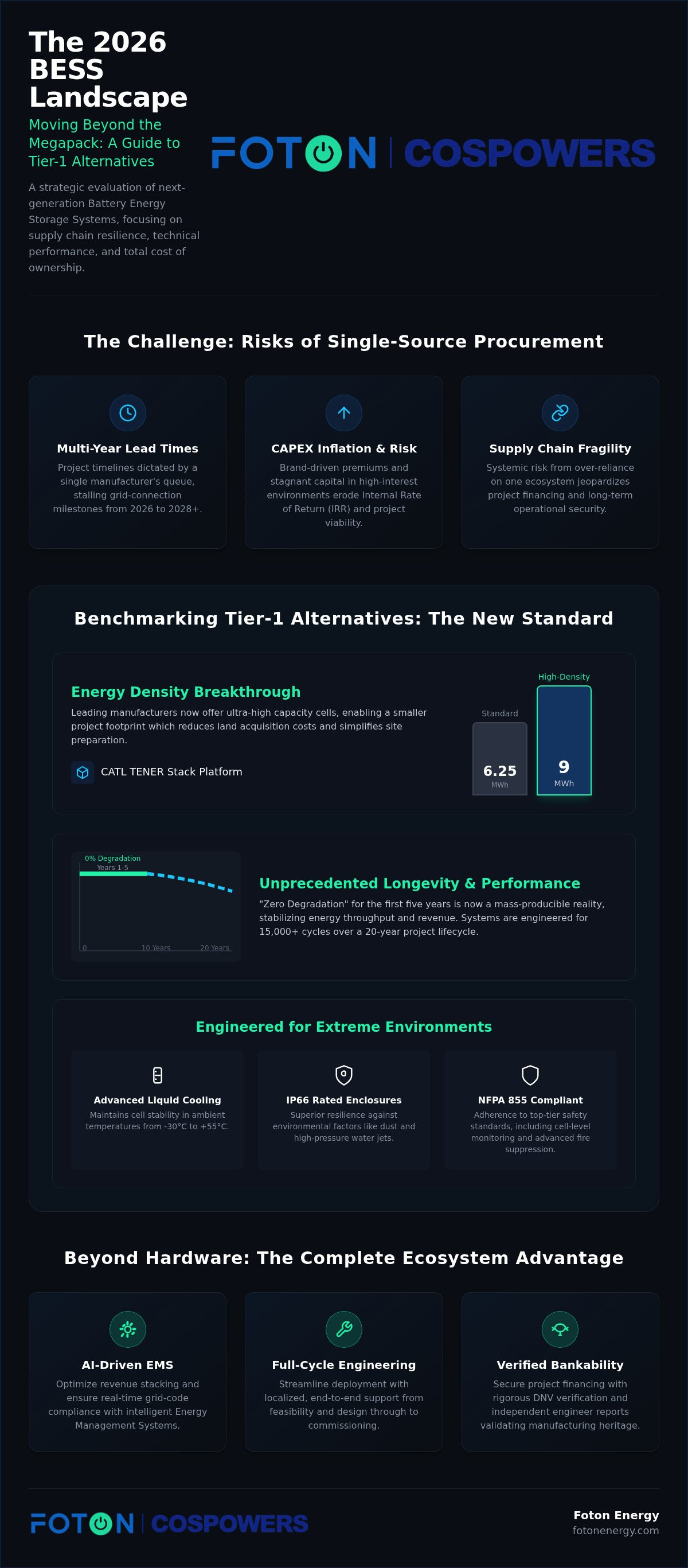
Technical performance parity is the new industry standard. In 2026, developers evaluating Tesla Megapack alternatives aren't just looking for comparable specs; they're looking for verified manufacturing excellence. Systems like the CATL TENER LFP platform now offer 6.25 MWh in a standard 20-foot container, while the newer TENER Stack version has reached a 9 MWh capacity. These high-density configurations allow for a significantly smaller project footprint, reducing land acquisition costs and simplifying site preparation. Leading Tier-1 manufacturers have responded to this shift by utilizing ultra-high capacity cells to drive rated capacity upward while maintaining strict IP66 enclosure standards for environmental resilience.
The "Zero Degradation" claim for the first five years of use has moved from marketing promise to mass-producible reality. This advancement stabilizes energy throughput during the most critical early years of a project's 20-year lifecycle. Thermal management has also evolved. Modern liquid cooling systems maintain cell stability in ambient temperatures ranging from -30°C to +55°C. When you combine this with the 2026 NFPA 855 safety standards, which require a Hazard Mitigation Analysis (HMA) for most installations, the focus shifts toward cell-level monitoring and advanced fire suppression. You can explore how these technical standards integrate with your specific site requirements through Foton Energy's engineering consulting services.
LFP vs. Sodium-Ion: The 2026 Performance Split
LFP remains the anchor for long-duration utility storage due to its proven cycle life and safety profile. However, the rise of the sodium-ion battery for data centers is addressing the unique power density needs of the AI sector. Sodium-ion units offer over 30 MWh per modular unit and a 15,000-cycle lifespan. These systems excel in extreme climates, retaining over 92% capacity at -20°C, making them a strategic choice for high-power applications where lithium-ion might struggle with temperature-related derating.
Modular vs. Monolithic: Integration Flexibility
Modular containerised systems have become the preferred architecture for utility scale BESS procurement. Unlike monolithic designs, modular units allow you to scale capacity incrementally without redesigning the entire balance of plant (BoP). This flexibility is essential for managing 20-year project lifecycles, as it enables easier module replacement and technology augmentation. Cospowers architecture leverages this modularity, providing a bankable framework that simplifies both the initial commissioning and long-term operational maintenance of the asset.
Bridging the Software Gap: AI-Driven EMS as a Strategic Differentiator
Software defines the modern energy asset. While earlier market cycles focused primarily on hardware specs, the 2026 landscape prioritizes the intelligence layer that orchestrates the battery's interaction with the grid. Many developers once assumed that sticking with Tesla was the only way to access high-performance bidding software, but the emergence of sophisticated Tesla Megapack alternatives has dismantled this software monopoly. Today, AI-driven Energy Management Systems (EMS) provide the same, if not superior, level of revenue optimization and grid-code compliance through open, interoperable architectures.
Intelligence is the key to maximizing IRR. Modern software doesn't just monitor state of charge; it actively forecasts energy demand and analyzes grid conditions to execute complex revenue stacking strategies. These systems ensure real-time frequency control and seamless integration with existing SCADA and utility-scale solar arrays. By leveraging predictive maintenance algorithms, these AI platforms extend cell life by identifying potential failures before they occur, significantly reducing long-term O&M costs. You can achieve higher operational uptime by choosing systems that prioritize software transparency over proprietary lock-in.
The Role of AI in Revenue Stacking
Automating the "smart" grid requires a software stack capable of simultaneously managing arbitrage, Frequency Control Ancillary Services (FCAS), and demand response. Foton's AI driven energy management system provides this level of strategic automation, matching top-tier industry performance while offering greater flexibility for multi-asset integration. In Australian grid-scale projects, software-led efficiency gains have demonstrated that local, responsive AI can outperform rigid, proprietary ecosystems. These platforms allow you to participate in multiple energy markets with the precision required to capture volatile price signals without compromising battery health.
Cybersecurity and Data Governance in BESS Software
Security is a non-negotiable pillar of utility-scale infrastructure. As BESS assets become more interconnected, ensuring NERC/CIP compliance within the software architecture is critical for risk management. Unlike some cloud-dependent systems, many leading Tesla Megapack alternatives offer localized data hosting options. This approach mitigates the risks associated with latency and external cyber threats, providing a more resilient framework for critical energy infrastructure. Standardized communication protocols now facilitate deeper integration with utility-scale solar and existing grid assets, ensuring that your data governance remains as robust as your physical hardware.
The Bankability Blueprint: Securing Project Finance for Non-Tesla BESS
Securing finance for utility-scale assets requires more than a famous logo. It demands a technical proof of performance that satisfies the rigorous risk-aversion of institutional lenders. While the market often defaults to certain names, sophisticated developers are successfully financing Tesla Megapack alternatives by presenting a robust "bankability dossier." This dossier centers on DNV-verified standards and comprehensive Independent Engineer (IE) reports that validate long-term operational stability. You'll find that financiers prioritize the underlying technical architecture and the manufacturer's ability to honor performance guarantees over mere brand recognition.
Manufacturing heritage is a primary pillar of this framework. A provider with 30+ years of industrial experience, such as Cospowers, offers a depth of historical data that newer market entrants simply cannot match. This legacy underpins the warranty structures and back-to-back performance guarantees that protect your investment against unforeseen technical failures. When your project is backed by a Tier-1 manufacturing heritage, you provide banks with the assurance that the technology partner will remain solvent and supportive for the entire 20-year project lifecycle.
Verification and Certification Standards
Compliance is the foundation of project approval. Your procurement strategy must prioritize equipment that meets UL9540A for fire safety and IEC 62933 for system performance. Lending institutions also look for a Tier-1 ranking in the BloombergNEF benchmarks, which serves as a critical proxy for financial stability and manufacturing quality. Presenting these certifications alongside localized grid-code compliance data ensures your project moves through the credit committee without delays. Utilizing specialized BESS engineering consulting services can streamline this documentation process, providing the technical weight needed to secure favorable debt terms.
Risk Mitigation and Insurance
Insurability is a critical component of the bankability framework. While LFP is the current benchmark for utility projects, sodium-ion architectures are gaining traction as their safety profiles and manufacturing processes are validated. You can mitigate technology risk by selecting Tesla Megapack alternatives from partners with a global support network spanning over 70 countries. This ensures that even in remote project sites, technical expertise and spare parts are always accessible. To begin building your bankable procurement strategy, contact our engineering team for a project feasibility assessment.
Strategic Procurement: Navigating the Foton and Cospowers Ecosystem
Strategic procurement in 2026 involves more than just selecting hardware; it requires a partnership that integrates global manufacturing scale with precise, local engineering support. As you evaluate Tesla Megapack alternatives, your goal is to find a path that bypasses the supply chain bottlenecks of the past while maintaining elite performance standards. Foton Energy provides this path as the exclusive strategic gateway to Cospowers, a Tier-1 manufacturer with a 30-year heritage in energy storage innovation. This relationship ensures that your project doesn't just receive a battery, but a fully integrated energy solution backed by decades of industrial data.
We offer a flexible procurement model that caters to the specific needs of your organization. Whether you require wholesale hardware procurement for a large-scale project or full-service engineering consulting to navigate complex grid-code requirements, our team provides the necessary technical depth. This collaborative approach moves beyond the "one-size-fits-all" model, allowing for bespoke system configurations that optimize your specific site conditions and revenue goals. You're not just buying an asset; you're securing a long-term operational partner.
The Foton Advantage: Global Reach, Local Engineering
Foton bridges the gap between high-volume Asian manufacturing and the stringent grid requirements of Australia, Ireland, and other global markets. We don't just ship containers; we provide end-to-end support from the initial project feasibility stage through to final grid-code commissioning. Our engineers work alongside your team to ensure that every utility-scale deployment meets the latest safety and performance standards. By aligning with us now, you can secure critical 2026-2027 delivery slots, ensuring your project remains on track despite broader market volatility.
Next Steps for EPC Partners and Financiers
Reliability is built on transparency. We invite EPC partners and developers to join the Foton Channel Partner Programme, a collaborative initiative designed to streamline the deployment of high-performance BESS assets. You can request comprehensive technical specifications and independent engineer (IE) reports for Cospowers systems to begin your internal bankability review. Scheduling a consulting session with our team will allow you to assess project feasibility and explore how our AI-driven EMS can maximize your long-term ROI. The future of energy infrastructure is resilient, multi-vendor, and software-defined. By diversifying your procurement strategy with Tesla Megapack alternatives today, you're building the foundation for a more stable and profitable energy portfolio.
Securing the Future of Your Energy Infrastructure
Strategic resilience in 2026 requires a move beyond brand-name reliance toward a multi-vendor procurement model. By evaluating Tesla Megapack alternatives, you're not just avoiding supply chain bottlenecks; you're actively optimizing your project's CAPEX and long-term revenue potential. We've seen that bankability is no longer exclusive to a single ecosystem. It's now anchored in DNV-verified standards, 30+ years of manufacturing heritage, and the intelligent performance of AI-driven Energy Management Systems. These pillars ensure that your utility-scale assets remain reliable, efficient, and profitable throughout their entire lifecycle.
Success in the modern grid depends on your ability to integrate high-performance hardware with localized engineering expertise. Foton Energy serves as the exclusive global partner of Cospowers, providing the technical depth and manufacturing stability required to satisfy even the most conservative financiers. We invite you to contact Foton Energy to secure your Tier-1 BESS procurement strategy for 2026. Together, we can build a more resilient energy future that is both technologically advanced and commercially stable. Your next project deserves the assurance of a partner who understands the intricacies of the global energy market.
Frequently Asked Questions
What are the primary competitors to the Tesla Megapack in 2026?
Tier-1 manufacturers such as CATL, BYD, and Cospowers represent the primary competition. Foton Energy provides a strategic gateway to Cospowers' utility-scale LFP and Sodium-Ion solutions. These providers offer high-density modular systems that match or exceed the performance of traditional market leaders. By choosing a partner with a 30-year manufacturing heritage, developers can secure reliable hardware that meets the technical demands of modern grid infrastructure without the brand-driven bottlenecks.
Is CATL Tener more energy-dense than the Tesla Megapack?
Yes, the 2026 CATL TENER Stack version offers a capacity of 9 MWh in a standard containerized format. This significantly exceeds the standard density of many existing integrated systems. High-density architectures allow developers to reduce the physical footprint of the project site. This advancement directly lowers land acquisition costs and simplifies site preparation requirements for grid-scale installations, making it a highly efficient choice for space-constrained utility projects.
Are non-Tesla BESS systems bankable for large-scale project financing?
Absolutely, bankability is secured through DNV-verified standards and independent engineer reports rather than brand name alone. Many Tesla Megapack alternatives from Tier-1 manufacturers are now fully bankable. Financiers prioritize manufacturing heritage, such as Cospowers' 30-year history, and rigorous international certifications like UL9540A to ensure long-term operational stability. This technical proof of performance provides the same level of investment security as traditional brand-name systems.
How does sodium-ion compare to LFP for utility-scale storage?
Sodium-ion excels in extreme climates and high-power applications, while LFP remains the benchmark for long-duration energy density. Sodium-ion systems can retain over 92% capacity at -20°C and offer lifespans of up to 15,000 cycles. While LFP is preferred for standard utility-scale storage, sodium-ion is becoming a critical alternative for data centers and regions with volatile temperature ranges. Each chemistry offers specific advantages depending on the project's operational environment and discharge requirements.
Does Foton Energy provide software that competes with Tesla's Autobidder?
Yes, Foton provides an AI-driven Energy Management System (EMS) designed for sophisticated revenue stacking and real-time grid interaction. This software manages arbitrage, FCAS, and demand response with the same precision as proprietary ecosystems. Unlike closed systems, our EMS offers greater interoperability with existing SCADA and solar assets. This allows for more flexible and transparent utility-scale storage operations, ensuring that you can maximize your asset's value across multiple energy markets.
What is the typical lead time for a Tier-1 BESS alternative in 2026?
Tier-1 alternatives often provide significantly optimized delivery windows compared to the multi-year waitlists associated with brand-dominant providers. By diversifying your procurement, you can often secure 2026-2027 delivery slots that align with immediate grid-connection milestones. This speed is a primary reason why developers are increasingly exploring Tesla Megapack alternatives to protect their project's Internal Rate of Return. Faster commissioning ensures that your capital isn't stagnant while waiting for production queues to clear.
How do I ensure grid-code compliance with a non-Tesla battery system?
Grid-code compliance is achieved through end-to-end engineering consulting and the use of intelligent software layers. Foton Energy provides specialized support to ensure every system meets local regulatory requirements and technical standards. We handle everything from initial project feasibility to final commissioning. This ensures that your non-Tesla BESS integrates seamlessly with the national grid and maintains high-performance reliability, providing the same level of operational assurance as any other Tier-1 system.


