

Safety is no longer a secondary consideration; it's the strategic foundation that makes high-density AI data centers commercially viable in 2026. You've likely felt the mounting pressure of managing catastrophic thermal risks in crowded server halls while navigating the volatile supply chains of legacy lithium systems. It's a complex balancing act where the stakes include both operational uptime and your global ESG goals; however, prioritizing sodium-ion battery safety for data centers offers a clear path forward. We recognize that for large-scale infrastructure investments, security and progress must be inextricably linked.
This guide demonstrates how sodium-ion technology is redefining industry benchmarks by effectively eliminating thermal runaway risks and securing long-term cost stability. You'll discover how this chemistry enables a more resilient backup architecture that supports the intense power demands of modern AI workloads. We'll examine the rigorous technical proof points behind these systems, their compliance with global safety standards like UL 9540A, and how this shift provides a bankable path for future-ready facility management. Together, we'll explore why a transition to sodium-ion is the most strategic move for your energy storage infrastructure.
Key Takeaways
- Evaluate how prioritizing sodium-ion battery safety for data centers eliminates the risk of catastrophic thermal runaway while maintaining peak operational uptime for critical server halls.
- Compare thermal thresholds and discharge efficiencies across LFP, VRLA, and sodium-ion chemistries to select the most resilient backup architecture for high-density AI workloads.
- Identify the role of Prussian Blue analogues and non-flammable electrolytes in maintaining cell stability during the high-stress, short-burst discharge scenarios typical of modern UPS systems.
- Discover how integrating AI-driven Energy Management Systems (EMS) transitions your safety strategy from a reactive measure to a predictive, automated protocol.
- Leverage the strategic advantage of Tier-1 manufacturing heritage to bridge the gap between advanced hardware and global data center engineering requirements.
The Data Center Safety Crisis: Why Traditional Chemistries Are Reaching Their Limit
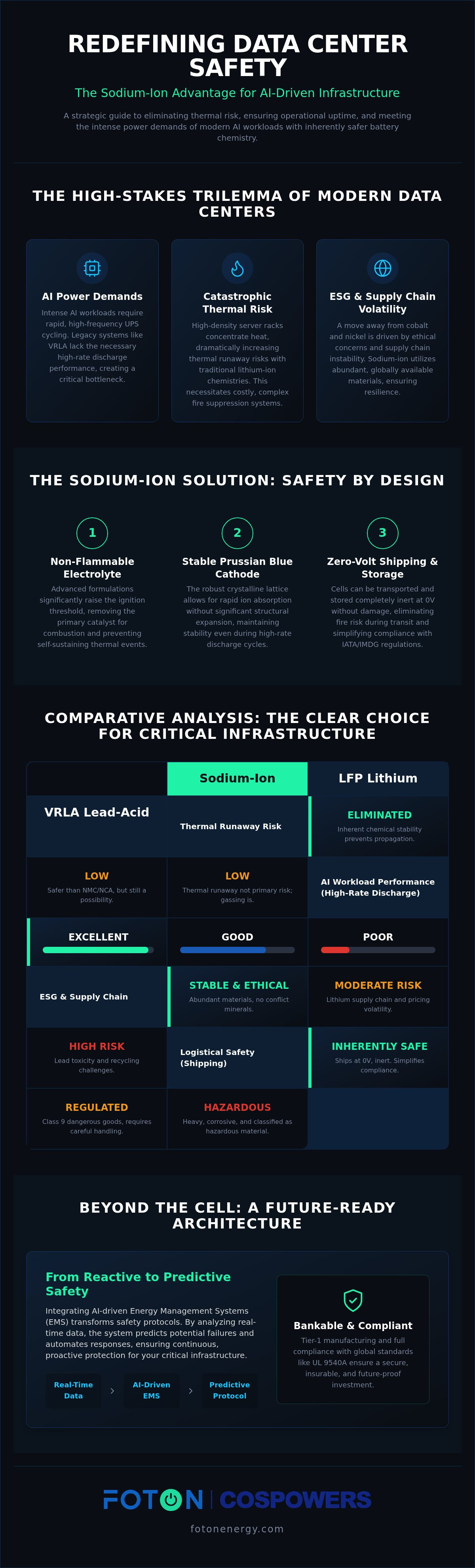
The infrastructure supporting modern global compute has reached a critical inflection point. Operators can't afford to ignore the escalating thermal runaway risks in high-density deployments where heat dissipation is already a primary engineering challenge. Prioritizing sodium-ion battery safety for data centers addresses this head-on. VRLA systems simply lack the rapid discharge capabilities required for the high-frequency UPS cycling demanded by 2026 AI hardware. This creates a "Safety-Performance-Sustainability" trilemma that forces a choice between risk and performance.
This crisis extends into the regulatory and financial landscape. New international shipping regulations effective January 1, 2026, including the adoption of UN 3551 and UN 3552, reflect a global push for more granular battery management. These standards impact how batteries are integrated into facilities and have a direct effect on insurance premiums. Failure to meet these evolving standards can limit site selection and increase the total cost of ownership for Tier-3 and Tier-4 data centers. We must recognize that legacy solutions are no longer sufficient for the scale of current infrastructure needs.
The AI Power Crunch and Fire Risk
Increased rack density necessitates a fundamental shift in battery safety architecture. Standard lithium-ion installations now require extensive, costly fire suppression systems and specialized containment to meet evolving global safety standards. These hidden costs often erode the initial ROI of high-density server halls and complicate site selection due to local fire codes. Sodium-ion technology serves as the primary solution for the AI-driven power crisis by providing high-rate discharge performance without the volatile thermal profile inherent to lithium chemistries.
ESG Mandates and Conflict Materials
Corporate sustainability goals are driving a decisive move away from cobalt and nickel-based chemistries. These materials are plagued by supply chain volatility and ethical concerns, making them a liability for long-term infrastructure planning. A Sodium-ion battery utilizes abundant, globally accessible raw materials, ensuring that your supply chain remains resilient against geopolitical shifts. By adopting these systems, operators can support net-zero goals and comply with increasingly strict green building certifications without compromising facility uptime. Prioritizing sodium-ion battery safety for data centers allows for a scalable, sustainable growth model that meets the demands of 2026 and beyond.
The Chemistry of Safety: Why Sodium-Ion Prevents Thermal Runaway
Fundamental security in power systems begins at the molecular level. While legacy lithium-ion systems often rely on volatile organic solvents, the current generation of sodium-ion cells utilizes advanced, non-flammable electrolyte formulations that significantly raise the threshold for ignition. This chemical shift is the cornerstone of sodium-ion battery safety for data centers, providing a bankable assurance that the system won't enter a self-sustaining fire state even under electrical abuse or mechanical failure. By removing the primary catalyst for combustion, we've created a storage solution that's inherently stable.
Logistically, sodium-ion offers a unique advantage: the ability to be shipped and stored at zero volts. Unlike lithium chemistries, which suffer from copper current collector dissolution at deep discharge, sodium-ion cells remain undamaged when completely drained. This eliminates the risk of transit fires and simplifies compliance with the 2026 IATA and IMDG regulations. For facility managers, this means receiving an inert product that only becomes "active" once commissioned on-site, drastically reducing the risk profile during the installation phase.
Prussian Blue and Structural Stability
The stability of these systems is largely attributed to the use of Prussian Blue analogues in the cathode. These materials feature a robust, porous crystalline lattice that allows for rapid ion absorption without significant structural expansion. During high-rate discharge cycles, which are common in UPS "short-burst" scenarios, the lattice remains intact. This structural integrity ensures that sodium-ion stays cool, whereas other chemistries might experience internal stress and heat buildup. A technical analysis of Sodium-Based Battery Technologies confirms that the solid electrolyte interphase (SEI) in sodium systems is remarkably stable, preventing the degradation that typically leads to internal short-circuits.
Operating Temperature Resilience
Data center operators can realize substantial gains in efficiency due to sodium-ion's wide operating window. These systems maintain performance stability from -40°C to +60°C, drastically reducing the reliance on heavy HVAC infrastructure. Sodium-ion batteries can retain over 90% of their capacity at -20°C, a feat that traditional LFP cannot match. This resilience prevents the internal short-circuiting often triggered by temperature-induced dendrite growth in other batteries. By lowering cooling requirements, you directly reduce the total cost of ownership and improve PUE ratings. If you're looking to optimize your facility's thermal management, exploring Data Centre & Telco Backup solutions can provide the specialized engineering insights needed to integrate these resilient systems. This temperature-agnostic performance ensures that sodium-ion battery safety for data centers remains consistent, regardless of the ambient environment.
Sodium-Ion vs. LFP vs. VRLA: A Comparative Safety Analysis
Selecting the ideal energy storage chemistry requires a rigorous evaluation of how different technologies respond to the extreme stresses of a mission-critical environment. While VRLA remains a legacy staple and LFP has gained significant market share, neither fully addresses the evolving sodium-ion battery safety for data centers profile required for 2026 infrastructure. We must look beyond simple capacity metrics to understand how thermal stability and discharge efficiency impact long-term operational security. The following analysis highlights the technical distinctions that make sodium-ion a superior strategic choice for modern facilities.
Thermal Runaway Thresholds
The "point of no return" defines the temperature at which a cell enters an uncontrollable, self-heating state. While NMC cells are notoriously volatile and LFP cells offer a safer threshold, sodium-ion technology exhibits a significantly higher thermal runaway onset temperature. This inherent stability simplifies facility fire coding and reduces the necessity for the complex, multi-layered fire suppression systems typically required for lithium-based halls. Sodium-ion systems consistently meet or exceed the rigorous testing requirements of UL 9540A, providing a level of safety that surpasses traditional lithium-ion and lead-acid alternatives in dense configurations.
Discharge Performance for Mission Critical
Data center UPS systems demand high-power, short-duration bursts that can push traditional batteries to their thermal limits. Sodium-ion cells excel in these scenarios, comfortably handling 3C to 5C discharge rates without the excessive heat generation that plagues LFP or the rapid degradation seen in VRLA systems. This efficiency is a critical component of Sodium-Ion Battery for Data Centers: Solving the AI Power Crunch in 2026, as it allows for leaner, more responsive backup architectures. Unlike lithium chemistries that may require derating during rapid discharge to prevent overheating, sodium-ion maintains a stable thermal profile even under maximum load.
Long-term safety is also a function of cycle life and physical footprint. Sodium-ion systems are engineered to maintain their safety characteristics over 10+ years of operation, with some platforms achieving up to 10,000 cycles. This durability ensures that the battery's safety profile doesn't diminish as the system ages. Additionally, the high energy density of modern sodium-ion cells allows for a reduced total footprint. By balancing sodium-ion battery safety for data centers with high-performance density, operators can maximize their white space without compromising on the security of their power backup systems. This combination of longevity and compact design provides a bankable foundation for any large-scale infrastructure investment.
Implementing Safety Architecture: Beyond the Battery Cell
Safety is a systemic achievement. While the inherent chemistry provides a stable foundation, true resilience is realized through a multi-layered architecture that integrates hardware and intelligence. For facility engineers, this means moving beyond the cell to look at the entire ecosystem. Sodium-ion battery safety for data centers is maximized when predictive software, advanced thermal management, and physical containment work in unison. This holistic approach ensures that potential issues are neutralized long before they can impact operational uptime or facility integrity.
Grid-code compliance in 2026 is now inextricably linked to operational safety. As data centers increasingly participate in grid stabilization and frequency response programs, the battery systems must handle rapid, unpredictable cycling. Sodium-ion’s ability to maintain a stable thermal profile during these high-stress events ensures that safety is never compromised by financial optimization strategies. Following global standards like UL 9540A requires this level of integrated thinking; hardware must be as smart as it is durable.
AI-Driven Predictive Monitoring
Intelligent oversight serves as the first line of defense. Foton’s AI EMS constantly analyzes high-frequency data streams to detect micro-anomalies that precede traditional hardware alarms. This includes identifying subtle voltage deviations or impedance changes that might indicate early-stage cell stress. By leveraging AI Driven Energy Management Systems: The 2026 Strategic Guide for BESS, operators transition from reactive maintenance to a predictive safety posture. Real-time thermal mapping and automated load balancing ensure that no single module is overstressed, effectively extending the functional lifespan of the entire array.
Containerized Safety Architecture
Physical design must complement digital intelligence. Modular BESS units are engineered for high-density arrays, incorporating proprietary thermal management systems that can toggle between air-cooled and liquid-cooled configurations depending on the specific rack density. These containerized solutions act as a final physical barrier; they are designed to contain an internal event and prevent propagation to adjacent units. Optimal BESS placement on data center campuses now follows a "Safety-by-Design" philosophy. We recommend units be spaced and oriented to facilitate easy access while maintaining physical isolation from critical server halls. To secure your facility's future, we invite you to consult with our team regarding Engineering Consulting to design a safety architecture that meets the most stringent global standards. This integrated approach ensures that sodium-ion battery safety for data centers remains a bankable asset for your infrastructure.
The Foton Advantage: Bankable Sodium-Ion Solutions for 2026
Excellence in energy storage isn't just about chemistry; it's about the reliability of the manufacturing source. Foton Energy serves as the strategic bridge between Tier-1 manufacturing and global data center engineering. By leveraging over 30 years of Cospowers' manufacturing heritage, we provide a foundation of stability that legacy startups simply can't match. This deep-rooted experience ensures that sodium-ion battery safety for data centers is a verified reality, not just a theoretical promise. We're not just providing hardware; we're delivering a legacy of proven performance.
Financiers and EPCs prioritize bankability above all else. A system is only as secure as the entity standing behind it. Our exclusive global strategic partnership with Cospowers allows us to offer Tier-1 energy storage status, which is a critical requirement for large-scale infrastructure financing. We provide the technical proof points and international certifications necessary to de-risk your investment, ensuring that your transition to sodium-ion is both technologically advanced and commercially stable. Trust is built through rigorous testing and operational excellence.
Tier-1 Manufacturing and Supply Chain Security
Sourcing from a Tier-1 manufacturer is the only way to guarantee long-term performance and safety. Foton ensures supply chain continuity by utilizing sodium's abundance, shielding global infrastructure projects from the volatility of lithium and cobalt markets. Our role involves more than just procurement. We provide comprehensive BESS Engineering Consulting Services: A Strategic Guide to Bankable Energy Storage in 2026 to ensure every deployment is optimized for its specific environment. This strategic oversight guarantees that sodium-ion battery safety for data centers remains consistent across your entire global portfolio.
Strategic Partnership for Global Scale
We operate a marketing and support network across 70+ countries, providing the local expertise needed for complex grid-code compliance and project feasibility. Our engineering teams collaborate with you to navigate the nuances of site selection and international safety regulations. This global reach, combined with our manufacturing depth, makes us a foundational pillar in the move toward cleaner, safer energy storage. The next step for your facility is a technical feasibility study for sodium-ion UPS upgrades. We invite you to partner with us in redefining the safety standards of the modern data center through visionary pragmatism and elite engineering.
Securing Your Infrastructure's Future with Sodium-Ion Innovation
Transitioning to sodium-ion technology marks a definitive shift toward a safer, more resilient data center landscape. By prioritizing sodium-ion battery safety for data centers, you're moving beyond the limitations of legacy chemistries to embrace a solution that naturally prevents thermal runaway. This chemistry supports high-density AI workloads while providing the long-term cost stability and compliance with global safety standards that your facility requires. We've demonstrated that safety is no longer a trade-off for performance; it's the foundation of modern uptime.
Foton Energy stands as your trusted partner in this evolution. As the exclusive global strategic partner of Cospowers, we bring 30+ years of manufacturing heritage to every project, ensuring your Tier-1 energy storage infrastructure is both bankable and future-ready. Our AI-driven EMS and expert engineering consulting provide the steady, guiding hand needed for large-scale transitions. Partner with Foton for Bankable Sodium-Ion Data Center Solutions and secure the resilience your facility deserves. Let's build a more secure and efficient digital future together.
Frequently Asked Questions
Are sodium-ion batteries more fire-safe than lithium-ion for data centers?
Sodium-ion batteries are inherently more fire-safe due to their stable chemical composition and non-flammable electrolyte formulations. Unlike traditional lithium-ion chemistries that can ignite under electrical stress, sodium cells exhibit a significantly higher thermal runaway onset temperature. This stability is a key component of sodium-ion battery safety for data centers, reducing the risk of self-sustaining fires in high-density rack environments. Their ability to operate safely without volatile thermal profiles makes them an ideal choice for mission-critical facilities.
Can sodium-ion batteries be used in existing data center UPS systems?
You can integrate sodium-ion batteries into existing UPS architectures with specialized engineering consulting to ensure voltage compatibility. These systems are particularly effective for UPS applications because they handle high-rate discharge cycles without the overheating common in lead-acid or lithium alternatives. While the physical footprint is comparable to LFP, an intelligent EMS is required to manage sodium's unique discharge curve. This allows facility managers to upgrade their backup resilience without a complete overhaul of their power distribution infrastructure.
What is the thermal runaway temperature for a sodium-ion battery?
Sodium-ion cells exhibit a thermal runaway onset temperature that is significantly higher than NMC and LFP chemistries. While specific values vary by manufacturer, the increased thermal stability ensures that the point of no return is much harder to reach during high-stress operations. This enhanced safety profile is a primary reason why these systems meet rigorous UL 9540A standards. By raising the threshold for ignition, sodium-ion technology provides a bankable layer of security for dense server halls where heat management is a constant challenge.
How does the energy density of sodium-ion compare to LFP in 2026?
As of 2026, the energy density of top-tier sodium-ion cells has reached approximately 175 Wh/kg, placing them on par with mainstream LFP batteries. This means you don't have to sacrifice floor space to achieve superior safety. For data center operators, this parity allows for the deployment of high-density backup systems that fit within existing rack footprints. The technology has evolved from pilot stages to a commercially viable alternative that matches the performance of traditional lithium-based storage solutions.
Do sodium-ion batteries require specialized fire suppression systems?
Sodium-ion batteries generally don't require the same level of complex, multi-layered fire suppression systems as lithium-ion installations. Because they lack the volatile thermal profile of legacy chemistries, they often simplify facility fire coding and compliance with local regulations. While standard safety protocols remain necessary for any high-voltage equipment, the reduced risk of catastrophic runaway events can lower insurance premiums and specialized containment costs. This makes sodium-ion battery safety for data centers a strategic advantage during the site selection and permitting phases.
What are the shipping safety advantages of sodium-ion batteries?
A major shipping advantage is the ability to transport sodium-ion batteries at zero volts without damaging the cells. This eliminates the risk of transit fires, a critical concern for international logistics. Under the new 2026 regulations, including UN 3551 and UN 3552, sodium-ion is classified as Hazard Class 9, reflecting its stable nature. These regulations facilitate safer air and sea transport, ensuring that your infrastructure components arrive on-site as inert, non-hazardous cargo before they're commissioned and charged.
Is sodium-ion technology considered 'bankable' for large-scale data center projects?
Sodium-ion technology is now considered highly bankable, especially when sourced from Tier-1 manufacturers with extensive heritage. Financiers and EPCs trust these systems because they're backed by decades of manufacturing expertise and rigorous international certifications. Foton’s strategic partnership with Cospowers provides the stability and technical proof points required for large-scale infrastructure investments. With global production capacity expected to reach 70 GWh in 2026, the technology has moved into the mainstream as a commercially stable and reliable energy storage solution.
How does cold weather affect sodium-ion battery safety and performance?
Sodium-ion batteries demonstrate exceptional performance in cold climates, retaining over 90% of their capacity at temperatures as low as -20°C. Unlike LFP batteries, which often require energy-intensive heating systems to maintain operation in winter, sodium-ion remains stable and efficient across a wide thermal range. This resilience reduces the reliance on heavy HVAC infrastructure, lowering your facility's PUE and total cost of ownership. Their ability to prevent internal short-circuiting at extreme temperatures ensures consistent safety regardless of the ambient environment.


