

In 2026, a commercial battery system without intelligent orchestration isn't an asset; it's a depreciating liability. While hardware provides the capacity, the software dictates the return on investment. Many industrial operators still view energy storage as a simple insurance policy against outages, yet they remain frustrated by high demand charges and the looming anxiety of premature battery degradation. Effectively optimizing c&i bess with ai software is no longer a niche upgrade; it's the foundational requirement for any facility aiming to balance grid-code compliance with the need to extract maximum value from every cycle.
You recognize that staying competitive requires more than just raw power. This guide reveals how AI-driven platforms transform your energy storage from a static backup into a dynamic, bankable financial engine. By integrating machine learning with Tier-1 hardware, you can effectively lower operational expenditure and extend your system's lifecycle through precision thermal management and load forecasting. We'll examine the 2026 strategic framework for securing automated revenue through grid services, leveraging the 30% federal investment tax credit, and generating the rigorous data sets that modern financiers demand. Discover how to turn your facility's energy footprint into a resilient source of long-term value.
Key Takeaways
- Understand how optimizing c&i bess with ai software shifts energy storage from a passive backup system into an active, autonomous financial asset.
- Learn how machine learning algorithms provide real-time precision for State of Health (SOH) and State of Charge (SOC) to prevent premature cell degradation.
- Discover algorithmic strategies for peak shaving and energy arbitrage that slash demand charges and maximize the bankability of your infrastructure.
- Gain a step-by-step framework for integrating Intelligent EMS into your microgrid while ensuring strict adherence to complex 2026 grid-code requirements.
- Identify the competitive edge of pairing Tier-1 manufacturing heritage with advanced software architecture to secure long-term operational resilience.
The Evolution of C&I Energy Storage: Why AI is Mandatory in 2026
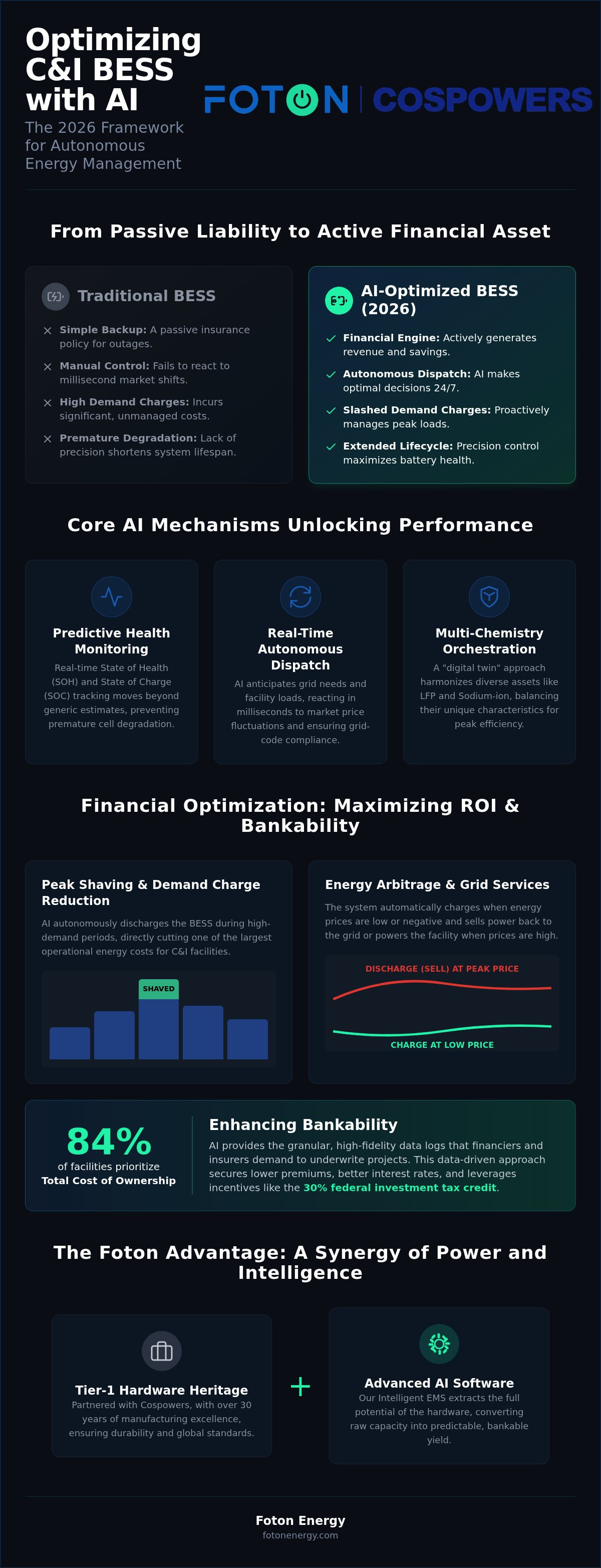
Energy infrastructure has moved past the era of "set and forget." For decades, commercial and industrial (C&I) facilities treated storage as a simple insurance policy against blackouts, but in 2026, this passive approach is a financial liability. The modern Battery Energy Storage System (BESS) must function as a high-performance orchestration engine. It's no longer about having power in reserve; it's about when, how, and at what price that power is deployed. We must recognize that manual energy management fails in a high-renewables environment where grid frequency and pricing fluctuate at speeds no human operator can track. True optimization requires shifting from simple monitoring to autonomous decision-making that anticipates grid needs before they occur.
Market Volatility and the AI Solution
Negative pricing and extreme peaks are the new normal in the 2026 energy market. You need an Intelligent EMS that reacts to millisecond-level grid fluctuations, ensuring the system discharges during peak pricing and charges when the grid is oversupplied. This autonomous response directly slashes industrial demand charges, which often account for a significant portion of a facility's total energy bill. By removing human error and utilizing real-time load forecasting, AI ensures your facility remains a supportive partner to the grid while protecting your operational bottom line. This level of responsiveness is the only way to navigate a market defined by volatility and rapid transition. To explore how these innovations are being applied to regional infrastructure, you can discover Construction Technology ConFeX KSA, which focuses on the digital and sustainable transformation of the built environment.
From Hardware to Software-Defined Power
Tier-1 hardware provides the durability, but software provides the intelligence. Foton’s partnership with Cospowers, a manufacturer with over 30 years of heritage, ensures that the hardware is built to global standards while our AI architecture extracts its full potential. We bridge the gap between rigorous manufacturing and cutting-edge software to ensure long-term resilience. AI-driven BESS serves as a financial optimization layer that converts raw hardware capacity into a predictable, bankable yield. This synergy allows for specialized applications, such as using sodium-ion systems for specific C&I needs, without sacrificing the precision of your energy management strategy.
Bankability hinges on high-fidelity data. A 2026 industry report by ZincFive found that over 84% of data center and industrial facilities now prioritize Total Cost of Ownership (TCO) for BESS, making optimizing c&i bess with ai software essential for meeting these rigorous financial targets. Financiers and insurers now demand granular, AI-validated logs to underwrite large-scale infrastructure risk. By providing this transparency, you secure the lower premiums and better interest rates required for a truly bankable project. This data-driven approach transforms a static asset into a resilient, high-performance financial instrument that supports both your sustainability goals and your fiscal health.
Core AI Mechanisms: Predictive Maintenance and Real-Time Dispatch
Precision is the hallmark of a bankable energy asset. In 2026, machine learning has moved beyond simple data logging to provide high-fidelity insights into State of Health (SOH) and State of Charge (SOC). By optimizing c&i bess with ai software, operators can move beyond generic manufacturer estimates to see the true, real-time status of every cell. This granularity allows for millisecond-level dispatch decisions that protect the physical integrity of the battery while maximizing available energy for grid services. It's the difference between guessing your capacity and knowing exactly how much power you can commit to a demand-response event.
Managing multi-chemistry fleets, such as combining Lithium Iron Phosphate (LFP) with Sodium-ion systems, requires a sophisticated digital twin approach. Different chemistries exhibit unique discharge curves, internal resistances, and thermal sensitivities that change over time. AI-driven EMS platforms act as the central nervous system, balancing these diverse assets to ensure they work in concert rather than in conflict. This coordination is critical for specialized industrial applications where power density and cost-efficiency must be balanced across different storage technologies. By harmonizing these variables, the software ensures that each chemistry operates within its optimal performance envelope.
Optimizing Discharge for Lifecycle Extension
Lifecycle extension is a direct result of intelligent discharge management. AI algorithms dynamically adjust the Depth of Discharge (DoD) based on real-time degradation models, ensuring that cells aren't pushed beyond their chemical limits during periods of high demand. For Sodium-ion storage, which carries specific thermal profiles and sensitivity to high-current discharge, the software manages cooling cycles proactively to prevent hotspots. Balancing cell voltages in real time prevents the premature aging that often plagues unmanaged systems, effectively stretching the asset's operational life and improving your long-term return on investment.
Predictive Analytics for O&M Efficiency
Operational expenditure (OPEX) drops when maintenance moves from reactive to predictive. Instead of waiting for a fault to trigger an outage, AI identifies subtle anomalies in voltage or temperature that signal an impending failure. This allows technical teams to perform proactive interventions during scheduled downtime, reducing onsite visits and preventing catastrophic downtime. Automated testing cycles ensure that safety architecture remains fully functional without manual oversight. If you're looking to enhance your facility's resilience, our Intelligent EMS solutions provide the technical proof points required for long-term security and operational excellence.
Financial Optimization: Maximizing ROI and Bankability
Financial resilience in 2026 requires more than just storing energy; it demands the algorithmic precision to deploy it at the exact moment of maximum fiscal impact. By optimizing c&i bess with ai software, facility owners shift from reactive cost management to proactive revenue generation. This software-driven approach enables a multi-faceted financial strategy: slashing demand charges through peak shaving, capturing price spreads via energy arbitrage, and participating in lucrative frequency regulation markets. These revenue streams don't just happen. They're engineered through real-time market data integration and predictive load modeling that turns a battery into a high-yield asset.
The ROI of Intelligent Peak Shaving
Peak shaving remains the primary driver of C&I BESS returns for most industrial operators. By analyzing years of historical load data, AI predicts upcoming peak events with high accuracy, ensuring that the battery is charged and ready to discharge when facility demand spikes. This coordination is particularly effective when managing behind-the-meter assets alongside the main grid connection. For a deeper look at these mechanics, explore our guide on Maximizing Peak Shaving ROI with Battery Storage. In regions like California, where peak grid power can reach $0.55/kWh under current rules, the ability to offset this cost with stored solar or low-rate grid power is the difference between a five-year and a ten-year payback period. The 30% federal investment tax credit (ITC) available in 2026 further accelerates this timeline, provided the business owns the system.
Securing Favourable Financing Terms
Bankability is the bridge between a visionary project and a commissioned asset. Lenders in 2026 prioritize projects that offer AI-backed performance guarantees because they significantly reduce the operational risk profile. When you provide a feasibility study built on rigorous AI modeling, you aren't just showing a projection. You're providing a technical proof point of long-term Internal Rate of Return (IRR). This transparency is what financiers demand before committing capital to large-scale infrastructure.
To achieve true bankability, a C&I project must align hardware excellence with digital intelligence. We recommend focusing on these foundational elements:
- Tier-1 Manufacturing Heritage: Utilize hardware with established track records, such as our partnership with Cospowers, which brings over 30 years of manufacturing expertise.
- DNV Verification: Ensure technical architecture meets international safety and performance standards to lower insurance premiums.
- Automated Reporting: Use AI to generate the high-fidelity data sets required for ongoing equity partner reviews and compliance audits.
- Grid-Code Compliance: Leverage engineering consulting to navigate the complex 2026 regulatory requirements in your specific region.
This structured approach ensures that financiers view your energy storage as a stable, high-yield asset rather than a speculative technical experiment. By grounding high-level goals in rigorous testing and operational excellence, you build the trust necessary for large-scale investment.
Implementation Strategy: Integrating AI with C&I Infrastructure
Successful deployment of energy storage requires a seamless bridge between physical assets and digital intelligence. In 2026, the process of optimizing c&i bess with ai software begins long before the first container arrives on site. It starts with a comprehensive digital twin of the facility's existing microgrid, allowing the Intelligent EMS to simulate load patterns and identify the most efficient interconnection points. This methodical approach ensures that the software-defined power layer integrates without disrupting critical industrial operations, providing a steady, guiding hand for technical partners through the entire commissioning phase.
Cybersecurity is a non-negotiable pillar of industrial energy software. As BESS units become more interconnected with the broader grid, they must adhere to rigorous data security standards to protect against unauthorized access and operational disruption. Foton ensures that all communication between the BMS, inverter, and cloud-based optimization layers is encrypted and compliant with international industrial control system protocols. This focus on security architecture reinforces the reliability of the system, making it a stable foundation for long-term infrastructure investment. We prioritize a clean, modern, and high-performance digital environment that mirrors the durability of our hardware.
Engineering and Grid-Code Compliance
Navigating the shifting regulatory landscape is often the most significant hurdle for C&I projects. You must ensure that your system meets the specific 2026 grid-code requirements, which often vary by region and utility provider. Utilizing professional BESS engineering consulting services allows you to automate compliance reporting through AI software interfaces, reducing the administrative burden on your facility management team. This partnership ensures that your safety architecture, including fire suppression and thermal management, is fully integrated with local codes from day one, grounding your high-level sustainability goals in rigorous operational excellence.
Scalability and Future-Proofing
Strategic ambition demands a system that grows alongside your business. Modular architecture allows for the seamless addition of new battery modules or even different chemistries, such as integrating sodium-ion for specialized backup needs within an existing LFP fleet. The AI software handles these additions by dynamically updating its control logic to maintain interoperability between different inverter and BMS protocols. For multi-site C&I operators, integrating distributed energy resource management (DERMS) capabilities ensures that your entire portfolio remains optimized as a single, cohesive energy asset. This interconnectedness is a critical link in your larger industrial ecosystem.
Are you ready to move from a static backup system to a high-performance energy engine? Contact our team today to explore how our Engineering Consulting and Intelligent EMS can secure your facility's future-readiness and long-term value.
The Foton Advantage: Intelligent EMS and Tier-1 Heritage
Foton stands as the critical link between Tier-1 manufacturing excellence and next-generation digital orchestration. Through our exclusive global partnership with Cospowers, we provide C&I operators with access to over 30 years of manufacturing heritage. This stability is the bedrock of any bankable energy project. However, optimizing c&i bess with ai software requires more than just high-quality cells; it requires a technical architecture that can translate chemical potential into financial performance. Foton’s Intelligent EMS serves as this translation layer, providing the real-time grid optimization necessary for modern industrial applications.
Our end-to-end support model moves beyond simple wholesale procurement. We provide the engineering consulting required to ensure your site meets 2026 grid-code requirements while maintaining a safety architecture that exceeds international standards. Whether you're deploying high-density LFP or specialized sodium-ion systems, our team provides the steady, guiding hand needed for complex infrastructure investments. We also invite EPCs and developers to join our channel partner programme, gaining access to a global supply chain and elite technical support that prioritizes long-term resilience.
Why Partners Choose Foton and Cospowers
Global leaders choose the Foton-Cospowers alliance because it combines deep manufacturing roots with a future-ready software stack. By leveraging AI driven energy management systems, our partners secure assets that are both durable and intelligent. We maintain a local engineering presence in Australia and other key markets to ensure your technical support is as responsive as the grid itself. This interconnectedness allows us to support specialized C&I applications with the "bankable" assurance that only comes from decades of proven operational excellence.
Next Steps for C&I Asset Owners
Taking the next step toward energy independence requires a clear, data-driven roadmap. We recommend initiating a project feasibility study to model your facility's specific load profile against 2026 market volatility and tariff structures. For those looking at larger deployments, sourcing utility scale BESS procurement through Foton ensures you receive Tier-1 hardware backed by the rigorous data sets financiers demand. We invite you to request a demonstration of the Intelligent EMS interface to see firsthand how optimizing c&i bess with ai software can transform your facility's energy footprint into a high-performance financial engine.
Securing Your Position in the 2026 Energy Landscape
The transition from passive energy storage to active, software-defined power is the defining shift for industrial operators in 2026. Hardware durability remains the foundation, but the true value lies in optimizing c&i bess with ai software to navigate market volatility and secure automated revenue. By integrating predictive maintenance with real-time dispatch, you ensure that your infrastructure is both resilient and high-performing over its entire lifecycle.
Success in this complex environment requires a partner who understands the synergy between Tier-1 manufacturing heritage and advanced digital orchestration. Foton provides the steady, guiding hand needed for large-scale investments, offering exclusive access to Cospowers’ global manufacturing expertise alongside full engineering and grid compliance support. It's time to move beyond simple backup and embrace a bankable energy future that supports both your sustainability goals and your fiscal health.
Partner with Foton for Intelligent C&I BESS Solutions and take the first step toward a more efficient, resilient industrial ecosystem. Your strategic energy transition starts today.
Frequently Asked Questions
What is the primary difference between a standard BMS and AI-driven EMS software?
A standard Battery Management System (BMS) operates at the hardware level to ensure cell safety and prevent immediate failures like overcharging. In contrast, an AI-driven Energy Management System (EMS) acts as a strategic orchestration layer. It uses machine learning to forecast facility loads and grid prices, making autonomous decisions about when to charge or discharge. While the BMS protects the hardware, the EMS maximizes the financial value and operational efficiency of the entire system.
Can AI software really extend the lifecycle of a C&I BESS?
AI software extends the lifecycle of a C&I BESS by maintaining optimal operating conditions through precision thermal management and depth of discharge control. By analyzing real-time degradation models, the software prevents the aggressive cycling that leads to premature cell aging. This proactive approach ensures that every cycle is optimized for longevity. It's a critical component for optimizing c&i bess with ai software, protecting your long-term infrastructure investment from unnecessary wear.
How does AI software help in reducing industrial demand charges?
AI software reduces industrial demand charges by executing intelligent peak shaving based on hyper-local load forecasting. The system identifies upcoming spikes in facility energy consumption and discharges stored power to flatten the load profile seen by the utility. Since demand charges can account for a large portion of C&I energy bills, this automated intervention provides immediate operational savings. The software adapts to changing production schedules without requiring manual adjustments from your facility team.
Is AI software compatible with both LFP and Sodium-ion battery systems?
Yes, advanced AI-driven EMS platforms are designed to be chemistry-agnostic, supporting both Lithium Iron Phosphate (LFP) and Sodium-ion systems. Because each chemistry has a unique internal resistance and discharge curve, the software utilizes specialized control logic to manage their distinct performance envelopes. This compatibility allows for multi-chemistry fleets where different storage technologies are paired to meet specific power and energy density requirements within a single industrial microgrid.
What data security measures are necessary for AI-driven energy storage?
Industrial energy software requires multi-layered cybersecurity, including end-to-end encryption for all data transmissions between the BMS, inverter, and cloud layers. Compliance with international industrial control system standards is essential to prevent unauthorized remote access. Necessary measures also include rigorous identity management and automated security audits. These protocols ensure that your facility's energy orchestration remains resilient against digital threats while maintaining the high-fidelity data logs required for bankability and insurance compliance.
How does AI modeling improve the bankability of a C&I energy project?
AI modeling improves project bankability by providing financiers with high-fidelity performance data and verifiable Internal Rate of Return (IRR) projections. Lenders prioritize projects that use optimizing c&i bess with ai software because it reduces the operational risk profile through automated health monitoring and revenue optimization. By replacing speculative estimates with rigorous, machine learning-validated feasibility studies, asset owners can secure more favorable financing terms and lower insurance premiums for their large-scale energy investments.
Can existing BESS hardware be retrofitted with Foton's Intelligent EMS?
Most existing C&I BESS hardware can be retrofitted with Foton’s Intelligent EMS, provided the original system supports standard communication protocols like Modbus or CAN bus. Our engineering consulting team assesses the compatibility of existing inverters and BMS layers to ensure a seamless digital integration. This retrofitting process allows facility owners to upgrade their storage assets into active financial instruments without the capital expenditure of a full hardware replacement, immediately enhancing system intelligence.
What is the typical ROI period for adding AI optimization to a C&I BESS?
The typical ROI period for adding AI optimization to a C&I BESS varies based on local utility tariffs and available incentives like the 30% federal ITC. In high-volatility markets, asset owners often see a payback period between three and seven years. By unlocking multiple revenue streams through energy arbitrage and ancillary services, AI optimization significantly accelerates this timeline compared to unmanaged systems. We recommend a project-specific feasibility study to determine the exact financial impact for your facility.


