

The reliability of your power architecture is the only thing standing between a high-performance AI facility and a catastrophic thermal event. You're facing a reality where traditional cooling and safety protocols are being pushed to their limits by unprecedented power densities. Choosing between sodium-ion vs lfp for data centers has become a critical strategic decision rather than a simple procurement task. It's a choice that impacts your insurance compliance, your fire suppression infrastructure, and your long-term financial stability in an era of increasing regulatory oversight.
We understand that your primary concern is maintaining absolute uptime while managing the inherent volatility of the lithium supply chain. This technical comparison provides a clear framework for evaluating Total Cost of Ownership (TCO) in the 2026 market. You'll discover how sodium-ion's superior thermal runaway onset of 210°C and its performance in high-discharge UPS conditions offer a bankable alternative to LFP. We'll examine the latest safety standards and performance benchmarks to help you build a resilient, future-ready energy strategy that balances performance with operational security.
Key Takeaways
- Analyze how AI-driven power density increases necessitate a shift toward battery chemistries with higher thermal stability and superior high-discharge profiles.
- Compare the technical nuances of sodium-ion vs lfp for data centers to determine which chemistry best secures your mission-critical UPS uptime and operational resilience.
- Validate safety standards for indoor battery rooms by examining the 210°C thermal runaway onset and superior electrolyte stability of modern sodium-ion systems.
- Develop a comprehensive framework for Total Cost of Ownership that accounts for manufacturing heritage, insurance compliance, and long-term supply chain security.
- Identify the strategic integration paths for deploying Tier-1 sodium-ion modules within existing high-density data hall architectures to optimize space and cooling efficiency.
Navigating the 2026 Data Center Power Crisis: LFP vs. Sodium-Ion
The 2026 data center landscape is defined by a single, relentless metric: power density per square foot. As massive AI clusters move from pilot programs to full-scale operations, the energy requirements for high-performance computing have outpaced traditional infrastructure. The debate between sodium-ion vs lfp for data centers is no longer a theoretical exercise for researchers; it's a fundamental decision for facilities engineering. This choice determines whether a facility can handle the thermal load of next-generation GPUs while maintaining the bankable reliability investors demand.
Lithium Iron Phosphate (LFP) has served as the industry standard for stationary Battery Energy Storage Systems (BESS) for years due to its relative stability. However, Sodium-ion battery technology has matured into a formidable contender. While LFP relies on lithium, a resource prone to supply chain volatility, Sodium-ion utilizes abundant sodium salts. This shift isn't just about resource availability. It's about how these chemistries respond to the specific thermal and discharge demands of an AI-first world. Utilizing a sodium-ion battery for data centers allows operators to address the 2026 power crunch with a chemistry designed for safety and speed.
The AI Power Crunch: Why Density Matters
GPU-heavy workloads have fundamentally altered the mission of the Uninterruptible Power Supply (UPS). Traditional systems were designed for long-duration backup during grid failures, often relying on diesel generators to sustain operations during extended outages. For industrial facilities that need to secure this secondary power supply, React Fueling provides the reliable commercial fuel delivery services necessary for mission-critical uptime. Today, they must handle high-intensity power bursts as AI models cycle through intensive training phases. Valve Regulated Lead Acid (VRLA) batteries are too bulky and slow to react to these modern transients. While LFP offers a significant step up, its thermal limitations in high-density halls create a "Resiliency Gap." Sodium-ion fills this void by offering:
- High-rate discharge capabilities: Perfect for the short, intense bursts required by AI hardware.
- Thermal stability: Superior performance in high-density halls where cooling systems are already at capacity.
- Rapid recovery: Faster recharge cycles to prepare for the next power transient.
Defining the 2026 Technology Readiness Level (TRL)
We've moved past the experimental hype of 2024 into the infrastructure reality of 2026. Sodium-ion is now commercially available at scale, with global shipments having surpassed 9 GWh in 2025. However, bankability remains the primary concern for large-scale investors. This is why Tier-1 manufacturing heritage is non-negotiable. Through our exclusive partnership with Cospowers, we provide systems backed by three decades of manufacturing excellence. In 2026, the distinction between a lab prototype and a mission-critical component is the presence of rigorous testing and international certifications. Choosing sodium-ion vs lfp for data centers requires a partner who can bridge the gap between innovative chemistry and global engineering standards.
Performance Metrics: Discharge Rates and Power Density for UPS
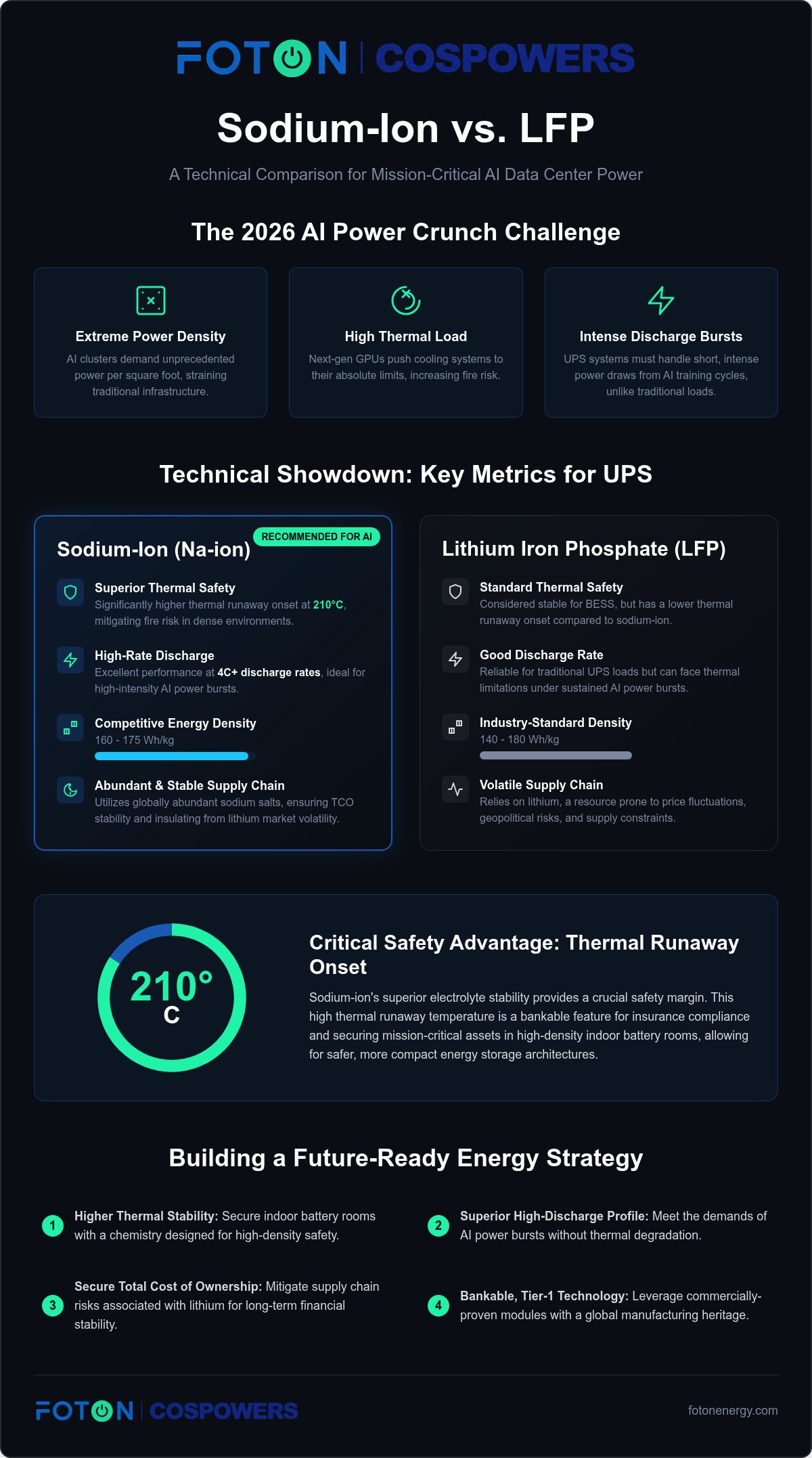
Reliability in a data center UPS environment isn't measured by how much energy you can store, but by how quickly you can release it. High-rate discharge is defined in 2026 as the ability of a cell to sustain a 4C or higher discharge rate without significant voltage sag or thermal degradation. While LFP has traditionally dominated this space, the comparison of sodium-ion vs lfp for data centers reveals a shifting advantage toward sodium's superior power density. In the mission-critical 2026 landscape, sodium-ion cells achieve energy densities of 160 to 175 Wh/kg, rivaling the 140 to 180 Wh/kg seen in LFP, but it's the power delivery that sets them apart.
The impact of voltage curves on Battery Management System (BMS) design is a critical technical consideration. Sodium-ion exhibits a more linear voltage drop compared to the exceptionally flat curve of LFP. While this requires a more sophisticated BMS to manage the wider operating window, it provides facility engineers with a far more accurate "fuel gauge" for State of Charge (SoC). This predictability is vital during the transition from grid to backup power, ensuring that the UPS provides a seamless bridge for AI workloads without the risk of sudden voltage collapse.
High-Rate Discharge and AI Load Profiles
AI clusters generate unpredictable, high-intensity load spikes that demand immediate response from the backup system. Sodium-ion chemistry maintains exceptional voltage stability during 4C discharge events, whereas LFP cells often experience a sharper thermal rise under identical stress. This thermal delta is crucial; higher temperatures during discharge accelerate cell aging and increase the burden on rack-level cooling. Research on the Sustainability and Performance of Na-ion vs Li-ion indicates that sodium-ion's internal resistance allows for more efficient high-current operations. For facility managers, this means UPS units can be sized more accurately without the "oversizing" traditionally required to mitigate LFP heat issues. If you're looking to optimize your rack-level integration, our engineering consulting services can help align your UPS architecture with these new performance benchmarks.
Cycle Life and Degradation Patterns
The 2026 benchmarks for sodium-ion cycle life have reached parity with mature technologies, with leading modules offering between 4,000 and 10,000 cycles. While LFP remains a standard with 6,000 to 10,000 cycles, the standby nature of data center applications shifts the focus toward calendar life. In a UPS hall, the battery spends most of its time at float voltage. Sodium-ion demonstrates excellent resilience to aging at high states of charge, which is a common failure point for lithium-based systems. For broader context on how these metrics scale, you can review our analysis of LFP battery cycle life for utilities. Ultimately, the sodium-ion vs lfp for data centers decision hinges on long-term stability; sodium-ion offers a more predictable state-of-health assessment over a typical 15-year facility lifespan.
Fire Safety and Thermal Stability: Mitigating Mission-Critical Risk
Mission-critical uptime is inseparable from fire safety. For indoor battery rooms, the technical comparison of sodium-ion vs lfp for data centers centers on thermal stability and the mitigation of catastrophic failure. While LFP is significantly safer than traditional cobalt-based lithium chemistries, sodium-ion represents a further evolution in safety architecture. This shift is particularly relevant as data centers face stricter fire safety regulations and rising insurance scrutiny in 2026. Choosing the right chemistry isn't just about performance; it's about securing your infrastructure against the most severe operational risks.
Safety is a proactive discipline. We utilize AI driven energy management systems to monitor cell-level impedance and temperature gradients in real time. These systems provide predictive safety monitoring, identifying potential thermal anomalies long before they escalate into a runaway event. By integrating advanced EMS with stable chemistry, operators can achieve a level of risk mitigation that meets the stringent requirements of modern data hall environments.
Thermal Runaway: Na-ion vs. LFP Parameters
The fundamental safety advantage of sodium-ion lies in its thermal runaway onset temperature. In 2026, certified sodium-ion cells demonstrate a thermal runaway trigger at approximately 210°C, whereas LFP typically enters runaway between 180°C and 220°C depending on the manufacturer. Beyond the trigger temperature, the nature of the event differs significantly. Sodium-ion cathode materials release less oxygen during decomposition, which reduces the intensity of the fire and makes it more manageable for standard suppression systems. These characteristics are critical for achieving UL9540A certification, the gold standard for large-scale BESS safety in 2026.
Safety Architecture in Modern Data Halls
We bridge the gap between Tier-1 manufacturing and global engineering by integrating Cospowers' 30-year manufacturing heritage into our modular data center solutions. This architecture prioritizes early detection through gas sensing and localized fire suppression within high-density racks. A unique logistical advantage of sodium-ion is its ability to be shipped at zero volts. Unlike LFP, which must maintain a minimum state of charge to prevent copper dissolution, sodium-ion can be completely discharged for transit. The ability to transport sodium-ion systems at zero volts significantly reduces the risk profile for logistics providers and site owners, directly lowering project insurance premiums.
Our collaborative approach ensures that your safety architecture is both compliant and bankable. We focus on durability and efficiency, providing a guiding hand for large-scale investors who require stable, high-performance energy storage. By aligning your facility with these advanced safety standards, you ensure long-term resilience in an increasingly regulated industrial ecosystem.
The Economic Outlook: Calculating TCO and Bankability
Financial viability in 2026 is driven by strategic foresight rather than simple upfront cell pricing. While earlier industry hype suggested sodium-ion would be half the price of lithium, the current market reflects a period of emerging parity. Sodium-ion cell costs currently sit between $70 and $120 per kWh, while LFP remains stable at approximately $70 to $80 per kWh. The true economic argument for sodium-ion vs lfp for data centers lies in the Total Cost of Ownership (TCO). When you factor in reduced fire suppression infrastructure, lower insurance premiums from zero-volt shipping, and decreased HVAC requirements, the "security premium" of sodium-ion becomes a measurable financial asset. For a broader look at how these economics scale, see our commercial and industrial BESS solutions guide.
Supply Chain Resilience and Material Abundance
Sodium's global abundance provides a structural hedge against the geopolitical volatility associated with lithium. By 2030, infrastructure planning requires a chemistry that doesn't rely on concentrated mineral deposits or sensitive trade routes. Sodium-ion also carries a superior sustainability score, aligning with the "Green Mandate" and new state-level regulations like Illinois' POWER Act. This material resilience ensures that your long-term expansion plans aren't held hostage by raw material shortages or sudden lithium price spikes.
Bankability and Tier-1 Certification
Financing a hyperscale data center requires more than technical specifications; it requires bankability. Strategic alignment for sodium-ion vs lfp for data centers is about the credibility of the partner behind the technology. Financiers in 2026 prioritize systems with DNV verification and a clear manufacturing heritage. Foton's exclusive partnership with Cospowers leverages a 30-year manufacturing history to provide the "bankable" assurance needed for large-scale infrastructure investments. We provide:
- Verified Performance Data: Rigorous testing under high-discharge UPS conditions.
- Comprehensive Warranties: System-level protection that secures long-term ROI.
- Operational Stability: A steady, guiding hand backed by international certifications.
Choosing a partner with a deep industrial ecosystem ensures your investment remains stable as the market evolves. Contact our engineering team to request a custom TCO analysis for your next high-density project.
Strategic Deployment: Integrating Tier-1 Solutions
Success in 2026 requires a nuanced deployment strategy rather than a one-size-fits-all approach. When evaluating sodium-ion vs lfp for data centers, your facility's specific Tier rating and workload profile must dictate the chemistry. For legacy Tier-1 and Tier-2 facilities where long-duration backup is the priority, the maturity of LFP remains a stable choice. However, for Tier-3 and Tier-4 hyperscale environments supporting dense AI clusters, the high-rate discharge and safety profile of sodium-ion provide a distinct competitive advantage. It's a strategic decision that balances immediate power needs with long-term infrastructure resilience.
The Hybrid Approach: Mixing Chemistries?
Strategic operators are increasingly exploring hybrid architectures to maximize both energy density and power response. You can deploy LFP for sustained, long-duration backup while utilizing sodium-ion modules to handle high-frequency regulation and rapid UPS transients. Our AI-driven EMS is designed to manage these multi-chemistry environments, harmonizing the different voltage curves and thermal characteristics into a unified power stream. To begin this transition, we recommend implementing a pilot sodium-ion rack within a controlled Tier-3 environment to validate performance under your specific load profiles. This phased integration allows you to leverage BESS engineering consulting services to conduct detailed feasibility studies before a full-scale rollout.
Procurement and Engineering Support
Moving from a technical evaluation to a live deployment requires a partner who understands the complexities of grid-code compliance and industrial-scale integration. Foton Energy serves as the strategic bridge between Cospowers' Tier-1 manufacturing and your facility's engineering requirements. We facilitate wholesale procurement of certified modules while providing the technical oversight necessary for seamless commissioning. As you finalize your 2026 infrastructure specifications, ensure your checklist includes:
- Thermal runaway onset verification: Confirming the 210°C benchmark for sodium-ion cells to ensure indoor safety compliance.
- Insurance and safety certification: Validating UL9540A and zero-volt transport protocols to reduce project premiums.
- BMS Interoperability: Ensuring communication protocols are compatible with existing data hall management software.
We invite you to participate in a shared vision of resilient, high-performance energy infrastructure. Our team provides the visionary pragmatism needed to navigate this transition, ensuring your data center remains both technologically advanced and commercially stable. By choosing Foton, you gain a trusted partner with a 30-year manufacturing heritage, ready to optimize your uptime and safety in the face of the AI power crunch. Don't leave your energy strategy to chance; align with a partner who understands the technical nuances of sodium-ion vs lfp for data centers.
Securing Your Infrastructure for the Next Decade of AI Growth
Strategic energy management is the foundation of high-density operational success. Choosing between sodium-ion vs lfp for data centers is no longer just a technical debate; it's a strategic move to future-proof your facility against increasing power densities and thermal risks. While LFP continues to provide reliable service for established workloads, sodium-ion's superior thermal runaway onset and high-rate discharge capabilities make it the definitive choice for the 2026 AI-driven data hall.
Reliability is built on proven heritage and intelligent integration. As the exclusive global partner of Cospowers, Foton Energy provides a bridge to more than 30 years of manufacturing excellence. We combine this stability with AI-driven safety and thermal management systems to ensure your investment is both resilient and compliant with evolving standards. We invite you to leverage our engineering expertise to optimize your facility's performance. Partner with Foton Energy for Tier-1 BESS Infrastructure and let's build a more secure, optimized future together.
Frequently Asked Questions
Is sodium-ion really safer than LFP for indoor data center use?
Sodium-ion demonstrates superior safety characteristics for indoor environments due to its higher thermal runaway onset of approximately 210°C. It's inherently more stable because the cathode materials release significantly less oxygen during decomposition compared to lithium-based chemistries. This reduction in oxygen release makes potential fires far more manageable for standard suppression systems. When evaluating sodium-ion vs lfp for data centers, these technical safety advantages directly translate into lower insurance premiums and easier regulatory compliance for high-density facilities.
How do the discharge rates of sodium-ion compare to LFP in UPS applications?
Sodium-ion batteries excel in UPS applications by maintaining exceptional voltage stability at discharge rates of 4C or higher. While LFP is a mature technology, it often experiences a sharper thermal rise during the high-intensity bursts required by modern AI workloads. Sodium-ion's lower internal resistance allows it to deliver power more efficiently without the heat-related degradation seen in other chemistries. This capability enables facility managers to size UPS systems more accurately while ensuring mission-critical uptime during power transients.
Can sodium-ion batteries be integrated into existing data center UPS systems?
Integration is feasible but requires a sophisticated Battery Management System (BMS) to handle sodium-ion's unique linear voltage curve. Unlike LFP's flat discharge profile, sodium-ion's voltage drops predictably, allowing for more accurate state-of-charge monitoring. While the physical rack footprints are often compatible, our engineering consulting team ensures that the BMS protocols are fully aligned with your existing data hall management software. This strategic approach ensures a seamless transition without compromising the reliability or the stability of your backup power architecture.
What is the expected cycle life of a sodium-ion battery in 2026?
In 2026, leading sodium-ion modules offer a cycle life ranging from 4,000 to over 10,000 cycles, with top-tier products like CATL's Naxtra reaching the higher end of that spectrum. This brings sodium-ion into parity with the 6,000 to 10,000 cycles typically expected from mature LFP technology. For data center applications, the calendar life often holds more strategic importance than cycle life, and sodium-ion shows excellent resilience when maintained at a float voltage over a typical 15-year facility lifespan.
Why is sodium-ion currently marketed as a solution for cold climates?
Sodium-ion batteries exhibit remarkable performance in cold climates, retaining over 90% of their capacity at -20°C. In contrast, LFP batteries typically drop to 70-75% capacity under similar conditions, often requiring auxiliary heating systems that increase operational costs. While data centers are climate-controlled, this cold-weather resilience provides an extra layer of security for outdoor BESS installations and reduces the energy load on thermal management systems during extreme external temperature fluctuations that can stress indoor cooling loops.
How does the bankability of sodium-ion compare to mature LFP technology?
Bankability for sodium-ion has matured rapidly, with financiers now prioritizing systems backed by Tier-1 manufacturing heritage and DNV verification. While LFP has a longer track record, the strategic partnership between Foton and Cospowers provides the 30-year legacy required to inspire investor confidence. In 2026, the comparison of sodium-ion vs lfp for data centers hinges on this "bankable" assurance, ensuring that large-scale infrastructure investments are protected by rigorous testing, operational excellence, and globally recognized certifications.
What are the primary cost drivers for sodium-ion batteries in 2026?
The primary cost advantage for sodium-ion stems from the global abundance and low cost of sodium salts compared to lithium. However, current 2026 pricing of $70 to $120 per kWh is driven by the ongoing scaling of manufacturing facilities. As production volumes increase and supply chains stabilize, the initial CAPEX is expected to drop further. Sophisticated buyers focus on the Total Cost of Ownership, where reduced fire suppression and insurance costs often offset the current cell price parity with LFP.
Can sodium-ion batteries be shipped at zero percent state of charge?
Yes, sodium-ion batteries can be completely discharged and shipped at zero volts without damaging the cells. This is a significant logistical advantage over LFP, which must maintain a minimum state of charge to prevent copper dissolution in the anode. Shipping at zero volts eliminates the risk of thermal events during transit, simplifies international logistics, and directly reduces project insurance premiums. This capability makes sodium-ion an exceptionally safe and cost-effective choice for global data center deployments where transport safety is paramount.


