

In 2026, the assumption that lithium-ion is the only bankable choice for resilient infrastructure has officially expired. While LFP remains a dominant force, the rapid ascent of sodium-ion as a cost-competitive alternative is fundamentally shifting how EPCs and developers approach stationary storage. You’re likely managing the dual pressures of lithium price volatility and supply chain bottlenecks that threaten project timelines. It’s difficult to balance strict safety requirements for critical infrastructure with the need for systems that won't degrade in extreme thermal environments.
This guide provides a definitive engineering framework to navigate the lfp vs sodium ion for microgrids selection process with professional confidence. We deliver a granular technical comparison of cycle life and energy density, verified against the Tier-1 manufacturing heritage of our strategic partner, Cospowers. You'll find a clear breakdown of safety standards alongside strategies for integrating AI-driven EMS to ensure peak performance. We're here to help you align your chemistry choice with the specific climate, cost, and resilience targets of your next microgrid project.
Key Takeaways
- Master the 2026 engineering framework for selecting lfp vs sodium ion for microgrids, aligning your chemistry choice with specific project climate and resilience goals.
- Compare technical benchmarks including cycle life and energy density to determine which chemistry maximizes ROI for high-cycling arbitrage versus wide-temperature stability.
- Assess total cost of ownership through the lens of bankability, leveraging Tier-1 manufacturing heritage and global certifications to secure large-scale infrastructure investments.
- Identify the optimal deployment strategy for remote and urban applications, balancing footprint constraints against the need for fire safety and maintenance efficiency.
- Learn how AI-driven EMS acts as a critical differentiator, coordinating hardware performance to ensure long-term reliability and grid optimization.
The 2026 Microgrid Landscape: Why Chemistry Selection is Critical
Microgrids have evolved from niche backup solutions into the vital organs of global energy infrastructure. In 2026, the demand for decentralized resilience is reaching a peak, driven by a projected 5.7% increase in U.S. electricity demand by 2030 and the rising frequency of extreme weather events. For EPCs and developers, the choice between lfp vs sodium ion for microgrids is no longer just a technical detail. It's a strategic decision that dictates project bankability and long-term operational success. We're seeing a fundamental shift from a lithium-only mindset to a more sophisticated, diversified chemistry strategy.
While Lithium Iron Phosphate (LFP) remains a dominant force, 2026 marks a definitive inflection point. Sodium-ion technology has successfully transitioned from pilot lines to commercial scale, offering a viable alternative for stationary storage where lithium supply chain bottlenecks once created significant project risk. This transition is accelerated by green mandates and regulatory pressures that favor sustainable, abundant materials. Developers now have the opportunity to architect systems that are not only high-performing but also resilient to the geopolitical shifts that often disrupt rare mineral markets.
Defining Microgrid Performance Requirements
Reliability is the non-negotiable mandate for modern infrastructure. Microgrids must provide 24/7 uptime for critical assets, requiring chemistry that can handle specific load profiles without premature degradation. Scalability also plays a central role; modular architecture allows C&I operators to expand capacity as their energy needs grow. Navigating the 2026 regulatory landscape, including legislation like the U.S. STRONG GRID Act, requires a deep understanding of Sodium-ion battery fundamentals and how they compare to established LFP standards in terms of safety and grid-code compliance.
The Supply Chain Factor: Lithium Volatility vs. Sodium Abundance
Supply security is a primary driver for the adoption of sodium-based systems. While LFP pack prices have stabilized near $81 per kWh in early 2026, the market remains sensitive to geopolitical shifts and strict Foreign Entity of Concern provisions. Sodium carbonate is roughly 1,000 times more abundant in the Earth's crust than lithium, which drastically reduces the risk of resource scarcity. By integrating sodium-ion into the mix, developers can mitigate the impact of raw material volatility on their capital expenditures. This abundance doesn't just lower costs; it provides a foundation of stability for large-scale infrastructure investments, ensuring that the components needed for grid expansion are always accessible and bankable.
Performance Benchmarking: LFP Stability vs. Sodium-Ion Versatility
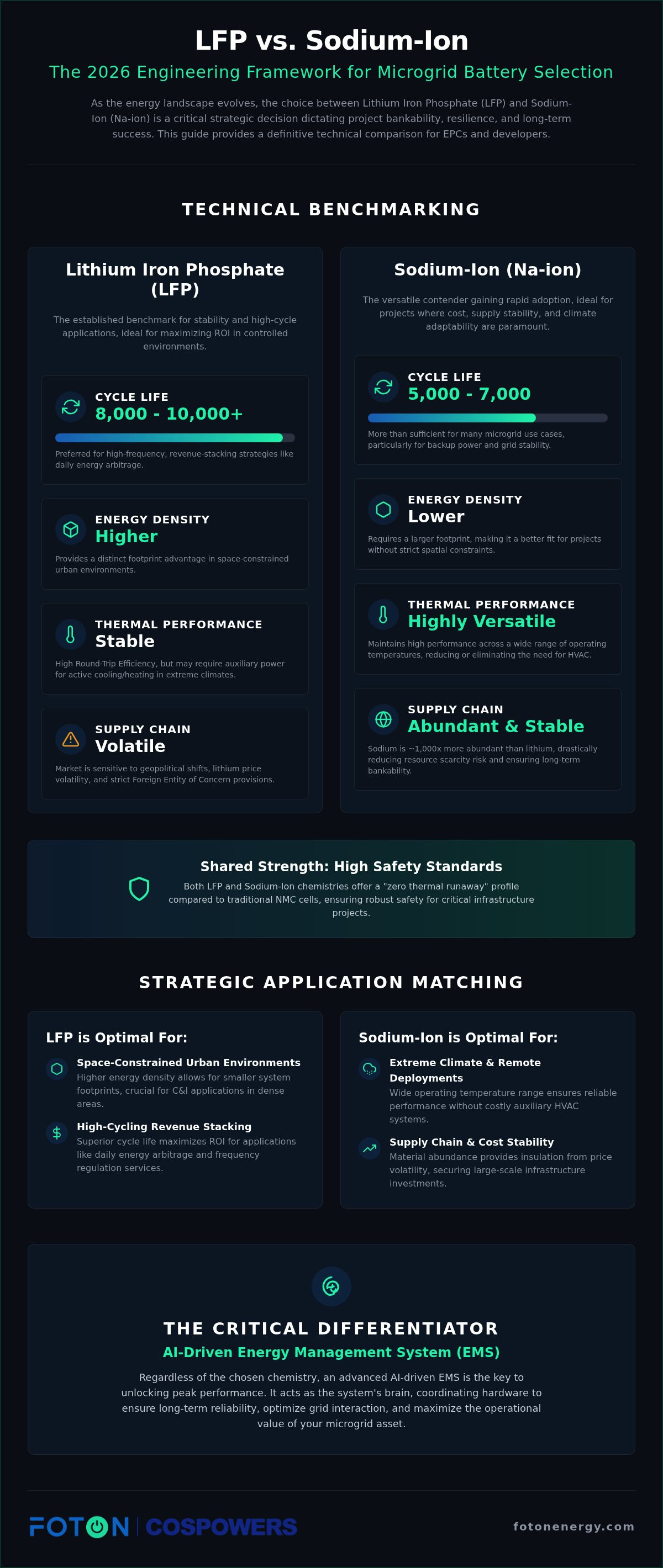
Engineering a resilient energy system requires a cold-eyed analysis of electrochemical trade-offs. When evaluating lfp vs sodium ion for microgrids, the decision hinges on whether your site prioritizes spatial efficiency or environmental adaptability. LFP batteries currently offer a higher energy density, providing a distinct footprint advantage in space-constrained urban environments. However, sodium-ion has emerged as a versatile contender, particularly for projects where operating conditions are less than ideal. Both chemistries share a "zero thermal runaway" profile when compared to traditional NMC cells, ensuring high safety standards for critical infrastructure.
LFP remains the industry benchmark for high-cycling applications. With cycle lives often exceeding 8,000 to 10,000 cycles, it's the preferred choice for revenue-stacking strategies like daily energy arbitrage. Conversely, 2026 benchmarks for sodium-ion cells show a cycle life range of 5,000 to 7,000 cycles. While lower than LFP, this is more than sufficient for many microgrid use cases, especially those focused on backup power and grid stability. As highlighted in a recent IEA report on battery storage, the diversification of chemistries is essential for a secure energy transition.
Round-Trip Efficiency (RTE) is often the hidden cost of microgrid operations. LFP generally maintains a higher RTE in controlled environments, but this advantage can be eroded by the auxiliary power required for active cooling or heating in extreme climates. Sodium-ion's inherent stability across a wider temperature range reduces the parasitic load of thermal management systems, potentially offering better net efficiency in harsh outdoor deployments.
Temperature Resilience: The Sodium-Ion Edge
Sodium-ion technology excels where lithium-ion struggles: extreme cold. It can maintain 90% of its discharge capacity at -40°C, eliminating the need for heavy, energy-consuming heating loads. LFP systems require sophisticated thermal management to prevent performance degradation below freezing, which adds complexity and cost to the overall system architecture. The thermal threshold where sodium-ion becomes the more efficient choice is typically found in environments that consistently drop below -10°C, where the parasitic load of LFP heating exceeds the sodium-ion efficiency gap.
Power Capability and High-Rate Discharge
Power profiles vary significantly between these two technologies. Sodium-ion cells demonstrate superior performance in high-power, short-duration bursts, making them ideal for frequency regulation and rapid response to transient loads. LFP maintains steady-state excellence, serving as the backbone for long-duration energy storage (LDES) and consistent discharge cycles. For developers seeking to optimize these performance profiles, our engineering consulting services can help map specific load requirements to the most cost-effective chemistry.
Total Cost of Ownership (TCO) and Bankability in 2026
Financiers don't just look at the price tag; they look at the risk profile. Choosing between lfp vs sodium ion for microgrids requires a shift from focusing on CAPEX to a rigorous TCO analysis. While LFP pack prices have settled around $81 per kWh in early 2026, the real value lies in the 10 to 15 year operational window. Cospowers' 30 year manufacturing heritage provides a critical safety net for LFP investments, offering the historical data financiers demand. Sodium-ion, while newer, is projected to deliver an 18% to 25% lower TCO over a decade in specific applications, particularly where maintenance and thermal management costs are high.
The emerging secondary market for sodium-ion components is also beginning to influence project valuations. As these systems reach the end of their first life, the ability to recycle materials like sodium carbonate more easily than lithium adds a layer of long-term value. For developers, this means the residual value of a microgrid asset is becoming a tangible part of the financial model, rather than a speculative footnote.
Analyzing Levelized Cost of Storage (LCOS)
Levelized Cost of Storage (LCOS) is the ultimate metric for microgrid developers. It accounts for the total cost of the system divided by the cumulative energy discharged over its life. For LFP, the high cycle life (often exceeding 8,000 cycles) drives down the LCOS for high-utilization sites that require daily energy arbitrage. Sodium-ion modules are currently following a steep cost curve; while system-level costs range between $80 and $120 per kWh today, the trajectory toward 2030 suggests rapid parity. We expect the ROI for sodium systems to improve as manufacturing scales, making them increasingly attractive for projects with lower cycling requirements but higher environmental stress.
Supply Chain Guide for Tier-1 Procurement
Bankability is synonymous with Tier-1 status. In 2026, a Tier-1 manufacturer is defined by more than just volume; it requires DNV verification, international safety certifications, and a transparent supply chain. Our strategic partnership with Cospowers allows Foton to serve as a bridge to this excellence, ensuring that EPC partners receive hardware that meets the most stringent global standards. We focus on securing supply chains that are resilient to geopolitical shifts, leveraging sodium's abundance to mitigate the risks associated with traditional lithium sourcing. This reliability is what allows developers to move from pilot projects to utility-scale deployments with absolute confidence.
Strategic Application: Matching Chemistry to Microgrid Use Cases
Successful microgrid deployment in 2026 requires more than just choosing a battery; it demands a strategic alignment between electrochemical properties and operational reality. The decision between lfp vs sodium ion for microgrids is often dictated by the physical and economic constraints of the site. Remote assets, such as mining operations in Western Australia, prioritize low maintenance and extreme temperature tolerance. In these environments, sodium-ion's ability to operate without heavy HVAC loads provides a significant advantage. Conversely, urban C&I sites in high-density areas like London or Singapore must maximize energy density and adhere to the strictest fire safety protocols, often making LFP the preferred choice for its compact footprint.
Mission-critical infrastructure, including data centers and telecommunications hubs, requires high-rate discharge capabilities for instantaneous backup. While LFP is excellent for steady-state energy storage, sodium-ion's superior performance in high-power bursts makes it an ideal candidate for frequency regulation and transient load management. We're also seeing the rise of hybrid strategies. By combining LFP for high-cycling arbitrage with sodium-ion for peak shaving and thermal resilience, developers can create a multi-layered defense against grid instability.
The 5-Step Selection Framework
To ensure project bankability, we recommend a methodical approach to chemistry selection:
- Step 1: Audit the environmental profile. Identify the full range of ambient temperatures. If the site consistently drops below -10°C or exceeds 40°C, sodium-ion's thermal stability offers lower parasitic loads.
- Step 2: Define revenue streams. Determine if the primary goal is daily energy arbitrage (favoring LFP's cycle life) or emergency backup and frequency response (favoring sodium-ion's power density).
- Step 3: Calculate energy-to-footprint ratios. Assess whether spatial constraints require the higher volumetric energy density of Tier-1 LFP modules.
- Step 4: Assess grid-connection strength. Weaker grids benefit from the rapid response times of sodium-based systems.
- Step 5: Optimize for LCOS. Select the configuration that delivers the lowest Levelized Cost of Storage over the asset's 15-year lifecycle.
Case Study Insights: Remote Australian vs. European Urban Deployments
Applying this framework to an off-grid mining site in Western Australia reveals that sodium-ion's resilience to heat reduces cooling costs significantly compared to standard lithium setups. In contrast, an urban data center microgrid in London benefits from LFP's proven track record and high energy density, allowing for more capacity within a restricted basement or rooftop footprint. Integrating these chemistries into commercial and industrial BESS solutions ensures that EPCs can provide a bankable guarantee to investors. For a tailored analysis of your project's specific load profile, consult with our engineering team today.
Future-Proofing with Foton: AI-Driven EMS and Tier-1 Hardware
Hardware is only as resilient as the logic that governs it. While the debate over lfp vs sodium ion for microgrids often focuses on cell chemistry, the 2026 reality is that project success depends on high-level system integration. Foton bridges the gap between raw hardware and operational excellence through our strategic alliance with Cospowers, a Tier-1 manufacturing partner with over 30 years of heritage. We don't just provide containers; we deliver intelligent infrastructure designed for longevity, safety, and bankability.
Our approach centers on the realization that a battery is only as smart as its controller. By deploying AI driven energy management systems, we empower developers to balance hybrid chemistries effectively. This intelligence layer ensures that every kilowatt-hour is optimized for the specific needs of the grid, whether that involves high-cycling arbitrage or rapid-response frequency regulation. This high-performance atmosphere is what separates a standard storage project from a foundational pillar of grid stability.
AI-Driven Optimization for Microgrid Resilience
Predictive maintenance is no longer a luxury. It's a necessity for protecting large-scale infrastructure investments. Our EMS utilizes machine learning to monitor cell health in real-time, identifying potential degradation patterns before they impact system uptime. This proactive approach extends the operational life of both LFP and Sodium-Ion assets, maximizing the ROI for EPC partners. AI algorithms dynamically adjust state-of-charge limits and discharge rates by mapping the flatter voltage profile of LFP against the sloping discharge curve of sodium-ion to maintain seamless power delivery. Real-time load balancing and peak shaving optimization become automated processes, reducing the need for manual intervention and lowering long-term OPEX.
End-to-End Engineering Support
Navigating the complexities of utility scale BESS procurement requires a partner who understands the nuances of grid-code compliance and safety architecture. Foton provides comprehensive engineering consulting, from initial feasibility studies to custom thermal management design. We ensure that your system meets the most rigorous DNV and Tier-1 standards, providing the grounded assurance that financiers require for large-scale deployments. Whether you're comparing lfp vs sodium ion for microgrids for a remote mining site or an urban C&I application, our team is ready to support your vision with technical proof points and operational excellence.
Partner with Foton for your next microgrid project and secure a future-ready energy solution backed by world-class manufacturing excellence and sophisticated software control.
Architecting the Future of Resilient Infrastructure
The decision between lfp vs sodium ion for microgrids has evolved into a strategic optimization of your project's environmental and financial profile. We've established that LFP's cycle life remains the benchmark for high-utilization sites, while sodium-ion's thermal resilience offers a breakthrough for extreme climates and high-power applications. Success in 2026 depends on aligning these electrochemical strengths with Tier-1 manufacturing standards and sophisticated software control. By leveraging our exclusive global partnership with Cospowers, you gain access to a 30 year heritage of excellence backed by an AI-driven energy management system designed for grid optimization.
It's time to move beyond the limitations of single-chemistry strategies and embrace a diversified, bankable approach to energy storage. Consult with Foton Energy's Engineering Team to refine your technical specifications and secure your project's long-term performance. We're ready to help you lead the transition toward a more stable and resilient energy future with professional confidence and technical precision.
Frequently Asked Questions
Is sodium-ion battery technology bankable for utility-scale microgrids in 2026?
Sodium-ion is bankable for utility-scale projects in 2026 when sourced from Tier-1 manufacturers like Cospowers. Financiers now accept these systems because they meet DNV verification standards and offer a transparent supply chain. While lithium remains the established leader, the cost stability of sodium-ion makes it an attractive, low-risk alternative. Working with an experienced strategic partner ensures that your microgrid infrastructure is backed by a credible manufacturing heritage and global reliability.
How does the energy density of sodium-ion compare to LFP for C&I applications?
LFP maintains a volumetric energy density advantage over sodium-ion in 2026. This makes LFP the preferred choice for space-constrained C&I applications where maximizing capacity in a small footprint is critical. Sodium-ion systems typically require more physical space to achieve the same energy output. However, for stationary microgrids where ground space is abundant, the density gap is often outweighed by the lower cost and thermal stability of sodium-based chemistries.
Can I mix LFP and sodium-ion batteries in the same microgrid system?
You can integrate both chemistries within a single system by utilizing an intelligent, AI-driven EMS. This hybrid approach allows you to leverage LFP for high-cycling arbitrage and sodium-ion for rapid-response frequency regulation or backup power. The EMS manages the different discharge characteristics of each chemistry to ensure seamless power delivery. This strategy is becoming a standard for developers looking to optimize the lfp vs sodium ion for microgrids balance across diverse load profiles.
What are the primary safety differences between LFP and sodium-ion batteries?
Both chemistries offer superior safety profiles compared to traditional NMC batteries, featuring "zero thermal runaway" characteristics during standard operation. Sodium-ion batteries have a slight edge in safety during over-discharge scenarios and can be transported at zero volts, which simplifies logistics. LFP is highly stable but requires more rigorous thermal management in high-temperature environments. Both meet international safety standards, making them suitable for critical infrastructure and urban deployments where fire safety is a primary concern.
Which chemistry performs better in extreme cold climates for remote microgrids?
Sodium-ion technology performs significantly better in extreme cold, maintaining up to 90% of its capacity at -40°C. This makes it the ideal choice for remote microgrids in arctic or alpine regions where LFP would require energy-intensive heating systems. By reducing the parasitic load of thermal management, sodium-ion improves the net efficiency of the entire system. In cold climates, the lower maintenance requirements of sodium-based systems often lead to a lower total cost of ownership.
What is the expected cycle life of a Tier-1 sodium-ion battery in 2026?
A Tier-1 sodium-ion battery in 2026 typically offers a cycle life between 5,000 and 7,000 cycles. While this is lower than the 8,000 to 10,000 cycles often seen in premium LFP cells, it's more than sufficient for many stationary storage applications. For microgrids focused on backup power or peak shaving rather than daily deep-cycling arbitrage, this cycle life provides an excellent balance of longevity and capital efficiency. Always verify these benchmarks with DNV-certified testing data.
How does AI-driven EMS improve the ROI of a multi-chemistry BESS?
An AI-driven EMS improves ROI by extending the operational life of your assets through predictive maintenance and precision load balancing. It optimizes the discharge curves of different chemistries to maximize energy throughput while minimizing degradation. This is especially critical when evaluating lfp vs sodium ion for microgrids, as the software ensures the most cost-effective chemistry handles the appropriate load. Automated peak shaving and frequency response further enhance revenue stacking opportunities, shortening the project's payback period significantly.
Are sodium-ion batteries more sustainable than LFP for green energy mandates?
Sodium-ion batteries are generally considered more sustainable than LFP due to the abundance of sodium carbonate, which is 1,000 times more plentiful than lithium. Sourcing sodium is less geographically concentrated, reducing the environmental and geopolitical impact of the supply chain. Additionally, sodium-ion cells don't require copper current collectors, using aluminum instead, which is easier to recycle. These factors help projects align with strict green energy mandates and corporate sustainability goals without sacrificing performance.


