

The strongest BESS installation business is built around project fit, not one standard system. Building a business as a BESS installer means matching each project type and customer configuration to a clear operational or financial need. Residential, commercial, off-grid and utility-scale projects each call for different decisions about system design, energy use and value.
Equipment and installation capability matter, but sustainable growth also depends on choosing projects that align with your expertise. A project’s suitability may depend on demand charges, time-of-use rates, backup requirements, available incentives and the customer’s investment objectives.
This article explains how those factors shape project selection and business strategy. It compares standalone, hybrid and co-located systems; considers residential, commercial, off-grid and utility-scale configurations; and explains how tariffs and incentives affect the project case. The aim is a practical framework for identifying where your installation business can deliver a strong fit and lasting value.
Key Takeaways
- Match standalone, hybrid, or co-located project designs to the customer’s energy needs and operating priorities.
- Assess how demand charges and time-of-use rates may shape battery dispatch and a project’s financial case.
- Compare incentives with project costs, operating assumptions, and expected savings when evaluating return on investment.
- Choose a configuration that fits the application, from residential and commercial systems to off-grid and utility-scale projects.
- Use project selection to focus your business on customer needs your capabilities can serve effectively.
Demand charges and time-of-use rate management
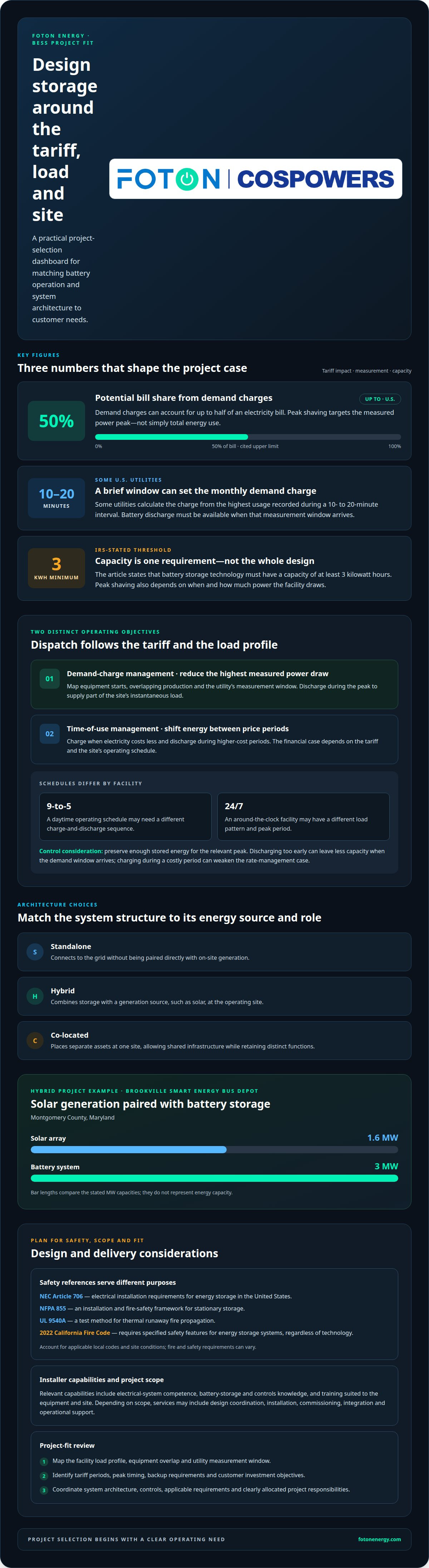
Demand charges make peak shaving a key use case for commercial energy storage systems. In the United States, demand charges can account for up to 50% of an electricity bill. Some US utilities calculate the monthly charge from the highest usage recorded during a 10- to 20-minute window. A brief period of simultaneous equipment use can therefore set the demand component for the month. The battery’s role is to reduce that measured peak, not simply to lower total energy consumption.
Start by examining how a facility’s load changes throughout its operating cycle. Note when major equipment starts, when production overlaps and when the utility measures demand. A battery can then discharge during a peak period to supply part of the site’s instantaneous load. This is peak shaving. Its value depends on whether stored energy is available during the utility’s measurement window and whether the system can meet the facility’s power needs at that time.
Time-of-use rates create a related but distinct opportunity. A battery can charge when electricity costs less and discharge during higher-cost periods. The operational schedule matters: a building with a 9-to-5 operating schedule may need a different charging and discharging sequence from a facility that runs 24/7. For example, daytime activity may drive a commercial site’s demand peak, while another site’s highest load may occur overnight. Dispatch should follow the tariff and load profile, not a generic clock schedule.
Assess the two objectives separately. Demand-charge management targets the highest measured power draw. Time-of-use management shifts energy use between higher- and lower-cost periods. One system may address both, but its controls need to preserve enough stored energy for the relevant peak while accounting for planned charging. Discharging too early can leave less capacity available when the demand window arrives. Charging during a costly period can weaken the rate-management case.
Battery size and dispatch capability should reflect the actual operating pattern. The Internal Revenue Service states that battery storage technology must have a capacity of at least 3 kilowatt hours. That threshold is a specific capacity requirement, while peak shaving also depends on when and how much power the facility draws. Evaluate the load profile, tariff periods, and measurement window together before shaping the system’s control strategy.
For an installer, this analysis makes project selection more disciplined. A strong candidate has a clear demand peak or a meaningful price difference between lower- and higher-cost periods. Map those periods against the facility’s schedule, then model charging and discharge around its operating needs. This turns rate management into a specific project objective and gives the customer a clear basis for understanding how the battery will be used.
Standalone, hybrid, and co-located BESS projects
Project architecture determines the battery’s energy source, operating role and connection to the site. A standalone system connects to the grid without being paired directly with on-site generation. A hybrid project combines storage with a generation source, such as solar. A co-located project places separate assets at one site, allowing shared infrastructure while retaining distinct functions. Each structure affects design coordination, controls and the customer’s operating objectives.
The Brookville Smart Energy Bus Depot in Montgomery County, Maryland, pairs a 1.6 MW solar array with a 3 MW battery system. It illustrates how a hybrid configuration can bring generation and storage together at one operating site. Another customer may need storage without on-site renewables or a system that supports existing equipment. Battery storage can also store power from a standby generator for use when the generator isn’t running.
Safety and code planning belong in early project design. In the United States, NEC Article 706 sets electrical installation requirements for energy storage, while NFPA 855 provides an installation and fire-safety framework for stationary storage. UL 9540A is a test method for thermal runaway fire propagation. These references serve different purposes, so project design should account for applicable local codes and site conditions. Fire and safety requirements for energy storage can vary, so project design should account for applicable local codes and site conditions. The 2022 California Fire Code requires specified safety features for energy storage systems, regardless of technology.
BESS installers need electrical-system competence, knowledge of battery storage and controls, and training relevant to the equipment and site. State and local requirements affect qualifications for particular installation work. Depending on its scope, a BESS installation business may provide design coordination, installation, commissioning, integration and operational support. Building a business as a BESS installer also means defining which responsibilities the team can deliver reliably.
Customer development can start with facilities seeking storage, solar contractors looking for integration partners, and utilities considering grid-connected projects. Build partnerships by clarifying technical interfaces, project responsibilities, and coordination for approvals and commissioning. For those building a business as a BESS installer, clear scopes help prevent gaps between generation, battery and grid connections.
Plan for insurance, warranty and liability exposure through project-specific contracts and clearly allocated responsibilities. Consider risks related to installation work, equipment performance, commissioning and operational handover. Ensure warranty terms align with the equipment supplied and the commitments in the installation contract.
To start and scale in a specific U.S. state, identify the target customer and project type, map applicable state and local requirements, establish qualified delivery capacity, and build partnerships. Then document a repeatable process for design coordination, installation, commissioning, and service as projects grow. For technical project planning, explore energy storage project considerations.
Financial incentives and return on investment
Incentives can strengthen a battery project’s investment case, but they shouldn’t replace a clear operating rationale. The Internal Revenue Service lists a 30% base federal investment tax credit under §48E for standalone battery storage systems. For a project assessment, distinguish the potential credit from savings generated through electricity use, demand management, or backup value. Each depends on different project characteristics and should be evaluated separately.
Build the return-on-investment model around the customer’s actual operating case. Compare the system’s project and operating costs with expected electricity savings and other measurable value, such as avoided disruption. Include charging needs, discharge patterns, controls, maintenance assumptions and the period used to assess benefits. Changes in electricity rates or operating schedules can alter projected savings, so test scenarios rather than relying on a single forecast.
Regional incentives can also affect the project economics. The research brief states that FEOC sourcing restrictions for the federal investment tax credit begin in 2026, and that the federal investment tax credit phases out after 2033. It also lists an exemption of 80% of a system’s appraised value from North Carolina property taxes for eligible commercial renewable energy systems. These provisions have different eligibility conditions and geographic reach, so they shouldn’t be treated as interchangeable benefits.
Startup costs for a BESS installation company depend on its project scope and operating model, not on one universal budget. Equipment needs may include electrical tools, testing instruments, safety equipment, vehicles and project-management software, as well as staff capability, insurance and working capital. The balance changes if the business holds inventory or focuses on larger, more complex projects.
In a customer proposal, separate forecast savings from incentive value and state the assumptions behind each. Explain how expected electricity use, charging source, operating schedule and system controls affect the result. If a project combines solar with battery storage, assess how the generation profile aligns with charging needs. Storage can strengthen a solar project’s business case, especially when stored electricity serves a defined operating objective.
Use sensitivity analysis to test changing assumptions. Compare the base case with scenarios involving different electricity prices, site loads or dispatch schedules, without presenting one forecast as certain. Then identify which assumptions have the greatest effect on projected savings. This gives the customer a clearer basis for comparing options and helps the installer prioritize projects with a coherent economic case.
For business planning, assess the economics of each project type before committing resources. A standalone system may have a different incentive profile from a system paired with generation. Keep incentive eligibility, equipment sourcing, customer savings and project delivery costs distinct in the model. This discipline helps installers explain the commercial rationale without relying on one incentive or overstating the expected return.
Load shifting and time-of-use arbitrage
Load shifting changes when a site uses stored electricity, moving consumption away from costly periods. With time-of-use arbitrage, a battery charges when electricity prices are lower and discharges when they rise. The value comes from the difference between those periods, after accounting for charging needs and energy lost during storage and conversion. A project therefore needs a tariff-based operating case, not just a battery sized to total daily consumption.
Start with the site’s interval load data and applicable tariff. Map when electricity is used, when lower-cost charging is available and when higher-cost periods begin. Then model how much energy storage can shift without disrupting operations. For example, a business with daytime solar generation may store excess energy for use at night or during cloudy periods. This schedule links the generation profile to later consumption.
Time-of-use prices alone don’t establish a project’s value. The operating model should account for the battery’s charging source, expected discharge schedule and energy reserved for other priorities. If a facility needs backup capacity, keeping stored energy available for outages can limit how much is available for daily arbitrage. The customer’s priorities between bill savings and backup readiness should guide how controls allocate capacity.
Treat that as a project-specific estimate, not a standard result for other facilities. Load patterns, tariff structures, available charging periods and operating strategy all shape the economics. A tailored assessment should show which assumptions produce the forecast and how changing them affects expected savings.
For installation businesses, load shifting offers a practical way to define a project’s value. Translate the customer’s tariff into clear operating periods, then compare a proposed charging and discharge schedule with the site’s consumption profile. Include exceptions, such as changing production schedules or a need to preserve backup capacity. This makes the control strategy part of project design, not an afterthought.
Review the model when the customer’s energy use or tariff changes. A schedule built around one operating pattern may no longer fit after changes in production, occupancy or electricity pricing. Reassess the charging source, discharge priorities and available storage capacity together. This keeps the arbitrage strategy aligned with site conditions and explains why projected savings may change as operating assumptions shift.
Strong project proposals connect each dispatch decision to a customer objective. Show when the battery charges, when it discharges and which needs take priority if they conflict. At a site with daytime solar and evening consumption, for example, surplus generation could be stored for later use while agreed backup capacity is retained. This clarity helps customers understand how the system supports their energy strategy and compare tailored designs.
Residential, commercial, off-grid, and utility-scale configurations
Configuration determines which customer needs a battery system can address and how the project is designed. Residential systems serve household energy needs, while commercial projects are shaped by facility loads and operating schedules. Off-grid systems must support sites without relying on a continuous grid connection. Utility-scale projects serve broader infrastructure needs, with requirements shaped by their role in the electricity system.
Residential storage often complements solar, shifting energy from generation periods to later household use. In the United States, storage was attached to over 28% of new residential solar installations in 2024, up from under 12% in 2023. That growth illustrates a market where customers may value self-consumption, backup, or both. The system’s intended role should guide how capacity is allocated and how it operates.
Commercial configurations start with the facility’s load, operating hours, and resilience priorities. A campus, for example, may coordinate storage across several buildings rather than treat each meter as an isolated project. One building owner planned to install more than 9 MWh of batteries in campus buildings over the following year. Such a project requires alignment between site needs, operating plans, and the way storage assets are coordinated.
Off-grid projects have a different design priority: supplying essential loads when grid electricity isn’t available. The energy source, expected consumption and required operating periods inform system design. Where renewable generation is available, storage can hold excess daytime solar energy for use at night or during cloudy periods. Without renewable infrastructure to charge batteries, storage alone does little to lower a building owner’s carbon emissions.
Utility-scale systems serve energy needs beyond an individual home or facility. Their scale and connection to the electricity network make project coordination and operating objectives central design considerations. By contrast, a mission-critical business may prioritize continuity at one site. Power outages at mission-critical operations can cost millions of dollars per hour, so resilience requirements can influence how customers value backup capability.
For an installation business, the clear takeaway is to organize project choices around the application, not just battery capacity. Match residential systems to household priorities, commercial projects to facility operations, off-grid designs to energy sources and essential loads, and utility-scale systems to network-level objectives. Then define the intended balance between savings, renewable energy use, and resilience. Explore BESS configuration options to consider how different applications shape project requirements.
Foton Energy (Foton Pty Ltd): C&I BESS
Foton Energy (Foton Pty Ltd) offers C&I BESS for businesses assessing storage around facility operations, energy use, and resilience needs. This is a natural next step when project analysis points to commercial or industrial storage and you need to align the system with the site’s objectives. Foton Energy also offers Residential Storage Systems, Utility-Scale Storage, and Data Centre & Telco Backup, supporting distinct applications across customer and infrastructure needs.
These offerings give installation businesses a basis for project conversations across commercial, residential, utility-scale and backup applications. Start with the customer’s operating priorities and the intended role of storage, then focus the discussion on project fit.
Contact Foton Energy (Foton Pty Ltd) to discuss a BESS project.
Build your next phase around project fit
Turn project selection into a repeatable commercial strategy. Define which customer needs your team can serve effectively, what evidence supports each project’s operating case, and how delivery responsibilities will be coordinated. This gives building a business as a BESS installer a durable direction, instead of making growth depend on pursuing every opportunity.
Foton Energy (Foton Pty Ltd) offers C&I BESS, Residential Storage Systems and Utility-Scale Storage. These systems support project-fit discussions across commercial facilities, residential applications and larger infrastructure needs. Bring the intended use, site context and operating priorities into the conversation to keep the next step grounded in the project’s requirements.
Contact Foton Energy (Foton Pty Ltd) to discuss a BESS opportunity and its project requirements. A focused conversation can help clarify where your business’s capabilities align with the application. Choose projects deliberately, build capability through delivery, and keep creating a stronger foundation for long-term growth.
Frequently Asked Questions
What licenses and certifications are required to install battery energy storage systems in the United States?
Requirements depend on the state, local jurisdiction, project scope, and work performed. Electrical installation qualifications and any required permits should be considered alongside system-specific training and commissioning capability. Distinguish personnel credentials from equipment standards: UL 9540A, for example, is a test method for thermal runaway fire propagation, not an installer qualification. Project planning should identify who is responsible for electrical work, system integration, and commissioning.
What permits, fire codes, electrical codes, and utility interconnection rules apply to BESS installations?
Applicable requirements vary by location and project design. In the United States, NEC Article 706 sets electrical installation requirements for energy storage, while NFPA 855 provides a framework for stationary-storage installation and fire safety. Local authorities and utilities may also have review and interconnection processes. A project team should map these requirements against the site plan, system configuration, and grid connection before finalizing design responsibilities.
What federal, state, and local incentives affect BESS installation demand and pricing?
Incentives may influence project economics, but eligibility depends on the project and its location. The Internal Revenue Service lists a 30% base federal investment tax credit under §48E for standalone battery storage systems. State-level policies can differ: eligible commercial renewable energy systems in North Carolina may qualify for an exemption of 80% of appraised system value from property taxes. Local utility programs may also shape customer demand, so model each benefit separately.
How do business models and economics compare for residential, commercial, and utility-scale BESS installation?
Residential projects typically focus on household energy use and backup priorities; commercial projects can be designed around facility operations and electricity costs. Utility-scale projects involve larger infrastructure and coordination with grid-related objectives. For an installer, these differences affect sales cycles, technical scope, partner roles and delivery planning. Compare each opportunity by customer needs, design complexity, integration requirements and the capabilities needed to deliver and support the system.


