

Territory rights can shape a BESS distribution opportunity as much as the products themselves. To understand how to become a BESS distributor, first define the markets and customer segments you can serve. Then assess supplier terms, volume pricing, and any territory protections.
Bulk purchasing can affect margins and inventory planning, but a distribution agreement also needs clear terms for sales territory, customer access, and technical support. International opportunities add complexity because market priorities and commercial arrangements vary by region.
This guide explains how distributors can evaluate volume pricing, negotiate territory protections, and build a practical path into domestic and international markets. You’ll see which decisions to address before committing, how to assess whether an exclusivity arrangement fits your growth plans, and when an established energy-storage partner can support the next step.
Key Takeaways
- Assess bulk pricing by weighing order volume against inventory, logistics, and customer demand.
- Define territory boundaries and exclusivity terms clearly so sales rights align with your growth plans.
- Shape international opportunities around regional demand, market access, and the commercial terms of each agreement.
- Prepare a focused distributor application that explains your market reach, customer base, and ability to support BESS projects.
- Identify the U.S. business registrations and product-related requirements relevant to your distribution model and locations.
Bulk purchasing and volume pricing
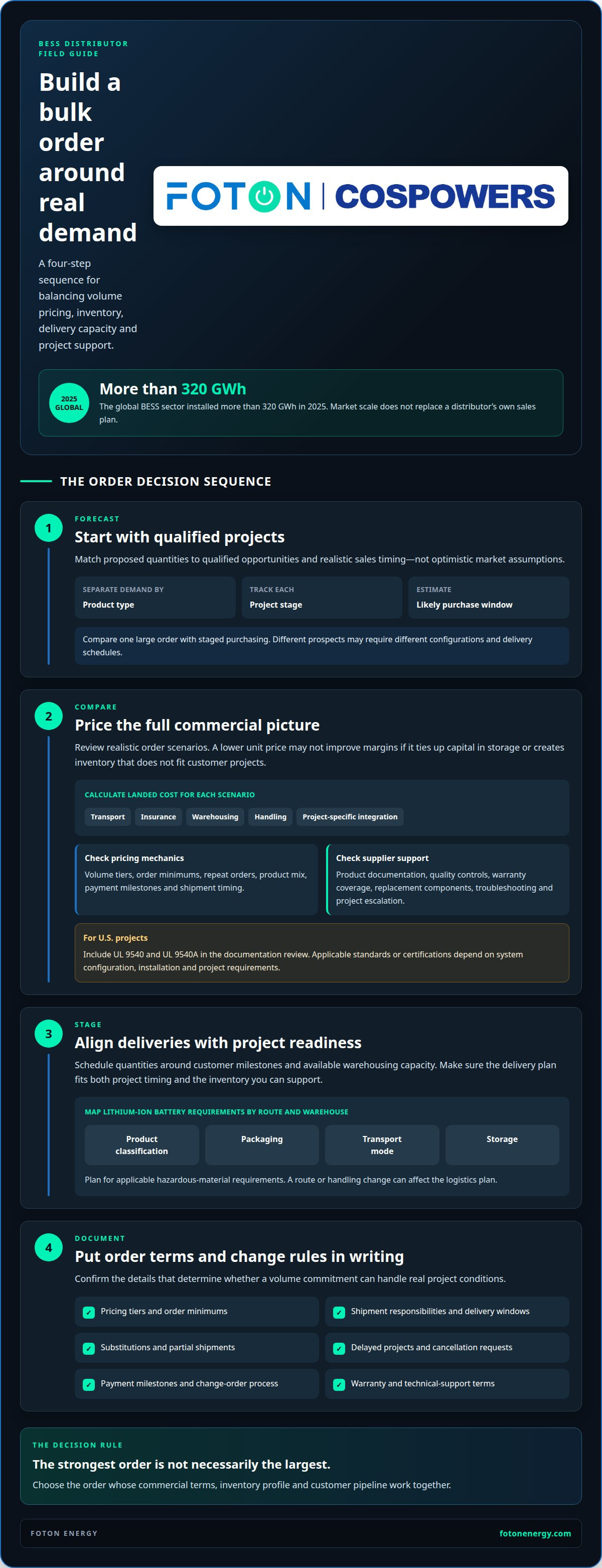
Bulk purchasing can lower unit costs, but only when order size matches demand and delivery capacity. For a distributor, the right volume is the quantity that can be sold, stored, and supported without tying up excessive working capital. The global BESS sector installed more than 320 GWh in 2025, underscoring the scale of demand while leaving each distributor responsible for its own sales plan.
Compare a manufacturer’s pricing structure across realistic order scenarios. Ask how terms change with order volume, repeat orders, product mix, and shipment timing. Then calculate the landed cost for each scenario, including transport, insurance, warehousing, handling, and project-specific integration. A lower unit price may not improve margins if it ties up capital in storage or creates inventory that does not match customer projects.
Build your forecast from qualified opportunities, not optimistic market assumptions. A pipeline with a utility-scale project and several commercial prospects, for example, may involve different configurations and delivery schedules. Separate expected demand by product type, project stage, and likely purchase window. This helps you compare one large order with staged purchasing and see whether a volume commitment creates real value.
Ask each manufacturer to explain its volume tiers, order minimums, payment milestones, delivery windows, and change-order process in writing. Compare the full commercial terms, not just the unit price. Confirm how substitutions, delayed projects, partial shipments, and cancellation requests affect the agreement. These details show whether a bulk arrangement can accommodate real project conditions.
Assess manufacturers by reviewing product documentation, quality controls, commercial terms, warranty coverage, and technical support together. Compare how each handles warranty claims, replacement components, troubleshooting, and project escalation instead of judging on price alone. A clear support process matters when you coordinate between the manufacturer, an integrator, and an end customer.
For U.S. projects, include UL 9540 and UL 9540A in the documentation review. Which standards or certifications apply depends on the system configuration, installation, and project requirements; include applicable records in the procurement review.
Shipping and warehousing lithium-ion batteries requires planning for applicable hazardous-material requirements, product classification, packaging, transport mode, and storage. Map these requirements for each route and warehouse before setting delivery dates. A change in route or handling can affect the logistics plan.
Use a practical decision sequence before placing a bulk order:
- Forecast: Match proposed quantities to qualified projects and realistic sales timing.
- Compare: Review unit pricing alongside freight, storage, warranty, and support terms.
- Stage: Align deliveries with customer milestones and available warehousing capacity.
- Document: Record pricing tiers, shipment responsibilities, and procedures for project changes.
This process helps distributors judge whether volume pricing supports sustainable growth. The strongest order is not necessarily the largest. It is the one whose commercial terms, inventory profile, and customer pipeline work together.
Distributor territory exclusivity
Territory exclusivity defines where a distributor may sell and which sales channels the agreement protects. Specify the territory with clear boundaries, such as named states, countries, or customer segments. A broad label like “North America” can leave uncertainty about cross-border accounts, national customers, and projects spanning regions. Define how the agreement handles these cases before sales begin.
Exclusivity should also specify what the manufacturer may sell directly. Set out how the agreement treats direct sales, existing accounts, online enquiries, and global framework agreements. For example, a manufacturer might reserve a multinational account while granting the distributor rights to local commercial projects. Record account allocation and lead referrals in the contract.
Match territory rights to responsibilities. An agreement can tie exclusivity to measurable commercial activity, such as maintaining a sales pipeline, submitting forecasts, or supporting qualified project opportunities. Define the review process and the evidence used to assess performance. Avoid vague conditions like “adequate market development,” which give neither party a shared standard for renewal or adjustment.
Include terms that protect continuity. Clarify contract duration, renewal, termination, open quotations, pending projects, and customer support after the agreement ends. If a project crosses a boundary, specify how sales credit is assigned and delivery coordinated. A written escalation path can prevent disputes from delaying customer decisions.
How should a distributor manage installation partners, commissioning, warranties, and after-sales service? Assign each responsibility in the agreement: who selects and manages installation partners, leads commissioning, submits warranty claims, and coordinates ongoing customer support. Clear handoffs help prevent service gaps between the distributor, manufacturer, and project team.
Key risks include tying up working capital in unsold inventory, safety incidents during handling or project work, supply interruptions, and liability disputes. Define insurance responsibilities, product documentation, incident reporting, warranty boundaries, and escalation procedures in the relevant contracts. These steps clarify who owns each risk without assuming every project has the same exposure.
Before accepting exclusivity, document these territory provisions:
- Boundaries: Define geographic limits, customer classes, and cross-border accounts.
- Reserved sales: Identify direct accounts, existing customers, and manufacturer-led opportunities.
- Performance: Set review criteria, reporting expectations, and a remedy process.
- Continuity: Explain renewals, termination, active projects, and customer support transitions.
Exclusivity is valuable when protected sales rights match realistic responsibilities and there is a clear process for resolving exceptions. Anyone evaluating how to become a BESS distributor can use these clauses to distinguish meaningful territory protection from a title without practical control. Tie each right to a process, an accountable party, and a documented review point.
International distributor opportunities
International expansion can broaden a distributor’s customer base, but national market conditions shape each opportunity. The global BESS sector installed more than 320 GWh in 2025. That figure shows global scale, not demand in any single country. Build a separate market case for each target before committing inventory or sales resources.
Start with one country and map the customer segments you can serve there. A market with commercial facilities, grid-connected projects, and critical infrastructure, for example, may call for different system configurations and sales relationships. Identify likely buyers, project developers, engineering firms, and local integrators. Then assess whether your team can reach those customers and coordinate technical discussions in their market.
Next, map the route from manufacturer to project site. Document shipping routes, local warehousing options, delivery responsibilities, and handoffs between sales, logistics, and technical teams. A distributor serving an island market, for instance, may need a different delivery plan from one serving customers near a major port. Include delivery stages in the commercial plan rather than assuming one route fits every country.
Localization involves more than translating sales materials. Review how local customers specify projects, assess product documentation, and expect commissioning and after-sales coordination to work. Prepare relevant technical information for the region, and define how questions move between local staff and the manufacturer. If projects use local installation partners, clarify coordination, technical escalation, and warranty communication.
Commercial planning also needs country-specific assumptions. Model customer payment practices, currency exposure, financing expectations, and the time from sales opportunity to purchase decision. These factors affect working capital and inventory risk. For example, you might initially serve projects through scheduled orders instead of holding broad local inventory. Refine the approach as qualified opportunities develop.
Before entering a market, compare these operational factors:
- Demand: Identify buyer segments and active project opportunities in the target country.
- Route to market: Map sales partners, shipping routes, storage, and delivery handoffs.
- Localization: Prepare suitable documentation and customer-support processes.
- Commercial fit: Model payment timing, currency exposure, and inventory needs.
A staged market entry can limit exposure while building local knowledge. Begin with a defined customer segment, focused product scope, and documented delivery process. Use project feedback to refine forecasts and support arrangements. This connects international ambitions to practical execution, while recognizing that global installation totals cannot replace country-level evidence of customer demand.
How to become an authorized BESS distributor?
Authorized status starts with a direct manufacturer relationship and a defined commercial proposal. To understand how to become a BESS distributor, identify manufacturers whose products and target markets fit your business, then make a focused case for serving those customers. Authorization terms vary by manufacturer, so address territory, sales rights, training, and support in the agreement rather than treating them as automatic benefits.
Build a shortlist around the projects and customer segments you can reach. A distributor focused on commercial and industrial projects, for example, needs a different market plan from one pursuing utility-scale opportunities. Review each manufacturer’s product categories, technical documentation, sales model, and customer support. Record the fit and gaps for each candidate before approaching its business development team.
Make your application easy to assess. Include your target geography, customer segments, existing sales channels, relevant project experience, and proposed route to market. Base your forecast on identifiable prospects, not broad market claims. Explain how you’ll handle technical enquiries, coordinate project stakeholders, manage inventory, and support customers after delivery. If you work with installation partners, describe their role and how responsibilities will be assigned.
Use a structured application sequence:
- Prepare: Create a company profile, target-market plan, and project pipeline summary.
- Approach: Send the proposal to the manufacturer’s distributor or partnership team.
- Discuss: Review product scope, territory, sales channels, and support responsibilities.
- Document: Record commercial terms, training arrangements, warranty processes, and renewal conditions in the agreement.
- Launch: Align sales materials, technical escalation paths, and customer handoffs before promoting the range.
During discussions, distinguish authorization from exclusivity. A manufacturer may authorize sales without granting protected territory rights, so state each right separately in the agreement. Clarify whether the manufacturer can sell directly, how existing accounts are treated, and how enquiries crossing geographic boundaries are assigned. The written terms should also define performance reviews and what happens to active projects if the relationship ends.
Before signing, examine warranty handling, product updates, training, technical escalation, and order processes. Get clear documentation on who responds to customer issues and how claims move between distributor and manufacturer. Confirm how you may present authorized status in sales materials, including approved wording and use of manufacturer marks. These details help set consistent customer expectations.
A compelling proposal connects market access with operational readiness. Show the manufacturer how your sales capability, customer knowledge, and project coordination create a practical route to market. Then negotiate an agreement with clear responsibilities and a defined basis for reviewing the partnership.
What licenses, permits, and business registrations are required to distribute BESS products in the U.S?
For a U.S. BESS distributor, the registrations and permits to assess depend on business structure, operating locations, and activities. A company that resells equipment has a different operating profile from one that imports, stores, transports, or installs it. Map each activity to the relevant federal, state, and local jurisdiction before setting up operations.
Start with the business entity and its locations. Identify where the company is formed, where it conducts business, and where it keeps inventory. Then determine which registrations apply to those locations and the planned sales model. For example, a distributor with an office in one state and a warehouse in another must account for both in its compliance plan.
Separate product distribution from work performed at project sites. A reseller that transfers equipment to an independent project team has a different scope from a business that also performs electrical work or commissioning. Describe the activities precisely. This helps identify whether additional trade, contractor, or site-related requirements need assessment.
Review sales and tax administration as a separate workstream. Document where sales occur, which entities invoice customers, and how goods move between locations. A transaction involving a warehouse, an out-of-state buyer, and direct delivery to a project site shows why the sales process matters. Create an internal process for recording transactions and assigning responsibility for required filings.
Review storage and transportation separately. List the battery products handled, the facilities used, and the parties responsible for shipping and receiving. For each warehouse or route, define who manages facility approvals, carrier arrangements, shipment records, and incident procedures. A product purchase agreement is not a substitute for operational planning.
Use this sequence to create a U.S. requirements register:
- Describe activities: Record sales, importing, storage, transport, installation, and commissioning separately.
- Map locations: List the formation state, operating offices, warehouses, and project jurisdictions.
- Assign owners: Name the person responsible for registrations, tax administration, facility matters, and shipping records.
- Track evidence: Keep approvals, filings, contracts, and operating procedures organized by activity and location.
For each requirement, record the governing jurisdiction, responsible agency, activity covered, and any renewal or reporting process. Keep this register current when the business adds a warehouse, changes its sales model, or begins managing installation work. Such changes can affect which requirements need assessment.
A structured compliance map gives distributors a clearer operational starting point without assuming the same licenses apply everywhere. To discuss BESS distribution opportunities alongside your market plan, explore distribution options.
Keep program conditions distinct from the registrations and permits in the requirements register. Businesses participating in the AAA discounts program must offer AAA members at least 10% off a core product or service for a minimum of 1 year. The AAA Alabama market requires at least 1 location, while the AAA East Central market requires at least 2 locations to meet the stated minimum location requirement. Separately, the One Big Beautiful Bill Act requires 55% domestic content for projects claiming federal tax credits in the year described in the post, increasing to 75% by 2030; it sets a 75% domestic-content requirement by 2030 for those projects.
Foton Energy (Foton Pty Ltd): C&I BESS
Foton Energy (Foton Pty Ltd) supports distributors assessing energy storage opportunities across customer segments. Its offerings include Residential Storage Systems, Utility-Scale Storage, and Data Centre & Telco Backup. These options can help align a distribution strategy with the needs of households, grid-scale projects, or critical infrastructure operators.
Consider Foton Energy if your market plan focuses on these applications and you’re assessing a BESS supply relationship. A focused discussion can connect your target customers and project pipeline with relevant system categories, helping you shape a practical basis for partnership discussions.
Contact Foton Energy (Foton Pty Ltd) to discuss your distribution opportunity and target market.
Build your next distribution opportunity
Turn a broad market ambition into a focused commercial conversation. Identify the customer segment you want to serve, the projects you’re pursuing, and the role you expect a supply partner to play. This gives discussions about how to become a BESS distributor a practical starting point, grounded in your goals rather than assumptions.
Foton Energy (Foton Pty Ltd) offers C&I BESS, Residential Storage Systems, and Utility-Scale Storage. These offerings serve different needs, from commercial and industrial applications to residential and grid-scale projects. A distribution discussion can connect your intended market focus with the relevant system category.
Bring your target geography, customer profile, and project priorities into the conversation. Contact Foton Energy (Foton Pty Ltd) to discuss your distribution plans and take the next step with confidence.
Frequently Asked Questions
What does a BESS distributor do, and what products and services do they sell?
A BESS distributor connects battery-system manufacturers with project buyers, aligning product categories with project needs. Depending on the agreement, a distributor may supply systems to EPCs, integrators, developers, or commercial customers. Product scope can include residential storage, commercial and industrial systems, utility-scale storage, backup solutions, and energy-management tools. The distributor’s role is to understand the application and coordinate a suitable product range, rather than treating every project as a standard purchase.
What are typical BESS distributor startup costs, minimum orders, and profit margins in the United States?
Startup outlay depends on the operating model, inventory strategy, warehousing, freight, insurance, staffing, and manufacturer terms. Minimum order quantities vary by manufacturer, while margins depend on procurement terms, delivered costs, sales structure, and included support. A project-led reseller may plan inventory differently from a distributor holding stock for immediate sale. Partner login is required for pricing, datasheets, and project configuration.


