

A battery can do more than keep selected equipment running during an outage. The black start capabilities of battery energy storage can help restore part of an electric grid without relying on the external transmission network. It can supply power to generator-support loads and help stabilize voltage and frequency as the network is rebuilt.
Black start matters because many power plants need electricity to start, even when the grid has failed. A battery energy storage system can provide an independent power source for parts of the restart process, but its role depends on its configuration and coordination with generators and grid operators.
Black start is easy to confuse with critical backup power. Backup power keeps priority loads operating; black start supports the wider process of bringing generation and grid infrastructure back online. This article explains what black start means, how battery storage can contribute to restoration, and how its grid-level role differs from supplying a facility during an outage.
Key Takeaways
- Understand how black-start resources help rebuild a de-energized grid when ordinary generation cannot restart on its own.
- See how battery storage can energize generator support loads and help manage voltage and frequency during restoration.
- Learn why inverter capability, control strategy, and coordination with grid operators shape a battery system’s role.
- Follow the restoration sequence, from initial power supply through generator startup and grid synchronization.
- Distinguish grid restoration from critical backup power, which keeps priority facility loads running during an outage.
What Is Black Start?
Black start is the process of restoring part of an electrical grid without relying on the external transmission network. It matters because many power plants need electricity to start, even during an outage.
Restoring a De-Energized Grid
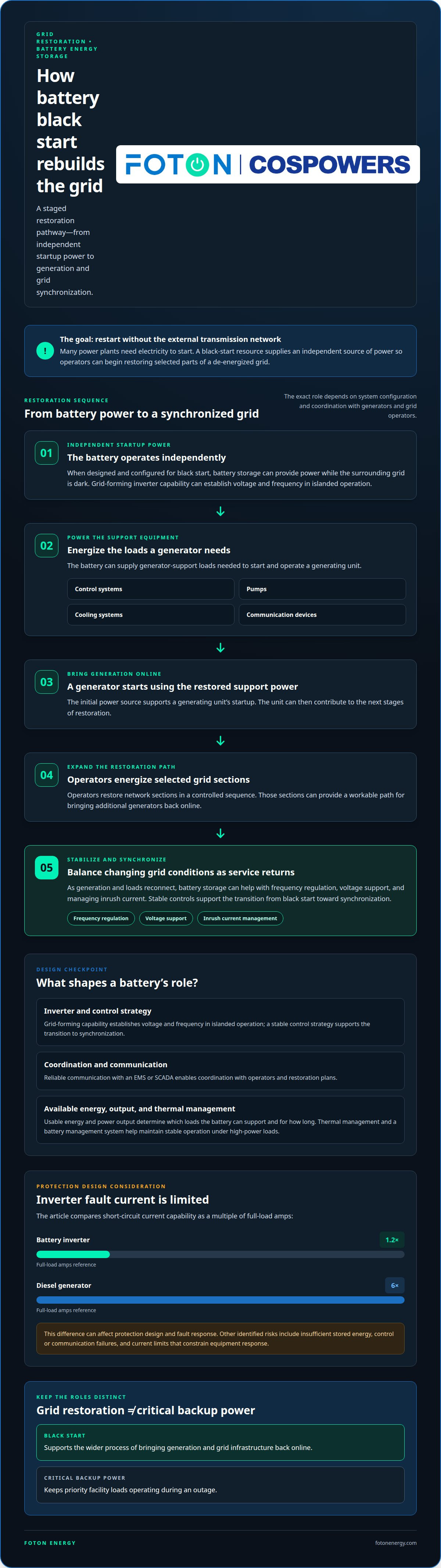
Black start resources can start independently when the surrounding grid is dark, then help bring other generation back online. The sequence matters: an initial resource supplies power, operators energize selected grid sections, and those sections support additional generators. Recovery therefore depends on more than restarting one power plant. Each stage must provide a workable path for the next.
Grid contingency plans identify which resources can start independently and how operators can use them during restoration. They also coordinate the order in which generators and network sections return to service. Diesel, propane, and gas generators can provide independent startup power, while hydropower plants have traditionally supported black start as well. Each resource has a defined role in the wider restoration sequence.
Backup resources support both the restart process and essential loads that must keep operating. A diesel generator, for example, may start without electricity and supply selected equipment during an outage. A battery energy storage system can instead power generator-support loads such as control systems, pumps, cooling systems, and communication devices. These loads help a generating unit start and operate as the electrical grid is rebuilt.
Solar panels alone generally cannot supply power during a grid outage unless the system has islanding capabilities. Islanding allows a solar energy system to operate separately from the wider grid instead of depending on its connection. Without islanding, a solar installation cannot be assumed to energize a dark network or provide independent startup power. Storage and system configuration determine what remains available.
During grid reconstruction, operators must balance electricity production and consumption while keeping network frequency stable. They restore generation and connect loads in a controlled sequence, adjusting the balance as each section returns. Battery storage can help with frequency regulation, voltage support, and managing inrush current. These functions address changing electrical conditions as equipment and network sections reconnect.
Restoration and Grid Reliability
Black start restoration supports grid reliability by creating a recovery path after a widespread failure, not by preventing every outage. The ability to restart independently gives operators resources to begin rebuilding when ordinary generation cannot start. A reliable restoration plan accounts for the first available power source, the loads it supports, and the next generation brought online.
During hurricanes in 2018, customers in Florida and the Carolinas lost electrical supply while the eastern United States grid continued operating. This example shows that outages can affect specific areas without a grid-wide failure. Black start resources help address broader restoration needs, while local backup supports selected loads. Coordinated planning links these roles and helps operators manage generation, network sections, and load as service returns.
Black start capabilities of battery energy storage systems
A battery storage system can supply startup power and support grid recovery when its controls and grid interface are designed for the task. Its response, operating limits, and coordination requirements distinguish it from conventional generators.
Battery Black Start in Renewable Systems
Battery black start capability lets a storage system provide power independently during an outage, including to renewable generation sites. This matters when wind or solar resources need auxiliary power or a stable electrical reference before reconnecting.
A battery can support solar or wind plants during outages, while renewable generation alone may be unavailable or variable during restoration. The battery’s usable energy and power output determine which loads it can support and for how long. In a renewable microgrid, system controls must coordinate storage, generation, and loads as operation shifts from islanded conditions toward grid connection.
Technical Requirements for Black Start
Black start operation requires controls that can establish and maintain voltage and frequency while isolated. This enables the battery to support equipment and manage changing conditions before the wider grid is available.
Grid-forming inverter capability allows a battery to establish voltage and frequency in islanded operation. A stable control strategy supports the transition from black start to synchronization, while reliable communication with an EMS or SCADA enables coordination with operators. Thermal management and a battery management system help maintain stable operation under high-power loads.
Inverter output also has limits: a battery inverter can provide short-circuit current equal to 1.2 times its full-load amps, compared with six times for a diesel generator. That difference can affect protection design and fault response. Key risks include insufficient stored energy, control or communication failures, and current limits that constrain equipment response.
Grid Rules and Operator Coordination
Black start coordination connects storage operation with transmission restoration plans. It matters because a battery’s role must align with the sequence and conditions set by grid operators.
In the United States, NERC restoration standards EOP-005-3 and EOP-006-3 address restoration from black-start resources and system restoration coordination. NFPA 855 outlines safety requirements for stationary energy storage, while UL 9540 validates integration of the battery, power conversion system, and energy storage management system. These standards cover distinct parts of planning, safety, and system integration.
Transmission system operators coordinate restoration plans with connected network and plant operators, and regularly check that the plans remain current and functional. No single market program makes every battery eligible for black-start service. Implementation depends on the applicable operator’s requirements and the project’s technical role.
Costs and Demonstrated Projects
The cost of adding black start capability depends on project design and is provided after a quote request. Key cost drivers include inverter capability, control and communication integration, protection changes, thermal systems, and testing.
California’s Imperial Irrigation District used a 33 MW/20 MWh lithium-ion battery in 2020 to start a 44 MW combined-cycle natural gas turbine. The example demonstrates a battery supporting generator startup, not a universal design specification. For a grid-scale project, utility-scale storage planning can connect system design with its intended operating role.
Compared with diesel generators and hydropower, batteries can deliver power within milliseconds, while diesel generators can provide greater short-circuit current. Hydropower has also traditionally provided black start capability. Each resource has different operating characteristics, so dependable restoration depends on matching it to the startup loads, controls, and network plan.
BESS black start restoration process
A battery energy storage system supports restoration by supplying initial electricity and helping control conditions as generation returns. The sequence connects startup loads, generator operation, and synchronization with the recovering grid.
The Restoration Process
The restoration process uses stored energy to power equipment needed to restart generation, then supports the transition toward grid synchronization. Each stage must operate within the electrical limits of the equipment being restarted.
A typical sequence follows these stages:
- Establish initial power. The battery supplies electricity to energize a step-up transformer and auxiliary loads needed for startup.
- Start generation. The supported generator starts and reaches operating conditions using the supplied auxiliary power.
- Coordinate electrical conditions. Once the main generator is running, the battery coordinates frequency and voltage to support synchronization with the grid.
- Expand restoration. Operators bring additional generation and loads online while keeping production and consumption in balance.
The sequence depends on controls that can manage each transition. A battery energy storage system must respond to changing loads as startup equipment draws power, then adapt as generation and network sections reconnect. A stable control strategy helps the system move from black start operation toward grid synchronization, treating startup power and grid support as connected functions.
The battery’s role also depends on its connection to the equipment being restarted. For example, it may supply transformer energization and auxiliary loads before the generator can produce electricity. After generation starts, its contribution can shift toward frequency and voltage coordination. This staged operation makes the battery part of a restoration plan, rather than a standalone source expected to restart an entire grid by itself.
Sustaining Restoration Operations
A battery can sustain restoration only while its available stored energy and power output meet the connected loads. A system’s megawatt rating alone does not show how long it can supply electricity.
For example, a 60 MW lithium-ion battery system with 240 MWh of storage can provide 60 MW for four hours, 30 MW for eight hours, or 15 MW for 16 hours. These operating points show the relationship between output and duration: higher power draws down stored energy faster.
A separate industrial microgrid example uses a 1 MW power conversion system and a 2 MWh battery. At full 1 MW output, the stored energy theoretically provides about two hours before losses, state-of-charge reserve, and operating limits are considered. The battery stores energy, while the power conversion system determines how much AC power it can deliver at a given time.
Actual restoration duration depends on the loads assigned to the battery, its power conversion system, available state of charge, and operating limits. A plan that prioritizes generator-support equipment uses stored energy differently from one serving additional loads. Battery output and remaining energy therefore shape how long the system can support a restoration sequence before another generation source must carry more of the demand.
Black start capabilities and critical backup power
Critical backup power and black start serve different recovery objectives. Backup keeps selected equipment operating during an outage; black start supports restoration of generation and the wider power system. A data centre, for example, may need continuous power for its own critical loads, while a utility restoration plan focuses on bringing grid resources back online. One battery system can serve different roles only when its design and controls match them.
At utility scale, black start capability supports grid reconstruction. A battery can help a generator start or assist an isolated microgrid, while operators coordinate the return of generation and loads. This differs from supplying a building’s normal electricity needs. The distinction affects which loads receive priority, how the system is controlled, and how its stored energy is allocated during an outage.
For a facility, backup power is measured by whether priority equipment can keep functioning when the normal supply fails. In an isolated microgrid, battery storage can support data centre power continuity while the site operates separately from the wider grid. Remote microgrids can also recover off-grid without diesel generators. These are local resilience functions, not necessarily black start services for a regional transmission network.
Residential solar-plus-storage offers another example. A solar-plus-storage system may allow a home to keep some loads operating during a grid outage if it is configured for islanding. The phrase “at some level” matters: available power depends on system configuration and the loads being served. Solar panels without islanding capability generally cannot supply electricity during an outage, so solar generation alone should not be treated as household backup.
Fuel-based backup has a different operating constraint. Traditional diesel backup generators typically have enough fuel storage for 24 hours of continuous operation, and fossil-fuel generators eventually run out of fuel. Battery systems do not depend on fuel delivery during operation, but their available energy is finite. In either case, the selected load and duration shape the backup plan.
The February 2021 Texas winter storms highlighted the importance of resource availability. Of the 13 primary generators designated as black-start capable, 9 were not operating consistently. Of the 15 secondary black-start-capable generators, 6 experienced temporary outages or lacked availability. These figures illustrate why a designated restoration role and a facility’s backup function must both be evaluated against real operating conditions.
For a utility, the central question is whether a resource can contribute to the planned grid restoration sequence. For a facility operator, it is whether critical loads can stay powered during an outage. An energy management system can prioritize loads and control how quickly they are added. This distinction helps align storage with the right objective: restoring the power system, maintaining essential site functions, or supporting both through coordinated configuration.
Battery energy storage for black starts
Battery storage can provide a fast, controllable source of startup power for generating plants. Its value lies not only in stored capacity, but also in how the system delivers power, controls electrical conditions, and coordinates with equipment during restoration.
At the start of a black-start sequence, a battery energy storage system can energize a step-up transformer and auxiliary loads. These loads support generator startup, while the battery’s power conversion system supplies electricity to the connected equipment. Large battery systems can deliver energy in seconds, making them useful when a rapid initial supply is needed before a plant begins generating.
That role requires more than connecting batteries to a generator. The inverter must support grid-forming operation, establishing voltage and frequency while the system is islanded. Controls then need to manage load changes as equipment starts and generation comes online. Thermal management and a battery management system help maintain stable operation under high-power loads. Together, these elements determine whether the storage system can provide the required startup support.
Capacity and output must match the restoration duty. A battery assigned to energize transformers and auxiliary equipment faces a different load profile from one also supporting multiple generators or network sections. The design must account for startup demand, the sequence of loads, operating reserves, and the transition to grid synchronization. These factors determine what the battery can support and for how long, rather than storage capacity alone.
A project in the Southeastern United States demonstrates the plant-level application: a battery system was installed to provide black-start capabilities for a 200-megawatt simple-cycle power station. The example shows how storage can support conventional generation without replacing the generator’s role in producing electricity. In renewable energy farms, storage configurations can also address limitations in traditional black-start schemes and support solar or wind plants during outages.
Compared with diesel, a battery can provide fast power without fuel delivery during operation, but inverter current capability is a design constraint. A battery inverter can provide short-circuit current equal to 1.2 times its full-load amps, while a diesel generator can provide six times its full-load amps. Protection systems and connected equipment must account for that difference. The battery’s controls also need reliable communication with EMS or SCADA so operators can coordinate its operation during restoration.
The practical takeaway is to define the restoration task first: identify which plants, transformers, or auxiliary loads need support, then align inverter capability, controls, thermal management, and capacity with that sequence. For projects assessing utility-scale battery storage, this task-led approach connects system configuration with the intended grid-support role.
Foton Energy (Foton Pty Ltd)
Foton Energy (Foton Pty Ltd) helps match energy storage choices to the operating needs of resilience and grid restoration. Its offerings include C&I BESS, Residential Storage Systems, Utility-Scale Storage, and Data Centre & Telco Backup. The right fit depends on whether the priority is supporting a facility’s critical loads, a residential system, or a larger grid-scale application.
For black start planning, align the system’s intended role with its power, capacity, controls, and coordination requirements. This distinction helps clarify whether storage is being considered for local backup or wider restoration support. Contact Foton Energy (Foton Pty Ltd) to discuss your energy storage needs.
Turn restoration goals into a resilient storage plan
Start by defining what resilience means for your site or network. Identify which loads must remain available, which generation assets need startup support, and how storage should coordinate with the wider power system. These priorities provide a practical basis for evaluating the black start capabilities of battery energy storage and determining how they fit within your operational plans.
Foton Energy (Foton Pty Ltd) can help align energy storage options with your application, whether the objective is facility resilience or broader grid support. A clear view of the operating role, control requirements, and restoration sequence makes planning more focused and actionable.
Contact Foton Energy (Foton Pty Ltd) to discuss your energy storage requirements and explore a suitable path forward.
Frequently Asked Questions
How Does a BESS Establish the Electrical Bus?
A BESS establishes an electrical bus by using a grid-forming inverter to create a voltage reference for connected equipment. The bus is the shared electrical connection where sources and loads meet. During startup, the system can energize the selected bus section, allowing designated auxiliary equipment to receive power. Operators can then add loads in a controlled sequence, monitoring voltage and frequency before connecting other sources.
What is black start capability in battery energy storage systems?
Black start capability means a battery system can provide power to begin recovery without depending on an energized external grid. Its role may be limited to supporting a generator or may contribute to a wider restoration plan. The key distinction is its assigned function: a battery configured for local backup does not automatically provide grid restoration services. The controls, electrical connection, and operating plan determine its role.
How can a battery energy storage system black start a power plant or grid?
A battery can supply electricity to the plant equipment needed for startup, such as controls and pumps, allowing a generator to begin operating. At the wider grid level, operators can use available generation to energize selected network sections and coordinate additional resources. The battery’s role depends on its connection and the restoration plan. For example, a storage system may start one plant without independently restoring an entire transmission network.
What grid-forming inverter features are needed for battery black start?
A grid-forming inverter must establish and regulate voltage and frequency while operating independently from the main grid. Its controls must also manage changing loads and support a stable transition toward synchronization. Communication with an EMS or SCADA helps coordinate operation with grid operators. Current limits matter too: inverter fault-current capability affects protection response, so the inverter and connected equipment must be designed to work together.
How do utilities test and commission battery energy storage black start capability?
Utilities can evaluate the planned startup sequence through commissioning tests that exercise the system’s controls, communications, and response to connected loads. Testing can verify that the battery energizes the intended equipment and that the inverter supports the required operating mode. UL 9540 validates integration of the battery, power conversion system, and energy storage management system; NFPA 855 outlines safety requirements for stationary energy storage systems.
How much does it cost to add black start capability to a battery energy storage system?
Cost depends on project design, including inverter capability, control and communication integration, protection changes, thermal systems, and testing.


