

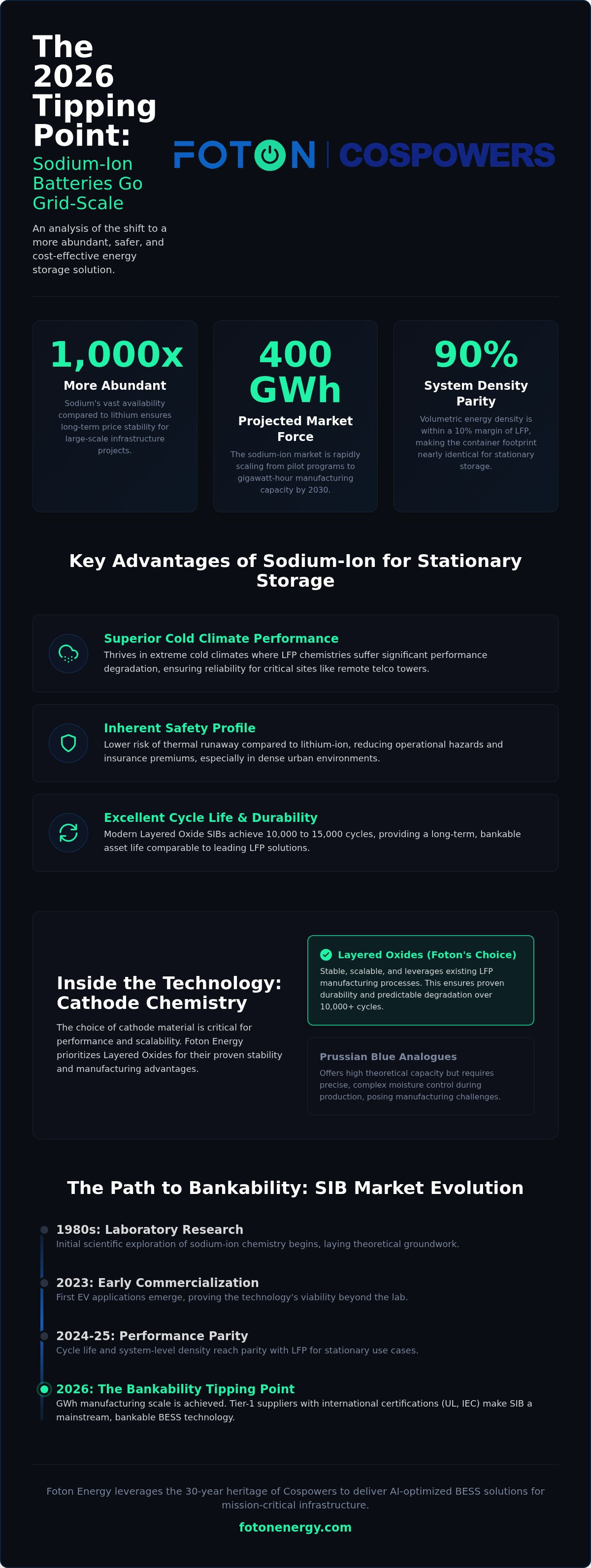
The era of lithium dependency is facing its most significant challenge yet as sodium emerges 1,000 times more abundant and increasingly more cost-effective. In 2026, the energy sector has reached a definitive tipping point where sodium ion battery commercialization is no longer a laboratory curiosity but a 400 GWh market force. You've likely felt the pressure of lithium price volatility and the persistent safety concerns associated with high-density urban energy storage. It's clear that relying on a single chemistry is no longer a viable strategy for resilient, long-term infrastructure.
This strategic analysis shows you exactly how sodium-ion technology has transitioned to global grid-scale deployment and what this shift means for your 2026 energy investments. We'll provide a clear understanding of current SIB bankability, comparing performance against LFP for specific mission-critical use cases like data centers and cold-climate telco sites. You'll also find a detailed sourcing roadmap for Tier-1 hardware to ensure your projects remain stable, safe, and high-performing in an evolving global market. It's time to move beyond pilot programs and integrate proven, resilient alternatives into your core energy strategy.
Key Takeaways
- Understand the 2026 landscape where sodium ion battery commercialization has evolved from pilot programs to gigawatt-hour manufacturing scale, providing a stable alternative to lithium.
- Learn why volumetric energy density is the superior metric for stationary storage and how sodium-ion thrives in extreme cold climates where other chemistries fail.
- Identify the economic advantages of sodium’s abundance and how its inherent safety profile reduces insurance premiums and operational risks in urban environments.
- Discover a strategic roadmap for sourcing Tier-1 hardware, focusing on international grid-code compliance and certifications like UL and IEC for long-term bankability.
- Explore how Foton Energy leverages the 30-year manufacturing heritage of Cospowers to deliver AI-optimized BESS solutions for mission-critical infrastructure.
The 2026 Landscape of Sodium-Ion Battery Commercialization
Sodium-ion batteries (SIBs) represent the first viable, sustainable alternative to lithium-ion dominance in the global energy market. While lithium remains essential for high-density mobile applications, the 2026 landscape has pivoted toward Sodium-ion battery technology for long-duration and grid-scale requirements. We've moved beyond the era of experimental chemistry. Today, sodium ion battery commercialization is defined by the decisive transition from pilot lines to gigawatt-hour (GWh) manufacturing capacity. This scaling is fueled by two primary sectors: stationary Battery Energy Storage Systems (BESS) and micro-mobility. For institutional investors, 2026 marks the bankability tipping point where the technology's lower cost profile and inherent safety outweigh the diminishing energy density gap.
Historical Context vs. Modern Commercial Reality
The journey of sodium-ion technology began with 1980s laboratory research, yet it remained a secondary priority while lithium-ion matured. The narrative changed in 2023 with the first commercial EV applications and intensified as global supply chain volatility saw lithium carbonate prices fluctuate between $13,000 and over $80,000 per ton. Between 2024 and 2025, the industry achieved critical milestones in cycle life and energy density, reaching parity with LFP in many stationary applications. We're no longer discussing theoretical benefits; we're observing a market where production is surging toward a projected 400 GWh by 2030. This growth represents a strategic shift toward materials that are 1,000 times more abundant than lithium, ensuring long-term price stability for large-scale infrastructure.
Global Manufacturing Capacity and Tier-1 Leadership
Geographically, the Asia-Pacific region continues to lead in total output, but 2026 has seen a significant regionalization of supply chains. Dedicated factories in the United States and Europe are now coming online to secure domestic energy resilience and reduce reliance on single-source markets. Success in this sector depends heavily on Tier-1 energy storage manufacturers who provide the rigorous testing and international certifications required for utility-scale deployment. Tier-1 manufacturing standards in the sodium-ion sector represent the integration of high-volume automated production with rigorous international certifications and a bankable track record of operational reliability. This industrial maturity ensures that sodium-based BESS is no longer a speculative choice but a foundational pillar for 2026 energy infrastructure strategy.
Technical Maturity: Overcoming the Energy Density Gap
The perceived energy density gap between sodium and lithium is rapidly closing at the system level. While lithium-ion cells traditionally offer higher gravimetric density, this metric is less critical for stationary storage than for electric vehicles. In the context of sodium ion battery commercialization, the focus has shifted toward volumetric density and system-level engineering. For a typical C&I or utility-scale project, the footprint difference between an LFP container and a modern sodium-ion container is now negligible, often falling within a 10% margin. This minor trade-off is offset by superior performance in extreme environments and a significantly safer thermal profile.
Chemistry Breakthroughs: Prussian Blue vs. Layered Oxides
Current Tier-1 manufacturing focuses on two primary cathode classes: Prussian Blue analogues and Layered Oxides. Prussian Blue offers high theoretical capacity but requires precise moisture control during production. Layered Oxides, which Foton utilizes through our partnership with Cospowers, provide a more stable and scalable path because they leverage existing LFP manufacturing processes. When paired with hard carbon anodes, these chemistries solve the historical intercalation challenges that once limited sodium's performance. Our engineering team prioritizes Layered Oxides for their proven durability and predictable degradation curves over 10,000 to 15,000 cycles.
AI-Driven Optimization for SIB Performance
Sodium-ion chemistries exhibit different voltage plateaus and discharge curves compared to lithium. To maximize asset life, we integrate an AI driven energy management system that creates a digital twin of the battery's chemical state. This intelligence allows for:
- Real-time SOC (State of Charge) calibration that accounts for sodium's unique chemical signature.
- Predictive thermal management that prevents localized hot spots before they occur.
- Dynamic discharge optimization that preserves cycle life during high-demand peak shaving.
Safety is a foundational pillar of this technology. Sodium electrolytes use non-flammable salts that are inherently more stable than organic lithium solvents, virtually eliminating the risk of thermal runaway in high-density urban areas. If you're planning a project in a climate with extreme temperature swings, you can consult with our engineering team to see how sodium-ion maintains 90% discharge efficiency even at -20°C.
Economic Drivers: Why Sodium-Ion is the New Standard for C&I BESS
LFP vs. Sodium-Ion: A 2026 Cost-Performance Analysis
When evaluating 4-hour duration projects, the comparison between LFP and sodium-ion reveals a narrowing gap in upfront costs and a widening lead in operational flexibility. Sodium-ion systems excel in commercial and industrial BESS solutions where peak shaving and load shifting are the primary ROI drivers. Because sodium-ion batteries can be fully discharged to zero volts without damaging the chemistry, they offer a higher usable capacity for daily cycling compared to many lithium counterparts. This capability allows industrial facilities to aggressively target demand charges, often resulting in a faster ROI despite the slightly lower energy density discussed in previous sections.
Mission-Critical Applications: Data Centers and Telco
The rise of generative AI has created an unprecedented demand for resilient, high-density power backup. Utilizing a sodium-ion battery for data centers is becoming the preferred strategy for solving the AI power crunch in 2026. Unlike traditional VRLA or LFP systems, sodium-ion offers a wider operating temperature range, which reduces the energy load required for cooling infrastructure. In remote telecom towers, this thermal resilience ensures uptime in fluctuating climates without the need for expensive HVAC systems. As an ESG-friendly alternative, sodium extraction also has a significantly lower environmental footprint, aligning with the sustainability mandates of global technology firms and infrastructure funds.
Strategic Implementation: Sourcing and Supply Chain for EPCs
Transitioning from technical potential to operational reality requires a structured procurement strategy. For EPCs and project developers, the successful integration of sodium ion battery commercialization depends on a four-step implementation framework designed to mitigate risk and ensure long-term bankability. This process begins with identifying manufacturers with a proven heritage. Selecting a partner with Tier-1 manufacturing standards, such as Cospowers, ensures that the hardware is backed by decades of industrial experience rather than just laboratory success.
Regulatory compliance is the next critical pillar. You must ensure all systems meet international grid-code standards, including UL 9540 and IEC 62619, to facilitate insurance approval and grid interconnection. Beyond certifications, evaluating the system-level safety architecture is essential. Sodium-ion containers should feature integrated fire suppression and advanced thermal monitoring to leverage the chemistry's inherent stability. Finally, managing global lead times requires a partner with an established marketing network across multiple regions. This geographic reach allows for more resilient logistics, protecting your project timelines from localized supply chain disruptions.
The Role of the Strategic Distributor
Direct procurement from a factory often lacks the localized technical support required for complex grid integrations. An exclusive partnership between an engineering firm and a Tier-1 manufacturer provides a layer of supply security and technical oversight. Our BESS engineering consulting services bridge the gap between raw hardware and specific grid requirements. We provide the feasibility studies and AI-driven commissioning support needed to ensure your assets perform as modeled from day one.
Future-Proofing Your Energy Infrastructure
Asset longevity is a primary concern for institutional investors. We recommend a modular architecture that allows for future chemistry upgrades without requiring a complete system overhaul. This approach ensures your 2026 investment remains relevant as sodium-ion technology continues to evolve toward 2030 net-zero mandates. Long-term asset management must also include a clear roadmap for end-of-life recycling. Sodium-ion modules are significantly easier to recycle than lithium counterparts; this simplifies your environmental compliance and reduces decommissioning costs. If you're ready to secure your 2026 hardware allocation, you can partner with Foton Energy to begin your project feasibility assessment.
Navigating the Tier-1 Transition with Foton Energy
Foton Energy stands as the foundational pillar for organizations ready to lead the shift toward non-lithium storage. As sodium ion battery commercialization accelerates, the need for a bankable, experienced partner becomes the deciding factor between project success and operational risk. We don't just provide hardware. We deliver a complete industrial ecosystem backed by the 30-year manufacturing heritage of Cospowers. Our exclusive global partnership ensures that our clients receive Tier-1 technology that's been subjected to rigorous international testing and optimized for real-world deployment.
Our support model is designed to be comprehensive and collaborative. We guide partners through every phase of the asset lifecycle, from initial feasibility studies and engineering consulting to AI-driven commissioning and long-term performance monitoring. With a marketing and support network spanning over 70 countries, Foton Energy provides the stability required for large-scale infrastructure investments. We ensure that your transition to sodium-ion is seamless, high-performing, and, above all, bankable.
The Cospowers Advantage
Reliability in the energy sector is built on proven experience. Cospowers is a Tier-1 energy storage manufacturer with a legacy that predates the modern battery boom, providing a level of manufacturing maturity that few others can match. Every sodium-ion module undergoes rigorous testing protocols to ensure grid-code compliance and safety in high-density environments. This heritage is essential as sodium ion battery commercialization moves from early adoption to mainstream utility use. It allows us to offer scalable solutions that meet the specific needs of utility-scale developers and C&I distribution partners. By choosing Foton, you're choosing a supply chain that's been refined over three decades of industrial excellence.
Partnering for a Smarter Energy Future
We invite you to participate in a shared vision for a more resilient global grid. Our channel partner programme offers resellers and EPCs the technical resources and supply security needed to dominate their local markets. Whether you're integrating backup for mission-critical data centers or deploying utility-scale peak shaving systems, our expert engineering team is available to solve complex integration challenges. We provide the intelligence and the hardware to ensure your projects stand the test of time. It's time to secure your position in the next generation of energy storage.
Contact Foton Energy to secure your 2026 sodium-ion supply chain.
Leading the Next Phase of Global Energy Resilience
The transition to a diversified energy storage strategy is no longer optional. As we've explored, sodium ion battery commercialization has reached a definitive maturity, offering a stable, safe, and cost-effective alternative to traditional lithium chemistries. By leveraging sodium's abundance and its superior performance in extreme environments, your 2026 infrastructure can achieve a level of resilience that was previously unattainable. The path forward requires more than just hardware; it demands a partner with a proven manufacturing heritage and the intelligence to optimize new chemistries for long-term bankability.
Foton Energy provides this stability as the exclusive global partner of Cospowers, a Tier-1 manufacturer with over 30 years of industrial excellence. Our integrated solutions combine this manufacturing heritage with AI-driven EMS technology to ensure your assets deliver peak performance from day one. Whether you're securing a mission-critical data center or scaling a utility-scale project, we're here to support your strategic growth. Secure your Tier-1 Sodium-Ion BESS infrastructure with Foton Energy and join the leaders of the smarter energy future. We look forward to building a more resilient grid together.
Frequently Asked Questions
Is sodium-ion battery technology commercially available in 2026?
Sodium-ion technology is fully commercially available in 2026, moving from pilot phases to gigawatt-hour scale production across global markets. Manufacturers have resolved previous production bottlenecks, enabling large-scale mass production for grid-scale energy storage. This shift has solidified sodium ion battery commercialization as a viable strategy for organizations seeking to diversify their storage assets. Projects are now being deployed at scale, supported by a supply chain that offers greater price stability than traditional lithium-based markets.
How does sodium-ion compare to LFP for utility-scale energy storage?
Sodium-ion provides a comparable energy density to LFP for stationary applications, with modern cells reaching approximately 175 Wh/kg. For utility-scale storage, the primary advantage is a more stable price floor due to sodium’s 1,000-fold higher abundance compared to lithium. Additionally, sodium-ion batteries can be discharged to zero volts without damaging the chemistry, providing a higher usable capacity for daily cycling. This makes the technology particularly effective for long-duration storage and high-frequency peak shaving.
Are sodium-ion batteries safer than lithium-ion batteries?
Sodium-ion batteries are inherently safer than lithium-ion alternatives due to their superior thermal stability and lower risk of thermal runaway. They utilize non-flammable electrolytes that remain stable even under high-stress conditions or physical damage. This improved safety profile is a critical advantage for high-density urban energy storage and indoor data center installations. It often results in lower insurance premiums and simplified fire suppression requirements compared to traditional lithium-based Battery Energy Storage Systems.
What are the main advantages of sodium-ion for data center backup?
The primary advantages for data center backup include a wider operating temperature range and high discharge rates for mission-critical UPS requirements. Sodium-ion systems reduce the energy load needed for cooling infrastructure, which is essential for managing the power crunch in generative AI facilities. Furthermore, the chemistry’s safety profile allows for higher-density deployments in urban centers with strict fire regulations. Its sustainable material profile also aligns with the ESG mandates of global technology firms.
Can sodium-ion batteries operate in extreme cold climates?
Sodium-ion batteries excel in extreme cold, maintaining approximately 90% discharge efficiency at -20°C and operating at temperatures as low as -40°C. This performance far exceeds LFP batteries, which typically require energy-intensive heating systems to function in sub-zero environments. For remote telecom towers and utility projects in high-latitude regions, this resilience ensures consistent uptime while reducing the complexity of thermal management systems. It makes sodium-ion the definitive choice for infrastructure in fluctuating or harsh climates.
What is the expected cycle life of a commercial sodium-ion battery?
Commercial sodium-ion batteries are now expected to exceed 10,000 to 15,000 cycles under standard operating conditions. This longevity makes them highly competitive for daily cycling applications like load shifting and demand charge management. When integrated with an AI-driven EMS, these assets can maintain their performance over decades of industrial use. This high cycle life ensures that the total cost of ownership remains low, providing a bankable ROI for long-term energy infrastructure investments.
Who are the leading Tier-1 manufacturers of sodium-ion storage?
Leading Tier-1 manufacturers include established global entities like CATL and our exclusive strategic partner, Cospowers. These manufacturers have invested heavily in dedicated GWh production lines to meet the surge in demand for non-lithium chemistries. Selecting a Tier-1 provider is essential for project bankability, as it ensures the hardware is backed by international certifications and proven manufacturing heritage. This industrial maturity provides the reliability required for large-scale commercial and industrial (C&I) and utility deployments.
Does Foton Energy provide engineering support for sodium-ion BESS integration?
Foton Energy provides comprehensive engineering consulting for every phase of sodium-ion BESS integration, from project feasibility to AI-driven commissioning. Our team ensures that your deployment meets strict grid-code compliance and international safety standards. We leverage our exclusive partnership with Cospowers to deliver Tier-1 hardware that is fully optimized for your specific site requirements. This end-to-end support ensures that your transition to sodium-ion technology is both technically sound and strategically aligned with your energy goals.


