

A commercial solar array without high-performance storage is no longer a complete energy strategy. It's a missed opportunity for optimization. You've likely realized that while your panels generate clean power, integrating battery storage with commercial solar is the only way to neutralize the high utility demand charges that still dominate your monthly balance sheet. It's a common friction point for industrial leaders who've invested in renewables but remain tethered to volatile grid pricing and complex compliance mandates. Reliance on solar alone isn't enough to secure the energy independence your facility requires in a shifting market.
This guide delivers the definitive technical and financial frameworks to master this integration. We'll move beyond the basics to provide a clear decision matrix for AC and DC coupling while evaluating the performance profiles of LFP versus Sodium-ion systems. You'll gain a methodical roadmap to future-proof your infrastructure using AI-driven Energy Management Systems and Tier-1 hardware standards. By the end of this analysis, you'll have the strategic blueprint needed to transform your solar assets into a resilient, high-performance energy ecosystem that delivers bankable long-term value.
Key Takeaways
- Evaluate the technical trade-offs between AC and DC coupling architectures to maximize round-trip efficiency and system longevity.
- Master the financial frameworks for integrating battery storage with commercial solar to neutralize high utility demand charges and secure energy independence.
- Utilize AI-driven Energy Management Systems to coordinate PV generation and battery discharge through sophisticated predictive analytics.
- Secure long-term infrastructure value by prioritizing Tier-1 manufacturing standards and bankable hardware with proven global reliability.
- Navigate grid-code compliance and system design complexities using a structured engineering framework for scalable energy storage projects.
The Strategic Business Case for Solar-Plus-Storage Integration
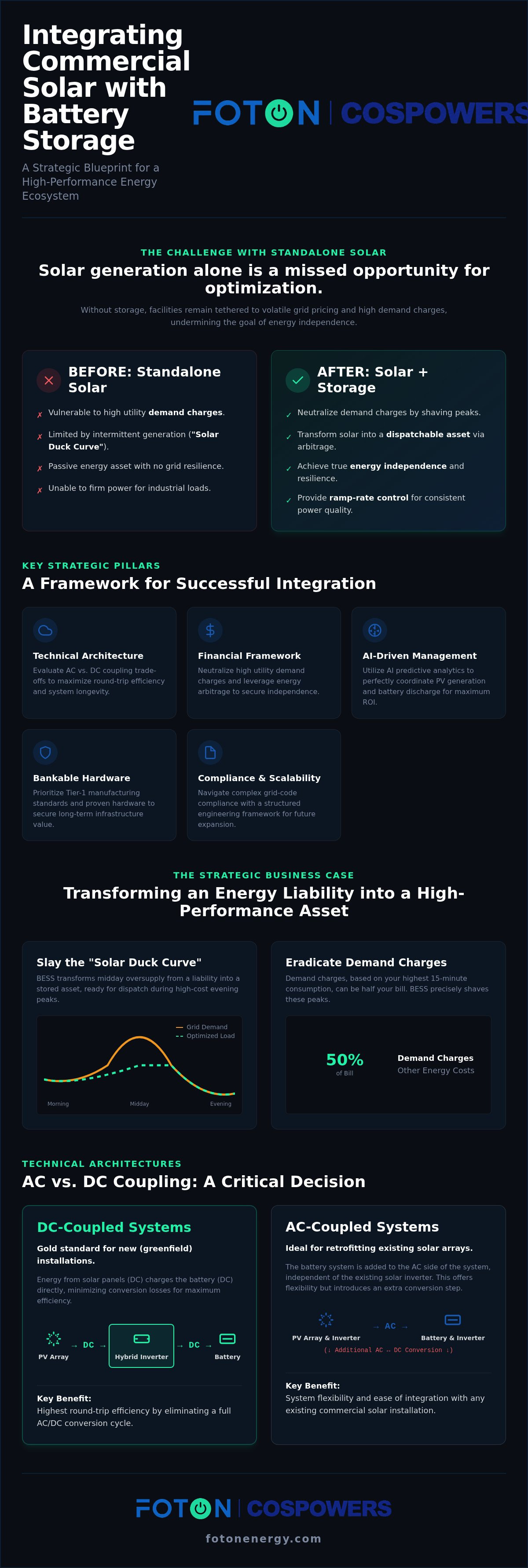
Strategic energy management has evolved beyond simple generation. Integrating battery storage with commercial solar represents the precise synchronization of photovoltaic (PV) generation with high-capacity Battery Energy Storage Systems (BESS). This alignment transforms solar from an intermittent resource into a dispatchable, high-performance asset. In the 2026 market, this isn't merely an efficiency gain; it's a commercial necessity. Without storage, industrial sites remain trapped by the "Solar Duck Curve," where midday oversupply reduces the value of exported energy while evening demand peaks drive utility costs to unsustainable levels.
Energy arbitrage serves as the operational backbone of this integration. By capturing low-cost or surplus solar energy during the day, facilities can discharge that power during expensive evening peaks. This process is supported by broader advancements in grid energy storage technology, which helps stabilize localized networks and improve overall system resilience. For industrial operators, the primary financial incentive is the aggressive reduction of demand charges. These fees, often calculated based on a site's highest 15-minute window of consumption, can constitute half of a facility's energy expenditure. High-performance storage provides the precision shaving mechanism necessary to flatten these peaks permanently and predictably.
Overcoming the Limitations of Standalone Solar
2026 Market Drivers: Grid Volatility and Incentives
Increased grid instability is now a primary concern for commercial continuity. Frequent frequency shifts and brownouts threaten sensitive hardware, making onsite resilience a top priority. High-performance BESS units act as a critical buffer, shielding operations from external volatility. Beyond immediate uptime, corporate financiers are prioritizing "bankable" assets that meet rigorous ESG reporting standards. Large-scale investors now view storage-integrated solar as a foundational pillar of a clean energy strategy. It offers the stability, data transparency, and long-term value required for institutional-grade infrastructure investments.
Technical Architectures: AC vs. DC Coupling for C&I Systems
Selecting the appropriate coupling architecture is a foundational engineering decision that dictates long-term system efficiency. Integrating battery storage with commercial solar involves more than just physical placement; it requires a strategic choice between AC and DC pathways for energy flow. The decision impacts everything from initial hardware costs to the round-trip efficiency of the entire installation. While both configurations serve the same goal of energy resilience, their performance profiles vary significantly based on whether the project is a new build or a complex retrofit of an existing array.
The U.S. Department of Energy provides extensive data on the evolution of Energy Storage technologies, highlighting how architecture choice influences grid stability. For industrial operators, the goal is to minimize conversion losses. Every time energy shifts from Direct Current (DC) to Alternating Current (AC) and back again, a percentage of power is lost to heat. Understanding these thermal and electrical trade-offs is essential for maintaining a bankable ROI over a 20-year asset lifespan.
DC-Coupled Systems: Efficiency and Integration
DC-coupled architectures are the gold standard for greenfield commercial installations. These systems utilize a single, high-capacity hybrid inverter to manage both the solar panels and the Battery Energy Storage System (BESS). By keeping the solar energy in its native DC form while charging the batteries, you eliminate a complete conversion cycle. This typically results in higher round-trip efficiency compared to AC-coupled alternatives. These systems are particularly well-suited for high-density LFP or Sodium-ion battery modules, though they require precise voltage matching and sophisticated charge controllers to manage the shared DC bus. If you're designing a system from the ground up, our engineering consulting team can help optimize these technical parameters for maximum yield.
AC-Coupled Systems: Flexibility and Retrofitting
AC-coupling remains the most pragmatic choice for integrating battery storage with commercial solar on sites that already have operational PV arrays. In this configuration, the solar inverter and the battery inverter operate independently on the AC side of the facility's switchboard. This separation allows you to scale storage capacity without interfering with existing solar hardware or voiding manufacturer warranties. AC-coupled systems also excel in grid-forming applications. They provide robust black-start functionality, allowing a facility to maintain critical loads during a total grid failure. This independent scaling capability makes AC-coupling a resilient choice for evolving industrial sites that may need to expand their storage capacity as operational demands grow.
Optimising Integration with AI-Driven Energy Management
Hardware alone cannot solve the complexities of modern energy markets. Integrating battery storage with commercial solar requires a central intelligence hub to orchestrate power flow with millisecond precision. This "brain" is the Energy Management System (EMS). It moves beyond passive monitoring to active, real-time coordination of PV generation, battery state-of-charge, and site-specific load requirements. By centralising these variables, the EMS ensures that your energy assets operate as a unified, high-performance ecosystem rather than isolated components.
Strategic foresight is built into the software through predictive analytics. A sophisticated AI driven energy management system ingests local weather data and historical consumption patterns to anticipate generation dips or demand surges. If a storm is forecasted for the afternoon, the system may prioritise pre-charging the BESS from the grid during low-cost morning hours. This ensures that the facility remains resilient and energy-independent when solar yields drop. Additionally, dynamic thermal management protocols are integrated to protect cell chemistry. These systems adjust discharge rates based on internal temperatures; this preserves the long-term health of the battery during the high-intensity cycles common in industrial applications.
Real-Time Load Balancing and Peak Shaving
Automation is the key to capturing value from utility demand response events. When the grid reaches critical stress levels, the EMS can automatically pivot the facility to battery power, reducing the strain on the localised network. For larger sites, this involves coordinating multi-container utility-scale deployments to maintain grid stability. Research like NLR's REopt analysis demonstrates how these cost-optimal technology combinations are essential for maximising commercial ROI. The AI also manages the nuanced discharge profiles of different chemistries, ensuring that Sodium-ion and LFP modules are utilised according to their specific performance strengths.
Predictive Maintenance and Asset Longevity
Reliability is maintained through granular, cell-level monitoring. The AI constantly scans for thermal anomalies or voltage deviations that could indicate potential hardware failures. By identifying these issues before they escalate, the system can trigger safety architecture protocols or alert maintenance teams. This shift from reactive to predictive maintenance significantly reduces operational energy costs and extends the total cycle life of the BESS. Remote diagnostic capabilities allow for rapid troubleshooting without the need for immediate on-site intervention, ensuring that your energy infrastructure remains operational and bankable for decades.
Bankability: Navigating Tier-1 Standards and Supply Chains
Bankability in 2026 is the critical bridge between technical feasibility and institutional investment. For project developers and facility owners, a system's true value is determined by the long-term reliability and financial stability of the manufacturer. Integrating battery storage with commercial solar is a multi-decade commitment; therefore, financiers prioritize hardware backed by a Tier-1 manufacturing heritage. This status, exemplified by partners like Cospowers with over 30 years of manufacturing experience, provides the "bankable" assurance that the technology will be supported throughout its entire operational life. Without this foundation, securing competitive financing for large-scale infrastructure becomes significantly more difficult.
The vetting process for these assets has become increasingly rigorous. Investors aren't just looking at peak efficiency; they're evaluating the resilience of the entire supply chain and the manufacturer's ability to honor warranties over 20 years. This requires a shift from simple procurement to strategic alignment with global leaders who possess the manufacturing scale and technical depth to weather market shifts. By choosing proven hardware, you ensure that your energy transition is built on a foundation of stability rather than speculation.
Tier-1 Certification and DNV Verification
Financiers now require more than marketing claims; they demand independent engineering reports and exhaustive cycle-life testing. DNV verification and similar third-party audits are essential for vetting commercial and industrial BESS solutions. These reports confirm that the hardware can meet its performance guarantees under real-world industrial conditions. Securing global supply chains for multi-megawatt projects also requires strategic partnerships that ensure hardware availability and long-term technical support. This level of transparency is what makes a project "financeable" in the eyes of top-tier lenders.
Safety Standards and Risk Mitigation
Safety architecture is a non-negotiable component of modern bankability. Systems must comply with international safety standards like UL 9540A and IEC 62619 to be considered for comprehensive insurance coverage. Integrating battery storage with commercial solar involves managing high-energy density modules, which necessitates proprietary fire suppression and thermal runaway mitigation protocols. These safety layers must be seamlessly integrated into the facility's existing energy network to prevent operational downtime. Insurance providers now look for cell-level monitoring and automated suppression as prerequisites for coverage. Prioritizing these elite safety protocols protects both your physical infrastructure and the financial viability of your energy investment; for additional physical security of outdoor cooling components, check out Wombat Cages.
Ready to secure your project's future with proven technology? Explore our Tier-1 energy storage systems to ensure your investment is built on a foundation of global excellence.
Strategic Implementation: Partnering for Scalable Infrastructure
Transitioning from a technical concept to an operational asset requires more than simple procurement. It demands a methodical, engineering-led approach where the design phase determines the ultimate ROI. Integrating battery storage with commercial solar is a sophisticated undertaking that relies on a strategic partnership to bridge the gap between Tier-1 manufacturing and on-site operational excellence. Successful deployment ensures that your energy infrastructure is not only functional today but remains scalable as your facility’s power requirements evolve over the next decade.
The choice between containerised and modular BESS solutions is a primary consideration during the design phase. Containerised systems provide a "plug-and-play" advantage for large-scale, utility-connected projects, offering rapid deployment and integrated thermal management. Conversely, modular systems allow for granular flexibility, making them ideal for industrial sites with significant spatial constraints or those requiring incremental capacity expansions. Selecting the right format is an engineering decision that balances installation speed with long-term site utility.
Phase 1: Feasibility and Grid-Code Analysis
Precision sizing begins with a granular analysis of site interval data. This process ensures the BESS is optimized for your specific load profile, preventing the common pitfall of over-engineering. Navigating the complexities of local utility requirements and grid-code compliance is where BESS engineering consulting services become indispensable. These experts manage the technical documentation and protection settings required for a stable grid connection. This phase also involves selecting the optimal chemistry; while LFP is the global standard for high-cycle longevity, Sodium-ion is emerging as a resilient alternative for specific discharge needs or extreme temperature environments.
Phase 2: Procurement and Commissioning
Moving from design to reality involves sourcing hardware through established Tier-1 strategic partners. For professional PV component sourcing and logistics, EEHD Erneuerbare Energien Handel und Distribution GmbH offers the specialized expertise needed to ensure every component meets the rigorous safety and performance standards discussed in previous sections. Integrating battery storage with commercial solar concludes with a structured commissioning process. This final stage involves the on-site synchronization of the AI-driven EMS with existing solar inverters and thermal management hardware. Rigorous testing and performance verification are conducted to confirm that the system meets its design targets, allowing for a successful financial close and the formal handover of a high-performance energy asset.
Integrating battery storage with commercial solar is the definitive step toward operational resilience and long-term cost stability. By aligning high-performance hardware with AI-driven management, facilities can finally eliminate volatile demand charges and achieve true energy independence. Success in this transition depends on selecting the right technical architecture and partnering with entities that offer a proven, bankable heritage. It's about moving from passive generation to active, intelligent energy control.
We've explored how AC and DC coupling strategies dictate system efficiency and why Tier-1 manufacturing standards are essential for institutional-grade project financing. Utilizing sophisticated Energy Management Systems ensures that your solar assets remain optimized against shifting grid codes and market fluctuations. As an exclusive strategic partner of Cospowers, Foton brings over 30 years of manufacturing excellence and global expertise to every industrial project. We invite you to Partner with Foton for Tier-1 Energy Storage Solutions to build a scalable, future-proof infrastructure. Let's transform your facility into a high-performance energy hub today.
Frequently Asked Questions
Is it better to retro-fit storage to existing solar or install a new integrated system?
Choosing between a retrofit and a new integrated system depends on your current infrastructure and efficiency goals. AC-coupling is the preferred method for retrofitting because it integrates with existing solar inverters without voiding warranties. For new projects, an integrated DC-coupled system is superior because it minimizes conversion losses by using a single hybrid inverter. This choice impacts long-term yield and capital expenditure, so feasibility studies are essential for determining the most cost-effective path for your site.
What is the typical ROI for commercial solar-plus-storage in 2026?
The ROI for integrating battery storage with commercial solar is primarily driven by the aggressive reduction of utility demand charges. By utilizing AI-driven peak shaving, industrial sites can flatten their consumption profiles and capture energy arbitrage opportunities. While specific payback periods vary based on local utility tariffs and state-level incentives, the integration of Tier-1 hardware ensures lower operational maintenance costs. This stability enhances the bankability of the asset, providing a resilient financial return over a 20-year lifespan.
Can I use Sodium-ion batteries for commercial solar integration?
Sodium-ion systems are a highly viable alternative to LFP for specific commercial applications. These batteries excel in extreme temperature environments where traditional chemistries might require extensive HVAC support. They offer a robust safety profile with a lower risk of thermal runaway, making them suitable for high-density industrial zones or data center backups. Our engineering consulting team evaluates site-specific discharge requirements to determine if Sodium-ion or LFP provides the best performance-to-cost ratio for your facility.
How does an Energy Management System (EMS) improve solar-plus-storage performance?
An intelligent EMS serves as the operational brain that synchronizes PV generation with battery capacity in real-time. It uses predictive analytics to ingest weather data and historical load profiles, allowing the system to pre-charge before expected demand peaks. This proactive management maximizes the self-consumption of solar energy and protects battery health by preventing deep discharge cycles. Without this coordination, your hardware can't respond dynamically to grid volatility or capture the full value of energy arbitrage.
What are the main safety requirements for indoor commercial BESS installations?
Indoor commercial BESS installations must adhere to rigorous international safety standards, including UL 9540A and IEC 62619. These requirements mandate integrated fire suppression systems and sophisticated thermal management to mitigate the risk of thermal runaway. Proper ventilation and structural fire ratings for the installation room are also critical for compliance. Utilizing Tier-1 hardware ensures these safety architectures are built into the modules, which simplifies the insurance underwriting process and protects your facility's operational continuity.
How do I ensure my energy storage project is bankable for financiers?
Bankability is secured by prioritizing hardware from manufacturers with a proven global heritage, such as our partner Cospowers. Financiers look for independent engineering reports and DNV verification to confirm the technology will meet its performance guarantees over two decades. Projects must also demonstrate grid-code compliance and use an AI-driven EMS for transparent data reporting. This combination of manufacturing stability and technical proof points reduces the perceived risk for large-scale infrastructure investors and lenders.
What is the difference between AC and DC coupling in a commercial setting?
AC coupling connects the solar and battery systems at the facility's main AC switchboard, allowing them to operate independently. This flexibility is ideal for scaling capacity or retrofitting existing arrays. DC coupling integrates both components on a shared DC bus behind a single hybrid inverter, which significantly improves round-trip efficiency by reducing energy conversion steps. Integrating battery storage with commercial solar via DC coupling is the preferred choice for greenfield projects aiming for maximum technical optimization.


