

By 2026, the success of a major energy storage project is no longer determined by the density of its cells, but by the intelligence of its interconnection. As global capacity reaches new heights, achieving seamless utility scale BESS grid integration has become the primary differentiator between stranded assets and high-performance infrastructure. You've likely experienced the mounting pressure of stringent grid code compliance, such as AEMO's latest standards, or the integration friction that occurs when hardware and software aren't perfectly aligned. It's a high-stakes environment where technical delays can quickly erode project returns.
This strategic guide provides the clarity needed to master the technical, regulatory, and financial complexities of modern energy storage. We'll show you how to transform these hurdles into competitive advantages, ensuring your assets remain reliable and bankable for the long term. We'll explore the impact of the 2026 NFPA 855 safety standards, the shift toward LFP-dominant architectures, and how AI-driven Energy Management Systems maximise revenue through ancillary services. Together, we'll build a framework for successful interconnection that balances aggressive performance targets with rigorous operational excellence.
Key Takeaways
- Transition from traditional synchronous generation to inverter-based resources by understanding the specific demands of 2026 high-penetration renewable networks.
- Execute seamless utility scale BESS grid integration by aligning Tier-1 hardware heritage with sophisticated power electronics and emerging sodium-ion technologies.
- Streamline the interconnection process using dynamic model validation to meet stringent regional grid codes, including AEMO and ENTSO-E requirements.
- Secure long-term asset reliability through advanced liquid cooling systems and cell-level monitoring designed to prevent thermal runaway.
- Optimise project bankability using AI-driven Energy Management Systems for predictive maintenance and high-frequency algorithmic trading.
The Evolution of Grid Stability: Why Utility-Scale BESS is Essential in 2026
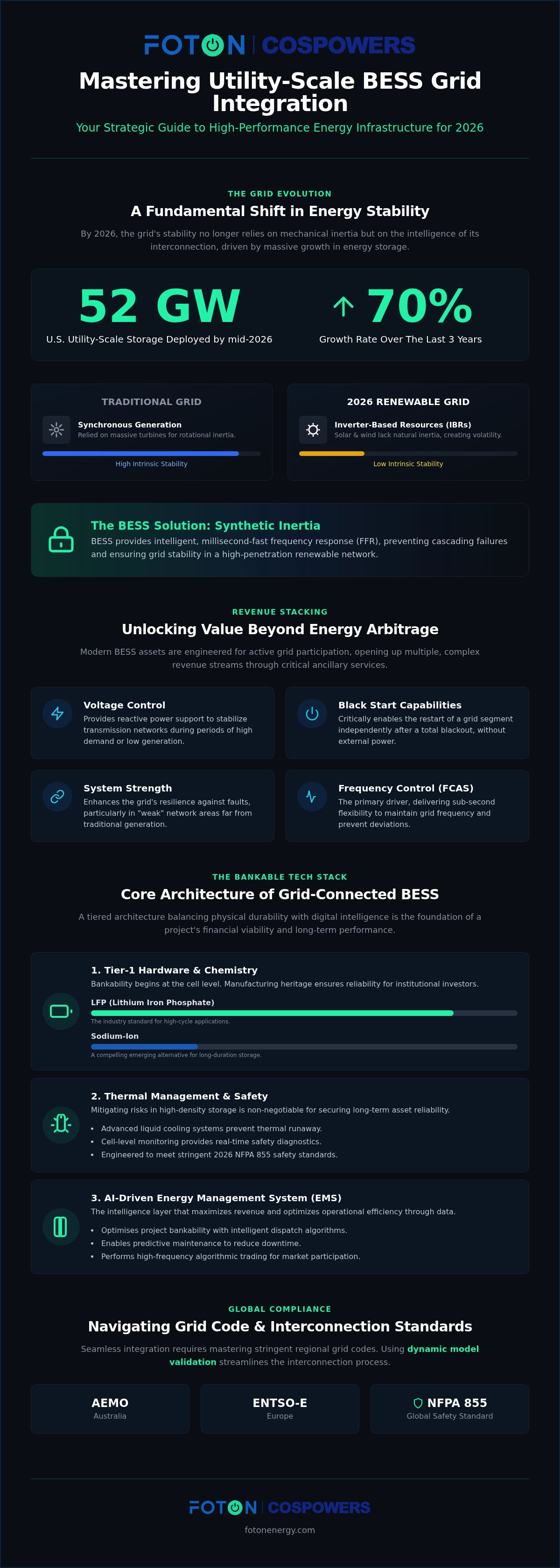
The global energy transition has reached a critical inflection point where the stability of the entire network depends on intelligent storage. As of mid-2026, the U.S. has deployed nearly 52 GW of utility-scale storage, reflecting a massive 70% growth rate over the last three years. This isn't just a capacity increase; it's a fundamental architectural shift. The traditional grid relied on the rotational inertia of massive electromechanical turbines to maintain frequency. Today, we're managing a landscape dominated by inverter-based resources (IBRs). This shift necessitates a sophisticated approach to utility scale BESS grid integration to maintain system frequency and voltage stability.
A modern Battery Energy Storage System (BESS) provides the synthetic inertia that IBRs naturally lack. By delivering Fast Frequency Response (FFR) in milliseconds, these systems prevent cascading failures during sudden generation drops. It's no longer just about moving energy from noon to midnight; it's about providing the sub-second flexibility that keeps the lights on in a volatile, high-penetration renewable network.
Addressing the Renewable Intermittency Challenge
Managing the "ramp" is the primary operational challenge for 2026 grid operators. Solar and wind generation can fluctuate rapidly, creating steep demand curves that traditional peaking plants struggle to follow. Utility-scale systems act as a high-performance buffer, absorbing excess energy during peak production and discharging it with surgical precision during peak demand. While utility-scale projects handle the bulk of transmission needs, commercial and industrial BESS solutions play an equally vital role at the grid edge, ensuring localised stability and reducing the burden on central infrastructure.
Ancillary Services and Revenue Stacking
Successful utility scale BESS grid integration unlocks a multi-layered revenue model that extends far beyond simple energy arbitrage. Frequency Control Ancillary Services (FCAS) remain a primary driver, but the 2026 market demands more complex support mechanisms. Modern assets are now engineered to provide:
- Voltage Control: Providing reactive power support to stabilise transmission networks during periods of high demand or low generation.
- Black Start Capabilities: The critical ability to restart a grid segment independently after a total blackout without relying on external power.
- System Strength: Enhancing the grid's resilience against faults, particularly in "weak" network areas far from traditional generation hubs.
This shift from simple storage to active grid participation ensures that storage assets remain bankable and resilient. By aligning Tier-1 manufacturing heritage with these critical grid services, developers can secure both operational excellence and long-term financial stability.
Technical Architecture of Grid-Connected BESS Integration
Utility-scale BESS grid integration is the seamless coupling of electrochemical storage with high-voltage transmission networks via intelligent power electronics. This integration requires a tiered architecture that balances physical durability with digital intelligence to ensure long-term asset performance. For developers and investors, the technical stack isn't just about hardware; it's the foundation of a project's financial viability and long-term bankability. To support the reliability of these power electronics systems, you can discover Adage Components for high-quality electronic parts like resistors and capacitors.
Bankability begins at the cell level, where manufacturing heritage acts as a proxy for reliability. Foton Energy leverages the 30-year legacy of Cospowers to deliver hardware that satisfies the rigorous demands of institutional investors. While Lithium Iron Phosphate (LFP) remains the industry standard for high-cycle applications, the 2026 landscape is seeing a significant shift in sodium-ion battery commercial availability. Sodium-ion offers a compelling alternative for long-duration storage due to its inherent safety and lower sensitivity to temperature fluctuations.
We prioritise containerised, modular architectures because they simplify the logistics of utility scale BESS grid integration. These pre-integrated units allow for rapid scaling and easier maintenance, ensuring that as your capacity needs grow, your infrastructure can expand without a complete technical overhaul. This modularity reduces the "integration friction" often found in bespoke, site-built systems, leading to faster commissioning and lower operational risk.
Grid-Forming vs. Grid-Following Inverters
The Power Conversion System (PCS) acts as the bridge between the DC battery modules and the AC grid. Traditionally, grid-following inverters relied on a stable external voltage source to operate. However, as renewable penetration increases, the grid itself often becomes "weak," particularly in remote areas. This is where grid-forming inverters become the backbone of a reliable grid.
Unlike their predecessors, grid-forming systems can set the voltage and frequency of the network independently. This capability allows the BESS to provide essential system strength and black start support, making it an indispensable asset for modern transmission operators. Future-proofing your project means investing in inverters that can adapt to these evolving utility requirements. If you're designing a high-density site, exploring our Utility-Scale Storage offerings can help you select the right inverter technology for your specific regional grid code.
The Digital Brain: EMS and AI Optimisation
The final layer of the architecture is the Energy Management System (EMS). This software layer manages the complex interplay between the batteries, the PCS, and the grid. By 2026, AI-driven EMS has moved from a luxury to a necessity, enabling predictive maintenance and real-time revenue optimisation. It ensures that every kilowatt-hour is dispatched at the most profitable moment while protecting the physical health of the battery modules through sophisticated cell-level monitoring.
Navigating Grid Code Compliance and Interconnection Standards
Compliance is the ultimate gatekeeper for any large-scale energy project. Even the most advanced hardware will remain a stranded asset if it fails to satisfy the rigorous requirements of the local network operator. Successful utility scale BESS grid integration demands a precise alignment with regional grid codes, such as AEMO's National Electricity Rules in Australia, FERC's mandates in the United States, or the ENTSO-E requirements across Europe. Each jurisdiction presents unique hurdles, from stringent harmonic distortion limits to specific reactive power capabilities that must be proven before a single kilowatt-hour is discharged.
Meeting these standards requires more than a simple checklist. It involves complex dynamic model validation to ensure the system behaves predictably during grid disturbances. Because these requirements are constantly shifting, engaging specialised BESS engineering consulting services is essential. Professional modelling ensures that your project is technically sound and financially bankable from the earliest feasibility stages, preventing the technical bottlenecks that often stall interconnection.
The Modelling and Simulation Phase
Accuracy in the simulation phase is the best way to avoid costly delays during commissioning. We utilise industry-standard tools like PSS/E for root-mean-square (RMS) studies and PSCAD for electromagnetic transient (EMT) analysis to simulate how the BESS interacts with the wider grid. These studies are critical for the R1 and R2 testing phases, where the theoretical performance of the inverter is validated against real-world disturbances. By identifying potential instabilities in a virtual environment, developers can reduce "re-work" and accelerate the path to full commercial operation.
Interconnection Agreements and SCADA Integration
A secure, high-speed communication link between the BESS and the System Operator is non-negotiable. This integration typically involves SCADA systems using protocols like DNP3 or IEC 61850 to provide real-time data for utility dispatch. Operators need precise visibility into state-of-charge, available capacity, and thermal health to manage the grid effectively. Simultaneously, cybersecurity has become a pillar of utility scale BESS grid integration. Protecting critical energy infrastructure from external threats requires adherence to global standards, ensuring that the "digital brain" of the system remains resilient against both physical and cyber vulnerabilities.
Thermal Management and Safety: Mitigating Risks in High-Density Storage
Safety is the bedrock of project bankability. As energy densities increase, the margin for error in thermal management vanishes. Effective utility scale BESS grid integration requires a safety-first mindset that begins long before the first battery container arrives on site. The 2026 edition of NFPA 855 has introduced more stringent requirements for large-scale fire testing, explosion prevention, and gas monitoring, making compliance a moving target for developers and investors alike.
The core challenge is preventing thermal runaway, a chain reaction where a cell's internal temperature rises uncontrollably. We mitigate this through granular, cell-level monitoring that identifies voltage and temperature anomalies before they escalate. Ensuring your utility-scale BESS procurement strategy prioritises these safety features is essential for securing project insurance and local planning approvals. Without these safeguards, the long-term reliability of the asset is fundamentally compromised.
Advanced Cooling Strategies for 2026
Liquid cooling has emerged as the superior choice for high-density utility deployments. Unlike traditional air cooling, which can struggle with "hot spots" in large containers, liquid systems circulate coolant directly across module plates to maintain a uniform temperature profile. This precision significantly extends the cycle life of LFP batteries by reducing thermal stress during rapid charge and discharge cycles.
Efficiency is equally important. Liquid cooling allows for higher Round-Trip Efficiency (RTE) by minimising the parasitic loads required to manage heat. Whether you're operating in the intense Australian heat or sub-zero Arctic conditions, active thermal management ensures the system remains within its optimal operational window. This stability is a key component of successful utility scale BESS grid integration, as it prevents thermal derating during critical grid events when the system's response is needed most.
Multi-Level Safety Architecture
A robust safety strategy employs a "defence in depth" approach. This starts with internal gas detection systems that provide an early warning of off-gas events, often minutes before a fire starts. Modern systems also include structural blast relief and deflagration venting to manage pressure in the unlikely event of an explosion, protecting both the asset and surrounding personnel. The Battery Management System (BMS) acts as the primary orchestrator, performing proactive fault isolation by disconnecting specific strings or modules if a safety threshold is breached. If you're ready to design a safe, high-performance site, explore our Engineering Consulting services to align your project with the latest global safety standards.
The Future of Intelligence: AI-Driven EMS for Grid Optimization
Physical hardware is only half the equation in 2026. To truly master utility scale BESS grid integration, an asset requires a digital brain capable of navigating the volatility of modern energy markets. An AI driven energy management system (EMS) transforms a passive storage unit into a proactive grid participant. These systems use machine learning to process vast streams of grid data, enabling real-time responses to frequency deviations and price signals that manual operations can't match.
Algorithmic trading is now the standard for maximising project returns. AI models forecast price spikes across multiple markets, ensuring that discharge cycles occur when revenue is at its peak. For hybrid plants where storage is co-located with solar or wind, the EMS optimises the entire facility as a single, cohesive unit. It balances renewable intermittency with the precision of the BESS, ensuring the combined output meets the exact requirements of the dispatch schedule while providing essential grid support.
Predictive Analytics and Asset Management
Downtime is the primary enemy of project returns. AI reduces O&M costs by shifting from reactive to predictive maintenance. By analysing subtle changes in cell voltage and impedance, the system forecasts potential failures weeks before they occur. It provides real-time State of Health (SoH) monitoring, which is critical for the bankability reports required by institutional investors. This intelligence also optimises charge and discharge profiles to preserve the warranty life of the cells, ensuring the asset remains productive for its intended operational lifespan.
Foton’s Integrated Approach to Grid Excellence
Foton Energy serves as the strategic link between world-class manufacturing and local technical execution. We bridge the gap between the 30-year Tier-1 heritage of Cospowers and the specific engineering demands of your local network. Our end-to-end consulting services guide developers through every phase of utility scale BESS grid integration, from initial feasibility and grid modelling to the deployment of intelligent EMS.
We invite you to leverage our global strategic partnership and local expertise to secure your high-performance infrastructure. Partner with Foton to secure your energy future and ensure your assets remain technically superior and commercially stable.
Securing Your Position in the 2026 Energy Landscape
The path to a resilient power network is paved with technical precision and strategic foresight. Success in this evolving market depends on your ability to align Tier-1 hardware heritage with AI-driven operational intelligence. We've explored how liquid cooling, grid-forming inverters, and rigorous compliance modelling form the foundation of a high-performance asset. Achieving seamless utility scale BESS grid integration is no longer a solo endeavour; it requires a deep synergy between manufacturing excellence and local engineering expertise.
As a Tier-1 Cospowers Strategic Partner with over 30 years of manufacturing heritage, Foton Energy provides the expert grid-code engineering support needed to navigate these complexities. We invite you to Consult with Foton’s Engineering Team for Your Next Utility-Scale BESS Project. Our collaborative approach ensures your infrastructure is not only technically superior but also fundamentally bankable. Together, we can transform technical hurdles into sustainable, high-performance infrastructure. The future of the grid is flexible, intelligent, and ready for your investment.
Frequently Asked Questions
What is the difference between grid-forming and grid-following BESS?
Grid-following inverters require a stable external voltage and frequency signal from the grid to synchronise their output. In contrast, grid-forming inverters can establish their own voltage and frequency reference independently. This capability is critical for black start services and stabilising weak network segments where traditional synchronous generation is absent. By 2026, grid-forming technology has become a standard requirement for many large-scale projects to ensure system strength in renewable-heavy networks.
How does utility-scale BESS help with frequency regulation?
Utility-scale systems provide frequency regulation by rapidly charging or discharging energy to balance the grid's supply and demand in real time. When frequency drops due to high demand, the system injects power; when it rises due to oversupply, it absorbs the excess. This sub-second response, known as Fast Frequency Response (FFR), is significantly more efficient than traditional thermal plants, making BESS the primary tool for maintaining grid stability.
Is LFP or Sodium-ion better for grid integration projects in 2026?
Lithium Iron Phosphate (LFP) remains the dominant choice for high-cycle, energy-dense applications due to its established manufacturing heritage and cost-efficiency. However, sodium-ion has emerged as a compelling alternative for long-duration storage and extreme temperature environments. While LFP excels in frequency market participation, sodium-ion offers improved safety profiles and reduced reliance on critical minerals. The choice depends on your specific project goals and the thermal demands of the site.
What are the main grid code compliance challenges for BESS in Australia?
The primary challenge for utility scale BESS grid integration in Australia is meeting AEMO's rigorous National Electricity Rules (NER). Developers must navigate complex R1 and R2 testing phases, which require detailed dynamic model validation in PSS/E and PSCAD. Common hurdles include managing harmonic distortion, ensuring system strength in remote regions, and maintaining secure SCADA communications. Professional engineering consulting is vital to prevent technical bottlenecks during the interconnection process.
How does an Energy Management System (EMS) improve BESS ROI?
An intelligent EMS maximises ROI by enabling revenue stacking and reducing long-term operational costs. It utilises AI to execute high-frequency algorithmic trading, ensuring energy is discharged during peak price events. Simultaneously, it performs predictive maintenance by monitoring cell health to prevent unplanned downtime. By optimising charge cycles to preserve warranty life, the EMS ensures the asset generates maximum value over its entire 15 to 20 year operational lifespan.
What safety certifications are required for utility-scale battery storage?
Utility-scale systems must adhere to a comprehensive suite of international standards to ensure bankability and operational safety. Key certifications include UL 9540 for system-level safety and UL 9540A for evaluating thermal runaway fire behaviour. Compliance with the 2026 edition of NFPA 855 is also mandatory for stationary storage installations. These standards cover fire suppression, explosion prevention, and emergency ventilation, providing the rigorous testing needed to satisfy insurers and regulators.
Can BESS provide virtual inertia to the power grid?
Yes, BESS provides virtual inertia through sophisticated power electronics that mimic the physical inertia of traditional rotating turbines. As fossil fuel plants are decommissioned, the grid loses its natural ability to resist rapid frequency changes. Grid-forming BESS fills this gap by responding almost instantaneously to frequency deviations. This digital response helps stabilise the network and prevents frequency collapses during sudden generation losses or transmission faults.
What is the typical lifespan of a utility-scale LFP battery system?
A high-quality utility-scale LFP system typically has an operational lifespan of 15 to 20 years. This duration depends on the depth of discharge, cycle frequency, and the effectiveness of the thermal management system. Modern liquid-cooled systems help maintain optimal temperatures, which significantly reduces cell degradation over time. With proactive monitoring and intelligent EMS management, most Tier-1 systems can maintain over 70% of their original capacity at the end of their design life.


