

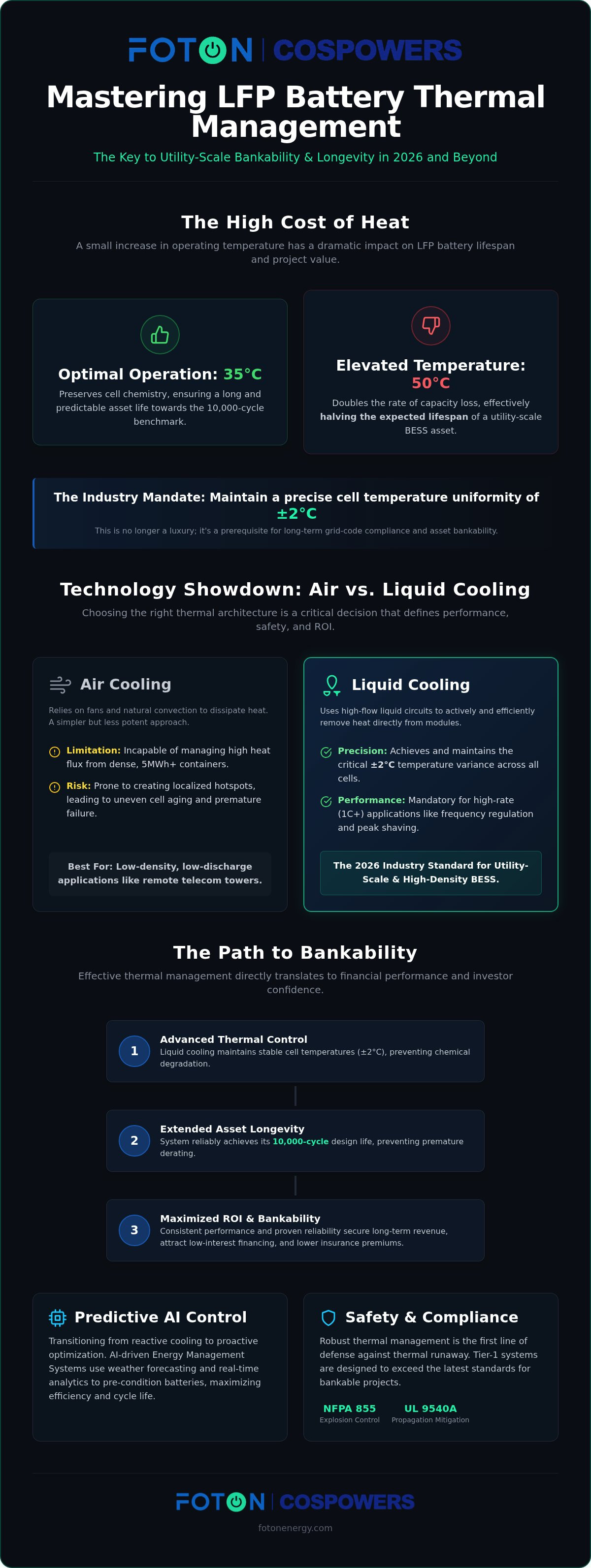
Increasing the operating temperature of LFP cells from 35°C to 50°C can double the rate of capacity loss, effectively halving the expected lifespan of a utility-scale asset. You've likely realized that as LFP captures 90% of the new storage market in 2026, the margin for thermal error has vanished. This is why sophisticated lfp battery thermal management systems have become the primary engine of project bankability. Maintaining a precise cell temperature uniformity of ±2°C is no longer a luxury; it's a prerequisite for long-term grid-code compliance. We recognize the pressure to deliver high-density storage that remains safe under extreme climates while meeting the rigorous requirements of the 2026 NFPA 855 standards.
This guide provides the technical clarity you need to master the architecture and financial impact of advanced thermal control. We'll demystify the transition from air to liquid cooling for high-capacity containers and explore how AI-driven energy management optimizes cycle life toward the 10,000-cycle threshold. By the end of this article, you'll have a strategic framework to select a thermal architecture that ensures safety certifications and maximizes the ROI of your large-scale infrastructure investments.
Key Takeaways
- Identify the direct correlation between thermal stability and utility-scale ROI, specifically how preventing capacity fade extends asset life toward the 10,000-cycle benchmark.
- Navigate the technical trade-offs between air and liquid lfp battery thermal management systems to select an architecture that aligns with 2026 bankability requirements.
- Discover how achieving a ±2°C temperature variance across modules through liquid cooling ensures long-term grid-code compliance and system safety.
- Transition from reactive cooling to predictive thermal control by integrating AI-driven Energy Management Systems that utilize weather forecasting and real-time analytics.
- Validate your project's safety profile by leveraging Tier-1 manufacturing standards and modular architectures designed to exceed the latest NFPA 855 explosion control requirements.
The Strategic Role of Thermal Management in LFP Longevity
Stability is the currency of the modern grid. Battery Thermal Management Systems (BTMS) serve as the active climate control layer for utility-scale LFP, regulating cell temperatures to prevent the chemical degradation that erodes project value. These lfp battery thermal management systems are no longer just auxiliary components; they are the central nervous system of the battery container. By maintaining a stable environment, we don't just protect the hardware; we secure the long-term revenue streams that investors depend upon.
While Lithium Iron Phosphate (LFP) batteries offer superior thermal stability compared to nickel-based chemistries, they remain highly sensitive to temperature fluctuations. Excessive heat accelerates the growth of the Solid Electrolyte Interphase (SEI) layer, which increases internal resistance and permanently strips away capacity. Conversely, operation in cold environments risks lithium plating during charging, a phenomenon that can lead to internal short circuits over time. This technical reality directly impacts the bottom line. Insurance providers now demand granular thermal data before underwriting large-scale assets, often tying premium rates to the documented efficiency of the cooling architecture.
Thermal Runaway Prevention and Safety Architecture
Preventing the initial spark is only half the battle. We must design systems that stop a single cell failure from becoming a catastrophic container event. LFP cells typically reach an exothermic reaction threshold at roughly 270°C. Robust lfp battery thermal management systems act as a critical thermal barrier, utilizing high-flow liquid circuits or advanced air distribution to wick away heat before it triggers adjacent cells. Adherence to UL 9540A standards isn't optional for bankable projects. It's the benchmark that proves a system can successfully mitigate propagation through active thermal intervention and integrated safety protocols.
Impact on Cycle Life and Bankability
Longevity defines the ROI of a 20-year energy storage asset. A well-managed LFP system can achieve 10,000 cycles, but this lifespan is entirely dependent on maintaining a consistent operating environment. Small deviations in temperature across a battery rack lead to uneven aging, creating "weak links" that force premature system-level derating. Financiers prioritize Tier-1 systems with proven manufacturing heritage, such as those from Cospowers, because they offer the data-backed reliability needed for low-interest debt financing. BTMS is the primary guardian of LFP bankability in 2026.
Active vs. Passive BTMS: Choosing the Right Architecture
Choosing between active and passive lfp battery thermal management systems is a strategic decision that dictates both the operational limits and the long-term maintenance profile of your asset. While passive systems offer a "set and forget" simplicity, active systems provide the granular control required for high-density, utility-scale applications. We must align the thermal architecture with the specific mission of the storage site to ensure both performance and cost-efficiency.
When to Deploy Passive Thermal Systems
Passive thermal management relies on natural convection, heat sinks, or Phase Change Materials (PCM) to absorb and dissipate heat without external power. These systems are ideal for remote telecom towers and lower-discharge C&I sites where maintenance access is limited. Because they lack moving parts like pumps or fans, they offer exceptional reliability in harsh, isolated environments. However, passive cooling is physically incapable of managing the heat flux generated in high-density 5MWh+ containerized configurations. For these larger installations, the thermal mass of the LFP racks quickly exceeds the dissipation capacity of passive sinks, leading to localized hotspots and accelerated aging.
The Necessity of Active Thermal Control
Active thermal control is mandatory for any BESS performing frequency regulation or heavy peak shaving. When batteries operate at 1C discharge rates or higher, the exothermic energy release requires immediate, forced intervention. Active lfp battery thermal management systems utilize a network of fans, pumps, and refrigerant cycles to maintain optimal chemistry. This architecture ensures that even during rapid cycling, the temperature remains within the narrow window required for peak efficiency. For those looking to optimize this balance in smaller footprints, our Commercial and Industrial BESS Solutions guide provides deeper insights into scaling these architectures effectively.
We must also acknowledge the "parasitic load" of these systems. Active cooling consumes a portion of the stored energy to power its own hardware. However, this small energy cost is a calculated investment. It prevents the accelerated capacity fade that occurs when LFP cells operate outside their ideal range, ensuring the system reaches its 6,000 to 10,000 cycle potential. If you're currently evaluating the feasibility of a high-density project, our engineering consultants can help model the precise thermal requirements of your specific grid application.
Liquid Cooling vs. Air Cooling: The 2026 Industry Standard
Liquid cooling has become the definitive standard for high-density lfp battery thermal management systems in 2026. While air cooling once dominated the market due to its mechanical simplicity, it now faces physical limitations in 5MWh+ containerized systems. Air-cooled BESS often suffer from uneven temperature distribution, where cells at the center of a rack stay hotter than those at the edges. In contrast, liquid cooling achieves a precise ±2°C temperature variance across all modules. This uniformity is the key to preventing "weak link" cell aging and ensuring the entire system reaches its maximum cycle potential.
Energy density requirements are driving this technological shift. Liquid-cooled architectures allow for significantly tighter cell packing, enabling energy densities that exceed 300kWh per square meter. This is nearly double the density of traditional air-cooled configurations. For utility-scale developers, this means smaller site footprints and reduced civil engineering costs. We've reached a point where the space-saving benefits of liquid systems often outweigh the higher initial hardware investment.
Efficiency Metrics: Air vs. Liquid
Efficiency in 2026 is measured by how effectively a system manages its parasitic power loss. Liquid systems typically offer a superior Coefficient of Performance (COP) because liquid is a much more efficient heat transfer medium than air. This reduces the energy the BTMS drains from the battery to maintain thermal stability. Beyond energy metrics, liquid systems solve the noise pollution challenges inherent in urban C&I BESS deployments. By eliminating the high-velocity fans required for air cooling, these systems operate quietly, making them ideal for mission-critical installations near commercial centers.
Total Cost of Ownership (TCO) Analysis
Initial CAPEX for liquid cooling is typically higher than air, but the long-term OPEX savings create a compelling financial case. Lower degradation rates and reduced energy consumption mean the cost per cycled kWh is significantly lower over a 20-year lifespan. This reality is reshaping the utility scale BESS procurement process, as buyers move away from first-cost metrics toward bankable lifecycle value. Data centers provide a clear case study for this transition. For these operators, the superior thermal reliability of liquid-cooled LFP is essential for maintaining the uptime required by high-performance computing environments.
Maintenance protocols have also evolved to match this standard. Modern liquid-cooled containers incorporate advanced leak-detection sensors and modular piping systems. These safeguards ensure that any fluid compromise is isolated immediately, preventing damage to the electrical architecture. It's this level of technical rigor that makes modern lfp battery thermal management systems the foundation of a resilient grid.
Integrating BTMS with AI-Driven Energy Management
Intelligence is the final layer of a resilient thermal strategy. While the physical hardware of lfp battery thermal management systems provides the capacity to cool, AI-driven Energy Management Systems (EMS) provide the foresight to optimize. We are moving beyond reactive cooling, where fans and pumps only engage once a threshold is reached. In 2026, the industry standard has shifted toward predictive modeling, where the system anticipates thermal loads before they occur. This proactive approach minimizes energy waste and ensures that the battery remains in its "sweet spot" during high-stress grid events.
Foton's intelligent EMS utilizes localized weather forecasts to pre-cool battery containers ahead of anticipated heatwaves or high-demand peaks. If the system knows a 40°C afternoon is coming, it can lower the internal temperature of the LFP racks during the cooler morning hours using low-cost energy. This strategic pre-cooling reduces the peak parasitic load on the BTMS when the grid is most strained. By treating thermal data as a critical input for performance monitoring, we transform the cooling system from a simple safety feature into a dynamic asset for grid-code compliance.
Predictive Maintenance and Early Warning Systems
Real-time thermal signatures allow us to identify "hot cells" long before they reach a critical failure point. AI algorithms analyze thousands of data points to detect subtle deviations in temperature that might indicate internal short circuits or accelerated aging. This level of granularity is essential for maintaining the safety of 5MWh+ high-density containers. For a deeper look at how software layers protect your investment, explore our AI Driven Energy Management Systems guide. These early warning systems enable operators to perform targeted maintenance, replacing a single module instead of risking a full-rack thermal event.
Optimizing Discharge for Market Participation
Dynamic thermal throttling allows a BESS to participate in lucrative frequency response markets without compromising its long-term health. When market prices spike, the EMS calculates exactly how much thermal stress a rack can handle based on its current state of health and the efficiency of the lfp battery thermal management systems. It balances the immediate revenue from a high-C discharge against the long-term cost of capacity fade. AI-driven EMS turns raw thermal data into actionable revenue by precisely timing discharge events to coincide with peak market prices while keeping cell temperatures within safe operational limits.
The integration of Tier-1 hardware with intelligent software ensures that your utility-scale asset remains both safe and commercially competitive. If you are designing a system for mission-critical applications, contact our engineering team to discuss how our AI-driven EMS can optimize your thermal performance.
Foton & Cospowers: Tier-1 Thermal Engineering at Scale
Success in utility-scale storage requires a foundation of proven manufacturing excellence. Through our exclusive global partnership with Cospowers, we deliver systems backed by a 30-year heritage of electrochemical innovation and industrial reliability. This isn't just about supplying hardware; it's about providing a bankable assurance that your infrastructure will perform exactly as modeled for its entire operational life. Cospowers stands as a Tier-1 manufacturer, ensuring that every cell and container meets the highest international standards for durability, safety, and efficiency.
Our modular safety architecture provides a multi-layered defense against thermal instability. We design from the cell level upward, ensuring that the precision integrated into our lfp battery thermal management systems protects the entire containerized asset. This hierarchical approach to safety allows our partners to deploy high-density storage in mission-critical environments with absolute confidence. By isolating potential thermal issues at the module level, we prevent the propagation of failure and maintain the integrity of the total system, even under the most demanding grid-cycling schedules.
The Cospowers Strategic Advantage
Cospowers provides the Tier-1 hardware foundation that makes large-scale projects financially viable. Our systems feature integrated liquid-cooling options that have undergone rigorous DNV and UL verification, providing the documented performance data that project financiers and insurers demand. This level of certification is vital for securing low-interest debt and reducing long-term insurance premiums. Beyond LFP, our expertise extends to emerging chemistries, including the sodium-ion battery for data centers, addressing the unique power density and thermal requirements of the rapidly expanding AI sector.
Partnering with Foton for Global Infrastructure
Foton Energy acts as the strategic engineering link between advanced manufacturing and operational success. We provide comprehensive BESS engineering consulting services to help you navigate the complexities of grid connection and custom thermal design. Whether you're deploying in the extreme heat of a desert environment or the sub-zero conditions of high-latitude regions, our team ensures your lfp battery thermal management systems are optimized for the local climate. We combine a global supply chain with local engineering expertise to support your project from initial commissioning through decades of performance monitoring.
Contact Foton Energy to design your bankable LFP storage system and secure the future of your energy infrastructure with a partner who understands the intersection of thermal science and financial performance.
Securing Long-Term Bankability Through Thermal Excellence
The transition to high-density utility storage in 2026 demands a definitive shift from basic air cooling to high-performance liquid architectures. We've established that maintaining a precise ±2°C temperature variance is the technical foundation of a 10,000-cycle asset life. By integrating sophisticated lfp battery thermal management systems with AI-driven predictive modeling, operators can now anticipate thermal loads before they ever impact cell health. This synergy between Tier-1 hardware and intelligent software layers ensures that your BESS remains safe, compliant, and commercially competitive throughout its entire 20-year operational lifecycle.
As the exclusive global partner of Cospowers, Foton Energy delivers the 30-year manufacturing heritage and elite engineering expertise required for mission-critical deployments in any climate. We invite you to secure your Tier-1 LFP infrastructure with Foton Energy and leverage our AI-driven thermal optimization for your next utility-scale project. Together, we can transform thermal stability into a strategic financial advantage for your energy portfolio. Let's build a more resilient and high-performance energy future today.
Frequently Asked Questions
What is the ideal operating temperature for LFP batteries in utility projects?
The optimal operating temperature for LFP batteries in utility-scale projects is between 15°C and 30°C. While LFP chemistry can technically function across a wider range from -30°C to +55°C, maintaining this narrow 15°C window maximizes round-trip efficiency and prevents accelerated aging. Consistency is the most important factor; large temperature swings increase internal resistance and lead to uneven cell degradation, which ultimately compromises the long-term ROI of the storage asset.
How does liquid cooling improve LFP battery lifespan compared to air cooling?
Liquid cooling significantly extends LFP lifespan by maintaining cell temperature uniformity within ±2°C. Air-cooled systems often struggle with localized hotspots, especially in high-density containers, which cause certain cells to age faster than others. By eliminating these thermal gradients, liquid-cooled lfp battery thermal management systems ensure the entire rack degrades at a predictable, uniform rate, allowing the system to reach 10,000 cycles or more before reaching 80% capacity.
Is liquid cooling safe for high-voltage LFP energy storage systems?
Yes, liquid cooling is safe and increasingly preferred for high-voltage LFP systems. Modern designs use non-conductive coolants and isolated piping to prevent electrical risks. These systems are engineered to meet stringent 2026 NFPA 855 safety standards. By providing superior heat dissipation, liquid cooling actually reduces the risk of thermal runaway propagation compared to air cooling, making it a safer choice for mission-critical, utility-scale infrastructure and high-density deployments.
Can an AI-driven EMS reduce the energy consumption of a thermal management system?
An AI-driven EMS can reduce the parasitic energy consumption of a thermal management system by up to 20% through predictive modeling. Instead of reacting to heat after it builds up, the AI uses weather forecasts and grid demand data to pre-cool the system during off-peak hours. This intelligent orchestration minimizes the load on pumps and fans during high-ambient temperatures, ensuring the BTMS operates at maximum efficiency while protecting the battery chemistry.
What are the maintenance requirements for a liquid-cooled BESS container?
Maintenance for liquid-cooled BESS containers focuses on coolant levels, pump health, and sensor calibration. While air systems require frequent filter cleanings to prevent dust buildup, liquid systems are largely sealed. Annual inspections typically include checking the integrity of modular piping and verifying the accuracy of leak-detection sensors. Because these lfp battery thermal management systems are modular, individual components can often be serviced or replaced without taking the entire container offline, ensuring maximum uptime.
Does thermal management affect the insurance costs of a large-scale BESS project?
Yes, advanced thermal management directly influences insurance premiums for large-scale BESS projects. Insurers prioritize systems with documented thermal stability and Tier-1 safety certifications like UL 9540A. Because liquid cooling reduces the probability of fire propagation and ensures more predictable asset degradation, it lowers the perceived risk profile of the project. This bankable assurance often translates into more favorable underwriting terms and lower annual insurance costs for project developers and owners.
How does Foton Energy ensure the bankability of its BTMS architecture?
Foton Energy ensures bankability by utilizing Tier-1 hardware from Cospowers, backed by over 30 years of manufacturing heritage. Our BTMS architectures undergo rigorous third-party testing and DNV verification to provide the performance data that financiers require. By combining this hardware with our proprietary AI-driven EMS, we offer a strategic engineering link that guarantees both safety and long-term financial performance. This approach provides a steady, guiding hand for large-scale investors and technical partners.
What happens to the BTMS during a power outage or grid failure?
During a grid failure, the BTMS is powered by the BESS itself or a dedicated uninterruptible power supply. The 2026 NFPA 855 standard requires backup power for critical safety systems, including thermal detection and ventilation. If the cooling system loses power, the EMS initiates a safe shutdown protocol to prevent heat buildup. High-quality systems include enough thermal mass to maintain safe temperatures during short-term outages, ensuring the cells remain within their safe operating window.


