

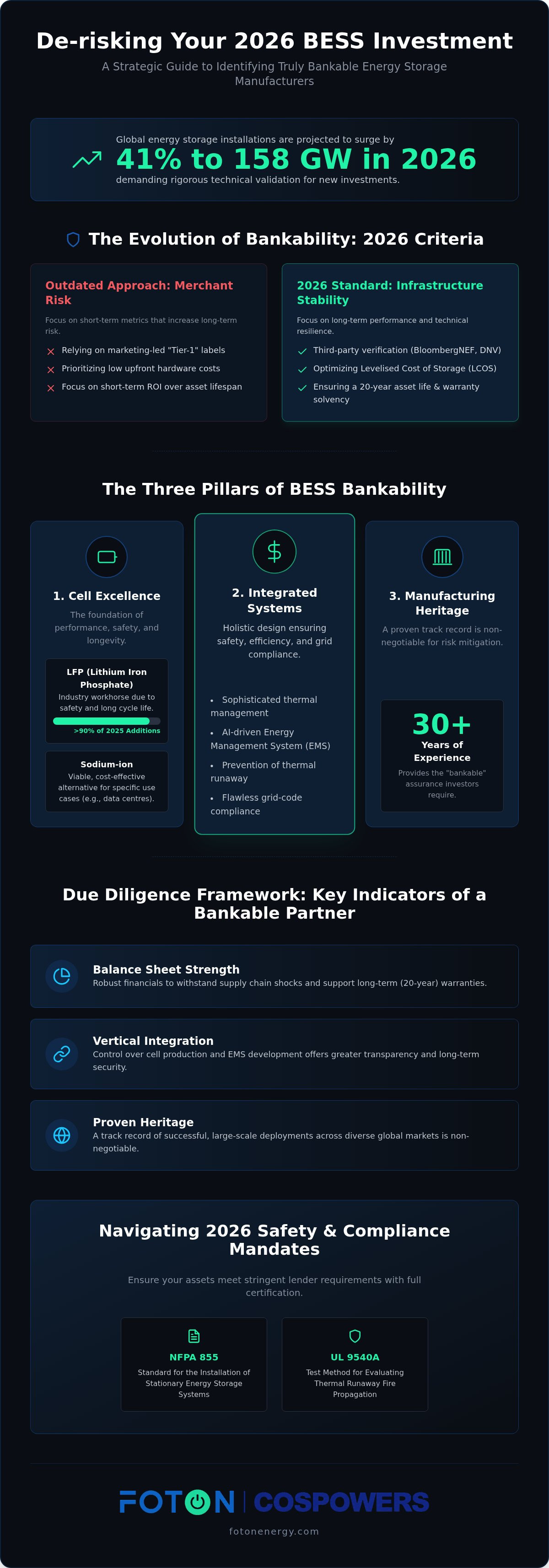
Global energy storage installations are projected to surge by 41% to reach 158 GW in 2026. This rapid growth has left many investors vulnerable to unproven technologies and marketing-led "Tier-1" claims. You've likely seen how easily a manufacturer can claim elite status without the operational heritage to back it up. Identifying truly bankable BESS manufacturers is no longer just about checking a list; it's about securing the long-term viability of your infrastructure through rigorous technical validation.
This strategic guide provides the clarity you need to de-risk your large-scale energy storage investments in 2026. We'll move beyond surface-level labels to explore the critical technical criteria that define industry leaders, from manufacturing heritage to the latest 2026 NFPA 855 fire safety mandates. You'll gain a robust framework for technical due diligence and a shortlist of manufacturers capable of meeting the strictest project finance audits. Let's look at how to verify certification status and manufacturer stability to ensure your next deployment is built on a foundation of performance and trust.
Key Takeaways
- Understand the evolving 2026 definition of bankability, moving beyond marketing labels to prioritize third-party verification from entities like BloombergNEF and DNV.
- Evaluate the performance profiles of LFP and Sodium-ion technologies to determine which chemistry best aligns with your specific C&I, utility, or data centre requirements.
- Implement a rigorous due diligence framework that validates technical certifications and manufacturing heritage to identify truly bankable BESS manufacturers for your project.
- Discover how leveraging 30 years of manufacturing excellence through strategic partnerships can bridge the gap between global Tier-1 production and local project security.
- Navigate the latest 2026 safety standards, including NFPA 855 and UL 9540A, to ensure your energy storage assets meet the stringent requirements of top-tier lenders.
Defining Bankability in the 2026 BESS Market
Bankability represents the threshold where a project transitions from a speculative risk to a financeable asset. For EPCs and financiers, selecting bankable BESS manufacturers is the most critical decision in the project lifecycle. In 2026, the criteria have evolved. It's no longer sufficient to merely appear on a quarterly list; lenders now demand a deep dive into manufacturing heritage and technical resilience. This shift ensures that capital is only deployed toward systems capable of delivering sustained performance over decades.
Third-party verification from organisations like BloombergNEF and DNV remains the industry standard for manufacturer ranking. However, "Tier 1" status is now viewed as the baseline rather than the finish line. Financiers look past the label to audit the underlying warranty solvency and the manufacturer's ability to support a 20-year asset life. If a manufacturer cannot prove they'll be around to honour a performance guarantee in 2046, the project simply won't get funded. Reliability is the new currency of the energy transition.
The Shift from Merchant Risk to Infrastructure Stability
Energy storage projects have undergone a fundamental transformation. They've moved from niche merchant assets to critical grid infrastructure. As a result, the primary concern for lenders has shifted from short-term ROI to long-term operational stability. This change reflects the maturing nature of the global market where performance certainty is paramount.
Modern investors prioritise the Levelised Cost of Storage (LCOS) over low upfront hardware costs. A battery energy storage system (BESS) must now demonstrate flawless grid-code compliance and high availability to secure favourable lending terms. This shift places immense pressure on manufacturers to deliver systems that aren't just functional, but intelligently integrated into the wider energy ecosystem. Projects that fail to meet these high standards of infrastructure stability often face significantly higher insurance premiums and financing rates.
Key Indicators of a Bankable BESS Partner
Identifying a truly bankable partner requires looking beneath the marketing hype. In 2026, the most reliable bankable BESS manufacturers share three distinct characteristics:
- Balance Sheet Strength: The financial health of the parent company must be robust enough to withstand global supply chain shocks and support long-term warranties.
- Vertical Integration: Manufacturers that control their own cell production and EMS development offer greater transparency and long-term security.
- Proven Heritage: A track record of successful utility-scale deployments across diverse global markets is non-negotiable for risk mitigation.
Foton Energy supports this bankability by aligning with partners who bring over 30 years of manufacturing heritage to the table. This depth of experience ensures that every component, from the cell to the intelligent EMS, is designed for the endurance required by mission-critical infrastructure. When heritage meets innovation, investors gain the "bankable" assurance they need to move forward with confidence.
The Three Pillars of BESS Bankability: Cells, Systems, and Heritage
Bankability in the 2026 energy storage market is built on three non-negotiable pillars: cell excellence, integrated architecture, and manufacturing heritage. While many bankable BESS manufacturers focus primarily on hardware specifications, true project stability comes from the synergy between these elements. A system is only as reliable as its weakest link, whether that's a volatile supply chain or an unproven thermal management strategy. Investors must look for a holistic approach to design that ensures long-term performance.
Pillar one focuses on the cells. Lithium Iron Phosphate (LFP) remains the industry workhorse, accounting for over 90% of annual additions in 2025 due to its safety and longevity. However, 2026 marks the rise of sodium-ion as a viable, cost-effective alternative for specific use cases like data centres. Pillar two addresses the integrated system architecture. High-performance BESS requires more than just high-quality cells; it demands sophisticated thermal management and AI-driven EMS to ensure safety and prevent thermal runaway. Finally, pillar three is manufacturing heritage. In an industry crowded with new entrants, three decades of experience provides the operational proof financiers require. Understanding these key factors in BESS bankability is essential for anyone looking to de-risk large-scale infrastructure.
Tier 1 Cell Manufacturing and Supply Chain Security
Tier 1 status begins at the cell level. Consistency in cell production determines the overall degradation profile and safety of the entire system. Bankable BESS manufacturers maintain rigorous control over their raw material sourcing, ensuring that every LFP or sodium-ion module meets international standards for purity and performance. This level of vertical integration is a primary defence against the supply chain instability that often plagues large-scale deployments. For a deeper look at managing these risks, consult our Sourcing Tier 1 Energy Storage: A Global Supply Chain Guide.
The Value of Manufacturing Heritage
Experience cannot be fast-tracked in the electrochemical sector. A 30-year legacy, such as that held by Cospowers, significantly reduces long-term operational risk for investors. This heritage means the manufacturer has already navigated multiple cycles of technology evolution, refining their processes through decades of real-world performance data. This history translates directly into bankable warranty structures that lenders can trust. Financiers prefer organisations that have demonstrated three decades of solvency and technical support. It's this stability that allows Foton Energy to act as a trusted strategic partner for your infrastructure goals. When you choose a partner with a deep manufacturing history, you aren't just buying hardware; you're investing in thirty years of failure-testing, refinement, and proven reliability.
LFP vs. Sodium-Ion: Comparing Technology Bankability
Technology selection in 2026 is no longer a binary choice. While Lithium Iron Phosphate (LFP) remains the dominant chemistry for utility-scale applications, sodium-ion has emerged as a strategically bankable alternative for specific high-growth sectors. Choosing between them requires a nuanced understanding of how each chemistry affects the long-term economic value of BESS. Bankable BESS manufacturers now offer diversified portfolios to address varying thermal requirements, safety profiles, and cost-performance ratios across different global climates.
LFP batteries accounted for over 90% of annual storage additions in 2025, solidifying their position as the industry benchmark for reliability. However, industry analysis in 2026 projects that sodium-ion cells could reach costs as low as $55 to $70 per kWh, compared to the $85 to $110 per kWh range for LFP. This shift is driving interest from financiers who prioritise low CAPEX in price-sensitive markets. Major producers like CATL anticipate sodium-ion will achieve full cost parity with LFP by the end of 2026, making it a viable contender for large-scale procurement strategies.
LFP Battery Cycle Life and Utility ROI
LFP remains the preferred choice for 20-year project horizons due to its superior cycle life and predictable degradation rates. For utility-scale and industrial projects, the ability to withstand daily deep-cycling without significant capacity loss is the primary driver of bankability. Modern LFP systems require sophisticated liquid cooling to manage high energy densities, a factor that lenders scrutinise during technical due diligence. To understand how these systems integrate into broader commercial strategies, explore our Strategic Guide to Commercial and Industrial BESS Solutions. High-density LFP storage continues to offer the most stable ROI for traditional grid-balancing services.
Sodium-Ion Bankability for Mission-Critical Infrastructure
Sodium-ion is rapidly gaining market share in the data centre and telecommunications sectors. Its superior performance in cold weather and inherent safety profile make it ideal for the AI-driven power crunches of 2026. Unlike lithium chemistries, sodium-ion cells can be discharged to zero volts for safer transport and maintain higher efficiency in extreme temperatures. These characteristics are particularly attractive for mission-critical infrastructure where fire safety and operational resilience are paramount. Our detailed analysis on Sodium-Ion Battery for Data Centers: Solving the AI Power Crunch in 2026 highlights why this technology is becoming a bankable necessity. Bankable BESS manufacturers that offer sodium-ion solutions provide an extra layer of de-risking for projects located in volatile environments or urban centres where safety regulations are most stringent.
The 2026 edition of NFPA 855 now mandates Large-Scale Fire Testing (LSFT), a requirement that directly impacts insurance premiums. Financiers are increasingly favouring manufacturers whose systems have already passed these rigorous tests, as it reduces the likelihood of catastrophic failure and lowers the overall cost of capital. Whether you deploy LFP for its proven cycle life or sodium-ion for its safety advantages, the manufacturer's ability to provide verified test data remains the ultimate indicator of bankability.
Due Diligence Framework: Evaluating BESS Manufacturers for Project Finance
Securing project finance in 2026 requires more than a reputable brand name; it demands a comprehensive audit of technical resilience and operational transparency. Financiers now employ a multi-layered due diligence framework to identify bankable BESS manufacturers capable of meeting 20-year performance guarantees. This process moves beyond surface-level specifications to scrutinise the manufacturer's internal quality controls and long-term solvency. A project's bankability is effectively a reflection of the manufacturer's ability to withstand technical and economic volatility.
To navigate this complex landscape, lead engineers and investors should follow a structured evaluation process:
- Step 1: Verify Technical Certifications. Ensure all systems meet the latest global standards, including UL 9540A (6th Edition) and IEC 62933. Compliance with the 2026 edition of NFPA 855 is now a prerequisite for most insurance underwriters.
- Step 2: Audit Manufacturing Facilities. Conduct a deep dive into factory automation and quality control. Traceability of raw materials is essential for ensuring cell consistency and long-term safety.
- Step 3: Review Third-Party Performance Reports. Reliable bankable BESS manufacturers provide independent scoring from firms such as PVEL or DNV. These reports offer an unbiased view of degradation rates and thermal performance.
- Step 4: Assess Local Engineering Support. Hardware is only half the battle. Evaluate the manufacturer's ability to provide on-site commissioning and long-term O&M support within your specific region.
- Step 5: Evaluate EMS Capabilities. The Energy Management System (EMS) must be sophisticated enough to handle complex grid-balancing services and AI-driven revenue optimisation.
Safety Architecture and Fire Suppression
Integrated safety features are the primary defence against thermal runaway. Liquid cooling has become the industry standard for high-density LFP systems, providing superior temperature control compared to traditional air-cooled alternatives. Lenders prioritise systems that demonstrate multi-level safety architecture, from cell-level sensors to container-level fire suppression. Grid-code compliance is equally critical, as it ensures the system can safely interact with local utility infrastructure without compromising grid stability.
The Role of Engineering Consulting in Bankability
Project feasibility studies serve as the foundation for securing large-scale finance. These studies don't just validate the hardware; they ensure the entire system architecture is optimised for the local grid and specific application needs. Local engineering support bridges the gap between high-tier manufacturing and successful grid integration, reducing the risk of costly delays. For a deeper understanding of how professional guidance secures your investment, read our BESS Engineering Consulting Services: A Strategic Guide to Bankable Energy Storage in 2026. Our team is ready to help you optimise your project bankability through rigorous technical validation and strategic planning.
Strategic Procurement: Foton Energy and the Cospowers Partnership
Strategic alignment is the final piece of the bankability puzzle. While identifying bankable BESS manufacturers is essential, the bridge between high-tier manufacturing and local project success is often found in strategic partnerships. Foton Energy serves as the exclusive global strategic partner for Cospowers, a Tier-1 manufacturer with over 30 years of manufacturing heritage. This relationship allows project developers and EPCs to leverage three decades of electrochemical expertise while benefiting from local engineering consulting and professional support. It ensures that the technical excellence of the factory floor translates directly into operational reliability on the project site.
Stability is a core requirement for large-scale infrastructure. With a global network spanning 70+ countries, the Foton and Cospowers partnership provides the scale and reach necessary to support mission-critical deployments. Whether you are developing utility-scale storage or securing data centre backup, this collaboration offers a secure supply chain backed by proven solvency. By aligning with bankable BESS manufacturers through a dedicated global partner, investors can mitigate the risks associated with international logistics and technical integration.
AI-Driven Energy Management for Asset Longevity
Intelligence is the guardian of hardware. Foton’s AI-driven Energy Management System (EMS) is designed to optimise battery health and maximise revenue generation across the entire asset lifecycle. Unlike standard control systems, our EMS utilises real-time monitoring and predictive maintenance to identify potential issues before they impact performance. This proactive approach is critical for maintaining the bankable status of an asset over a 20-year horizon. For a comprehensive look at how software protects your investment, consult our AI Driven Energy Management Systems: The 2026 Strategic Guide for BESS. By integrating machine learning with Tier-1 hardware, we ensure your system remains resilient against evolving grid demands.
Wholesale Procurement for EPCs and System Integrators
Efficiency in procurement is vital for meeting tight project timelines. Foton Energy streamlines the supply chain for high-capacity LFP and Sodium-ion hardware, providing EPCs and system integrators with a single point of accountability. We offer end-to-end support, moving from initial feasibility studies and engineering consulting through to final commissioning and long-term O&M. This holistic approach reduces the administrative and technical burden on your team, allowing you to focus on project execution. We invite you to partner with Foton Energy for your next bankable BESS project to experience the synergy of global manufacturing power and local expertise. Our commitment is to provide the stable, high-performance infrastructure required to lead the global energy transition.
Securing Your Energy Infrastructure for the Next Decade
Navigating the complexities of the energy transition requires a shift from short-term hardware procurement to long-term infrastructure stability. We've explored how bankable BESS manufacturers are defined by more than just production volume; they're validated by 30+ years of manufacturing heritage and rigorous compliance with evolving 2026 safety standards. Whether you're deploying LFP for utility ROI or Sodium-ion for mission-critical data centres, the foundation of your success lies in technical due diligence and intelligent system integration.
As the exclusive global partner of Cospowers, Foton Energy provides the bridge between Tier-1 manufacturing excellence and local project bankability. Our AI-driven EMS ensures your assets are optimised for both health and revenue over their entire lifecycle. It's time to move beyond the marketing hype and build with a partner who prioritises resilience and technical proof. Consult with Foton Energy for Bankable BESS Procurement and secure the future of your energy storage investments today. We look forward to supporting your vision for a cleaner, more reliable grid.
Frequently Asked Questions
What makes a BESS manufacturer "bankable" in 2026?
A manufacturer is bankable when financiers and lenders accept their hardware as a low-risk asset for long-term project financing. This status is determined by a combination of balance sheet strength, vertical integration of cell manufacturing, and third-party validation from firms like BloombergNEF. In 2026, bankable BESS manufacturers must also demonstrate compliance with the latest fire safety standards, such as the 2026 edition of NFPA 855, to ensure the asset remains insurable over its 20-year lifespan.
How does Tier 1 status differ from bankability?
Tier 1 status is a baseline metric of manufacturing capacity and financial health, but it doesn't always guarantee project bankability. While Tier 1 manufacturers produce high volumes and are often vertically integrated, bankability is a project-specific evaluation performed by lenders. A manufacturer might be Tier 1 but lack the local engineering support or specific safety certifications required by a financier for a particular jurisdiction. Bankability represents the "final approval" for capital deployment.
Why is manufacturing heritage important for battery storage financiers?
Heritage provides the operational proof that a manufacturer can honour long-term warranties and technical support. Financiers prefer partners with a stable history, such as the 30-year legacy of Cospowers, because it reduces the risk of company insolvency during the asset's life. This experience reflects decades of failure-testing and refinement in electrochemical storage, ensuring that the technology has evolved beyond the experimental phase into a foundational, reliable industrial pillar.
Is Sodium-ion battery technology considered bankable for commercial use?
Yes, sodium-ion is becoming a bankable choice in 2026, particularly for data centres and cold-climate applications. With cell costs projected between $55 and $70 per kWh, it offers a compelling safety profile and cost-efficiency. Major bankable BESS manufacturers are now integrating sodium-ion into their portfolios as it nears cost parity with LFP. Its ability to operate safely at zero volts and perform in extreme temperatures makes it an attractive, low-risk option for specific mission-critical infrastructure.
What certifications should I look for in a bankable BESS manufacturer?
Key certifications for 2026 include UL 9540A (6th Edition) for thermal runaway testing and the NFPA 855 standard for stationary energy storage installation. You should also verify:
- IEC 62933 for general BESS safety and performance.
- UN38.3 for safe battery transport.
- Local grid-code compliance certificates specific to the project's region.
These documents provide the technical proof points that lenders require to mitigate fire risk and operational downtime.
How does an Energy Management System (EMS) affect project bankability?
An intelligent EMS acts as the guardian of the hardware, directly impacting the project's revenue-generating potential and asset longevity. Financiers look for AI-driven EMS capabilities that provide real-time monitoring and predictive maintenance. By optimising charging cycles and preventing cell stress, a sophisticated EMS ensures the system meets its promised degradation curve. This software-driven reliability is essential for maintaining the economic value and bankable status of the project throughout its operational life.
Can Foton Energy support utility-scale BESS grid-code compliance in Australia?
Foton Energy provides comprehensive engineering consulting to ensure utility-scale projects meet stringent Australian grid-code requirements. Our team bridges the gap between Tier-1 manufacturing and local regulatory standards, facilitating smooth commissioning and grid integration. Through our exclusive global partnership with Cospowers, we combine 30 years of manufacturing heritage with local technical expertise. This ensures that your storage system isn't just high-performing hardware, but a fully compliant, bankable asset ready for the Australian market.


