

A utility-scale BESS project is only as resilient as the degradation curve in its spreadsheet. You're likely aware that while the global BESS pipeline now exceeds 800 GWh, the gap between a theoretical return and a bankable asset is widening. Lenders no longer accept optimistic averages. They demand rigorous technical proof that your asset won't become stranded before it reaches its tenth year of operation. It's a high-stakes environment where inaccurate assumptions about battery chemistry or long-term O&M costs can quickly derail even the most ambitious infrastructure investment.
We're here to bridge that gap. This guide provides a definitive framework for building a bankable utility scale bess financial model that satisfies the requirements of Tier-1 lenders. You'll learn how to master the complexities of multi-service revenue stacking and align CAPEX decisions with real-world performance metrics. We'll examine the critical intersection of AI-driven dispatch and hardware durability, providing you with the technical confidence to forecast a robust IRR and NPV. By the end of this guide, you'll have a strategic roadmap to transform volatile energy markets into stable, high-performance investments that stand the test of time.
Key Takeaways
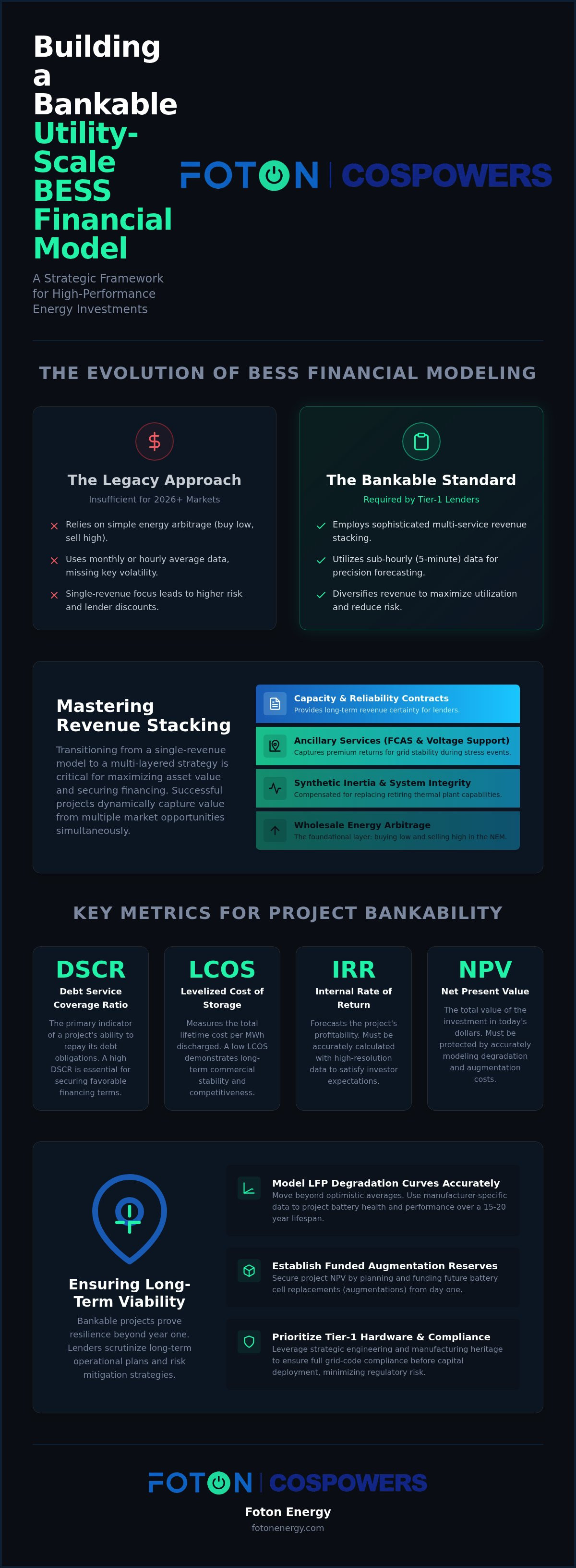
- Transition from simple arbitrage to sophisticated revenue stacking, integrating grid-firming and ancillary services to maximize asset utilization.
- Build a bankable utility scale bess financial model by utilizing sub-hourly resolution data and Tier-1 hardware specifications to satisfy rigorous lender requirements.
- Evaluate long-term project viability by accurately modeling LFP degradation curves and establishing funded augmentation reserves to protect your NPV.
- Secure project financing by prioritizing Debt Service Coverage Ratio (DSCR) and Levelized Cost of Storage (LCOS) as primary indicators of commercial stability.
- Leverage strategic engineering consulting and Tier-1 manufacturing heritage to ensure full grid-code compliance before capital deployment.
Why Utility-Scale BESS Financial Modelling is Shifting in 2026
The financial architecture for a battery energy storage system (BESS) has moved beyond the era of simple energy arbitrage. In previous market cycles, buying low and selling high was the primary narrative for project viability. By 2026, this approach has become insufficient. Grid operators now prioritize system resilience, and institutional lenders have tightened their requirements for capital deployment. To secure the lower interest rates associated with "bankable" projects, a utility scale bess financial model must now account for a sophisticated blend of grid-firming services and market participation strategies. While global supply chain stabilization has brought predictability to initial CAPEX projections, it has also shifted the investor's focus toward long-term operational excellence and revenue diversification.
The Move Toward Multi-Asset Revenue Stacking
Single-revenue models no longer satisfy the risk committees of major investment banks. The 2026 energy landscape requires a proactive revenue stacking strategy. This means your model shouldn't just forecast price spreads; it must integrate Frequency Control Ancillary Services (FCAS) and System Integrity Protection Schemes (SIPS). We're seeing a particular emphasis on the financial value of "Synthetic Inertia." As traditional thermal plants retire, grid codes increasingly compensate BESS assets that provide instantaneous frequency response. By participating in Virtual Power Plants (VPPs), developers can aggregate these capabilities, transforming a physical battery into a strategic grid asset that captures multiple premiums simultaneously.
The Importance of Data Granularity
Precision is the new standard for project bankability. Relying on monthly or even hourly averages is a recipe for stranded assets. The extreme volatility of 2026 energy markets demands sub-hourly resolution to capture the true value of rapid-response storage. Lenders often apply a heavy "uncertainty discount" to projects that lack this level of detail. Moving to 5-minute interval data allows for a more accurate Internal Rate of Return (IRR) forecast, reflecting how the asset will actually perform during peak stress events. AI-driven forecasting further reduces risk by aligning projected dispatch with real-time market conditions. High-resolution data is the essential foundation for any accurate BESS NPV calculation.
Revenue Stacking Strategies: Beyond Simple Energy Arbitrage
Maximizing the commercial performance of a grid-scale asset requires a shift from passive observation to active market participation. A truly robust utility scale bess financial model no longer treats arbitrage as a standalone driver but as one layer in a complex, multi-faceted revenue stack. By 2026, the most successful projects are those that pivot between wholesale price spreads, frequency regulation, and capacity market commitments in real-time. This dynamic approach ensures that the asset captures value during both routine operations and extreme grid volatility.
Front-of-the-Meter (FTM) Revenue Drivers
Wholesale energy price arbitrage in the National Electricity Market (NEM) remains a foundational element of the stack. However, the real margins often lie in ancillary services like frequency regulation (FCAS) and voltage support. These high-speed responses demand sophisticated control systems but offer premium returns when the grid is under stress. Additionally, long-term capacity payments and grid reliability contracts provide the essential revenue certainty that satisfies institutional lenders. Balancing these streams requires a model that can simulate various market conditions with high fidelity.
There is a critical trade-off between aggressive cycling for immediate revenue and the long-term health of the battery cells. The latest cost projections for utility-scale battery storage suggest that CAPEX efficiency is deeply tied to how these cycles are managed over 15 to 20 years. Every discharge has a physical cost. Your financial model must calculate the marginal cost of cycling to ensure that a high-revenue day doesn't disproportionately accelerate degradation and shorten the asset's useful life.
Optimizing Dispatch with AI
Deploying an AI driven energy management system is the most effective way to manage this complexity. These systems use predictive analytics to capture peak prices while simultaneously managing state-of-health (SoH) constraints. By automating participation in contingency events, developers can reduce operational overhead and eliminate the latency of human decision-making. This intelligent dispatch ensures the asset is always serving the most profitable market segment without exceeding its thermal limits. If you're looking to refine your dispatch logic, our Engineering Consulting experts can help align your software strategy with your hardware's physical capabilities.
CAPEX and OPEX Drivers: Evaluating Tier-1 Hardware and Degradation
Effective cost management begins with a granular understanding of hardware specifications. A utility scale bess financial model must look far beyond the sticker price of battery cells to achieve project bankability. While global average turnkey CAPEX ranges from $125/kWh to $220/kWh, the battery modules themselves are only one component. Balance-of-plant, EPC, and grid interconnection fees can constitute 45% to 55% of your total project budget. This distribution highlights why a strategic utility scale BESS procurement process is as vital as the financial modeling itself. Partnering with Tier-1 manufacturers like Cospowers, backed by a 30-year heritage, provides the operational data needed to secure lower insurance premiums and more favorable warranty terms, directly improving the project's bottom line.
LFP vs. Sodium-Ion: A Financial Comparison
The 2026 market marks a significant shift as Sodium-Ion technology nears utility-scale cost-parity with LFP. While LFP remains the industry standard with a cycle life of 8,000 to 10,000 cycles, Sodium-Ion offers distinct financial advantages in extreme climates. Its superior thermal management reduces the energy density requirements for cooling systems, potentially lowering long-term OPEX in high-temperature regions. When evaluating your 20-year NPV, you must weigh the established bankability of LFP against the resilience and emerging cost-efficiency of Sodium-Ion chemistries. Choosing the right chemistry isn't just a technical decision; it's a strategic move to optimize your Levelized Cost of Storage (LCOS).
The Cost of Augmentation
Managing battery degradation is a critical variable in any long-term financial forecast. Typical capacity loss averages 2% to 3% per year, which requires a clearly defined augmentation strategy. Developers must choose between initial oversizing, which increases Day 1 CAPEX, or a "top-up" strategy that relies on future battery price curves. Modular containerized energy storage systems have revolutionized this process by allowing for seamless, "plug-and-play" capacity additions. This modularity reduces future labor costs and minimizes site downtime during augmentation phases. By modeling these interventions with precision, you ensure the asset maintains its grid-firming capabilities without unexpected capital calls in the second decade of operation.
Building a Bankable Model: Key Metrics and Sensitivity Analysis
Bankability isn't a vague concept; it's a measurable set of ratios that satisfy a lender's risk department. While many developers focus exclusively on Internal Rate of Return (IRR), a truly robust utility scale bess financial model must prioritize Debt Service Coverage Ratio (DSCR) and Levelized Cost of Storage (LCOS). These metrics provide the transparency needed to secure non-recourse debt in a market where merchant revenue can be volatile. As interest rates remain elevated in 2026, understanding your Weighted Average Cost of Capital (WACC) is essential for accurate NPV forecasting and long-term asset stability.
Key Financial Metrics for Lenders
Lenders view merchant-heavy projects with caution, often requiring higher equity cushions. For projects backed by a tolling agreement, you can typically achieve a loan-to-cost ratio of 65% to 75% with interest rates around SOFR plus 225 to 300 basis points. Fully merchant assets, however, are often capped at 40% to 50% leverage with significantly higher spreads. Success hinges on a DSCR that stays within the 1.30x to 1.40x range. Additionally, LCOS is the critical benchmark for utility off-takers. With current benchmarks sitting between $60 and $85 per MWh, your utility scale bess financial model must demonstrate how Tier-1 hardware keeps these costs competitive against traditional peaking plants.
Sensitivity and Scenario Analysis
Static models don't survive real-world market shifts. Your financial framework needs to withstand rigorous stress testing across three primary scenarios. Scenario A assumes high price volatility in the National Electricity Market (NEM), where frequent price spikes reward rapid-response assets. Scenario B models a stabilized grid with lower spreads, testing the asset's reliance on ancillary service payments. Scenario C is the most critical: it simulates accelerated degradation caused by high-intensity cycling. If your model doesn't account for the increased O&M and augmentation costs associated with aggressive revenue capture, your long-term returns will be fundamentally flawed.
Preparing for "Black Swan" events, such as prolonged grid outages or sudden regulatory shifts, ensures your investment remains resilient under pressure. If you need to validate your assumptions against real-world performance data, our Engineering Consulting team provides the technical depth required for institutional-grade bankability.
Ensuring Project Bankability with Foton’s Strategic Infrastructure
Project bankability is secured through the alignment of theoretical modeling and physical reality. While a utility scale bess financial model provides the necessary roadmap, its value is entirely dependent on the reliability of the underlying hardware data. Foton Energy (Foton Pty Ltd) acts as the critical link between high-level investment goals and operational excellence. By integrating Tier-1 manufacturing standards with AI-driven optimization, we provide the technical assurance that institutional lenders require to commit capital. Our end-to-end infrastructure solutions are designed to mitigate the specific risks that often lead to "uncertainty discounts" during the financing phase.
The Foton Advantage in Financial Validation
Technical transparency is the foundation of institutional trust. Lenders demand technical proof rather than generic performance estimates. Through our exclusive strategic partnership with Cospowers, Foton Energy (Foton Pty Ltd) provides access to a 30-year manufacturing heritage and comprehensive performance data for both LFP and Sodium-Ion modules. This transparency allows developers to build a utility scale bess financial model based on real-world degradation curves and thermal efficiency metrics. We don't just supply hardware; we provide the technical support needed for seamless commissioning and long-term asset management. This strategic alignment ensures that your procurement decisions are directly optimized for your project's specific IRR and NPV targets, providing a grounded assurance that satisfies even the most rigorous risk committees.
Operational intelligence protects your long-term IRR. Our Intelligent EMS plays a pivotal role in proving operational efficiency to investors. By leveraging AI-driven dispatch logic, Foton Energy (Foton Pty Ltd) demonstrates how the asset will navigate the complexities of revenue stacking mentioned earlier in this guide. This software layer provides the audit trail and predictive analytics necessary to validate that the battery will perform as forecasted, even under volatile grid conditions. It transforms a stationary storage unit into an active, intelligent participant in the global energy market.
Next Steps: From Financial Model to Commissioning
Strategic alignment transforms a forecast into a physical asset. Transitioning from a 20-year financial forecast to a finalized EPC contract requires a steady, guiding hand. The engineering consulting services provided by Foton Energy (Foton Pty Ltd) bridge this gap by ensuring that your project feasibility studies align perfectly with 2026 grid-code compliance standards. We help developers navigate the technical architecture required for successful interconnection, reducing the likelihood of costly delays during the construction phase. Our global partner network and manufacturing stability provide a reliable foundation for large-scale infrastructure, ensuring that the momentum built during the modeling phase carries through to successful commissioning and operation.
Securing the future of your energy investment requires more than a spreadsheet. It requires a partner who understands the interconnectedness of hardware performance, market dynamics, and financial stability. To refine your modeling assumptions or explore Tier-1 procurement options, consult with Foton Energy (Foton Pty Ltd) for your next Utility-Scale BESS project and ensure your asset is built for long-term commercial resilience.
Securing Long-Term Performance in Global Energy Markets
Mastering the economics of grid-scale storage is no longer just about forecasting price spreads. It's about building a foundation of technical durability and operational intelligence. By prioritizing Tier-1 hardware through our partnership with Cospowers and utilizing AI-driven EMS for dispatch optimization, developers can transform volatile market conditions into stable, high-performance assets. We've explored how sub-hourly data and sophisticated revenue stacking are essential for satisfying institutional lenders in 2026. Building a robust utility scale bess financial model requires this synthesis of technical precision and market foresight.
Foton Energy (Foton Pty Ltd) provides the global engineering consulting expertise necessary to navigate these complexities from initial feasibility to final commissioning. Our end-to-end solutions ensure that your project isn't just a theoretical success but a bankable reality. We invite you to take the next step in your infrastructure journey by accessing our deeper technical resources. Download our Strategic Guide to Bankable BESS Infrastructure to start optimizing your project today. The future of the grid is being built now, and we're ready to help you lead the way.
Frequently Asked Questions
What is the most important metric in a utility-scale BESS financial model?
The Debt Service Coverage Ratio (DSCR) is the most critical metric for securing non-recourse debt. While IRR measures investor return, lenders prioritize the asset's ability to cover its debt obligations during periods of low market volatility. A bankable utility scale bess financial model typically targets a DSCR between 1.30x and 1.40x. Levelized Cost of Storage (LCOS) is equally vital for comparing BESS performance against traditional peaking plants and securing long-term off-take agreements.
How does battery degradation affect the long-term IRR of a storage project?
Battery degradation directly reduces the project's energy throughput, which lowers annual revenue and the overall Internal Rate of Return (IRR). Typical capacity loss averages 2% to 3% per year. If a model fails to account for funded augmentation reserves or initial oversizing, the project may face a revenue cliff in later years. Accurate modeling of degradation curves ensures that long-term cash flows remain sufficient to cover both operational costs and investor expectations.
Can I model Sodium-Ion batteries using standard LFP financial templates?
Standard LFP templates are insufficient for Sodium-Ion assets because the two chemistries have distinct physical and economic profiles. Sodium-Ion batteries often exhibit different degradation rates and superior performance in extreme temperatures, which alters thermal management OPEX. While Sodium-Ion is nearing cost-parity in 2026, its cycle life and efficiency curves require bespoke modeling. Using LFP assumptions for Sodium-Ion hardware can lead to inaccurate augmentation schedules and flawed 20-year NPV forecasts.
What is revenue stacking and why is it necessary for BESS bankability?
Revenue stacking is the practice of capturing multiple income streams from a single battery asset. This includes energy arbitrage, frequency control ancillary services (FCAS), and capacity payments. It's necessary for bankability because single-stream models are often too volatile for institutional lenders. By diversifying revenue, a utility scale bess financial model demonstrates a more stable cash flow profile, reducing the project's reliance on unpredictable wholesale price spreads during periods of grid stability.
How much does AI-driven EMS improve the financial performance of a BESS?
AI-driven Energy Management Systems (EMS) significantly improve performance by optimizing dispatch timing and reducing operational overhead. These systems use predictive analytics to capture peak prices while simultaneously managing the battery's state-of-health to minimize degradation. By automating participation in contingency events, AI-driven EMS can increase annual revenue by capturing high-value events that human operators might miss. This technology provides the technical proof of efficiency that institutional investors demand before committing capital.
What are the typical OPEX costs for a grid-scale battery system in 2026?
Typical OPEX for a 2026 grid-scale system includes scheduled maintenance, insurance premiums, land leases, and augmentation costs. Maintenance and insurance often constitute the largest share of ongoing expenses. Insurance costs are particularly sensitive to hardware quality; Tier-1 systems often command lower premiums due to their proven safety records. Additionally, developers must model funded augmentation reserves to ensure the asset maintains its nameplate capacity over its 15 to 20 year operational lifespan.
How do interest rate fluctuations impact the feasibility of BESS projects?
Interest rate fluctuations directly impact the Weighted Average Cost of Capital (WACC), which changes the project's Net Present Value (NPV). In the high-interest environment of 2026, even small rate hikes can compress margins and lower the Debt Service Coverage Ratio (DSCR). This makes the project less attractive to lenders and increases the equity requirement. Successful developers use sensitivity analysis to stress-test their models against SOFR fluctuations, ensuring the project remains viable under various financing conditions.
Why do lenders require Tier-1 hardware for project finance?
Lenders require Tier-1 hardware because it represents a lower technical and financial risk. Manufacturers with an extensive heritage, such as Cospowers, provide the long-term performance data and warranty security that institutional investors need. Tier-1 certification ensures that the battery modules meet rigorous international standards for safety and efficiency. This reliability reduces the likelihood of catastrophic failure or premature degradation, providing the bankable assurance that allows for higher leverage and more favorable interest rates.


