

By 2026, the industrial backup landscape won't just be about surviving power outages; it'll be about meeting stringent fire safety standards while maximizing every square meter of facility floor space. You've likely felt the operational strain of aging VRLA banks, from the relentless maintenance cycles to the physical bulk that restricts your facility's growth. Migrating from lead-acid to lithium for industrial backup is a strategic upgrade that transforms your energy infrastructure from a depreciating asset into a high-performance engine of resilience. It's no longer a simple battery swap. It's a structural evolution toward bankable, future-ready power.
We understand that the shift requires more than just new hardware. It demands technical certainty and a clear path to profitability. This guide provides the technical confidence you need to navigate system compatibility, implement AI-driven energy management, and build a robust ROI framework for your transition. We'll explore how advanced LFP and Sodium-ion solutions from Foton Energy (Foton Pty Ltd) offer the durability and safety required by upcoming 2026 regulations. From optimizing floor space to reducing operational downtime, you'll master the transition to a smarter, more efficient industrial ecosystem.
Key Takeaways
- Identify the 2026 safety and fire suppression mandates that mean legacy VRLA banks don't meet the requirements for modern industrial loads.
- Master the technical intricacies of migrating from lead-acid to lithium for industrial backup, specifically regarding inverter synchronization and advanced thermal management.
- Evaluate a 15-year economic framework that balances upfront capital costs with long-term operational savings and new revenue from demand response.
- Implement a structured five-step integration roadmap designed to maintain grid stability while transitioning to high-performance LFP or Sodium-ion infrastructure.
- Leverage the strategic engineering heritage of the Foton-Cospowers partnership to ensure your backup system is both bankable and future-ready.
The Lead-Acid Legacy vs. 2026 Industrial Demands
The era of passive energy storage is ending. Legacy Valve Regulated Lead-Acid (VRLA) systems, once the bedrock of industrial backup, are struggling to keep pace with the high-density power demands of modern facilities. These systems were designed for a time when backup was a "just in case" insurance policy. Today, industrial operations require dynamic energy assets that do more than just sit idle. Migrating from lead-acid to lithium for industrial backup isn't just about replacing a battery; it's a structural pivot toward a smarter, more integrated power architecture. Industrial Battery Migration is a strategic transition to high-density LFP or Sodium-ion chemistry designed to enhance operational resilience and efficiency.
The Limitations of VRLA in High-Performance Environments
VRLA banks are notoriously sensitive to temperature. Maintaining their lifespan requires rigorous environmental controls, often leading to high HVAC costs that erode your operational budget. Beyond cooling, the hidden OPEX of frequent replacement cycles creates a constant drain on technical resources. Industrial workflows now move at a pace that VRLA simply can't support. Their slow charging rates and limited discharge depth mean they can't handle rapid-cycle events or the sudden spikes common in heavy machinery and AI-driven data processing. As we approach 2026, the inefficiency of these legacy systems becomes a liability for any facility aiming for grid independence or high-availability targets.
The Lithium Advantage: LFP for Critical Infrastructure
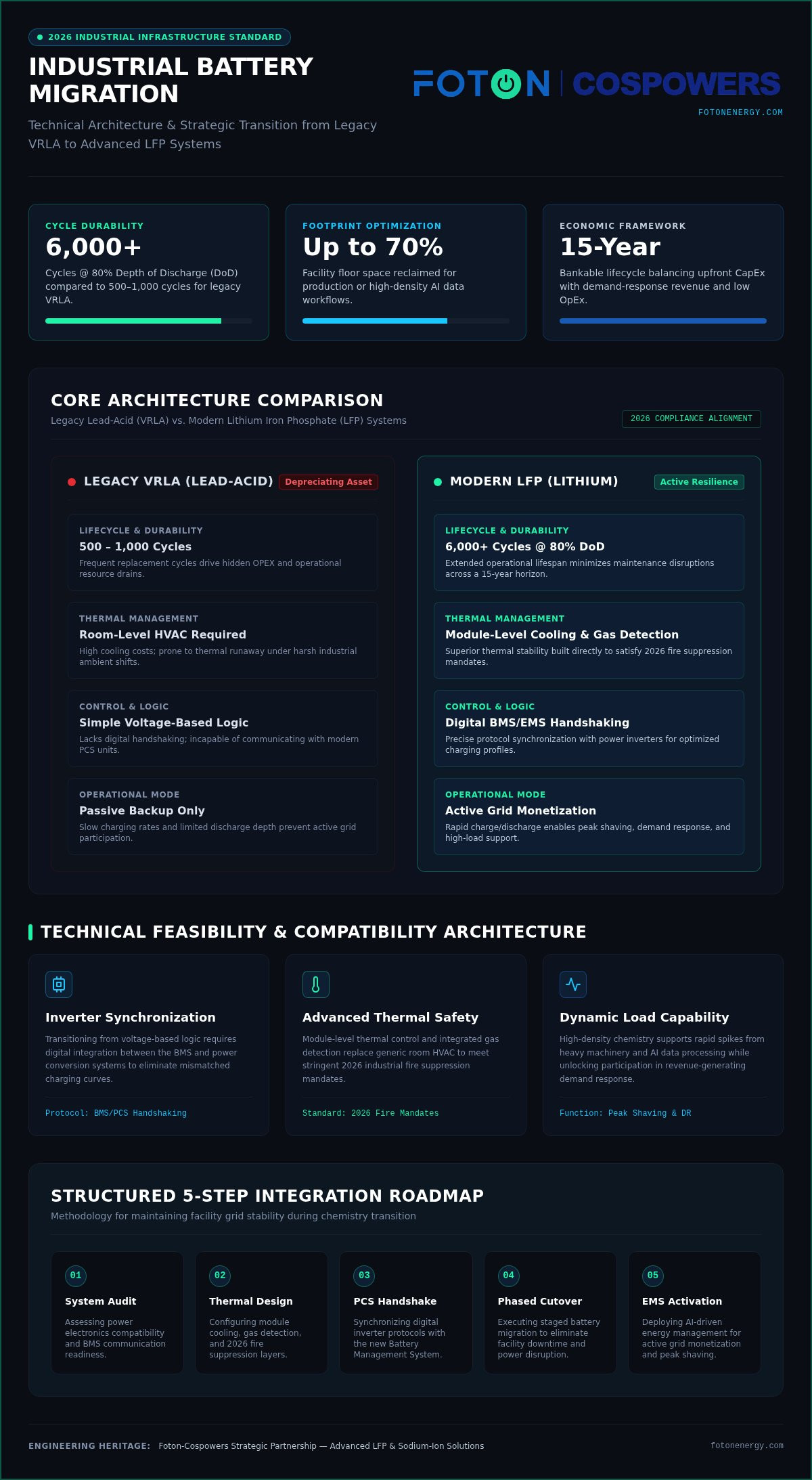
The shift to modern lithium-ion battery technology offers a radical improvement in volumetric energy density. For facility managers, this means reclaiming up to 70% of floor space previously occupied by bulky lead-acid racks. This reclaimed space can be repurposed for production or data processing, directly impacting the bottom line. Lithium Iron Phosphate (LFP) has emerged as the industrial standard due to its specific performance profile:
- High Cycle Life: Achieving 6,000+ cycles at 80% Depth of Discharge (DoD), which dwarfs the 500-1,000 cycles typical of VRLA.
- Enhanced Safety: LFP provides superior thermal stability, essential for meeting stringent 2026 fire suppression standards and insurance requirements.
- Rapid Response: Faster charging and discharging capabilities allow for active grid participation, such as peak shaving and demand response programs.
Environmental and ESG mandates are tightening globally. By 2026, sustainable industrial battery systems will be the baseline for compliance. Modern lithium systems align with these goals by offering significantly longer lifespans and lower environmental impact over their total lifecycle. Migrating from lead-acid to lithium for industrial backup positions your facility as an active participant in the energy market, allowing you to monetize your backup assets while securing your operations against grid instability.
Technical Feasibility: Assessing System Compatibility
Seamless power electronics integration is the cornerstone of a successful upgrade. When migrating from lead-acid to lithium for industrial backup, the primary challenge isn't the physical battery; it's the communication between the energy storage and your existing inverters. Lead-acid systems operate on a simple voltage-based logic, whereas lithium-ion modules require sophisticated handshaking with power conversion systems. You must ensure your current infrastructure can interpret the digital signals from a modern Battery Management System (BMS) to prevent mismatched charging profiles that could compromise bankability.
Thermal management requirements also undergo a fundamental shift. While VRLA banks rely on room-level HVAC to prevent "thermal runaway," lithium systems utilize module-level cooling to maintain optimal operating temperatures. Recent U.S. Department of Energy battery research indicates that advanced thermal stability is critical for the high-density configurations required by 2026 safety standards. Your facility must transition from simple air circulation to integrated fire suppression and gas detection architectures that are specifically tuned for LFP chemistries. If you're unsure about your facility's readiness, a strategic engineering consulting assessment can identify critical integration gaps before procurement begins.
BMS and EMS: The Brains of the Migration
Your legacy lead-acid chargers are incompatible with lithium safety protocols. They lack the ability to balance individual cells or respond to the millisecond-level data provided by a lithium BMS. To achieve true operational resilience, you should integrate AI driven energy management systems. These platforms move beyond basic monitoring, using digital twins to provide predictive maintenance alerts. This digital transition ensures that your backup system is an active, intelligent asset rather than a dormant insurance policy.
Footprint Optimization and Modular Scaling
Reclaiming floor space is one of the most immediate benefits of migrating from lead-acid to lithium for industrial backup. High-density LFP racks allow for significant footprint reduction, but this requires careful structural consideration regarding weight distribution on existing raised floors. For larger operations, containerized energy storage systems offer a "plug-and-play" alternative that bypasses the need for extensive indoor retrofitting. Avoid the temptation of hybrid lead-lithium setups; the mismatched internal resistance between chemistries creates significant safety risks and operational inefficiencies that can lead to premature system failure.
The Economics of Migration: ROI and Bankability
Industrial energy storage is no longer just a sunk cost. While legacy lead-acid systems appear cost-effective on a CAPEX sheet, their high OPEX and short lifespan create a deceptive financial profile. Migrating from lead-acid to lithium for industrial backup shifts the focus to a 15-year Total Cost of Ownership (TCO) model where the initial investment is offset by operational longevity and asset monetization. Tier-1 manufacturing heritage, such as the 30-year track record provided by Cospowers, ensures that your infrastructure is bankable for financiers who require proven reliability before approving large-scale capital allocations. Modern safety architecture doesn't just protect personnel; it protects the balance sheet. Systems that meet 2026 standards often qualify for reduced industrial insurance premiums because they mitigate the risks of thermal runaway and hydrogen gas accumulation inherent in older VRLA banks.
Leveraging Commercial and Industrial BESS Solutions for ROI
Don't view your backup system as a dormant insurance policy. Instead, treat it as a dynamic energy asset. By utilizing lithium's high cycle life, you can engage in strategic discharge to reduce peak demand charges, which often account for a significant portion of industrial utility bills. Many facilities are now using their backup capacity to participate in Frequency Control Ancillary Services (FCAS), turning an emergency reserve into a monthly revenue stream. This level of optimization requires a deep understanding of load profiles. Engaging BESS engineering consulting services early in the process ensures that your system is sized correctly for both critical backup and market participation, maximizing your return on investment from day one.
Financing the Transition
Financing requires proof. Tier-1 hardware delivers it. To secure competitive loan terms in 2026, your energy infrastructure must demonstrate compliance with international safety and performance benchmarks. Adhering to U.S. Department of Energy battery technology resources and certifications like UL9540A or IEC 62619 provides the "bankable" assurance that lenders demand. As government incentives for green manufacturing and resilient infrastructure continue to evolve, owning your energy storage asset can offer significant tax advantages. However, for organizations prioritizing liquid capital, leasing models for industrial energy storage are becoming a viable pathway to modernize without the full upfront CAPEX of migrating from lead-acid to lithium for industrial backup. By aligning your procurement with high-performance LFP or Sodium-ion modules, you ensure your facility remains competitive in an increasingly volatile energy market.
A 5-Step Roadmap for Industrial Lithium Integration
Transitioning to a high-performance energy environment requires a methodical execution plan. Migrating from lead-acid to lithium for industrial backup is a multi-phase engineering project that demands precision to avoid operational disruptions. A successful roadmap moves beyond simple procurement; it aligns your technical architecture with your long-term financial objectives. By following a structured five-step process, you can ensure your facility meets 2026 safety standards while maximizing the ROI of your new energy assets.
- Step 1: Feasibility and Load Profiling: Map your facility's specific load profiles and critical backup windows to determine the exact energy and power requirements.
- Step 2: Procurement: Source Tier-1 LFP or Sodium-ion modules that provide the bankability required by financiers and insurers.
- Step 3: Engineering Design: Develop a comprehensive plan that covers grid-code compliance, thermal management architecture, and electrical protection.
- Step 4: Installation and Commissioning: Execute a phased swap to minimize downtime, followed by rigorous site acceptance testing.
- Step 5: Lifecycle Management: Implement software-driven optimization to monitor health, manage state of charge, and participate in energy markets.
Feasibility and Procurement Strategy
Success begins with data. You must conduct a rigorous BESS project feasibility study to identify the optimal chemistry for your specific use case. While LFP remains the industry standard for density and safety, you should also evaluate a Sodium-ion battery for data centers if your project involves extreme temperature environments or specific sustainability mandates. Understanding the 2026 state of sodium-ion battery commercial availability is essential for projects slated for late-year deployment. Choosing between direct procurement and EPC-led sourcing depends on your internal engineering capacity, but always prioritize Tier-1 manufacturers like Cospowers to ensure long-term support and hardware stability.
Commissioning and Safety Testing
The commissioning phase is where technical theory meets operational reality. Standard operating procedures for decommissioning legacy lead-acid banks must include hazardous material handling and site decontamination to prepare for high-density lithium racks. Site Acceptance Testing (SAT) for high-voltage lithium containers involves stress-testing the communication between the BMS and the inverter. You must also verify the integration of fire suppression and gas detection systems to meet modern safety codes. Training facility staff on lithium-specific safety protocols and EMS operation ensures the system remains a resilient pillar of your infrastructure. To begin your transition with a verified technical partner, you can request an engineering feasibility consultation today to secure your facility's power future.
Migrating from lead-acid to lithium for industrial backup is a significant undertaking, but a phased roadmap reduces risk and ensures that every technical decision supports your broader business goals. By prioritizing Tier-1 hardware and AI-driven management, you transform your backup system into a high-performance engine of industrial resilience.
Future-Proofing with Foton Energy and Cospowers
The Foton-Cospowers partnership represents a strategic convergence of high-tier manufacturing and advanced engineering. For organizations migrating from lead-acid to lithium for industrial backup, this alliance provides the stability of a 30-year manufacturing heritage combined with sophisticated Australian technical oversight. We don't just supply hardware; we deliver bankable infrastructure that has been deployed across more than 70 countries. This global reach ensures that our systems are tested against diverse grid conditions and regulatory environments, offering a level of reliability that legacy VRLA banks simply cannot match.
Reliability is a byproduct of rigorous standards. Our Tier-1 manufactured LFP and Sodium-ion modules are designed to meet the upcoming 2026 safety requirements, ensuring your facility remains compliant and insured. By choosing a partner with deep-rooted manufacturing experience, you mitigate the supply chain risks often associated with emerging energy technologies. We provide a steady, guiding hand for large-scale infrastructure investments, ensuring that your transition to high-performance lithium is both technically sound and commercially stable.
Wholesale Solutions for EPCs and Resellers
Engineering, Procurement, and Construction (EPC) firms require more than just a vendor; they need a strategic link in their supply chain. Foton Energy offers direct access to Cospowers Tier-1 manufactured modules and containerized solutions, providing the supply security necessary for multi-megawatt projects. Our transparent supply chain ensures that resellers can commit to delivery timelines with confidence. We offer collaborative engineering support throughout the deployment phase, assisting with grid-code compliance and system integration to ensure every wholesale unit performs at its peak.
Consulting for Mission-Critical Facilities
Mission-critical environments like data centres, hospitals, and telecom hubs cannot afford the downtime associated with aging battery technology. Our engineering consulting services specialize in designing resilient backup architectures that leverage AI-driven energy management systems. These platforms optimize asset longevity by monitoring cell health in real-time and predicting maintenance needs before they impact operations. If you are currently managing legacy VRLA systems, migrating from lead-acid to lithium for industrial backup is the most effective way to secure your facility's long-term viability.
Contact our engineering team today for a comprehensive migration feasibility assessment to determine the most cost-effective path for your upgrade. Join the Foton channel partner programme to lead the 2026 energy transition.
Securing Industrial Resilience for 2026 and Beyond
Modernizing your energy infrastructure is a strategic necessity for maintaining a competitive edge in an increasingly volatile power market. By transitioning to high-density LFP or Sodium-ion chemistries, you don't just solve the maintenance headaches of legacy VRLA banks; you reclaim vital facility floor space and ensure compliance with stringent 2026 safety regulations. Migrating from lead-acid to lithium for industrial backup transforms a passive insurance policy into a bankable, revenue-generating asset through peak shaving and demand response. It's a fundamental move toward intelligence and long-term operational stability.
Success in this transition requires a partner with proven manufacturing heritage and deep technical expertise. Foton Energy, the exclusive global strategic partner of Cospowers, offers Tier-1 manufactured hardware backed by 30 years of industrial excellence. Our AI-driven Energy Management Systems provide the real-time optimization needed to maximize your ROI while securing your facility against grid instability. We're ready to help you navigate the technical complexities of system compatibility and integration. Contact Foton Energy for an Industrial BESS Feasibility Study and begin your journey toward a resilient, future-ready power architecture today.
Frequently Asked Questions
Is it possible to drop lithium batteries into an existing lead-acid rack?
Simple drop-in replacements are generally not recommended for high-capacity industrial environments. While some small-scale modules claim compatibility, migrating from lead-acid to lithium for industrial backup involves a fundamental change in power electronics and communication. Lithium modules require a Battery Management System (BMS) that must synchronize with your power conversion system. Additionally, the structural load and thermal management needs of high-density lithium differ significantly from legacy lead-acid racks.
How much floor space can I save by migrating to LFP batteries?
Industrial facilities typically reclaim up to 70% of their existing battery room floor space by transitioning to high-density Lithium Iron Phosphate (LFP) modules. Because lithium has a much higher volumetric energy density, you can achieve the same backup capacity in a fraction of the footprint. This reclaimed space allows for facility expansion or the installation of additional revenue-generating equipment, directly improving the operational efficiency of your infrastructure.
What are the fire safety requirements for industrial lithium backup in 2026?
By 2026, compliance with UL9540A and IEC 62619 standards is the baseline for industrial energy storage. These regulations mandate rigorous thermal runaway testing and integrated fire suppression systems. Modern architectures utilize module-level monitoring and gas detection to identify potential faults before they escalate. Foton Energy integrates these safety features into every deployment, ensuring that your backup infrastructure meets the most stringent international insurance and safety benchmarks.
Do I need to replace my existing industrial UPS to support lithium migration?
Most legacy UPS systems designed for VRLA banks are incompatible with the digital communication requirements of lithium-ion technology. While some modern inverters can be upgraded via firmware, migrating from lead-acid to lithium for industrial backup usually requires hardware that can communicate directly with a lithium BMS. This integration ensures that charging profiles are precisely managed, preventing overcharging and extending the lifespan of your Tier-1 manufactured battery modules.
What is the expected ROI period for a lead-acid to lithium migration?
The ROI period generally ranges between three and five years, depending on how actively you utilize the battery asset. While the initial capital expenditure is higher, the total cost of ownership is lower due to a 15-year lifespan and reduced maintenance. If you use your backup capacity for peak shaving or Frequency Control Ancillary Services (FCAS), the additional revenue streams can significantly accelerate the payback period compared to passive lead-acid systems.
Is sodium-ion a viable alternative to lithium for industrial backup in 2026?
Sodium-ion is a viable and increasingly popular alternative for specific industrial use cases, particularly in extreme temperature environments. It offers excellent thermal stability and lower raw material costs, making it a strategic choice for cost-sensitive projects or data centres with high-density cooling requirements. Foton Energy provides both LFP and sodium-ion solutions, allowing you to select the chemistry that best aligns with your facility's operational profile and sustainability goals.
How do I ensure my energy storage project is bankable for financiers?
Bankability is achieved by using Tier-1 manufactured hardware with a proven track record, such as Cospowers modules. Financiers require evidence of durability, international certifications, and long-term performance data. Implementing AI-driven energy management systems also enhances bankability by providing real-time optimization and predictive maintenance. This data-driven approach reassures investors that the asset will maintain its performance and value over its 15-year operational lifecycle.
What happens to the old lead-acid batteries during the migration process?
Decommissioning legacy VRLA banks requires a certified hazardous material handling process. Lead-acid batteries are highly recyclable, and professional migration services include the safe removal and transport of these units to specialized recycling facilities. This ensures your project remains compliant with environmental regulations and ESG mandates. Proper disposal is the final step in a successful transition, clearing the way for your high-performance, high-density lithium energy infrastructure.


