

The 36-month wait for a utility grid upgrade is no longer just a project delay; it's a strategic liability that stifles industrial growth and erodes investor confidence. As interconnection queues across major markets stretch toward 2026 and beyond, the traditional model of waiting for central infrastructure is failing to meet the pace of modern industry. You've likely felt the pressure of rising peak demand charges and the urgent need to satisfy aggressive ESG mandates while expansion plans remain stalled by a utility backlog. Finding viable alternatives to grid expansion for industrial parks has shifted from a forward-thinking luxury to a commercial necessity for maintaining a competitive edge.
We believe that energy independence is the foundation of industrial resilience. This guide explores how to bypass infrastructure bottlenecks through the deployment of Non-Wires Alternatives (NWA), including high-performance Battery Energy Storage Systems (BESS) and intelligent microgrids. You'll discover how AI-driven energy management optimizes site performance and why Tier-1 hardware is critical for long-term bankability. We'll examine the specific ROI of onsite storage versus traditional upgrades, providing you with a clear roadmap to secure the reliable, high-capacity power your facility requires without waiting on the grid.
Key Takeaways
- Identify how Non-Wires Alternatives (NWA) provide a strategic bypass to multi-year utility infrastructure delays through localized power generation and storage.
- Discover why Battery Energy Storage Systems (BESS) are the most effective alternatives to grid expansion for industrial parks, serving as a virtual buffer for high-demand processes.
- Compare the technical advantages of LFP and Sodium-ion chemistries to determine the optimal balance of energy density, safety, and cost for your specific industrial application.
- Learn how AI-driven Energy Management Systems (EMS) transition facilities from passive energy consumers to active, optimized microgrids capable of real-time load balancing.
- Understand the critical role of Tier-1 hardware and professional engineering consulting in securing project bankability and ensuring long-term operational reliability.
The Grid Capacity Crisis: Why Industrial Parks Need Non-Wires Alternatives
The centralized power model is fracturing. Industrial developers are facing a reality where the utility grid is no longer a guaranteed service; it's a structural bottleneck. As we move into 2026, the gap between industrial energy demand and grid capacity has widened into a crisis that threatens project viability. Relying solely on utility-led infrastructure is a high-risk strategy that often results in multi-year delays and missed commercial opportunities. Proactive energy planning is the only way to ensure your facility doesn't become a stranded asset.
The 2026 Industrial Power Bottleneck
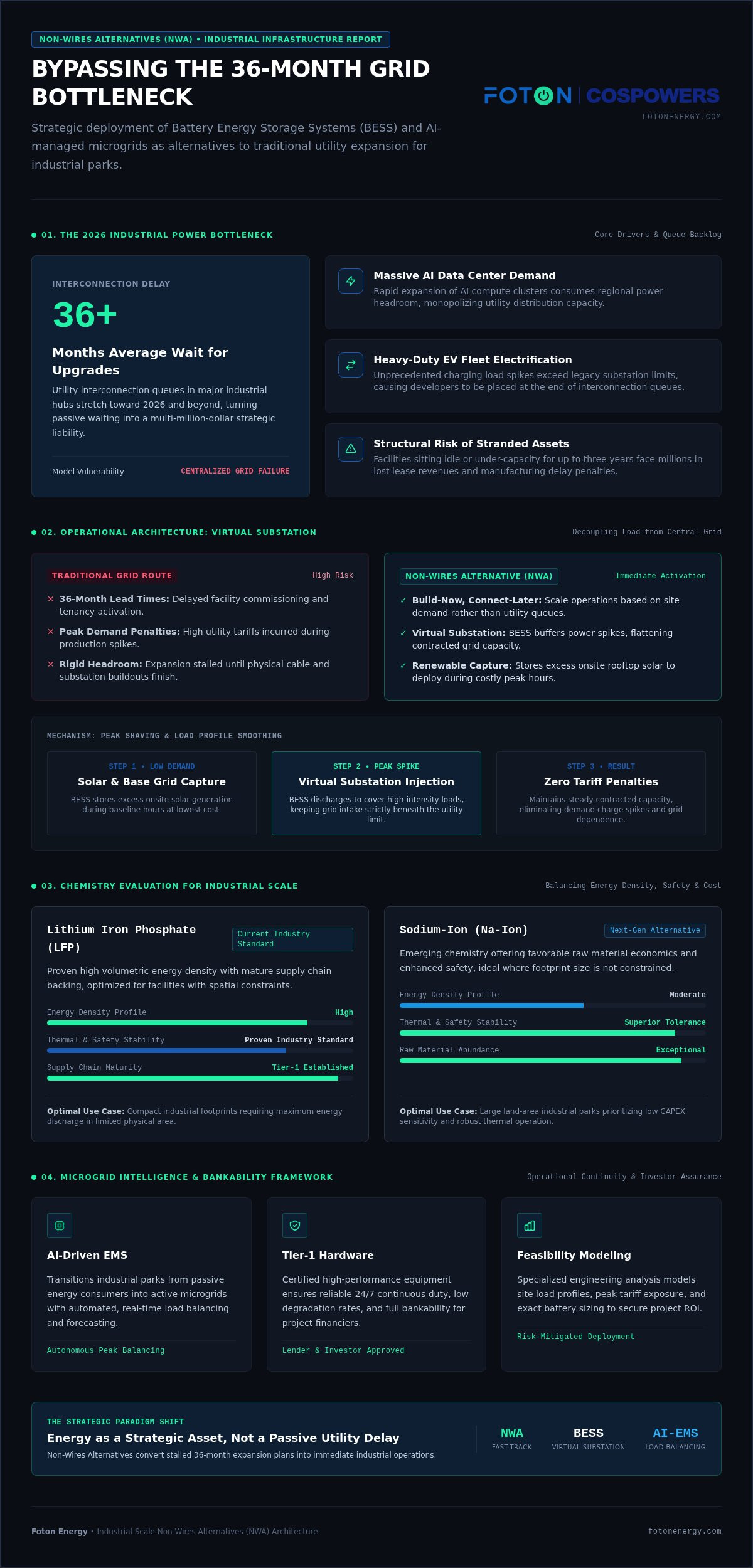
Wait times for new transmission and distribution connections in major industrial hubs now frequently exceed three years. This congestion isn't just a matter of bureaucracy. It's a physical limitation of aging distribution networks that weren't designed for the current era of rapid electrification. The massive energy requirements of AI data centers and the widespread adoption of heavy-duty EV fleet charging have consumed existing headroom, leaving industrial parks at the end of a very long queue. To address this, we define Non-Wires Alternatives (NWA) as the strategic deployment of distributed energy resources (DERs) to defer or eliminate the need for traditional grid upgrades. By integrating localized power solutions, developers can bypass these utility queues entirely. This shift toward microgrid technology allows for immediate site activation while the broader utility network catches up.
Economic Drivers for Grid Independence
The financial cost of waiting for a grid upgrade is often far higher than the capital investment required for private energy infrastructure. When an industrial park sits vacant or under-capacity for 36 months, the lost rental income and production value can reach millions. This economic reality is driving a massive shift toward self-sufficiency. Regulatory frameworks are also evolving, with many regions now offering incentives for distributed energy resources that help stabilize the local network. Implementing commercial and industrial BESS solutions has become the primary method for securing reliable power. These systems allow parks to manage their own load profiles, effectively creating alternatives to grid expansion for industrial parks that deliver immediate ROI. We are seeing a transition where energy is no longer a passive utility expense but a strategic asset that ensures operational continuity and long-term bankability.
Battery Energy Storage Systems (BESS) as the Primary Grid Alternative
Battery storage has evolved from a simple backup solution into a sophisticated virtual substation. For developers facing multi-year utility delays, a high-performance BESS serves as the most effective of all alternatives to grid expansion for industrial parks, providing immediate capacity without the need for physical cable upgrades. By decoupling energy consumption from grid supply, these systems allow facilities to scale operations based on demand rather than utility availability. This shift enables a "build-now, connect-later" strategy that protects project timelines and ensures operational readiness from day one.
Peak Shaving and Demand Charge Management
Reducing your "contracted capacity" is the most direct way to bypass grid constraints. Peak shaving allows an industrial park to draw a steady, lower level of power from the grid while using the BESS to cover high-intensity spikes in demand. This strategy effectively flattens the load profile, preventing the facility from exceeding its allocated utility limit and incurring heavy penalties. When integrated with onsite renewables like rooftop solar, the BESS captures excess generation during low-demand periods, creating a reservoir of "free" capacity for peak hours. This technical approach aligns with the non-wires alternatives framework from EPRI, which highlights storage as a primary tool for deferring expensive transmission upgrades. It's a pragmatic solution that turns energy storage into a bankable asset with a clear path to ROI.
Grid Strengthening and Voltage Support
Industrial zones often suffer from "weak grid" conditions, where heavy machinery and large motors cause voltage sags and frequency fluctuations. A Tier-1 BESS provides synthetic inertia and active voltage regulation, acting as a stabilizer for the entire park's electrical network. This level of power quality is essential for high-precision manufacturing and mission-critical infrastructure. For instance, ensuring reliability through a sodium-ion battery for data centers within an industrial park can prevent costly downtime caused by transient grid events. These systems respond in milliseconds to balance the load, providing a level of resilience that traditional grid infrastructure often lacks. Beyond reliability, BESS owners can access revenue stacking opportunities by participating in frequency response markets, allowing the system to generate income while it serves its primary role as a grid alternative. If you're ready to evaluate your site's potential, you can consult with our engineering team to design a system tailored to your specific load profile.
Comparing Energy Storage Chemistries: LFP vs. Sodium-Ion for Industrial Scale
Choosing the right electrochemical foundation is a pivotal step in designing robust energy infrastructure. While we've established storage as the primary mechanism for bypassing utility delays, the chemistry you select determines the long-term safety, cost-efficiency, and environmental resilience of your project. It's not just about raw power; it's about strategic alignment with your site's specific operational needs. For developers evaluating alternatives to grid expansion for industrial parks, the choice between Lithium Iron Phosphate (LFP) and Sodium-Ion (Na-ion) represents a strategic decision that impacts project bankability for decades.
LFP: The Bankable Standard for High-Density Storage
LFP has solidified its position as the industry standard for commercial and industrial applications. This dominance is driven by a superior cycle life, often exceeding 6,000 cycles at 90% depth of discharge, which ensures a low total cost of ownership over the system's lifespan. From a safety perspective, LFP is significantly more stable than traditional cobalt-based chemistries. Containerized LFP systems utilize advanced thermal management and multi-tier fire suppression protocols to maintain operational safety in high-density industrial zones. Because LFP is the current benchmark, it offers the highest level of standardization for utility-scale procurement. This makes it a dependable choice for investors who prioritize proven performance and established global supply chains.
Sodium-Ion: The Strategic Choice for Safety and Cold Climates
Sodium-Ion technology is emerging as a critical alternative, particularly for projects where safety and temperature resilience are paramount. Unlike lithium-based systems, sodium-ion batteries are inherently safer due to their lower risk of thermal runaway and ability to be transported at zero volts. This makes them ideal for high-safety environments like data centers or chemical processing plants within industrial parks. One of the most significant advantages of sodium-ion is its performance in extreme climates. While lithium capacity can degrade in sub-zero temperatures, sodium-ion maintains high efficiency, ensuring reliable power delivery in cold regions. Supply chain stability is another key driver. Sodium is abundant and geographically diverse, which helps insulate developers from the price volatility of lithium markets. Staying informed on sodium-ion battery commercial availability is essential for 2026 planning, as these systems move from pilot phases to large-scale industrial deployment. As manufacturing scales, we expect the price floor for sodium-ion to drop, offering a highly cost-effective solution for long-duration energy storage.
Implementing Microgrids and AI-Driven Energy Management
Hardware alone cannot solve the capacity crisis. High-performance infrastructure requires a sophisticated digital brain to function at peak efficiency. The shift toward AI driven energy management systems represents the final step in decoupling industrial growth from utility constraints. These systems transform static storage into a dynamic asset that anticipates demand rather than simply reacting to it. For developers seeking alternatives to grid expansion for industrial parks, AI integration is the catalyst that makes a localized energy strategy both technically feasible and commercially superior to traditional utility upgrades.
The Role of AI in Grid Optimization
Machine learning algorithms analyze historical consumption patterns and real-time weather data to forecast industrial demand peaks with high precision. This foresight allows the BESS to pre-charge during low-cost, off-peak periods and discharge when the grid is most stressed or expensive. Beyond internal site optimization, AI enables automated participation in frequency control ancillary services (FCAS). This creates a secondary revenue stream by selling stability back to the utility, effectively turning a backup system into a profit center. Intelligent systems also manage the physical health of the hardware through dynamic thermal management, ensuring high-density battery containers operate within optimal temperature ranges to maximize their 20-year operational lifespan. These predictive analytics, often enhanced by specialized monitoreo de temperatura industrial, also identify potential hardware failures before they occur, reducing maintenance costs and preventing unscheduled downtime.
Managing energy across a multi-tenant industrial park requires a sophisticated digital architecture that balances the needs of various operational profiles. Modern microgrids handle complex energy allocation and sub-metering to ensure accurate billing and transparency for diverse tenants. This infrastructure seamlessly integrates multiple energy sources, including onsite solar, wind, BESS, and traditional backup generators, into a single, cohesive network controlled by a central intelligence. Maintaining mission-critical reliability is achieved through "island mode" capabilities, which allow the park to disconnect from the utility during a failure and run autonomously. This ensures that a local grid outage doesn't result in a total operational shutdown for high-value manufacturing tenants. By utilizing these alternatives to grid expansion for industrial parks, developers can offer a premium, resilient environment that the aging central grid simply cannot match.
Optimize your facility with our intelligent EMS solutions.
Navigating Feasibility and Bankability for Industrial Energy Projects
Transitioning from a conceptual design to a commissioned asset requires a rigorous focus on commercial viability. While the technical alternatives to grid expansion for industrial parks are now well-established, securing project financing depends entirely on the "bankability" of the hardware and the engineering behind it. Financiers and insurers demand proof of long-term performance and safety before committing capital to private infrastructure projects. Without a foundation of certified, Tier-1 equipment, even the most innovative energy strategy will struggle to move past the feasibility stage.
Securing Tier-1 Bankability
Financiers prioritize reliability above all else. This is why Tier-1 hardware is a non-negotiable requirement for large-scale industrial deployments. Our exclusive partnership with Cospowers brings over 30 years of manufacturing heritage to every project, providing the structural stability that global investors require. Certification by bodies like DNV is essential for insurance verification and risk mitigation. These standards ensure that the safety architecture of the BESS can withstand the rigors of an industrial environment while maintaining peak performance. Structuring long-term asset management involves more than just a warranty; it requires a commitment to performance guarantees that protect the project's ROI over its entire lifecycle. By utilizing proven technology, developers can present a low-risk profile to lenders, effectively unlocking the capital needed to bypass utility delays.
Steps to an Industrial BESS Feasibility Study
A successful deployment begins with a granular understanding of the site's electrical behavior. Professional BESS engineering consulting services are critical for translating raw load data into a sized NWA solution. This process involves site-specific load profiling to identify the exact capacity needed to shave peaks and manage demand without a full grid expansion. Navigating local grid-code compliance is another complex hurdle that requires deep technical expertise and strategic planning. A comprehensive feasibility study ensures that your microgrid architecture integrates seamlessly with the existing utility connection while meeting all regulatory safety requirements. Foton Energy acts as your strategic partner throughout this journey, providing end-to-end engineering consulting and wholesale procurement of Tier-1 hardware. We help you move beyond the grid bottleneck by delivering a fully bankable energy asset. If you're ready to secure your facility's future, contact our team today to begin your feasibility assessment.
Securing Your Industrial Future Beyond the Grid
The era of waiting for utility-led infrastructure is over. By deploying decentralized power through BESS and AI-driven microgrids, you're not just bypassing a queue; you're building a resilient, bankable asset. We've established that localized storage and intelligent management are the most effective alternatives to grid expansion for industrial parks, enabling immediate site activation and superior power quality. Whether you require the high-density performance of LFP or the extreme safety of Sodium-ion, the path to energy independence is now clear and commercially viable.
Foton Energy is your strategic partner for large-scale infrastructure. As the exclusive global partner for Tier-1 Cospowers, we bring 30+ years of energy storage engineering heritage to every project. Our solutions feature AI-driven safety and thermal architecture to ensure long-term operational stability. It's time to take control of your energy destiny and secure the capacity your facility requires. Consult with Foton Energy for your Industrial BESS Strategy and begin your journey toward a resilient, grid-independent future.
Frequently Asked Questions
What are the main alternatives to grid expansion for industrial parks?
Non-Wires Alternatives (NWA) represent the most effective strategy for bypassing utility bottlenecks. These solutions primarily include large-scale Battery Energy Storage Systems (BESS), onsite renewable generation like solar or wind, and sophisticated demand-response programs. By localized power generation and storage, industrial parks can meet their energy requirements without waiting for physical upgrades to the transmission or distribution network. This approach ensures project timelines remain intact despite utility congestion.
Can a BESS really replace a grid upgrade for an industrial site?
Battery storage acts as a localized buffer that handles high-intensity peak loads that would otherwise exceed your grid connection limit. Through peak shaving, the BESS discharges during periods of high demand and recharges when consumption is low. This effectively reduces the "contracted capacity" you need from the utility. For many sites, this eliminates the immediate necessity for expensive and time-consuming physical cable or transformer upgrades.
How long does it take to deploy a containerized BESS compared to grid expansion?
Deploying a containerized BESS typically takes between 6 and 12 months from design to commissioning. In contrast, utility grid expansions in major industrial hubs now frequently face lead times exceeding 36 months. This speed to market allows developers to activate their facilities and begin generating revenue years earlier than traditional methods. It's a pragmatic solution for businesses that cannot afford to wait on utility timelines.
Is sodium-ion battery storage ready for industrial use in 2026?
Sodium-ion technology has reached commercial maturity for specific industrial applications, particularly where safety and temperature resilience are priorities. It's an excellent choice for data centers and facilities in extreme climates due to its inherent thermal stability. Foton Energy provides these systems through our Tier-1 manufacturing partnership, ensuring that sodium-ion is a bankable and reliable option for modern industrial energy infrastructure deployments.
What is the ROI of using BESS as a non-wires alternative?
The return on investment is driven by three primary factors: avoided capital expenditure for grid upgrades, significantly reduced peak demand charges, and new revenue from grid services. Additionally, the ability to occupy a site years earlier provides a massive boost to project IRR. When you factor in the 20-year lifespan of Tier-1 hardware, the cumulative savings often far exceed the initial investment in storage infrastructure.
Does an industrial park need a microgrid to avoid grid expansion?
A microgrid provides the essential control architecture that makes alternatives to grid expansion for industrial parks fully functional. While a standalone BESS can perform simple peak shaving, a microgrid integrates storage, onsite renewables, and tenant loads into a single, optimized network. This structure allows for "island mode" operation, ensuring 100% uptime for tenants even if the primary utility connection fails or remains limited.
What certifications are required for bankable industrial energy storage?
Financiers and insurers require hardware to hold Tier-1 status and international certifications such as UL 9540A for fire safety and DNV verification for performance. These benchmarks prove the system is safe for high-density industrial environments and will perform as promised over its lifecycle. Our partnership with Cospowers ensures that all hardware meets these rigorous global standards, providing the "bankable" assurance that large-scale investors demand.
How does an AI-driven EMS improve BESS performance?
An AI-driven Energy Management System (EMS) uses predictive analytics to forecast demand peaks and optimize charging cycles. It prevents battery degradation by managing depth of discharge and thermal levels in real-time. By analyzing market pricing and grid stress, the AI automatically shifts loads to the most cost-effective periods. This intelligence is critical for maximizing the ROI of storage assets in complex, multi-tenant industrial environments.


