

In 2026, a battery energy storage system that fails to meet evolving grid requirements isn't just a technical oversight; it's a stranded asset that threatens your entire capital structure. You've likely experienced the frustration of regulatory bottlenecks or the friction of aligning with diverse international standards. These challenges aren't just administrative hurdles. They're fundamental risks to your project's ROI and long-term viability.
Expert BESS grid-code compliance consulting transforms these complex requirements into a strategic advantage for your utility-scale investments. We agree that securing project financing requires more than just hardware; it demands a bankable assurance of technical performance and grid stability. This guide provides a clear roadmap for navigating the current regulatory landscape with confidence. We'll detail how rigorous engineering insights and AI-driven optimization ensure your assets meet the highest global standards for resilience. By the end of this article, you'll understand how to verify technical performance and streamline the commissioning process to achieve seamless grid integration. Let's secure your infrastructure's future through operational excellence and strategic alignment.
Key Takeaways
- Recognize why 2026 is a critical turning point for utility-scale storage, where increased renewable penetration demands more sophisticated dynamic response capabilities.
- Master the technical pillars of frequency control and power quality to prevent harmonic distortion from compromising your asset's performance and grid stability.
- Utilize specialized BESS grid-code compliance consulting to navigate the friction between global IEEE 1547 standards and localized mandates like the Australian National Electricity Rules.
- Implement a methodical engineering roadmap that secures asset bankability and ensures your project moves smoothly from preliminary feasibility studies to final commissioning.
- Discover how the synergy of Tier-1 manufacturing heritage and elite engineering expertise can de-risk your investment and streamline complex grid integration.
What is BESS Grid-Code Compliance in the 2026 Energy Landscape?
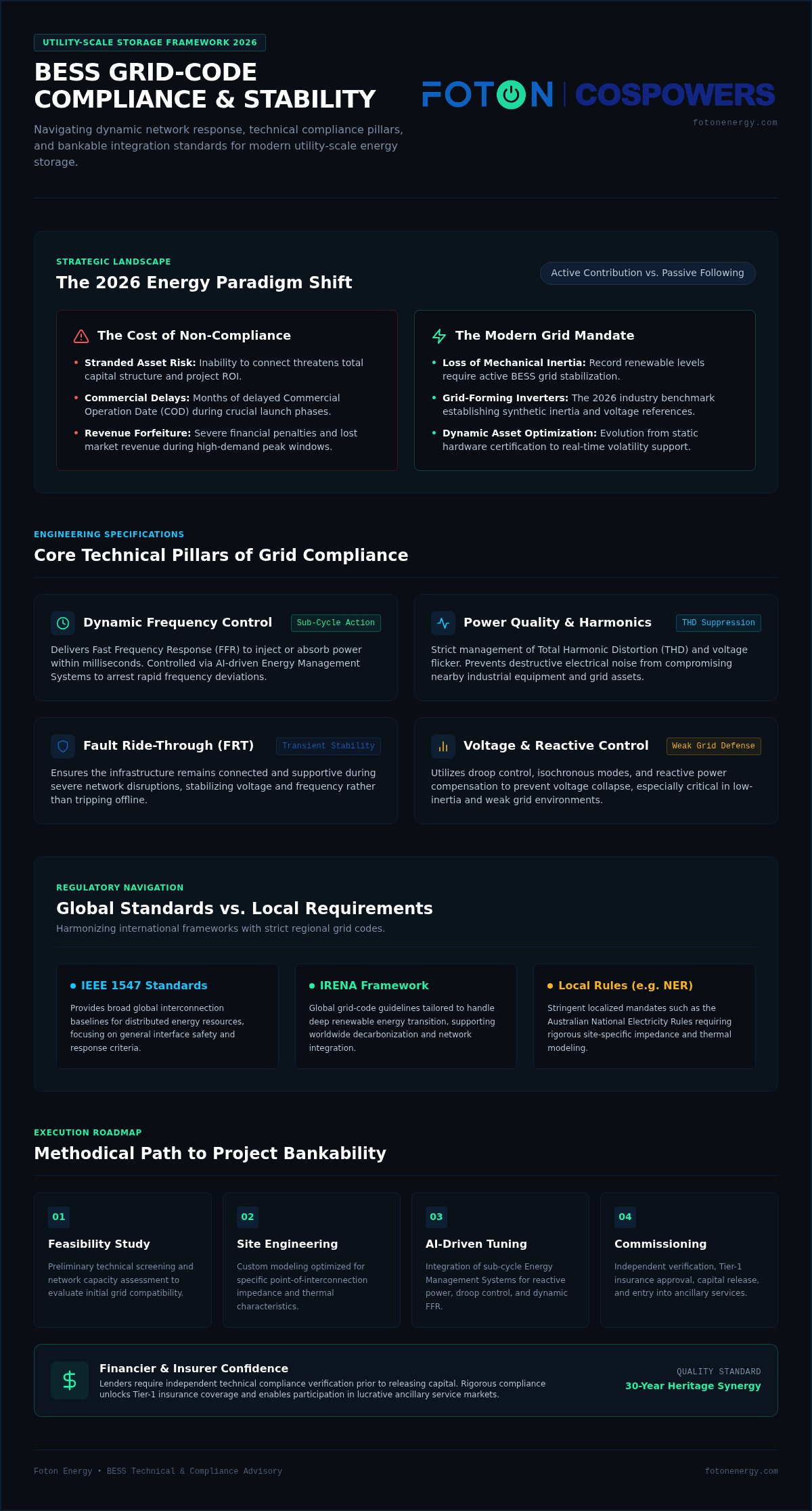
Grid-code compliance is the technical foundation upon which utility-scale energy storage is built. It's the set of rules that ensures a battery system integrates with the local network without causing instability or interference. Strategic BESS grid-code compliance consulting is no longer an optional service but a foundational requirement for any developer aiming for a seamless grid connection. In 2026, these grid code requirements have evolved from simple connection guidelines into rigorous performance mandates that dictate how an asset responds to real-time volatility.
The current year marks a definitive turning point. With renewable penetration reaching record levels, the grid has lost much of its traditional mechanical inertia. This shift forces developers to move away from passive storage systems that merely follow the grid's lead. Instead, modern assets must actively contribute to stability. Failing to meet these standards results in more than just a regulatory slap on the wrist; non-compliance leads to severe financial penalties, months of delayed commercial operation (COD), and significant lost revenue during peak market windows.
The Core Objectives of Modern Grid Codes
The primary goal is maintaining frequency and voltage stability within increasingly volatile energy markets. Modern codes require robust Fault Ride-Through (FRT) capabilities, ensuring that your infrastructure remains connected and supportive during transient grid disturbances. Grid-forming inverters represent the 2026 benchmark for utility-scale BESS, providing the necessary synthetic inertia to stabilize modern power networks. These systems don't just react to the grid; they establish the voltage and frequency references required for a resilient energy ecosystem.
Why Consulting is Mandatory for Bankability
Financiers and insurers now view compliance as a primary risk indicator. Engaging in professional BESS grid-code compliance consulting provides the independent verification that lenders require before releasing capital. They use these detailed compliance reports to assess the long-term viability of the project and its ability to participate in lucrative ancillary service markets. Moving beyond off-the-shelf hardware is essential. Site-specific engineering ensures that your system is optimized for the unique impedance and thermal characteristics of its location, securing the bankable status needed for Tier-1 insurance and large-scale infrastructure backing. Let's prioritize precision to ensure your project stands as a pillar of reliability in the modern grid.
Technical Pillars of BESS Grid-Code Compliance
Compliance in 2026 demands a shift from static equipment certification to active system optimization. High-performance battery assets must deliver precise dynamic responses to maintain grid equilibrium. This is where professional BESS grid-code compliance consulting becomes indispensable. It bridges the gap between hardware capability and the rigorous demands of modern power networks.
Dynamic performance focuses on Frequency Control and Fast Frequency Response (FFR). As mechanical inertia declines, batteries must inject or absorb power within milliseconds to arrest frequency deviations. This requires an AI Driven Energy Management Systems capable of sub-cycle decision-making. Simultaneously, managing power quality involves strictly controlling Total Harmonic Distortion (THD) and voltage flicker. These technical pillars ensure your system doesn't introduce noise that could destabilize sensitive industrial equipment nearby.
The synergy between hardware and software is the hallmark of a bankable project. Tier-1 hardware, backed by a 30-year manufacturing heritage, provides the physical resilience, while intelligent control systems provide the operational intelligence. Aligning these elements with the IRENA grid code framework ensures your asset remains a supportive pillar of the global energy transition.
Frequency and Voltage Regulation Strategies
Reliable grid support relies on sophisticated control methodologies like droop control and isochronous modes. In weak grid environments, managing reactive power compensation is vital to prevent voltage collapse. Our engineering team specializes in tuning these parameters to ensure your system provides a stabilizing influence exactly when the network is most vulnerable. If you're looking to optimize your site's performance, consider how utility-scale storage engineering can de-risk your deployment.
Modeling and Simulation Requirements
Utility-scale approval in 2026 requires more than just spreadsheets. Network operators demand high-fidelity PSCAD and PSS/E models to predict how your BESS will behave during extreme events. These simulations are essential for validating "black start" capabilities, where the battery provides the initial energy to restart a collapsed grid section. Digital twin simulations allow us to bridge the gap between theoretical modeling and site commissioning, ensuring that what works on a computer also performs flawlessly in the field. Integrating BESS grid-code compliance consulting into the modeling phase is the key to securing project financing and long-term operational success.
Global Standards vs. Local Requirements: Navigating the Gap
Strategic project development in 2026 requires a nuanced understanding of the divergence between international frameworks and regional mandates. While many developers look to IEEE 1547 as a baseline, utility-scale success depends on meeting more stringent local criteria. Expert BESS grid-code compliance consulting identifies these gaps early, preventing the costly redesigns that occur when global hardware meets localized network constraints. We see a growing adoption of the IEEE 2800 interconnection standards, which provide a more rigorous performance envelope for inverter-based resources, yet even these must be mapped against specific utility expectations.
European markets prioritize the EN 50549 standards for distributed energy resources, focusing heavily on power quality and reactive power management. However, the most significant engineering challenges often emerge in regions with unique topography. Australia's "long-stringy" grid, characterized by vast distances and low system strength, presents a technical frontier that tests the limits of standard equipment. These conditions demand customized control settings and advanced protective relaying that go far beyond basic international certifications.
Australia's AEMO and NER Compliance
The Australian National Electricity Rules (NER) are often cited as the global gold standard for engineering rigor. Navigating the 5.3.4A and 5.3.4B negotiation process with the Australian Energy Market Operator (AEMO) requires deep technical evidence and iterative simulation. This process isn't just a bureaucratic hurdle; it's a technical verification that the asset won't destabilize the network. Integrating these requirements into your utility-scale BESS procurement strategy ensures that your selected hardware is capable of the high-speed response demanded by the market operator.
Chemistries and Certification: LFP vs. Sodium-Ion
As we move through 2026, the diversification of battery chemistries introduces new compliance layers. While Lithium Iron Phosphate (LFP) remains the industry workhorse with established certification pathways for Tier-1 containers, Sodium-ion technology is carving a significant niche. Sodium-ion requires distinct fire safety and thermal management compliance due to its different chemical behavior under stress. Ensuring your project accounts for the sodium-ion battery commercial availability and its specific regulatory landscape is vital for long-term safety and insurance bankability. Our consulting approach harmonizes these chemical-specific needs with the overarching grid code, providing a clear path to commissioning regardless of the chosen technology.
The BESS Consulting Roadmap: From Feasibility to Commissioning
Achieving full commercial operation in 2026 requires a methodical, multi-stage engineering journey. Many developers make the mistake of treating certification as a final checkbox; however, elite BESS grid-code compliance consulting integrates these requirements from the initial site selection. This proactive approach de-risks the project, ensuring that technical constraints don't become financial liabilities during the final stages of commissioning. A structured roadmap transforms regulatory pressure into a predictable project milestone.
The roadmap begins with Preliminary Grid Impact Studies. This phase evaluates the local network's system strength and thermal capacity to accommodate new storage capacity. Next, Detailed System Design transitions into hardware selection, where we leverage a 30-year manufacturing heritage to source Tier-1 components that align with specific grid demands. Advanced modeling follows, utilizing R1 and R2 testing protocols to create a high-fidelity digital twin of the asset's performance. Finally, on-site commissioning and performance verification lead into long-term asset monitoring and compliance audits, ensuring the system remains a supportive pillar of the grid throughout its operational life.
Early-Stage Feasibility: Avoiding Sunk Costs
Identifying grid constraints before major hardware procurement is the most effective way to protect your capital. The Grid Connection Point is the critical engineering variable that determines the technical feasibility and economic viability of your utility-scale storage project. Engaging in BESS Engineering Consulting Services during this stage allows developers to pivot their strategy or optimize system sizing before committing to expensive, long-lead equipment orders. This foresight is what separates bankable infrastructure from stalled projects.
R2 Testing and Final Grid Acceptance
The transition from simulation to reality occurs during R2 testing. This phase involves rigorous field testing to validate the PSCAD and PSS/E models developed during the earlier design phases. Discrepancies between simulated performance and real-world grid response are common, requiring precise inverter tuning and EMS optimization to resolve. Securing the final Letter of Compliance is the ultimate milestone, signaling to financiers that the asset is ready for commercial operation and market participation. To ensure your project meets these rigorous standards without delay, partner with our team for utility-scale storage engineering that guarantees performance and grid-readiness.
Foton Energy: Your Strategic Partner for Bankable Compliance
Foton Energy stands as a foundational pillar in the global energy storage sector. Unlike traditional testing houses that offer surface-level certification, we provide a unified engineering approach. By integrating specialized BESS grid-code compliance consulting with our Tier-1 manufacturing heritage, we eliminate the technical friction that often occurs between hardware vendors and grid engineers. Our team takes end-to-end accountability for the project lifecycle. We don't just advise; we ensure the system performs under the most demanding grid conditions. This commitment to operational excellence is why developers in over 70 countries trust our stable, future-ready solutions.
Our AI-driven EMS serves as a critical compliance tool, providing the real-time monitoring required for long-term asset resilience. In the 2026 market, where frequency response and synthetic inertia are mandatory, our software offers the sub-cycle precision needed to maintain stability. This intelligence allows your assets to participate in complex ancillary service markets without risking non-compliance penalties. We provide the steady, guiding hand that large-scale investors need to feel secure in their infrastructure investments.
Tier-1 Hardware Meets Strategic Engineering
We leverage our extensive 30-year legacy of manufacturing excellence to streamline the certification process. This capability allows us to offer pre-certified modular containers that drastically reduce the risks associated with site-specific commissioning and long-lead approvals. These systems are engineered to withstand the rigorous standards of the modern grid, providing a bankable assurance that satisfies both financiers and insurers. For developers focusing on smaller footprints, our Strategic Guide to C&I BESS explains how this same high-level engineering rigor is applied to commercial and industrial applications. This vertical integration ensures that hardware limitations never compromise your project's strategic goals.
Collaborative Imperative: Engineering a Resilient Future
Success in the utility-scale sector depends on strategic alignment. We invite EPCs and developers to join our Channel Partner Programme, an initiative designed to provide integrated compliance support throughout the project roadmap. Our BESS grid-code compliance consulting is a living service that evolves alongside 2026 regulations and AI breakthroughs, ensuring your infrastructure remains at the cutting edge of performance. We combine our global manufacturing reach with deep local expertise to solve the most complex integration challenges. Let's build a more resilient energy ecosystem together. Partner with Foton for your next utility-scale BESS project to secure a compliant, high-performance asset that delivers long-term value and operational stability.
Engineering a Resilient and Bankable Energy Future
The energy landscape of 2026 demands a shift from passive storage to active grid-forming resilience. We've explored how technical pillars like frequency response and power quality aren't just targets but fundamental requirements for project viability. Navigating the gap between global standards and local mandates requires more than just testing; it requires a strategic roadmap. Professional BESS grid-code compliance consulting ensures your asset moves seamlessly from feasibility to commercial operation without the friction of regulatory delays.
Foton Energy provides the stability your investors demand. We leverage a Tier-1 Cospowers manufacturing heritage and a global network spanning 70+ countries to deliver solutions that are both technologically advanced and commercially stable. Our AI-driven EMS provides the real-time optimization necessary for long-term grid support and financial performance. Secure your BESS project's bankability with Foton's engineering expertise and transform complex regulatory hurdles into a competitive advantage. It's time to build a more stable and progressive infrastructure for the clean energy transition.
Frequently Asked Questions
What are the primary grid-code compliance requirements for BESS in 2026?
In 2026, compliance centers on dynamic performance, including fast frequency response (FFR) and synthetic inertia. Assets must support grid stability during disturbances through fault ride-through (FRT) capabilities and precise voltage regulation. These mandates ensure that inverter-based resources don't destabilize the network as traditional mechanical inertia declines. Engaging in BESS grid-code compliance consulting early helps identify these site-specific requirements before hardware procurement, ensuring the system is optimized for its unique connection point.
How does grid-code compliance impact BESS project financing and bankability?
Compliance is a primary indicator of project risk for lenders and insurers. A project that lacks a clear path to grid acceptance is considered unbankable because it faces significant revenue loss from commissioning delays or disconnection penalties. Professional consulting provides the independent verification financiers require to release capital. By proving that the asset meets all technical performance standards, developers secure the bankable assurance needed for large-scale infrastructure backing and Tier-1 insurance coverage.
What is the difference between AEMO NER and IEEE 1547 standards?
IEEE 1547 serves as a foundational global standard for interconnecting distributed energy resources with the grid. In contrast, the Australian National Electricity Rules (NER) managed by AEMO are significantly more rigorous. They address the unique challenges of a long-stringy grid with low system strength. While IEEE 1547 provides a broad performance envelope, NER compliance requires iterative PSCAD modeling and complex negotiations to ensure the asset supports local frequency and voltage stability under extreme conditions.
Can AI-driven EMS help in maintaining continuous grid-code compliance?
Yes, AI-driven Energy Management Systems (EMS) are essential for maintaining continuous compliance in volatile 2026 markets. These systems provide sub-cycle decision-making and real-time monitoring to ensure the battery responds correctly to frequency deviations. By automating the technical response to grid signals, an intelligent EMS prevents the asset from violating its connection agreement. This software-driven approach offers long-term resilience and allows the system to participate safely in lucrative ancillary service markets.
What are the risks of using non-Tier-1 battery hardware for grid connection?
Using non-Tier-1 hardware introduces significant technical and financial risks. These components often lack the rigorous testing and manufacturing heritage required to pass complex PSCAD simulations during the grid integration phase. This can lead to persistent modeling failures, delayed commercial operation dates, and increased insurance premiums. Financiers typically require Tier-1 hardware, such as systems backed by a 30-year Cospowers heritage, to ensure the asset remains bankable and operationally stable throughout its entire lifecycle.
How long does the BESS grid-code compliance consulting process typically take?
The timeline for BESS grid-code compliance consulting varies based on project scale and regional grid complexity. Typically, the process begins with preliminary feasibility studies and extends through detailed design, modeling, and final on-site commissioning. This journey often spans several months as it involves iterative simulations and negotiations with network operators. Starting this process during the early feasibility stage is vital to avoid sunk costs and ensure that hardware selection aligns with the grid's specific technical constraints.
Is Sodium-ion technology compliant with current utility-scale grid codes?
Sodium-ion technology is compliant with utility-scale grid codes, provided the system includes chemistry-specific safety and control architectures. In 2026, these systems require distinct certifications for fire safety and thermal management to meet international standards. While the electrical performance mimics traditional LFP systems, the unique chemical behavior of sodium-ion demands specialized engineering to ensure grid-forming capabilities. We provide the necessary consulting to integrate these emerging chemistries into stable, bankable energy storage deployments worldwide.
What specific modeling software is required for BESS grid integration studies?
Utility-scale grid integration studies primarily require PSCAD and PSS/E modeling software. These tools create high-fidelity digital twins of the battery system to predict its behavior during transient events and steady-state operation. PSCAD is particularly critical for analyzing electromagnetic transients in weak grids, while PSS/E focuses on broader system stability. Accurate modeling is a mandatory step for securing a Letter of Compliance and is a cornerstone of the professional engineering services provided during the integration process.


