

A single power interruption in a high-volume facility doesn't just halt production; it triggers a cascading financial failure that costs tens of thousands of dollars in lost inventory and line cleaning. In 2026, relying on aging infrastructure is no longer a viable strategy for backup power for the food processing industry. You understand that when the cold chain breaks, the clock starts ticking on regulatory compliance and profit margins.
It's frustrating to watch peak demand charges consume up to 50% of your electricity bill while diesel generators sit idle, offering nothing but a heavy carbon footprint. This guide demonstrates how Tier-1 battery energy storage systems (BESS) transform resilience from a sunk cost into a strategic asset. You'll discover how to achieve instantaneous, zero-millisecond switchovers that protect sensitive equipment and maintain FSMA 204 traceability standards without the lag of traditional backup.
We'll explore the technical architecture of bankable LFP and sodium-ion solutions, the impact of the 30% Investment Tax Credit under the One Big Beautiful Bill Act, and how AI-driven optimization delivers a faster ROI than diesel ever could. Together, we can secure your operational future through intelligent, high-performance energy infrastructure.
Key Takeaways
- Eliminate the financial ripple effect of power instability by implementing millisecond-response BESS that maintains sterile environments and prevents expensive line-restart costs.
- Identify the ideal battery chemistry for your facility, comparing the high cycle life of LFP against the thermal resilience of sodium-ion in cold storage.
- Optimize your backup power for the food processing industry using AI-driven EMS to prioritize critical cooling loads and ensure real-time operational continuity.
- Streamline your procurement process by focusing on Tier-1 manufacturing standards that ensure project bankability and long-term hardware reliability.
- Capitalize on the 2026 regulatory landscape by integrating storage solutions that meet modern ESG mandates while qualifying for significant investment tax credits.
The High Cost of Power Instability in Food Processing
Power isn't just a utility; it's the heartbeat of your production floor. When the grid fluctuates, the consequences aren't merely dark hallways; they're compromised batches, damaged reputations, and severe financial leakage. Reliable backup power for the food processing industry is the foundational pillar of modern operational excellence. It's the difference between a seamless shift and a week-long recovery process.
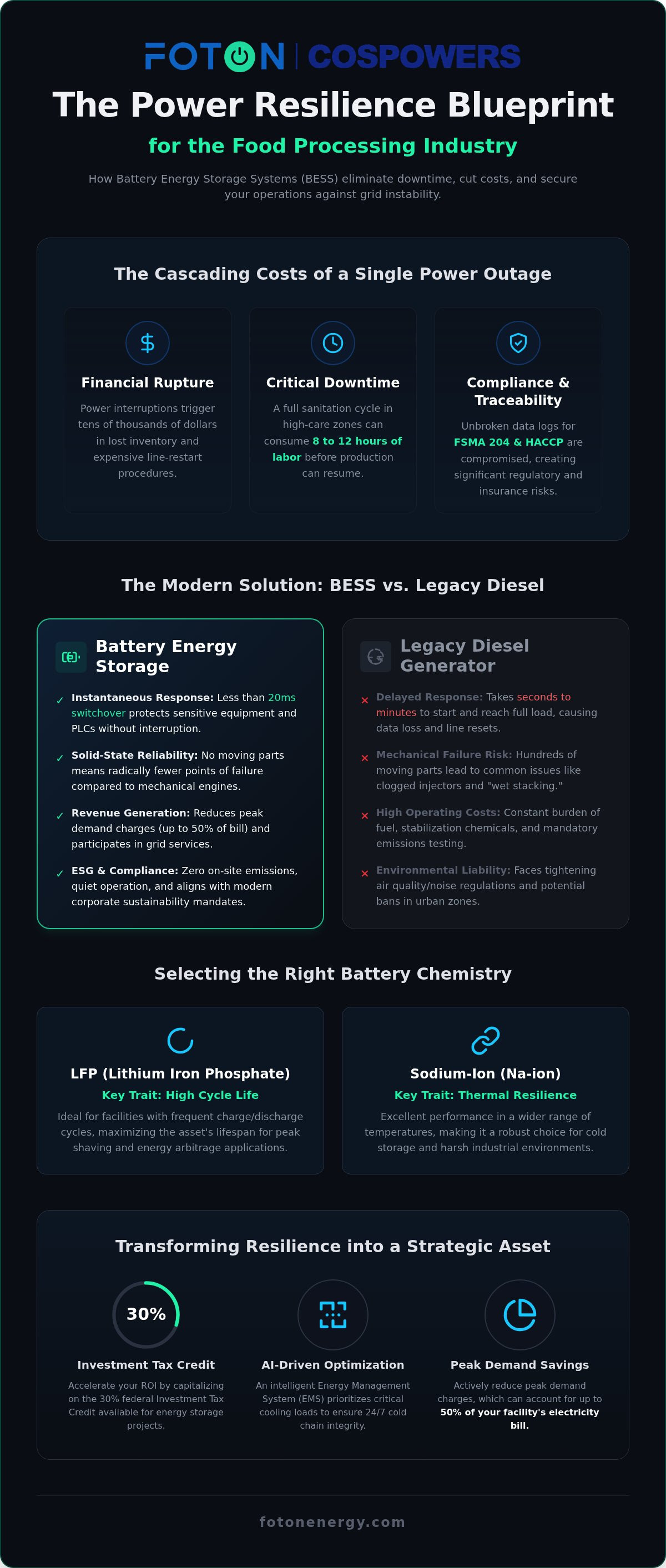
A power outage triggers a "restart" cost that often exceeds the value of the energy itself. In high-care zones, a loss of positive pressure or a temperature excursion necessitates a full sanitation cycle, often consuming eight to twelve hours of labor before a single unit can be produced again. Beyond the immediate loss of inventory, regulatory compliance under HACCP and FSMA 204 depends on unbroken data logs. If your power drops, your traceability drops with it, creating a "bankable" risk that most modern insurers are no longer willing to cover without a proven resilience strategy.
Micro-Outages and the Cost of a Single Second
Precision is the standard for 2026 manufacturing. Voltage sags lasting only milliseconds can trip sensitive PLC-controlled machinery, causing motors to stall and sensors to reset. These micro-outages are often more damaging than total blackouts because they occur frequently and without warning. A Battery Energy Storage System (BESS) serves as a high-performance buffer, delivering an instantaneous frequency response that bridges the gap between grid failure and internal systems. While a traditional UPS might protect a single server, an industrial-scale BESS provides the massive discharge capacity needed to keep entire production lines synchronized and sterile.
Ensuring Cold Chain Integrity
Cooling systems represent 30% to 50% of a food processing plant's total energy consumption. They're also the most vulnerable link in your infrastructure. While 81% of facilities have some form of backup, recent data shows that 63% don't have the capacity to handle outages lasting more than a few hours. This gap is where spoilage occurs. Integrating commercial and industrial BESS solutions ensures that your climate control remains 24/7 active, even during prolonged grid instability. By utilizing intelligent storage, you can maintain the strict temperature windows required for high-risk proteins and dairy, protecting both your product quality and your bottom line.
BESS vs. Diesel Generators: Decarbonizing Your Backup Strategy
Diesel generators have served as the industry's insurance policy for decades, but they're increasingly ill-suited for the precision requirements of 2026. For backup power for the food processing industry, the mechanical delay inherent in internal combustion engines is a liability. While a generator requires seconds or even minutes to reach full load, a BESS responds in less than 20 milliseconds, providing a seamless transition that keeps sensitive electronics online. This instantaneous response prevents the staggering cost of power outages that occurs when automated production lines lose synchronization and require manual resets.
Reliability in a food facility depends on simplicity. Solid-state battery systems eliminate the hundreds of moving parts found in mechanical engines, removing common failure points like clogged fuel injectors, degraded starters, and "wet stacking" from under-utilization. For facilities still maintaining legacy systems, sourcing critical components from Representaciones BURG SpA ensures that existing engines remain functional during the transition to modern storage. Beyond the hardware, the hidden costs of diesel are mounting. Fuel degradation requires expensive chemical stabilization, and mandatory emissions testing creates a recurring operational burden. Transitioning to BESS allows facilities to bypass these mechanical risks while providing a cleaner, more reliable foundation for critical infrastructure.
Environmental and ESG Compliance
Food processors in urban zones face tightening air quality and noise regulations that make traditional diesel testing difficult to permit. New legislation, such as California's SB 978, signals a future where new diesel installations may be banned in high-pollution corridors. Leveraging the latest sodium-ion battery commercial availability allows your facility to deploy sustainable, non-toxic storage that aligns with corporate net-zero mandates. These systems provide a "bankable" path toward decarbonization without sacrificing the high-discharge performance needed for heavy industrial loads.
Total Cost of Ownership (TCO) Analysis
The fundamental difference between these technologies is utility. A diesel generator is a "sunk cost" asset that only provides value during an emergency. In contrast, a BESS is a proactive financial tool. When not providing backup, the system performs peak shaving, discharging stored energy when grid prices are highest to reduce demand charges that can account for 50% of your monthly utility bill. Partnering with experts for engineering consulting ensures your transition to solid-state storage is both technically sound and financially optimized.
When accounting for fuel maintenance, carbon penalties, and the revenue generated via peak shaving, the 10-year total cost of ownership for a Tier-1 BESS is significantly more favorable than a traditional diesel generator.
Sodium-Ion and LFP: Selecting the Right Battery Chemistry
Selecting the right electrochemical foundation is a strategic decision that dictates the long-term bankability of your infrastructure. For backup power for the food processing industry, the choice between Lithium Iron Phosphate (LFP) and Sodium-ion (Na-ion) depends on your specific thermal environment and operational rhythm. Both chemistries offer superior safety profiles over traditional lead-acid or nickel-manganese-cobalt (NMC) alternatives; however, their performance diverges when subjected to the extreme conditions of a food manufacturing floor.
The Sodium-Ion Advantage for Cold Storage
Sodium-ion batteries have emerged as a disruptive force in 2026, with cell pricing ranging approximately from $50 to $56 per kWh. This chemistry is particularly effective for facilities with extensive refrigeration requirements because sodium-ion maintains high discharge efficiency even in sub-zero temperatures. Unlike lithium-based systems that often require energy-intensive heating blankets to function in cold rooms, sodium-ion remains operationally stable. Its non-flammable characteristics and simplified shipping requirements make it a resilient choice for urban processing centers. For a broader look at how this technology scales in high-demand environments, you can consult the guide on sodium-ion battery for data centers.
LFP for High-Cycle Reliability
Lithium Iron Phosphate (LFP) remains the industry standard for high-cycle applications. If your facility utilizes BESS for daily peak shaving alongside emergency backup, LFP offers a proven depth of discharge (DoD) that sustains thousands of cycles without significant degradation. This longevity is critical for maintaining the strict FDA guidelines on food safety during power outages, as it ensures the system has the energy density to bridge long-duration events. Foton's Tier-1 Cospowers modules utilize advanced LFP cells to provide the mission-critical reliability needed to protect high-value inventory while delivering a consistent return on investment.
Safety is non-negotiable. Modern industrial BESS installations must adhere to the 6th edition of UL 9540A, published on March 13, 2026, and NFPA 855 standards. These certifications ensure that your fire suppression and thermal management systems are integrated at the cell level, preventing thermal runaway before it begins. By matching these high-performance chemistries to your facility's peak load requirements, you create a resilient energy shield that protects both your product and your profit margins.
Leveraging AI-Driven EMS for Operational Continuity
Hardware is only half of the resilience equation. The true value of backup power for the food processing industry in 2026 is found in the software layer that orchestrates it. An intelligent Energy Management System (EMS) transforms a passive battery into a proactive financial and operational tool. By utilizing predictive analytics, these systems identify potential cell failures or thermal anomalies before they manifest as hardware breakdowns, ensuring your facility is never caught off guard.
Dynamic load management is a critical feature for high-volume processors. During a power event, the EMS doesn't just provide energy; it prioritizes it. By automatically identifying and sustaining critical cooling lines and sterile environment controls while shedding non-essential peripheral loads, the system extends your operational window. This level of granular control ensures that your most sensitive inventory remains protected for the maximum possible duration, far exceeding the capabilities of a standard "all-or-nothing" generator switch.
Smart Monitoring and Remote Management
Managing energy across multiple geographical sites requires a unified, high-performance view. By implementing AI driven energy management systems, facility managers can access cloud-based dashboards that provide real-time health metrics for every BESS module in their network. These platforms also automate grid-code compliance reporting, ensuring your facility meets local utility standards without manual data collection. This visibility allows for a collaborative approach to energy strategy, where local operations and global headquarters stay aligned on resilience goals.
Optimizing the Microgrid
A BESS acts as the central brain of a facility-wide microgrid, managing the complex interplay between the utility grid, on-site solar arrays, and battery storage. When solar production peaks, the EMS directs excess energy into the BESS rather than wasting it or selling it back at unfavorable rates. By intelligently balancing these diverse energy sources, AI-driven systems reduce operational energy waste by 15-20% in 2026 through precise load forecasting and real-time adjustment. This optimization allows your facility to transition seamlessly between power sources, maintaining the "zero-second" uptime profile required for modern automation.
Beyond emergency backup, the EMS constantly scans for peak demand windows to perform daily peak shaving. It discharges the BESS to lower your facility's highest consumption points from the grid, directly reducing the demand charges that often inflate industrial utility bills. To see how these intelligent systems can be tailored to your specific facility requirements, explore our Intelligent EMS solutions and engineering consulting services.
Strategic Implementation: Engineering and Tier-1 Procurement
Deploying high-capacity backup power for the food processing industry is a multi-phase engineering endeavor that requires precise strategic alignment. To ensure your investment delivers both operational security and a rapid return on capital, you must look beyond simple battery capacity. A successful implementation integrates advanced site analysis with Tier-1 procurement standards to create a "bankable" energy asset that satisfies both technical requirements and financial stakeholders.
Navigating the global supply chain for high-capacity battery containers requires a partner who understands the nuances of industrial integration. From managing the logistics of containerized units to ensuring that your fire suppression systems meet the latest UL 9540A 6th Edition standards, every detail influences the long-term stability of your infrastructure. This meticulous approach ensures your facility remains a foundational pillar of the global food supply chain, where even the transport of liquid ingredients—supported by specialized solutions from siaflexitanks.com—must meet the highest standards of reliability and safety.
Feasibility and System Design
The foundation of any resilient energy strategy is a detailed feasibility study. This process begins by analyzing your facility's load profiles to determine the exact kWh capacity required to bridge outages without over-investing in unused storage. For food processors, this means accounting for the high inrush currents of large refrigeration compressors and the steady-state needs of automated packaging lines. Sizing the system correctly is the most critical step in maximizing your ROI.
Space availability often dictates the choice between containerized outdoor units and modular indoor BESS configurations. While containerized systems offer rapid deployment for utility-scale needs, modular indoor units provide flexibility for facilities with limited exterior footprints. Engaging BESS engineering consulting services early in the design phase allows you to navigate these architectural choices while ensuring full grid-code compliance from day one.
Ensuring Long-Term Bankability
Financiers and insurance providers prioritize "bankability," which is defined by the quality of the hardware and the stability of the manufacturer. In 2026, the global market emphasizes Tier-1 manufacturing standards to mitigate the risks of technical failure or manufacturer insolvency. Foton's exclusive strategic partnership with Cospowers, backed by over 30 years of manufacturing heritage, provides the elite reliability and international certifications that large-scale investors demand.
Strategic procurement also involves maximizing available financial incentives to offset initial costs. The One Big Beautiful Bill Act (OBBBA) of 2025 provides a 30% Investment Tax Credit for battery energy storage systems through 2033, significantly lowering the initial capital barrier. For larger processing hubs, utility scale BESS procurement strategies enable you to secure high-capacity battery containers that meet your local resilience needs while aligning with broader ESG mandates. By partnering with established industry leaders, you ensure your facility is equipped with a high-performance system that remains operationally excellent for the next decade.
Securing Your Operational Future with Intelligent Storage
The transition from reactive diesel engines to proactive, solid-state energy storage is a strategic necessity for high-volume facilities. By integrating millisecond-response BESS, you eliminate the risk of micro-outages and ensure your cold chain remains unbroken. This shift doesn't just protect inventory; it transforms your energy infrastructure into a bankable asset that reduces demand charges and meets strict ESG mandates.
Success in the modern market requires more than just hardware. It demands a sophisticated software layer and elite manufacturing standards. Choosing the right chemistry, like thermally resilient sodium-ion for cold storage or high-cycle LFP, is essential for building a truly resilient facility. Effective backup power for food processing industry operations is now a fundamental pillar of long-term commercial stability.
Foton Energy provides the expertise needed for this transition through our exclusive global partnership with Cospowers, offering Tier-1 hardware and AI-driven EMS optimization. Partner with Foton Energy for your Tier-1 food industry BESS deployment and secure your production lines today. We're ready to help you build a cleaner, more resilient future.
Frequently Asked Questions
Is battery backup really cheaper than diesel generators for food processing?
Yes, battery systems offer a superior total cost of ownership over a 10-year period. While diesel generators are sunk costs that require expensive fuel and ongoing mechanical maintenance, a BESS generates revenue through peak shaving during normal operation. It eliminates the fuel degradation risks and emissions penalties that plague traditional backup power for the food processing industry. By reducing monthly demand charges, the system effectively pays for its own capital expenditure.
Can sodium-ion batteries be used in walk-in freezers?
Sodium-ion batteries are uniquely suited for sub-zero environments found in industrial cold storage. While standard lithium chemistries often require energy-intensive heating blankets to maintain performance, sodium-ion cells maintain high discharge efficiency at temperatures as low as -20°C. This makes them a superior choice for facilities where thermal management is a primary operational challenge, ensuring reliable backup without the parasitic energy drain of auxiliary heaters.
How long does a typical industrial BESS take to install?
Installation timelines typically range from three to six months depending on system complexity and grid connection requirements. This period includes the initial feasibility study, engineering design, and final site commissioning. Containerized solutions are often faster to deploy than modular indoor systems because they arrive pre-configured. Early engagement with engineering consultants helps streamline the permitting process and ensures grid-code compliance from the start of the project.
What is the fire safety risk of installing large-scale batteries in a food plant?
Fire risks are strictly managed through compliance with the 6th Edition of UL 9540A and NFPA 855 safety standards. Modern Tier-1 systems utilize LFP or sodium-ion chemistries, which are inherently more stable than older lithium-ion variants. These systems feature integrated fire suppression and thermal management at the cell level. When installed by certified partners, the safety profile of a solid-state BESS is comparable to or better than storing large volumes of combustible diesel fuel.
Does BESS help with peak shaving in the food industry?
Peak shaving is one of the primary financial drivers for industrial energy storage. Food facilities often face high demand charges during mid-day production peaks when cooling systems work hardest. The BESS discharges stored energy during these windows to lower the facility's peak draw from the grid. This strategic shift reduces utility costs significantly, providing a predictable return on investment that traditional emergency generators simply cannot match.
Can I use BESS to go completely off-grid for my processing facility?
Going completely off-grid is technically possible but requires an extensive investment in storage and renewable generation. Most facilities find a hybrid microgrid approach more bankable. By combining BESS with on-site solar, you can achieve significant energy independence while maintaining a grid connection for extreme loads. This setup provides the most reliable backup power for the food processing industry while optimizing your capital expenditure and operational risk.
What certifications should I look for in a Tier-1 battery manufacturer?
You should prioritize manufacturers with UL 9540, NFPA 855, and IEEE 1547 certifications. These international standards verify that the equipment meets rigorous safety, installation, and grid-interconnection requirements. Tier-1 status also implies a bankable track record, ensuring the manufacturer has the financial stability to support long-term warranties. Partnering with established entities like Cospowers ensures your infrastructure meets these elite global benchmarks for mission-critical reliability.
How does AI improve the lifespan of an industrial backup battery?
AI-driven EMS platforms utilize predictive analytics to manage the state of health for every individual cell in the system. By optimizing charging cycles based on real-time temperature data and load forecasts, the AI prevents over-discharge and thermal stress. This proactive management can extend the operational life of the system by several years compared to passive monitoring, ensuring your investment remains high-performing throughout its entire lifecycle.


