

In the high-stakes world of utility-scale infrastructure, a battery module is no longer just a storage component; it's the primary risk-mitigation asset for your entire capital investment. Choosing the right Cospowers LFP battery technology means moving beyond basic energy storage and into a realm of strategic reliability. You're likely all too familiar with the anxiety of deploying hardware in volatile climates or the constant pressure to meet the stringent safety requirements of the 2026 NFPA 855 standards. Finding a partner that balances elite technical performance with global supply chain stability shouldn't feel like an impossible task.
This guide provides a deep dive into how this technology bridges the gap between theoretical capacity and operational resilience. You'll discover how a 30-year manufacturing heritage translates into DNV-verifiable safety and bankable long-term performance. We'll explore the integration of AI-driven Energy Management Systems, examine the thermal optimization strategies for high-density configurations, and outline the strategic path for wholesale procurement and engineering support through Foton Energy's global network. By the end of this analysis, you'll understand why Cospowers stands as a foundational pillar for the next generation of energy infrastructure.
Key Takeaways
- Understand how a 30-year manufacturing heritage establishes Cospowers LFP battery technology as a Tier-1 global benchmark for large-scale infrastructure.
- Analyze the multi-level safety protocols and advanced thermal management systems designed to exceed 2026 international fire safety standards.
- Evaluate the commercial bankability of LFP systems through cycle life expectations ranging from 6,000 to over 10,000 cycles.
- Identify scalable energy storage solutions across utility grids, industrial sites, and telecommunications for optimized peak shaving and grid stability.
- Leverage the exclusive strategic partnership with Foton Energy for end-to-end engineering consulting and streamlined wholesale hardware procurement.
What is Cospowers LFP Battery Technology? Defining the Tier-1 Standard
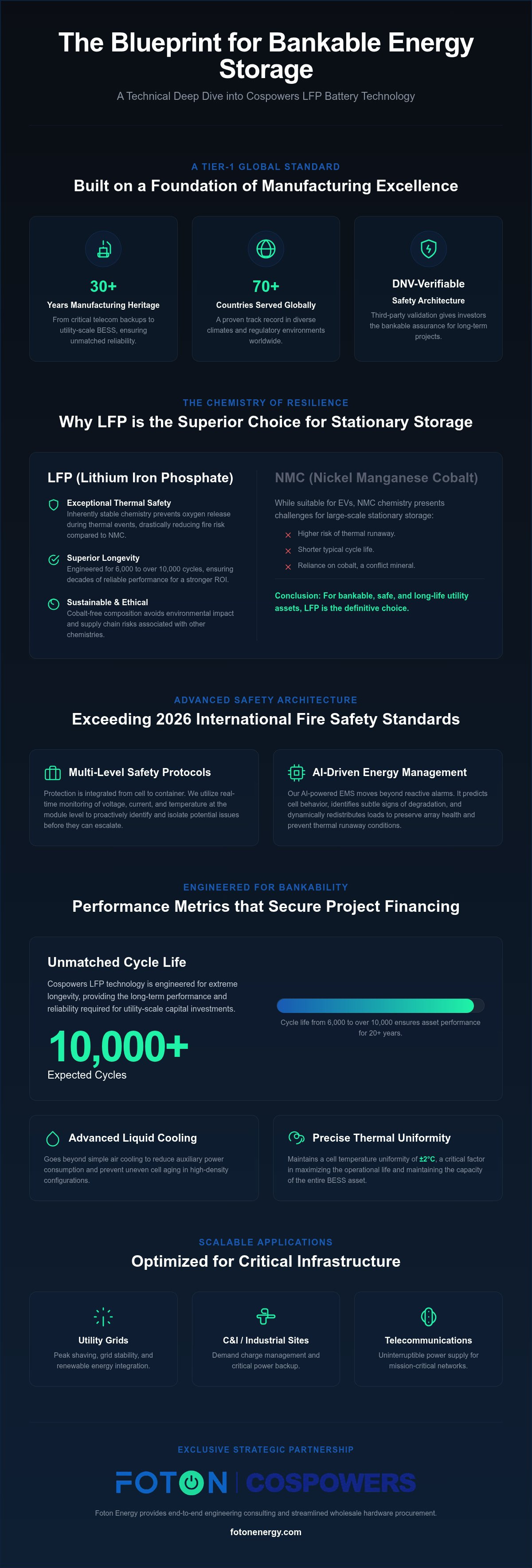
Cospowers LFP battery technology represents the apex of stationary energy storage for 2026. It's built on a foundation of reliability that large-scale developers and EPCs require for project bankability. While many manufacturers are newcomers to the energy transition, Cospowers brings over 30 years of manufacturing heritage to every cell. This deep experience ensures that quality control isn't just a goal but a standard operating procedure across their global facilities in China and India. By prioritizing long-term stability over short-term density gains, Cospowers has established itself as a foundational pillar for critical infrastructure projects worldwide.
The Chemistry of Resilience: Why LFP?
Choosing the right chemistry is a strategic decision that impacts the entire lifecycle of an asset. Lithium iron phosphate (LFP) battery technology has emerged as the preferred choice for stationary storage due to its superior safety profile. Unlike Nickel Manganese Cobalt (NMC) chemistries, LFP offers exceptional thermal stability and a significantly longer cycle life. The molecular structure of LFP is inherently stable, ensuring that the P-O bond remains intact and prevents the release of oxygen even during severe thermal events. Beyond safety, it's a more sustainable choice that aligns with modern ESG goals.
The primary advantages of LFP for industrial applications include:
- Thermal Safety: High resistance to thermal runaway compared to other lithium-ion variants.
- Longevity: Capable of maintaining performance through 6,000 to 10,000+ cycles.
- Sustainability: Cobalt-free composition reduces environmental impact and supply chain risks.
- Efficiency: Low self-discharge rates and high round-trip efficiency for grid-scale applications.
While these advantages are primarily discussed in the context of stationary storage, they are equally critical for the high-performance power systems used in electric mobility. For instance, Xion Motors leverages advanced electrical components to drive their commercial three-wheeled electric vehicles and custom transport solutions, ensuring safety and efficiency in demanding urban environments.
Cospowers' Manufacturing Pedigree
Reliability is earned through decades of performance. Cospowers' journey began in critical telecom backup systems, where failure was never an option. This rigorous background allowed them to scale into utility-scale BESS and C&I solutions with a level of precision that few can match. Today, they serve over 70 countries, supported by an exclusive strategic partnership with Foton Energy. This Tier-1 status is vital for project financing. It gives investors the bankable assurance that the hardware will perform as promised for 20 years or more. Their global manufacturing capacity is backed by DNV-verifiable safety architecture, ensuring that every container shipped meets the highest international standards for 2026 energy markets.
Advanced Safety Architecture and Thermal Management
Safety in large-scale energy infrastructure requires a holistic, multi-layered approach. Cospowers LFP battery technology integrates protection at every level, from the chemical stability of the individual cell to the structural integrity of the shipping container. We utilize multi-level safety protocols that include real-time monitoring of voltage, current, and temperature at the module level. This proactive stance ensures that potential issues are identified and isolated before they can escalate into a system-wide event. For developers, this means the difference between a high-risk asset and a secure, long-term investment.
A critical differentiator in our architecture is the AI-driven Energy Management System (EMS). Traditional systems often react only when a threshold is breached, but our AI models are designed to predict cell behavior. By analyzing historical data and real-time telemetry, the EMS identifies subtle signs of cell degradation or thermal imbalances before they become critical. This intelligence allows the system to redistribute loads or adjust cooling cycles dynamically, preserving the health of the entire array and preventing the conditions that lead to thermal runaway.
Optimizing Thermal Performance in High-Density BESS
High-density configurations generate significant heat during rapid charge and discharge cycles. Traditional air cooling often struggles to maintain uniformity across thousands of cells. We utilize advanced liquid cooling technology to achieve a cell temperature uniformity of ±2°C. This precision is vital because even small temperature variances can lead to uneven aging and reduced capacity. By optimizing thermal pathways, we reduce auxiliary power consumption, ensuring more stored energy reaches the grid rather than being wasted on cooling. This level of control is fundamental to the long-term performance and cycle life of the hardware.
Safety Certifications and Grid Compliance
Compliance isn't just about meeting local checkboxes; it's about operational security in a global market. Our systems are rigorously tested to meet UL9540A and IEC 62619 standards, providing the documentation needed for insurance and permitting. For mission-critical environments like data centers, our proprietary safety architecture includes integrated gas detection and automated fire suppression systems. Foton Energy provides the necessary expertise to ensure your project meets renewable energy grid code compliance across diverse jurisdictions. If you're designing a high-density facility, our team can provide detailed engineering consulting to optimize your safety footprint and thermal efficiency.
Engineering for Bankability: Cycle Life and Performance
Bankability represents the bridge between a technical specification and a successful financial close. For EPCs and energy developers, Cospowers LFP battery technology offers more than just energy storage; it provides a predictable financial asset. A project is considered bankable when its technical performance is backed by enough data to satisfy the risk assessments of debt providers and institutional investors. By delivering a cycle life that ranges from 6,000 to over 10,000 cycles, Cospowers ensures that the underlying hardware remains operational long after the initial investment has been recouped. This durability is confirmed through DNV-verifiable safety architecture and independent engineering reports that validate degradation curves over a 20-year horizon.
Maximizing ROI Through Performance Monitoring
Project ROI is directly tied to how effectively a system is managed throughout its operational life. High-fidelity data acquisition through BESS performance monitoring tools allows operators to visualize cell health in real time. This granular visibility is supported by a comprehensive review of LFP battery technology, which highlights how electrode engineering impacts long-term stability. By utilizing advanced predictive analytics, operators can extend the effective LFP cycle life by 15%, significantly deferring capital expenditure for cell replacement. Predictive maintenance doesn't just reduce O&M costs; it ensures the system is always available to capture high-value market events, such as frequency response or peak demand spikes.
Financier Requirements for Grid-Scale Projects
Financiers prioritize Tier-1 hardware because it fundamentally reduces the cost of capital. When a developer uses proven technology with a 30-year manufacturing heritage, the perceived risk of the project drops, leading to more favorable interest rates and insurance premiums. Technical due diligence for utility scale BESS procurement often hinges on the manufacturer's ability to provide transparent performance data and long-term warranties. Foton Energy acts as a critical link in this process, providing the engineering consulting required to align technical designs with financier expectations. We help developers navigate the complexities of grid code compliance and performance guarantees, ensuring that the final configuration is both technically superior and commercially stable.
Scalable Applications: From Telecom to Utility-Scale Grids
The transition to a decentralized energy landscape requires storage technology that is as flexible as it is robust. Cospowers LFP battery technology provides this essential versatility, offering a modular platform that scales from localized telecom sites to massive utility-scale grid assets. Our containerized solutions are designed for rapid deployment, allowing EPCs to meet aggressive project timelines while ensuring the highest levels of safety and performance. This modularity isn't just about physical size; it's about the strategic alignment of hardware with specific operational goals across diverse industrial sectors.
Utility and Grid-Scale Infrastructure
Grid-scale applications demand hardware that can handle the rigors of front-of-the-meter operation. Cospowers systems excel in frequency regulation and voltage support, acting as a critical buffer that balances the intermittent nature of wind and solar farms. Our modular architecture supports multi-MW deployments that are easily expanded as grid requirements evolve. This same engineering excellence is vital when integrating Cospowers LFP into commercial and industrial BESS solutions. Industrial facilities use these systems for peak shaving and demand charge reduction, effectively insulating their operations from volatile energy pricing while improving their overall sustainability profile.
Mission-Critical Telecom and Data Centres
The rapid expansion of AI and high-performance computing has placed unprecedented stress on backup power infrastructure. Many operators are now replacing legacy VRLA batteries with LFP to benefit from superior energy density and a significantly longer lifespan. Cospowers has developed a specialized 48V smart series for green telecom base stations, providing a compact and intelligent backup solution that thrives in harsh outdoor environments. In the data centre environment, these systems provide both short-term bridging power and long-term backup for intelligent server rooms, ensuring that data integrity is never compromised by grid instability. The ability to monitor these assets remotely via AI-driven EMS adds an extra layer of security for mission-critical operations.
If you're planning a large-scale deployment and require technical validation, contact us to discuss our utility-scale storage and engineering consulting services.
The Foton Energy Partnership: Global Distribution and Engineering
Foton Energy serves as the exclusive global strategic partner for Cospowers. This alignment ensures that every deployment of Cospowers LFP battery technology is backed by a world-class engineering team. It's a partnership designed to bridge the gap between high-capacity manufacturing and complex on-site integration. We provide the commercial stability and technical oversight that institutional investors demand, turning high-performance hardware into a bankable asset. By combining a 30-year manufacturing heritage with modern strategic distribution, we create a seamless path from the factory floor to final grid interconnection.
Strategic Sourcing and Global Logistics
Navigating the global energy storage supply chain requires more than just capital. It requires a partner who understands the intricacies of international logistics and regional regulatory shifts. Foton manages wholesale hardware procurement for projects of all scales, ensuring that Tier-1 hardware is available when and where it's needed. We provide local support and technical assistance in over 70 countries. This global footprint allows system integrators to execute on procurement strategies without the risks typically associated with long-distance supply chains. By streamlining the path from the factory to the project site, we help our partners maintain aggressive deployment schedules while ensuring all equipment meets the latest 2026 transport and safety standards.
Integrated Engineering and AI Solutions
Engineering excellence is the true differentiator in the BESS market. Foton provides comprehensive BESS engineering consulting services that cover the entire project lifecycle. We don't just ship containers; we partner on feasibility studies, custom system designs, and final commissioning. This end-to-end involvement ensures that the integration of AI-driven EMS is optimized for the specific load profiles of each site. We also offer licensing for our proprietary AI-driven EMS for third-party integrations, allowing other manufacturers to benefit from our predictive optimization models. This collaborative approach ensures that Cospowers LFP battery technology remains at the forefront of the intelligent energy transition.
For resellers and installers looking to scale, the Foton Channel Partner Programme offers a clear path to market leadership. This programme provides priority access to hardware, extensive technical training, and co-marketing support. It's a collaborative imperative aimed at building a more resilient and sustainable energy future. We invite you to join this shared vision and leverage our manufacturing heritage to drive your next large-scale infrastructure investment.
Securing Your Infrastructure in the 2026 Energy Landscape
Building a resilient energy future requires more than just high-capacity hardware; it demands a strategic alignment with proven Tier-1 standards. We've explored how Cospowers LFP battery technology provides the foundation for this stability through its 30-year manufacturing heritage and DNV-verifiable safety architecture. By integrating AI-driven thermal management and achieving cycle lives of up to 10,000+, these systems move beyond basic storage to become bankable assets for utility-scale and industrial projects alike. This technical maturity ensures your investment remains protected against the evolving demands of the global grid.
The path to operational excellence is paved with technical validation and collaborative engineering. As the exclusive global partner for Cospowers, Foton Energy provides the end-to-end consulting and wholesale procurement expertise needed to navigate complex global supply chains. We invite you to Partner with Foton Energy for Tier-1 Cospowers BESS Solutions to ensure your next infrastructure investment is both technologically advanced and commercially secure. It's time to leverage elite manufacturing standards and intelligent optimization to power your vision for a sustainable future.
Frequently Asked Questions
What is the typical cycle life of Cospowers LFP battery modules?
Cospowers LFP battery technology typically achieves a cycle life ranging from 6,000 to over 10,000 cycles at standard discharge rates. This longevity depends on the specific module configuration and your operational environment. It's built for endurance. By maintaining high capacity over thousands of cycles, these modules provide the long-term stability required for project bankability. This performance ensures that utility-scale assets remain productive for 20 years or more.
Is Cospowers LFP technology safer than NMC for indoor data centres?
LFP is significantly safer than NMC for indoor data centre environments because it has a much higher thermal runaway threshold. The chemical structure of Lithium Iron Phosphate prevents the release of oxygen during a thermal event, which is the primary cause of fire propagation in NMC systems. This inherent stability makes it the ideal choice for high-density, mission-critical backup where safety and fire prevention are the highest priorities.
How does liquid cooling improve the performance of Cospowers BESS?
Liquid cooling improves BESS performance by maintaining a cell temperature uniformity of ±2°C across the entire system. This precision prevents hot spots that lead to uneven cell aging and capacity loss. By optimizing thermal pathways, liquid cooling also reduces auxiliary power consumption compared to traditional air-cooled systems. This efficiency means more stored energy is available for the grid, directly improving the round-trip efficiency and ROI of your installation.
Can Cospowers LFP systems be integrated with existing solar PV arrays?
Cospowers systems are designed for seamless integration with both new and existing solar PV arrays through AC-coupled or DC-coupled architectures. Our engineering team provides consulting to ensure the BESS is correctly sized to capture excess solar generation for peak shaving or frequency regulation. This compatibility allows industrial facilities and utility providers to maximize their renewable energy utilization while stabilizing the local grid connection without replacing existing infrastructure.
What certifications do Cospowers LFP batteries hold for grid-scale use?
Cospowers LFP battery technology holds a comprehensive suite of international certifications including UL9540A, IEC 62619, and UN38.3. These standards are essential for grid-scale use, as they provide the technical validation required by insurers and regulatory bodies. The architecture is also DNV-verifiable, ensuring every unit meets the stringent safety benchmarks established for the 2026 energy market. It's a globally recognized standard for large-scale infrastructure.
Does Foton Energy provide installation services for Cospowers hardware?
Foton Energy doesn't provide direct installation services. We focus on wholesale hardware procurement and end-to-end engineering consulting. Our team works collaboratively with EPCs and certified installers to ensure hardware is integrated correctly according to project specifications. We provide the technical expertise, project feasibility studies, and commissioning support necessary to guarantee a bankable asset. It's about strategic partnership and technical oversight rather than manual labor.
How does the AI-driven EMS from Foton optimize Cospowers battery health?
The AI-driven EMS optimizes battery health by using predictive analytics to identify subtle signs of degradation before they become critical. It monitors real-time telemetry to balance loads across cells, which can extend the effective cycle life by up to 15%. This intelligent management prevents thermal imbalances and ensures the system operates within its optimal window. It's a proactive approach that reduces O&M costs and maximizes long-term reliability for investors.
What is the difference between Cospowers LFP and sodium-ion technology?
LFP is the mature industry benchmark for high-cycle longevity and safety, while sodium-ion is an emerging technology suited for specific cost-sensitive applications. LFP offers a robust supply chain and proven performance over decades of use. Sodium-ion technology provides better performance in extreme cold and utilizes more abundant raw materials. Foton Energy offers both systems to ensure our partners have the right chemistry for their specific geographic and commercial requirements.


