

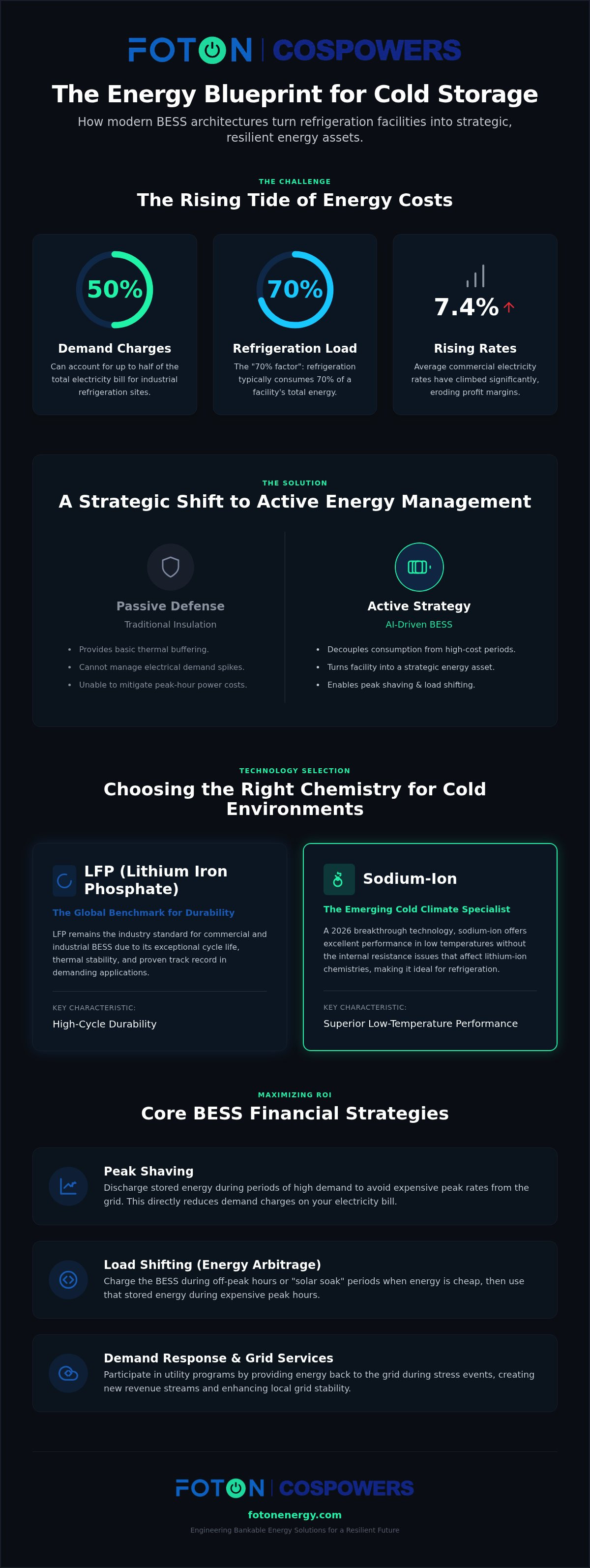
Did you know that demand charges now account for up to 50% of the total electricity bill for many industrial refrigeration sites? As average commercial electricity rates climbed 7.4% to reach 13.51¢/kWh in 2026, the deployment of advanced energy storage solutions for cold storage facilities has transitioned from a sustainability luxury to a critical financial imperative. This shift is driven by a volatile energy market and the urgent need to secure temperature-sensitive inventory against grid instability.
You're likely managing the heavy burden of 24/7 cooling loads while facing aggressive decarbonization mandates and the rising costs of safety compliance. It's a complex landscape where traditional backup power is no longer sufficient to maintain a competitive edge. We understand that your primary objective is to balance operational reliability with the necessity of reducing peak demand charges.
This guide demonstrates how modern BESS architectures and AI-driven energy management systems can turn your facility into a strategic energy asset. We'll show you how to leverage high-performance LFP and sodium-ion technologies to build a resilient, bankable infrastructure that integrates seamlessly with renewable sources. We will explore the technical pathways to securing your facility's future while optimizing every kilowatt-hour consumed.
Key Takeaways
- Analyze why the unique energy intensity of industrial refrigeration requires a strategic shift from passive insulation to active, AI-driven load management.
- Identify the most resilient energy storage solutions for cold storage facilities by comparing the high-cycle durability of LFP with the superior low-temperature performance of sodium-ion chemistry.
- Master peak shaving and load shifting techniques to transform energy-heavy compressors into flexible assets that capitalize on off-peak rates and solar soak periods.
- Ensure long-term facility security by implementing advanced thermal management systems and fire suppression architectures that exceed 2026 global safety standards.
- Establish project bankability by leveraging Tier-1 manufacturing heritage and data-driven feasibility studies to secure your large-scale infrastructure investment.
The Energy Intensity Challenge: Why Cold Storage Needs BESS
Cold storage facilities are energy giants. They consume four to five times more electricity per square foot than standard commercial buildings. This extreme intensity stems from the constant demand of industrial refrigeration systems that must maintain sub-zero temperatures regardless of external conditions. In 2026, as commercial electricity rates have surged by 7.4% year-over-year, managing this consumption is no longer just an operational task; it's a financial necessity. The cost of inaction is high, especially as time-of-use (ToU) tariffs and demand charges continue to erode profit margins.
The "70% factor" defines the unique pressure on these sites. Since refrigeration typically accounts for 70% of a facility's total energy load, any fluctuation in grid pricing or reliability has an outsized impact on the bottom line. Implementing energy storage solutions for cold storage facilities allows operators to decouple their energy consumption from high-cost peak periods. It transforms the facility from a passive consumer into a strategic energy asset that can survive grid instability while keeping operational costs predictable.
Anatomy of Cold Storage Energy Use
Compressors and fans serve as the primary drivers of peak demand. These components require massive surges of power to start and maintain temperature setpoints. While many operators rely on the inherent Thermal Energy Storage (TES) of their insulated rooms, this physical insulation cannot manage electrical demand spikes or mitigate the rising cost of peak-hour power. Insulation is a passive defense; BESS is an active strategy.
Reliability is paramount. For pharmaceutical and food supply chains, even a brief power outage can result in catastrophic inventory loss. Modern energy storage solutions for cold storage facilities provide the instantaneous response needed to bridge grid gaps. They ensure that sensitive assets remain within strict temperature tolerances while simultaneously buffering the facility against the grid's volatility. It's about securing the supply chain as much as it's about saving money.
While securing energy for cold storage is vital, eCommerce brands must also optimize their broader distribution strategy; you can check out Pik Pak Logistics for a clear guide on 3PL pricing models in Australia.
The Shift to Grid-Interactive Facilities
Modern warehouses are evolving. By integrating commercial and industrial BESS solutions, facilities can participate in lucrative demand response programs. Instead of simply paying for power, you can offer flexibility back to the grid during times of stress. This transition from a passive energy consumer to an active grid asset creates new revenue streams and enhances local grid stability.
BESS technology enables precise load shifting. Facilities can charge their systems during "solar soak" periods when renewable energy is abundant and cheap, then discharge that power during peak evening rates. This strategic movement of energy reduces demand charges, which can account for 30% to 50% of a commercial electricity bill. It's a bankable approach that prioritizes long-term resilience and operational excellence.
LFP vs. Sodium-Ion: Selecting Chemistry for Refrigerated Environments
Choosing the right electrochemical foundation is the most critical decision in designing energy storage solutions for cold storage facilities. While phase-change materials offer basic thermal buffering, they lack the sophisticated load-shifting capabilities required to manage modern demand charges. In 2026, the debate has shifted from whether to use batteries to which chemistry best serves the sub-zero environment. LFP remains the global benchmark for industrial durability, yet sodium-ion has emerged as a formidable specialist for temperature-sensitive applications.
Sodium-Ion: The Cold Climate Specialist
The 2026 breakthrough in sodium-ion battery commercial availability has fundamentally changed the ROI calculation for refrigerated warehouses. Unlike traditional lithium-ion chemistries that struggle with internal resistance in the cold, sodium-ion cells retain over 90% of their capacity at -20°C. This exceptional performance ensures that your BESS remains fully operational even when placed in close proximity to the cold chain infrastructure. With cell costs reaching parity at approximately $19/kWh, sodium-ion also offers a more sustainable supply chain by eliminating reliance on critical minerals like cobalt and lithium.
Safety remains a paramount concern in high-density warehouses. Sodium-ion chemistry is inherently more stable during thermal runaway scenarios, making it an ideal candidate for facilities with strict fire safety mandates. By integrating these systems, operators can make significant progress in decarbonizing cold storage facilities without compromising on safety or performance. Its high discharge rates allow it to handle the aggressive current draws of industrial compressors with ease.
LFP Reliability for 24/7 Operations
Lithium Iron Phosphate (LFP) continues to be the preferred choice for facilities prioritizing maximum cycle life and long-term bankability. With the ability to withstand over 6,000 cycles at 80% depth of discharge, LFP systems provide the decade-plus operational lifespan that large-scale infrastructure investors demand. Foton Energy (Foton Pty Ltd) ensures this reliability by sourcing Tier-1 LFP modules through our exclusive partnership with Cospowers, a manufacturer with over 30 years of heritage in energy storage excellence. These containerized systems are modular, allowing for seamless scaling as your facility expands.
Standardization is the core of LFP's appeal. The mature ecosystem around LFP means that replacement parts, international certifications, and maintenance protocols are well-established. This maturity provides a level of "bankable" assurance that is vital for securing project financing. Whether you require a dedicated backup for a pharmaceutical wing or a site-wide peak shaving asset, selecting the right chemistry is a project-dependent process. We invite you to consult with the technical engineering team at Foton Energy (Foton Pty Ltd) to determine which chemistry aligns with your facility's specific thermal and electrical profile.
Maximizing ROI: Peak Shaving and Demand Charge Management
Financial performance in the cold storage sector is increasingly dictated by the structure of the electricity bill. Demand charges, which can account for 30% to 50% of a commercial electricity bill, represent a massive overhead that traditional efficiency measures simply can't address. By deploying energy storage solutions for cold storage facilities, operators can target these fixed costs directly. This isn't just about saving energy; it's about strategically managing when and how that energy is drawn from the grid to protect your margins.
Peak shaving serves as the primary mechanism for immediate cost reduction. When industrial compressors and fans cycle on, they create massive, short-lived spikes in electrical demand. Utilities charge heavily for these peaks, often based on the single highest 15-minute interval of the month. A BESS detects these surges in real-time and discharges stored power to flatten the spike. This ensures the facility's metered demand remains below a set threshold, transforming a volatile load profile into a predictable, cost-optimized asset.
Load shifting and energy arbitrage offer a second layer of ROI. During the "solar soak" hours of the morning, electricity prices often drop significantly due to renewable oversupply. Your storage system captures this inexpensive power. When peak evening rates hit, the system discharges, allowing the facility to avoid the highest time-of-use tariffs. This strategy capitalizes on market volatility to widen profit margins while maintaining the strict thermal setpoints required for inventory safety.
AI-Driven Optimization for Cold Loads
Integrating an AI driven energy management system is essential for orchestrating these complex maneuvers. These systems don't just react; they predict. By analyzing weather forecasts, grid pricing, and the specific thermal mass of your refrigerated rooms, AI optimizes the battery's state-of-charge to ensure maximum availability during peak windows. It also enables predictive maintenance by identifying subtle efficiency drops in refrigeration cycles before they escalate into costly hardware failures.
Revenue Stacking: Beyond Cost Savings
Revenue stacking allows facilities to move beyond simple cost avoidance. By participating in Frequency Control Ancillary Services (FCAS), your BESS can generate revenue by helping the grid maintain stability through rapid injection or absorption of power. For enterprises with multi-site portfolios, Virtual Power Plant (VPP) integration turns a collection of warehouses into a powerful grid-interactive resource. These passive revenue streams accelerate the payback period, making the transition to advanced storage a highly bankable investment for 2026.
Engineering for Safety: Thermal Management and Fire Suppression
Safety architecture within temperature-controlled environments is a non-negotiable pillar of infrastructure design. When integrating energy storage solutions for cold storage facilities, the primary engineering challenge is managing the thermal relationship between high-output battery modules and sub-zero refrigeration zones. Foton Energy (Foton Pty Ltd) utilizes the 30-year manufacturing heritage of Cospowers to deliver modules that prioritize safety at the cell level. In 2026, compliance with NFPA 855 requires a rigorous Hazard Mitigation Analysis (HMA) for nearly all BESS installations, ensuring that fire propagation is physically impossible between units.
Large-scale fire testing, specifically UL 9540A, has become a prerequisite for securing insurance and financing in the refrigerated warehouse sector. These systems are designed to operate within precise thermal envelopes; they use dedicated climate control to maintain battery longevity without leaking heat into your refrigerated aisles. It's a balance of high-performance energy discharge and disciplined thermal containment that protects both the hardware and the high-value inventory it supports.
BESS Placement Strategies
Selecting the right location for your storage system involves balancing grid-code compliance with operational efficiency. Outdoor containerized deployments are often preferred for cold storage sites because they isolate the battery's heat rejection from the facility's cooling load. This separation reduces the strain on your refrigeration compressors and simplifies fire suppression logistics. If indoor placement is required, the engineering must include sophisticated HVAC integration to ensure the BESS doesn't become a heat source that drives up your energy intensity.
Redundancy and Resilience
For mission-critical pharmaceutical and food supply chains, redundancy is the difference between success and total inventory loss. We implement N+1 architecture in our system designs, ensuring that even if one string of batteries requires maintenance, the facility remains protected. This resilience is bolstered by black start capabilities, which allow your refrigeration systems to restart independently during a total grid collapse. This level of autonomy is a core component of a bankable energy strategy.
Navigating these technical requirements demands expert oversight from a partner that understands the specific risks of refrigerated environments. The role of BESS engineering consulting services provided by Foton Energy (Foton Pty Ltd) is to bridge the gap between high-level energy goals and ground-level safety realities. From initial load profiling to the final commissioning of fire-rated enclosures, professional consulting ensures that your storage asset is both a financial winner and a fortress of operational security.
The Path to Bankability: Implementing Your Storage Strategy
Transitioning from strategic planning to physical deployment requires a rigorous focus on bankability. For energy storage solutions for cold storage facilities, this means ensuring every component meets the strict criteria of project financiers and insurers. A successful implementation depends on a data-driven foundation and a supply chain backed by decades of manufacturing excellence. Foton Energy (Foton Pty Ltd) moves beyond theoretical savings to deliver a resilient, high-performance asset that stands up to the scrutiny of large-scale infrastructure investment.
The path to a successful BESS deployment is paved with precision. It's not enough to simply install a battery; the system must be integrated into the facility's unique thermal and electrical ecosystem. This requires a collaborative approach between engineering consultants, EPC partners, and facility operators to ensure the final solution delivers the promised ROI without compromising the integrity of the cold chain.
The Feasibility Framework
We begin every project with a granular analysis of at least 12 months of interval data. This load profiling allows us to size the BESS perfectly for your specific refrigeration cycles, avoiding the common pitfalls of over-engineering or under-capacity. By evaluating solar PV integration alongside the storage asset, we maximize self-consumption and drive a more aggressive Internal Rate of Return (IRR). Calculating precise payback periods ensures the project aligns with your broader capital expenditure goals and long-term sustainability mandates.
Our feasibility studies go beyond simple cost-benefit ratios. We analyze local grid-code requirements and 2026 safety standards to ensure your facility is ready for immediate commissioning. This thorough preparation reduces project risk and accelerates the timeline from initial concept to operational reality. It's about building a case for excellence through technical proof points before a single module is delivered to the site.
Why Foton Energy (Foton Pty Ltd) and Cospowers?
Reliability is built on heritage. Foton Energy (Foton Pty Ltd) provides a direct link to Tier-1 hardware through our exclusive partnership with Cospowers, an entity with over 30 years of experience in energy storage manufacturing. This relationship allows us to streamline utility-scale BESS procurement, offering wholesale hardware advantages and manufacturing stability that independent developers often lack. You aren't just buying a battery; you're investing in a legacy of stability and future-readiness.
Choosing the right partner means gaining access to advanced software licensing and real-time EMS integration. Our energy storage solutions for cold storage facilities are designed to be intelligent assets that adapt to market volatility. By selecting modular, software-defined systems, you're preparing your infrastructure for the grid dynamics of 2035 and beyond. We invite you to join us in building a cleaner, more resilient industrial landscape through proven expertise and operational excellence.
Securing the Future of Industrial Refrigeration
Cold storage energy management has evolved into a high-stakes balancing act between operational reliability and financial resilience. By implementing advanced energy storage solutions for cold storage facilities, you're not just mitigating demand charges; you're future-proofing your facility against a volatile energy landscape. The transition toward AI-driven management and safety-first architectures ensures your inventory remains secure while your energy profile becomes a strategic asset.
Success in 2026 requires a partner who combines technical innovation with a proven manufacturing heritage. Foton delivers this through our exclusive Tier-1 Cospowers partnership and an AI-driven EMS designed for complex industrial optimization. With global engineering support across 70+ countries, we provide the stability and technical expertise needed for large-scale infrastructure. It's time to move beyond passive insulation and embrace a bankable energy strategy that delivers long-term value.
Partner with Foton for your cold storage BESS project feasibility study and transform your energy overhead into a competitive advantage. Let's build a more resilient and sustainable cold chain together.
Frequently Asked Questions
How much can a BESS reduce energy costs for a cold storage facility?
A BESS can reduce total electricity costs by 30% to 50% primarily through demand charge mitigation. Since refrigeration loads create intense peak spikes, using energy storage solutions for cold storage facilities to shave these peaks prevents the utility from billing at the highest possible rate. Additionally, load shifting allows facilities to avoid high time-of-use tariffs by discharging during expensive evening windows.
Is sodium-ion better than LFP for refrigerated warehouses?
Sodium-ion is superior specifically for low-temperature performance, while LFP remains the global benchmark for cycle life. Sodium-ion cells retain over 90% of their capacity at -20°C, making them ideal for placement near cooling infrastructure. However, LFP is often preferred for 24/7 operations requiring maximum durability, as it typically offers over 6,000 cycles at high depth of discharge. The choice depends on your facility's thermal layout.
Can BESS provide enough backup power to prevent inventory loss during a long outage?
A correctly sized BESS provides instantaneous backup power that can bridge grid outages and prevent catastrophic inventory loss. By integrating black start capabilities, the system ensures refrigeration compressors can restart independently of the grid. While the duration of backup depends on the battery's energy capacity and the facility's load, these systems are designed as mission-critical insurance for high-value pharmaceutical and food supply chains.
What is the typical ROI for energy storage in the cold storage sector?
Most cold storage facilities see a project payback period between 3 and 7 years depending on local utility rates and available incentives. In 2026, federal tax credits and state-level rebates, such as the 30% federal tax credit, significantly accelerate this timeline. Beyond direct savings, revenue stacking through grid services can further improve the Internal Rate of Return for these large-scale infrastructure investments.
How does an AI-driven EMS improve the efficiency of refrigeration?
An AI-driven EMS improves efficiency by predicting refrigeration needs based on weather patterns, grid pricing, and thermal mass. Instead of reacting to spikes, the system proactively manages the battery's state-of-charge to ensure power is available during the most expensive intervals. This intelligence also enables predictive maintenance, identifying efficiency drops in cooling fans or compressors before they result in operational downtime.
What safety certifications should I look for in an industrial battery system?
You should prioritize systems that carry NFPA 855 (2026 edition) compliance and UL 9540A certification. These standards ensure the BESS has undergone large-scale fire testing and features advanced hazard mitigation architecture to prevent thermal runaway propagation. In high-density refrigerated warehouses, adhering to these global safety standards is a prerequisite for securing both project financing and comprehensive insurance coverage.
Can I integrate solar panels with my cold storage BESS?
Integrating solar PV, such as high-efficiency panels from Nippon Energy, with energy storage solutions for cold storage facilities is a highly effective strategy for maximizing self-consumption. The BESS captures excess solar generation during the day, which can then be discharged during peak evening periods when refrigeration loads remain high but solar output has ceased. This synergy reduces reliance on the grid and helps facilities meet increasingly stringent ESG and decarbonization mandates.
How long do industrial-scale batteries last in cold climate applications?
Tier-1 industrial batteries typically last 10 to 15 years when managed by an intelligent thermal management system. While extreme cold can stress certain chemistries, modern containerized solutions use dedicated climate control to keep cells at an optimal operating temperature. This environmental regulation, combined with high-quality manufacturing heritage, ensures that the storage asset maintains its performance and bankability throughout its operational lifespan.


