

In 2026, the true measure of a BESS asset's value isn't found in its nameplate capacity; it's found in the precision of its digital twin. As utility-scale O&M costs now range between $6 and $10 per kW-year, relying on reactive maintenance is no longer a viable strategy for institutional investors. You likely recognize that siloed data across different OEM hardware creates blind spots that threaten both your internal rate of return and your grid-code compliance. Integrating sophisticated BESS performance monitoring software has moved from a technical luxury to a foundational requirement for project bankability.
We'll show you how to transform raw battery data into a strategic advantage that ensures long-term reliability and high-performance output. This guide provides a framework for selecting software that automates compliance with the 2026 edition of NFPA 855 while extending battery life through intelligent cycle management. Let's explore the essential features that provide centralized visibility across global portfolios and turn complex technical architecture into a steady, guiding hand for your energy storage investments.
Key Takeaways
- Move beyond basic telemetry to an integrated architecture where SCADA and EMS modules work in tandem to orchestrate optimal charge and discharge cycles.
- Master the chemical-specific algorithms required to protect LFP cycle life and optimize the unique performance profiles of emerging Sodium-Ion storage.
- Utilize BESS performance monitoring software as a critical engine for project bankability, providing the transparent, real-time data that financiers require during due diligence.
- Eliminate regulatory risk by automating grid-code compliance, ensuring your utility-scale assets avoid costly penalties while maintaining peak reliability.
Beyond Simple Monitoring: Why BESS Asset Management Software is Critical in 2026
Modern energy storage demands more than a passive dashboard. In 2026, BESS asset management software functions as an integrated ecosystem that merges real-time monitoring with active control and financial optimization. It's the difference between a project that merely operates and one that consistently meets its bankability targets. As the global market scales toward a $74.6 billion valuation, the complexity of managing a Battery Energy Storage System (BESS) requires a decisive move away from reactive maintenance. Strategic software ensures that every kilowatt-hour of capacity remains profitable and grid-compliant throughout its 15 to 20 year lifespan.
Project owners are moving beyond standard OEM tools that offer limited, proprietary visibility. The industry has shifted toward AI-driven predictive performance to identify anomalies before they escalate into hardware failures or safety incidents. This proactive approach is essential for managing the full asset lifecycle, from the initial construction phase through to final decommissioning. By utilizing advanced BESS performance monitoring software, developers can maintain a steady, guiding hand over their infrastructure, ensuring that high-level goals for a cleaner future are grounded in operational excellence.
The Evolution of Energy Management Systems (EMS)
Traditional SCADA systems provided the foundation for site-level visibility, but they often lack the intelligence to navigate 2026's volatile energy markets. Modern energy management systems now use AI to predict market shifts and grid demand, orchestrating discharge cycles when they're most valuable. This high-level coordination is vital for preventing accelerated hardware degradation. Real-time data aggregation monitors internal cell temperatures and voltage spreads to prevent thermal runaway, a critical safety requirement under the 2026 NFPA 855 standards. For developers managing multi-OEM utility portfolios, vendor-neutral platforms are no longer optional. They're the only way to ensure uniform safety and performance standards across diverse hardware assets.
Addressing the #1 Industry Challenge: Data Silos
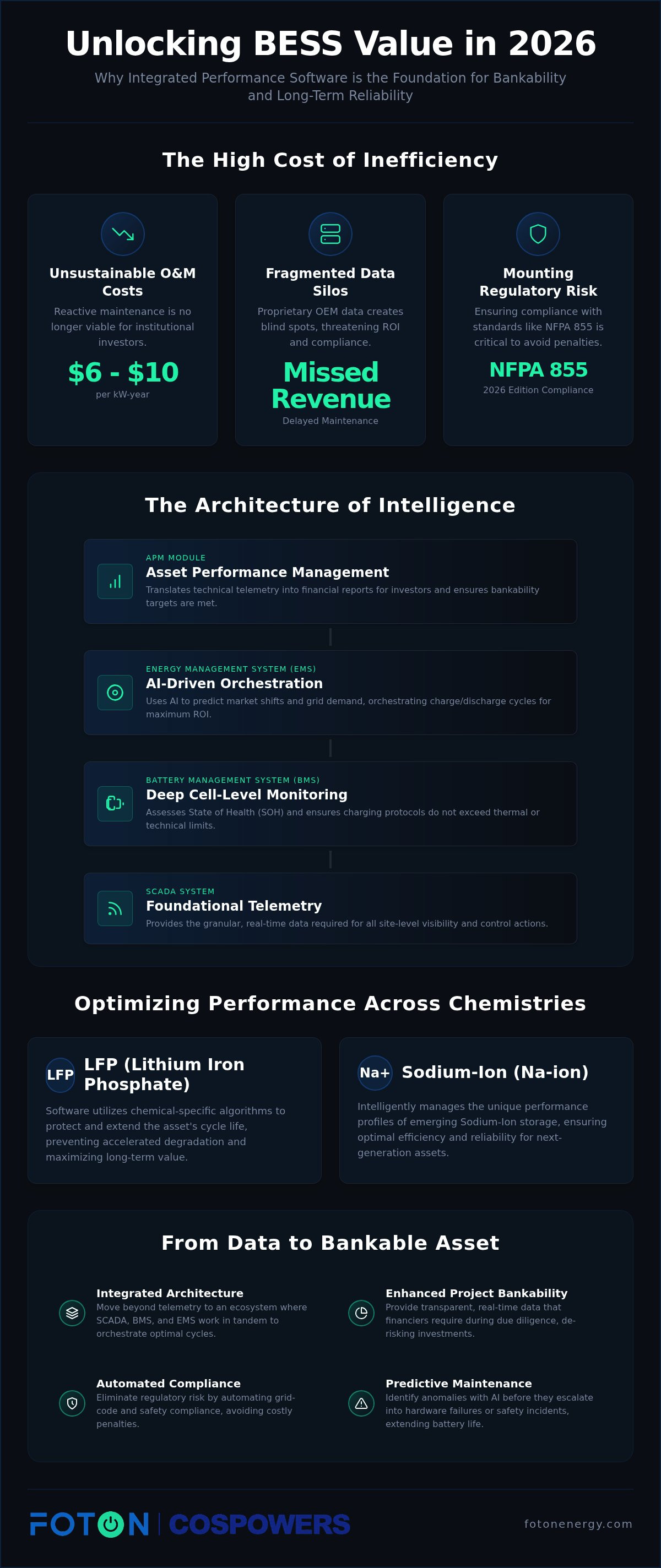
Fragmented data is a silent drain on project ROI. When performance metrics are trapped in proprietary OEM formats, EPCs, developers, and O&M teams spend more time reconciling spreadsheets than optimizing assets. These silos lead to delayed maintenance and missed revenue opportunities in frequency regulation or capacity markets. BESS asset management software serves as the digital twin of physical energy infrastructure, providing a single source of truth for all stakeholders. Centralizing these metrics allows teams to identify underperforming strings across global portfolios instantly. This level of transparency is required to reduce high O&M costs, which currently average between $6 and $10 per kW-year for utility-scale systems. Comprehensive BESS performance monitoring software bridges the gap between hardware and financial performance, turning raw battery data into a bankable asset.
The Architecture of Intelligence: Key Modules in Modern BESS Software
The technical backbone of a high-performance energy asset is its software stack. This isn't a single application; it's a multi-layered architecture where SCADA, EMS, and BMS modules collaborate to ensure reliability. SCADA provides the real-time telemetry required for site-level visibility, serving as the foundational layer for all control actions. Without this granular data stream, managing a global portfolio of assets becomes a series of reactive corrections rather than a synchronized strategy.
Integrating the Battery Management System (BMS) allows for deep cell-level monitoring. This data is essential for assessing the State of Health (SOH) and ensuring that charging protocols don't exceed technical or thermal limits. The Energy Management System (EMS) then takes this data to orchestrate charge and discharge cycles, maximizing ROI by participating in frequency regulation or capacity markets. For investors, transparency is non-negotiable. Asset Performance Management (APM) modules translate this technical telemetry into financial reports, which is critical when applying a formal BESS performance evaluation method to verify that the asset is meeting its projected yield. Implementing high-tier BESS performance monitoring software ensures that these layers communicate without friction, protecting both the hardware and the investment's bottom line.
AI-Driven Energy Management and Optimization
Machine learning models now forecast demand and optimize peak shaving strategies for commercial and industrial users with unprecedented accuracy. These algorithms analyze historical load patterns and weather data to schedule battery discharge when it provides the highest financial value. Predictive maintenance is another critical pillar; it identifies potential inverter failures or cell imbalances before they trigger an unplanned shutdown. This proactive approach is a core part of how AI-driven energy management systems reduce the O&M burden typical of utility-scale projects. Automated bidding modules also allow utility-scale assets to participate in global energy markets in real-time, capturing revenue that manual trading simply can't reach.
Safety Architecture and Thermal Management Integration
Safety architecture must be hard-coded into the software logic. Modern BESS performance monitoring software integrates directly with fire suppression systems and advanced cooling loops to provide a comprehensive safety net. By managing real-time thermal profiles, the software extends battery cycle life and ensures compliance with the 2026 NFPA 855 safety standards. Automated logging and threshold alerts provide a permanent record of operational safety, which is vital for maintaining insurance coverage and permit approvals. This level of technical oversight transforms a collection of batteries into a secure, high-performance infrastructure asset that stakeholders can trust for decades.
Optimizing Performance Across Chemistries: LFP vs. Sodium-Ion Management
Effective asset management requires a deep understanding of electrochemical nuances. A generic control layer can't account for the distinct thermal and degradation profiles of different battery types. In 2026, high-performance BESS performance monitoring software must be chemistry-aware to deliver accurate State of Charge (SOC) estimations. This is particularly critical for Lithium Iron Phosphate (LFP), which exhibits a flat voltage curve that makes traditional voltage-based SOC tracking unreliable. By utilizing sophisticated models like the Energy Storage Evaluation Tool (ESET), asset managers can simulate performance across varying chemistries to ensure bankability before deployment.
Balancing depth of discharge (DOD) with longevity is the primary challenge for utility-scale LFP projects. While LFP is the default for over 70% of grid-scale contracts, its lifecycle is highly sensitive to temperature and cycling frequency. Software algorithms must dynamically adjust discharge limits to prevent accelerated aging while still meeting grid service obligations. This chemical-specific intelligence allows operators to maintain a steady, guiding hand over their assets for the full 20-year project duration. Precise BESS performance monitoring software ensures that these operational boundaries are respected, protecting the physical integrity of the cells while maximizing revenue through stacked services.
Maximizing LFP Bankability through Software
Optimizing high capacity LFP battery modules for long-duration storage requires precise thermal management and cell balancing. Since LFP cell prices have stabilized at $95 to $110 per kWh in 2026, the industry's focus has shifted from procurement costs to lifecycle value. For a deeper look at the hardware these systems support, see our Strategic Guide to Commercial and Industrial BESS Solutions. Strategic software prevents degradation patterns by limiting peak temperature exposure and managing micro-cycles that often go unnoticed by basic monitoring tools. This proactive oversight is essential for maintaining the high-performance standards required by institutional investors.
Sodium-Ion: Software's Role in Commercial Availability
Sodium-Ion technology is expanding at a projected CAGR of 35% through 2033, driven by its superior performance in cold climates and lower fire risk. Adapting the EMS for these systems is essential because Sodium-Ion supports faster discharge profiles than standard LFP. You can read more about the 2026 sodium-ion battery commercial availability to understand the market trajectory. In mission-critical environments, such as a sodium-ion battery for data centers, chemistry-specific software ensures that the system responds instantly to power surges without compromising cell integrity. This level of technical oversight transforms emerging chemistries into dependable, grid-ready solutions.
The Bankability Audit: How Software Derisks Energy Storage Investments
Bankability is the ultimate filter for large-scale energy infrastructure. In 2026, financiers no longer view software as a secondary add-on; they prioritize projects that utilize advanced BESS performance monitoring software as a core risk-mitigation tool. During the due diligence phase, lenders scrutinize the software's ability to provide an immutable record of asset health, degradation rates, and historical availability. Without this transparency, calculating the long-term internal rate of return (IRR) becomes a speculative exercise rather than a grounded financial projection. Digital twin simulations allow developers to derisk feasibility studies by modeling how the system will perform under specific market conditions before a single battery container is installed.
Generating bankable reports is essential for maintaining investor confidence throughout the project lifecycle. These reports translate complex technical telemetry into clear metrics regarding revenue tracking and warranty compliance. If an asset fails to meet its projected yield, the software provides the forensic data necessary to identify whether the issue stems from hardware defects, environmental factors, or grid-dispatch errors. This level of granular visibility ensures that all stakeholders have a steady, guiding hand over the investment, turning raw operational data into a secure financial asset.
Derisking through Grid-Code Compliance
Automated grid-code compliance is a primary driver of financial stability in 2026. Modern software manages complex frequency response and voltage control requirements in real-time, ensuring the asset stabilizes the grid rather than disrupting it. This is particularly critical during utility scale BESS procurement, where projects must meet strict local utility standards to avoid heavy non-compliance penalties. By automating these technical responses, developers can significantly lower the cost of project insurance and secure more favorable debt financing terms. Reliable, software-driven compliance eliminates the human error that often leads to regulatory friction and financial loss.
Maximizing Revenue: Peak Shaving and Arbitrage
Maximizing ROI requires the sophisticated co-optimization of multiple revenue streams, often referred to as revenue stacking. For commercial and industrial (C&I) applications, algorithmic control of behind-the-meter BESS allows businesses to reduce industrial demand charges through precise peak shaving. The software must balance these high-value discharge events with manufacturer warranty constraints to ensure that aggressive revenue seeking doesn't lead to premature cell degradation. Intelligent optimization software enables you to participate in energy arbitrage and frequency regulation simultaneously, maximizing the utility of every cycle. To ensure your project meets these elite performance standards, consider partnering with Foton for strategic BESS engineering and consulting services that bridge the gap between hardware and high-finance requirements.
Strategic Integration: Partnering with Foton for End-to-End BESS Excellence
Foton Energy (Foton Pty Ltd) serves as the strategic link between robust energy infrastructure and the digital intelligence required to manage it. Leveraging extensive engineering expertise and a deep understanding of manufacturing processes, Foton draws on decades of industry heritage to deliver solutions that are both technologically advanced and commercially stable. Our approach integrates AI driven energy management systems directly with Tier-1 LFP and Sodium-Ion hardware. This ensures the software layer isn't a secondary add-on but a native component of the asset's architecture. This synergy is fundamental to our Tier-1 assurance in wholesale battery storage procurement, where we verify that the software and hardware are perfectly synchronized to meet 2026's rigorous bankability standards.
The value of an asset is often decided during the commissioning phase. Foton provides specialized BESS engineering consulting services to oversee software integration and grid-code synchronization, preventing the delays that often plague large-scale deployments. By including a sophisticated BESS performance monitoring software layer in our wholesale offerings, we provide a steady, guiding hand for investors who require long-term reliability. We don't just sell components; we provide a high-performance ecosystem designed for durability and financial resilience.
Custom Software Integration and Engineering Support
Navigating the specific requirements of local utilities requires more than off-the-shelf tools. Foton supports EPCs in achieving grid-code compliance through bespoke software tuning, ensuring that every project meets local frequency and voltage regulations from day one. Explore our BESS engineering consulting services to see how we bridge the technical gap between site construction and active grid participation. Our global support network spans 70+ countries, providing the localized expertise necessary to maintain BESS performance monitoring software across diverse global portfolios. This deep engineering expertise and industry heritage allows us to offer a level of technical depth that software-only providers cannot match.
The Foton Advantage for C&I and Utility Projects
Scalability is a core requirement for 2026 energy storage projects. By combining AI driven energy management systems with modular energy storage architecture, Foton allows C&I and utility-scale projects to expand in lockstep with growing demand. This integrated strategy ensures mission-critical uptime for data centers, hospitals, and telecom backup power where even a micro-second of interruption is unacceptable. We eliminate the hidden costs of data silos by providing a centralized platform that manages both LFP and Sodium-Ion assets with equal precision. Contact Foton for a strategic consultation on your 2026 BESS asset management project to discover how our engineering expertise can transform your raw battery data into bankable financial performance.
Securing the Future of Your Energy Infrastructure
The transition from simple telemetry to intelligent asset management is the defining shift for energy storage in 2026. You've seen how centralizing visibility across global portfolios and automating grid-code compliance can transform a volatile utility project into a stable, bankable asset. By prioritizing high-performance BESS performance monitoring software, developers can finally bridge the gap between complex battery chemistry and institutional financial requirements.
Foton stands as your dedicated partner in this evolution. As the exclusive global partner of Tier-1 manufacturer Cospowers, we combine 30 years of manufacturing heritage with DNV verified systems and AI-driven EMS for real-time grid optimization. Our integrated approach ensures that your hardware and software work in perfect alignment to maximize ROI and ensure long-term resilience. Request a Strategic BESS Software Consultation with Foton today to secure your project's competitive edge. We look forward to building a more resilient and profitable energy future together.
Frequently Asked Questions
What is the difference between an EMS and BESS asset management software?
An Energy Management System (EMS) focuses on real-time site control, while BESS asset management software provides a broader financial and operational overview of a project's lifecycle. The EMS handles immediate charge and discharge commands to meet grid demands. In contrast, asset management software tracks long-term health, warranty compliance, and portfolio-wide performance metrics to ensure the investment remains bankable over twenty years.
How does BESS software improve the ROI of commercial energy storage?
Software improves commercial ROI by co-optimizing multiple revenue streams, such as peak shaving and energy arbitrage, without violating hardware warranties. By using BESS performance monitoring software, operators can precisely manage depth of discharge to extend battery life while capturing maximum market value. This intelligent balancing act prevents the premature degradation that often erodes the profitability of industrial storage assets.
Can BESS asset management software manage different battery chemistries simultaneously?
Advanced platforms use chemistry-aware algorithms to manage LFP and Sodium-Ion batteries within the same portfolio. Each chemistry has unique voltage curves and thermal limits that require specific control logic for accurate State of Charge (SOC) estimation. Centralizing this data allows asset managers to compare performance across different technologies and optimize dispatch strategies based on the specific strengths of each battery type.
Is software integration necessary for grid-code compliance in Australia?
Integration is essential for meeting the strict grid-code requirements set by the Australian Energy Market Operator (AEMO). Software enables the fast frequency response and voltage control necessary for grid stability, particularly in regions with high renewable penetration. Without automated compliance logic, projects risk heavy financial penalties and potential disconnection from the Australian network during volatile grid events.
How does predictive maintenance in BESS software reduce O&M costs?
Predictive maintenance identifies technical anomalies, such as cell imbalances or inverter inefficiencies, before they lead to a total system shutdown. This proactive approach reduces high O&M costs, which currently average between $6 and $10 per kW-year for utility-scale assets. By addressing minor issues during scheduled windows, operators avoid the emergency repair fees and lost revenue associated with unplanned downtime.
What should financiers look for in BESS software to ensure project bankability?
Financiers prioritize software that provides high-fidelity data transparency and immutable operational logs for due diligence. They look for systems that automate warranty tracking and provide clear evidence of grid-code compliance to mitigate regulatory risk. Robust BESS performance monitoring software that is DNV verified or Tier-1 certified offers the bankable assurance required to secure favorable debt financing and lower insurance premiums.
Can Foton's software integrate with third-party battery hardware?
Foton's software architecture is built on open communication protocols to allow for seamless integration with a wide range of third-party hardware. While it's optimized for the Tier-1 LFP and Sodium-Ion systems from Cospowers, it can aggregate data from various OEM inverters and battery racks. This flexibility is vital for developers who need a single source of truth across a diverse, multi-vendor global portfolio.
Does BESS software help in managing thermal safety and fire suppression?
Modern software serves as a critical safety layer by monitoring real-time thermal profiles and integrating directly with fire suppression systems. It can trigger automated cooling responses or emergency shutdowns if temperatures exceed safe thresholds defined by NFPA 855 standards. This continuous oversight prevents thermal runaway and ensures that safety systems are always ready to respond to internal or external threats.


