

Thermal management and fire protection systems are projected to account for over 20% of total BESS costs by 2035, marking a definitive shift in how we value infrastructure safety. For developers and EPCs, the era of treating bess fire suppression systems as a secondary concern has ended. With the 2026 edition of NFPA 855 now mandating Large-Scale Fire Testing and the 6th Edition of UL 9540A enforcing installation-level propagation standards, the technical barrier to entry has never been higher. It's a landscape where a single regulatory oversight can stall a multi-million dollar project or lead to prohibitive insurance premiums.
You likely understand that staying ahead of these shifting grid-code requirements is the only way to protect your investment from catastrophic thermal runaway events. This guide provides the strategic framework you need to master the current regulatory landscape, ensuring your projects remain safe, compliant, and bankable. We'll examine the latest suppression technologies and provide a clear roadmap for achieving global compliance while significantly reducing your insurance risk profile.
Key Takeaways
- Identify the critical transition from battery cell venting to full thermal runaway to implement more precise mitigation protocols.
- Evaluate the performance differences between aerosol, clean agent, and water-based bess fire suppression systems to optimize your safety architecture.
- Master the 2026 regulatory shifts in NFPA 855 and UL 9540A to secure project bankability and reduce long-term insurance risk.
- Shift your strategy from reactive suppression to proactive detection using multi-sensor arrays that identify hazards before they escalate.
- Leverage the heritage of Tier-1 manufacturing and AI-driven EMS to build a resilient, grid-compliant energy storage infrastructure.
The Critical Risks: Thermal Runaway and BESS Fire Dynamics
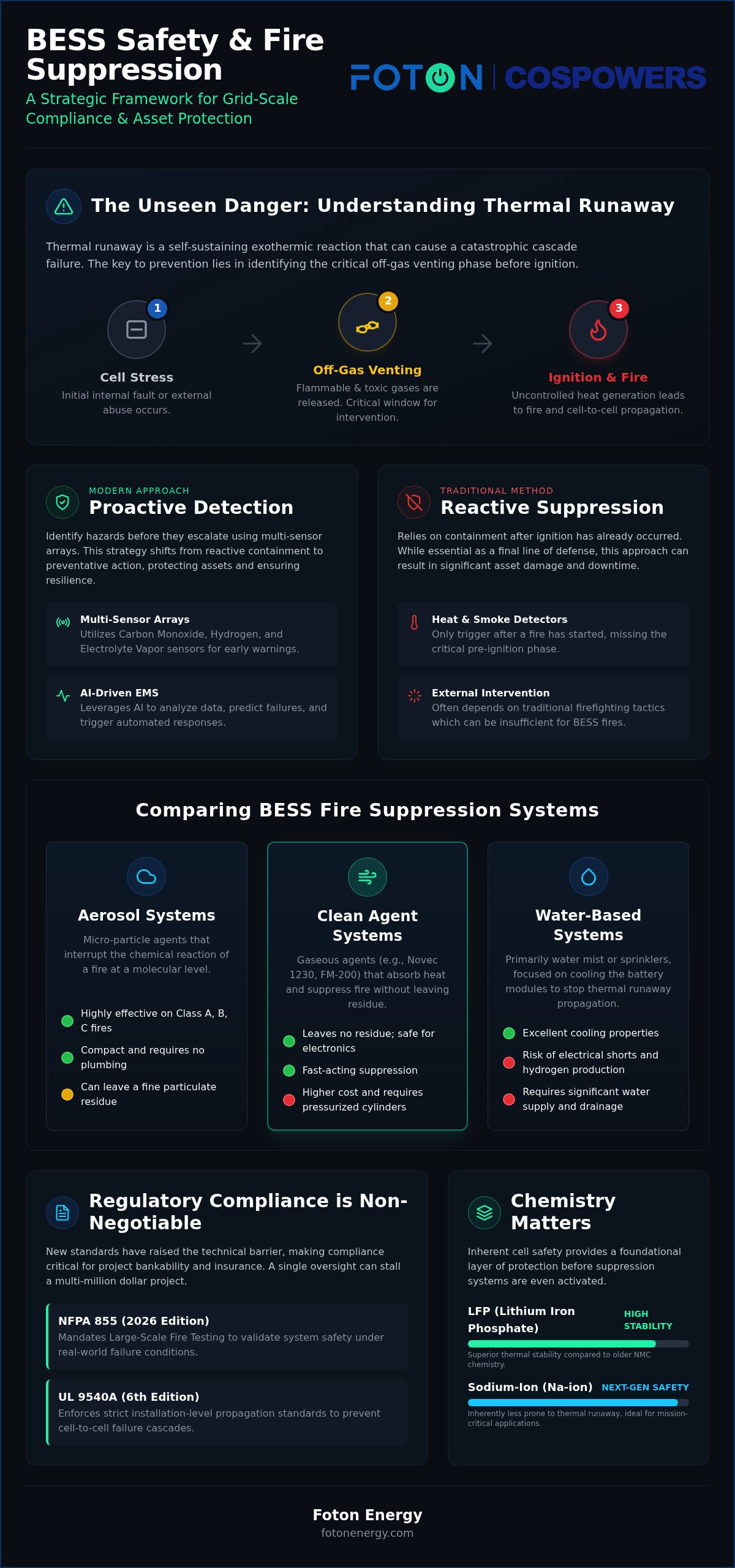
Thermal runaway is the defining technical challenge of modern energy storage. It's a self-sustaining exothermic reaction where a cell's internal temperature rises uncontrollably, triggering a cascade of failures across the entire module. When the rate of internal heat generation exceeds the system's ability to dissipate it, the battery enters a state of chemical instability that's difficult to reverse without immediate intervention.
Understanding the mechanics of a Battery Energy Storage System is vital for any developer aiming for long-term project viability. Before ignition occurs, batteries enter a critical venting phase. During this stage, flammable and toxic gases are released under high pressure as the internal separators fail. If bess fire suppression systems don't intervene during this specific off-gas window, the risk of a catastrophic explosion or rapid fire spread increases. We must view this venting phase as a final opportunity for preventative action rather than the start of an inevitable fire.
To better understand this concept, watch this helpful video:
Traditional firefighting tactics often prove insufficient for these high-density environments. While water is an effective cooling agent, it can occasionally exacerbate the situation by causing electrical shorts or reacting with certain battery components to produce hydrogen gas. As energy density in utility-scale containers continues to rise, the sheer volume of stored energy makes fire severity significantly more intense. We must approach safety as a holistic architecture rather than a simple reactive measure that relies on external intervention after a failure occurs.
Chemistry Matters: LFP vs. Sodium-Ion Safety Profiles
Lithium Iron Phosphate (LFP) has largely replaced NMC in stationary storage due to its superior thermal stability. However, the market is now looking toward sodium-ion battery commercial availability as the next evolution in safety. Sodium-ion cells offer inherent advantages in high-safety environments like mission-critical data centers because they're less prone to thermal runaway even under extreme stress. This chemistry shift provides a foundational layer of protection before suppression systems are even activated.
The Role of Electrolytes in Fire Propagation
The flammable liquid solvents within the electrolyte serve as the primary fuel source during a fire. Once a single cell fails, the heat transfers to neighbors, causing cell-to-cell propagation that can consume a full-scale container in minutes. This chain reaction is why early detection of electrolyte leakage is a priority for modern bess fire suppression systems. Thermal runaway represents the primary hurdle for BESS grid-scale bankability.
BESS Safety Architecture: Detection vs. Suppression
Safety in energy storage has evolved from a reactive checklist into a sophisticated, integrated architecture. While bess fire suppression systems are critical for containment, the industry's focus has shifted toward proactive detection that identifies failure points before ignition. This architectural approach treats fire safety as a primary design pillar rather than a late-stage addition. By prioritizing early intervention, developers can protect high-value assets and ensure long-term operational resilience without relying solely on the final, destructive line of defense.
Effective safety architecture depends on multi-sensor arrays that monitor for more than just smoke or heat. Modern systems employ a layered strategy, utilizing carbon monoxide, hydrogen, and electrolyte vapor sensors to identify the earliest signs of cell stress. According to EPRI BESS fire safety research, this combination of sensory data is essential for distinguishing between a minor technical fault and a developing thermal event. When these sensors work in unison, they provide a granular view of the container's internal environment, allowing for targeted responses that prevent localized issues from escalating into container-wide failures.
The intelligence behind these sensors lies in their integration with an AI driven energy management system. This software doesn't just record data; it analyzes performance patterns to predict potential hazards. If a single module shows anomalous temperature spikes or voltage fluctuations, the EMS can trigger an automated emergency shutdown or isolate the affected string. This predictive capability transforms bess fire suppression systems from simple extinguishers into intelligent mitigation tools that operate with surgical precision.
Early Warning Systems: Off-Gas Detection
The "golden window" is the brief period between the initial venting of flammable gases and the moment of ignition. During this phase, specialized sensors detect rising levels of carbon monoxide and hydrogen, providing a critical lead time that smoke detectors cannot match. AI-driven EMS protocols use this data to activate high-volume ventilation or inert gas pre-discharge, effectively neutralizing the explosive atmosphere before a spark can occur. This proactive intervention is the key to maintaining site safety in high-density utility installations.
Integrated Thermal Management
Thermal management serves as the first line of defense against runaway conditions. High-performance liquid cooling systems offer superior heat dissipation compared to traditional air cooling, keeping cells within their optimal temperature range even during rapid discharge cycles. This stability reduces the chemical stress that leads to cell degradation and eventual failure. Foton's safety architecture prioritizes these advanced cooling methods to ensure that active suppression is rarely needed. You can explore how these integrated thermal solutions enhance project durability by consulting with our engineering team.
Suppression Technologies: Comparing Aerosol, Clean Agent, and Water
Selecting an extinguishing agent for bess fire suppression systems is a technical decision that directly impacts project bankability and site recovery timelines. There is no universal solution; rather, the choice depends on the specific energy density, chemistry, and location of the installation. We must evaluate these technologies through the lens of both immediate fire knockdown and the long-term integrity of the remaining equipment. A successful suppression event shouldn't result in the total loss of the asset due to agent-related damage.
Strategic deployment typically follows one of two methodologies: total flooding or local application. Total flooding involves filling the entire container volume with an agent to ensure that fire cannot find an unshielded pocket to continue its growth. Local application targets specific battery racks or modules, aiming to contain the event at the source while minimizing agent usage. While utility-scale projects often lean toward water-based cooling or aerosols, mission-critical environments require agents that leave zero residue and prevent electrical conductivity issues.
Recovery implications are often overlooked during the initial procurement phase. Traditional water-based systems are excellent at cooling, but they present significant clean-up challenges and can lead to the total write-off of unburnt modules due to moisture ingress. Modern gaseous and aerosol alternatives offer a more surgical approach, prioritizing the preservation of adjacent hardware to ensure that the facility can return to operational status as quickly as possible.
Condensed Aerosol Systems
Condensed aerosols work by releasing ultra-fine solid particles that interrupt the chemical chain reaction of a fire at the molecular level. These systems are highly valued in C&I applications because they don't require complex piping or pressurized cylinders, making them exceptionally compact. They're particularly effective at reaching hidden fires within densely packed battery racks. However, you must account for the fine residue left behind after discharge and the temporary loss of visibility, which can complicate immediate post-event inspections.
Clean Agents (Novec 1230 / FM-200)
Clean agents are non-conductive gases that extinguish fires by rapidly removing heat and displacing oxygen. They're the gold standard for a sodium-ion battery for data centers, where protecting sensitive server infrastructure is as important as stopping the fire itself. These agents evaporate instantly, leaving no residue and requiring zero cleanup. It's vital to stay informed on the regulatory status of these chemicals; while Novec 1230 remains a preferred choice for its low global warming potential, many older HFC-based agents are currently facing global phase-down mandates under environmental protection protocols.
Standards, Compliance, and Project Bankability
Safety certifications are the primary metric financiers use to evaluate project viability. In 2026, a project's "bankability" depends on its ability to demonstrate rigorous compliance with evolving international standards. Lenders and investors no longer view bess fire suppression systems as optional accessories. Instead, they're foundational pillars of a risk-management strategy that protects both physical assets and long-term revenue streams. Without verified safety data, securing the necessary capital for large-scale infrastructure becomes an insurmountable challenge.
The 2026 edition of NFPA 855 has fundamentally altered the landscape by making Hazard Mitigation Analysis (HMA) a default requirement for nearly all installations. This change forces developers to account for fire dynamics and explosion control early in the design phase. These standards dictate critical site parameters, including separation distances between containers and proximity to occupied buildings. By adhering to these prescriptive requirements, EPCs can streamline the permitting process with local Authorities Having Jurisdiction (AHJ) and avoid costly late-stage modifications that can derail construction timelines.
Navigating NFPA 855 and UL 9540A
Distinguishing between product and installation standards is vital for successful project execution. UL 9540 focuses on the safety of the energy storage system as a product, while NFPA 855 governs how that product is safely integrated into a specific site. The 6th Edition of UL 9540A, released in March 2026, now formally incorporates Large-Scale Fire Testing (LSFT). This testing provides the empirical data required to prove that a thermal event won't propagate between units. For developers managing utility scale BESS procurement, documenting this compliance is the most effective way to ensure project approval and grid connection.
The Role of Insurance and Financial Risk
Insurance premiums for BESS projects have historically been high due to the fear of catastrophic thermal runaway. However, implementing a "bankable" safety architecture that exceeds minimum requirements can significantly reduce the cost of capital. Third-party validations, such as DNV verification, provide insurers with the assurance that safety claims are backed by rigorous, independent testing. Tier-1 manufacturing heritage ensures long-term asset safety by leveraging decades of proven engineering expertise and rigorous quality control. By aligning your suppression strategy with global grid-code compliance, you can secure more favorable terms from underwriters. To discuss how to optimize your project's safety profile, you can consult with our BESS engineering experts today.
Foton’s Strategic Approach: Integrated Safety for Tier-1 BESS
Foton Energy serves as the vital bridge between world-class manufacturing and the rigorous safety demands of local energy projects. Our exclusive global partnership with Cospowers, a Tier-1 manufacturer with over 30 years of manufacturing heritage, allows us to deliver systems where safety is a foundational element rather than a secondary addition. We provide the technical stability needed for large-scale infrastructure investments, ensuring every project is backed by decades of proven engineering expertise. This partnership ensures that our clients receive hardware that isn't just technologically advanced, but also commercially stable and bankable.
Reliability is maintained through our AI-driven Energy Management Systems (EMS), which provide 24/7 predictive safety monitoring. These systems analyze real-time performance data to detect anomalies, such as subtle temperature fluctuations or voltage imbalances, long before they escalate into hazardous conditions. By integrating sophisticated software with high-performance hardware, we offer a level of operational security that protects your long-term asset value. Our approach moves beyond simple compliance, aiming for a future-ready infrastructure that remains resilient under the most demanding grid conditions.
Wholesale Procurement with Safety Built-In
We ensure that every module we provide meets or exceeds the most stringent global safety certifications, including the latest UL 9540A requirements. Our containerized solutions arrive with pre-installed bess fire suppression systems, reducing on-site complexity and ensuring that every component is factory-tested for seamless integration. This "plug-and-play" safety architecture minimizes installation risks and accelerates the path to grid-code compliance. It's a methodical process designed to give developers and EPCs immediate value and peace of mind.
To ensure your site layout is fully optimized for both performance and safety, you can collaborate with our BESS engineering consulting services. We guide you through the entire project lifecycle, from initial feasibility studies to final commissioning and grid connection. Our engineering team works as your supportive partner, ensuring that your bess fire suppression systems are integrated into a holistic safety layout that satisfies both insurers and local authorities.
Future-Proofing Your Energy Infrastructure
Building a resilient energy future requires more than just high-quality hardware; it demands strategic alignment and a commitment to long-term operational resilience. Foton Energy is dedicated to providing the steady, guiding hand needed to navigate the complexities of the 2026 energy landscape. We invite EPCs, developers, and resellers to join our global channel partner program, gaining access to a reliable supply of Tier-1 technology and comprehensive technical support. Let's work together to build infrastructure that is not only efficient but fundamentally secure. Partner with Foton for your next utility-scale BESS deployment and experience the assurance that comes from working with a foundational pillar of the energy storage industry.
Securing the Future of Grid-Scale Energy Storage
Safety in energy storage has evolved into a strategic pillar that determines the financial and operational success of your infrastructure. By prioritizing proactive detection and integrating advanced bess fire suppression systems, you protect your capital and ensure long-term grid stability. The transition toward performance-based standards like NFPA 855 and the adoption of safer chemistries are no longer optional trends; they're the new benchmarks for project bankability.
Foton Energy stands as your steady partner in this evolving landscape. As the exclusive global partner of Tier-1 manufacturer Cospowers, we leverage over 30 years of manufacturing heritage to deliver a sophisticated, AI-driven safety architecture. Our expert engineering consulting ensures your system meets every grid-code requirement while reducing insurance risk. We invite you to design your bankable energy storage project with Foton Energy and build an infrastructure grounded in reliability. Let's work together to create a safer, high-performance energy ecosystem.
Frequently Asked Questions
What is the difference between fire detection and fire suppression in a BESS?
Fire detection identifies the precursors of a thermal event, while bess fire suppression systems actively intervene to extinguish or contain the fire. Detection involves sensors for smoke, heat, and off-gases like hydrogen or carbon monoxide. Suppression uses agents such as clean gases or aerosols to interrupt chemical chain reactions. Integrating both into an AI-driven EMS ensures a proactive safety architecture that minimizes damage before active suppression is even required.
Is water effective for extinguishing lithium-ion battery fires?
Water is primarily used as a cooling agent rather than a chemical suppressant for lithium-ion failures. While it can help prevent propagation by cooling surrounding cells, it often fails to stop the internal exothermic reaction of a cell in runaway. Water can also cause electrical short circuits or lead to the accumulation of explosive hydrogen gas. Most modern safety designs favor gaseous or aerosol agents for initial containment and localized protection.
What are the requirements for NFPA 855 compliance in 2026?
The 2026 edition of NFPA 855 mandates a Hazard Mitigation Analysis (HMA) for most installations regardless of energy capacity. It also requires Large-Scale Fire Testing (LSFT) to validate that fire won't spread between units under real-world conditions. Other key requirements include prescriptive explosion control measures and strict adherence to separation distances. Compliance is essential for securing permits from local authorities and ensuring the long-term bankability of the project.
How does UL 9540A testing affect BESS installation spacing?
UL 9540A test results provide the empirical data needed to justify reduced separation distances between BESS units. Without this testing, NFPA 855 typically requires a default 10-foot clearance between containers and nearby structures. If the data proves that fire does not propagate between racks or modules during a full-scale burn test, developers can design more compact site layouts. This significantly increases the energy density and land-use efficiency of the installation.
Can sodium-ion batteries catch fire like lithium-ion batteries?
Sodium-ion batteries are fundamentally more thermally stable than traditional lithium-ion chemistries. They're less prone to the rapid, self-sustaining heat generation known as thermal runaway even when subjected to mechanical or electrical stress. While they are significantly safer for mission-critical environments like data centers, they still require professional safety monitoring and appropriate thermal management. This ensures long-term operational resilience and protects the asset from environmental factors or external fire risks.
What is the best fire suppression agent for a containerized BESS?
The optimal agent depends on your project's specific recovery and clean-up requirements. Clean agents like Novec 1230 are ideal for environments where avoiding equipment damage is a priority because they leave zero residue. Condensed aerosols offer a compact, pipe-free solution for rack-level protection in C&I containers. We recommend consulting with engineering experts to match the suppression technology to your system's energy density and the specific chemical profile of your battery modules.
How do fire suppression systems impact BESS project insurance premiums?
Robust bess fire suppression systems directly lower insurance premiums by reducing the "Probable Maximum Loss" for underwriters. Insurers in 2026 prioritize projects that utilize Tier-1 hardware with verified UL 9540A data and AI-driven predictive monitoring. By demonstrating a proactive approach to hazard mitigation, developers can secure more favorable coverage terms. This reduces the overall cost of capital and makes the project more attractive to risk-averse long-term investors.
Do I need a fire suppression system for a residential BESS?
Residential BESS requirements vary by jurisdiction, but most local codes now mandate early detection and specific installation locations. While active suppression systems are standard in utility-scale projects, residential units often rely on inherent chemistry safety and fire-rated enclosures. You should always verify local AHJ requirements and NFPA 855 standards for home storage. This ensures your installation meets the necessary safety criteria and remains eligible for residential property insurance coverage.


