

A BESS warranty is no longer a static insurance policy; it's a high-stakes risk management framework that determines the bankability of your infrastructure for decades. In 2026, the shift toward throughput-based guarantees and capacity retention milestones means that understanding long term BESS warranty considerations is now a prerequisite for project viability. You likely recognize that a warranty is only as strong as the entity standing behind it, and it's natural to feel uneasy about manufacturer insolvency or the opaque legal language found in modern Long-Term Service Agreements (LTSAs).
We'll help you master these complexities to ensure your large-scale energy projects maintain peak technical performance and ironclad financial security. This guide provides a strategic roadmap for structuring bankable agreements that satisfy lenders while leveraging AI-driven EMS data to validate performance claims. You'll discover how to minimize downtime through guaranteed spare parts protocols and align your assets with the 30-year manufacturing heritage required for true stability. Let's build a foundation of operational excellence that turns technical uncertainty into a predictable, high-performance investment.
Key Takeaways
- Understand why 2026 marks a shift from simple product guarantees to multi-layered performance contracts that ensure long-term project bankability.
- Navigate complex long term BESS warranty considerations by mastering the technical nuances of Depth of Discharge (DoD) and C-rates within your contract's fine print.
- Leverage the 30-year manufacturing heritage of reputable Tier-1 partners to secure the financial stability of your 20-year energy storage investments.
- Shift from traditional warranties to strategic Long-Term Service Agreements (LTSAs) that clearly define excusable downtime and protect against operational risks.
- Utilize AI-driven Energy Management Systems (EMS) as a digital notary to validate performance metrics and identify cell imbalances before they lead to system failure.
The Evolving Landscape of BESS Warranties in 2026
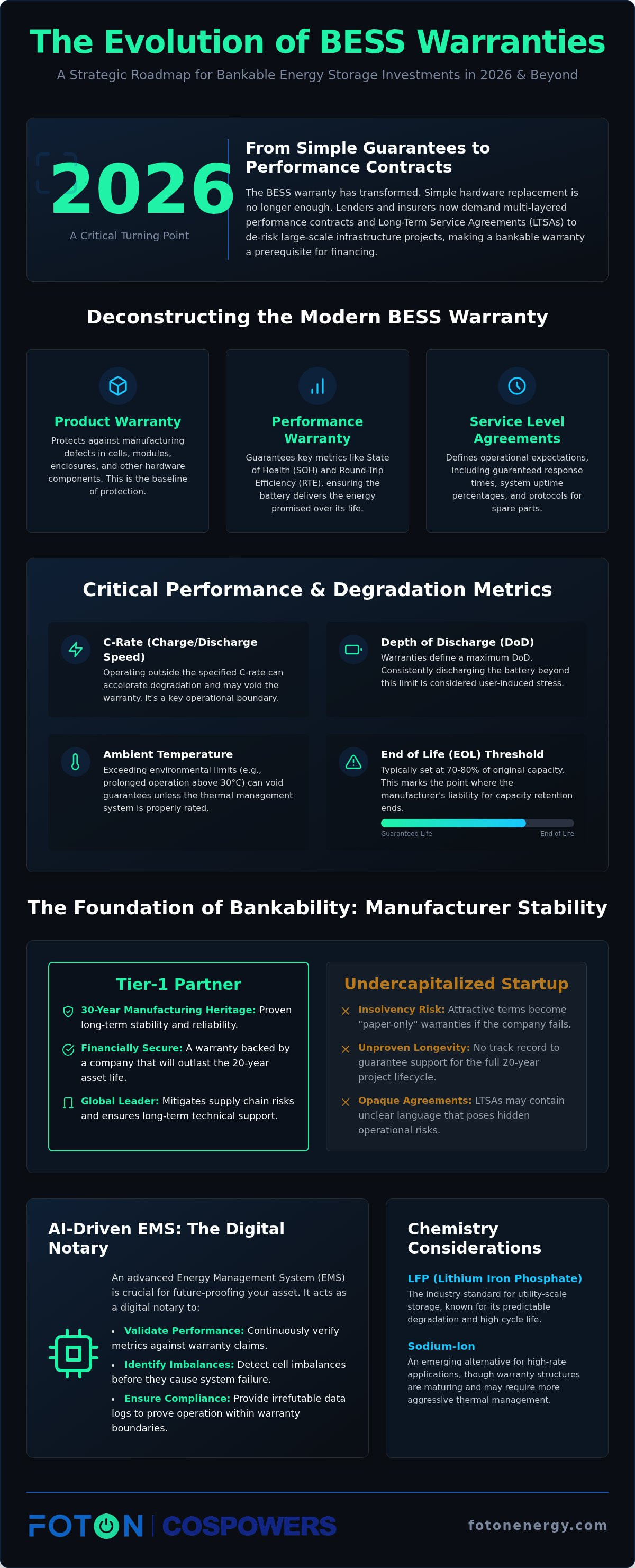
A BESS warranty is no longer a simple hardware guarantee; it's a sophisticated, multi-layered risk-management framework. This contract covers everything from manufacturing defects to capacity retention and rigorous performance metrics. We've reached a critical turning point in 2026. Simple hardware replacement clauses are no longer sufficient for the scale of modern energy deployments. A Battery Energy Storage System (BESS) requires a comprehensive legal and technical shield to remain viable over a twenty-year lifecycle.
Project developers have moved toward Long-Term Service Agreements (LTSAs) that prioritize total system availability. Lenders and insurers now demand these robust structures to de-risk large-scale infrastructure investments. Without a bankable warranty, securing project financing is nearly impossible. High-performance projects require a partner that understands how technical performance translates directly into financial security. We focus on building these structures to ensure long-term asset bankability from day one.
Key Components of a Modern Storage Warranty
Modern warranties are structured across three distinct pillars. The Product Warranty protects against manufacturing defects in cells, modules, and enclosures. It's the baseline of protection. Next, the Performance Warranty guarantees State of Health (SOH) and Round-Trip Efficiency (RTE). These metrics ensure the battery delivers the energy promised throughout its life. Finally, Service Level Agreements (SLAs) define operational expectations. These include guaranteed response times and system uptime percentages. Together, these components create a holistic safety net for the asset owner.
The Impact of Market Volatility on Warranty Security
Market stability is the primary filter for financial institutions. They prioritize Tier-1 status because a warranty is only as strong as the company standing behind it. Some undercapitalized startups offer attractive terms that essentially function as "paper-only" warranties. If the manufacturer isn't around in fifteen years, those terms are worthless. This is why long term BESS warranty considerations must prioritize manufacturer heritage. We leverage the thirty-year manufacturing history of partners like Cospowers to provide a foundation of stability. Strategic partnerships with established global leaders mitigate supply chain risks and ensure technical support remains available. Bankability starts with a guarantor you can trust to outlast the asset itself.
Technical Degradation and Performance Metrics
Battery degradation is an inevitable chemical reality, but its impact on your financial model depends entirely on how it's codified in your agreement. Long term BESS warranty considerations must account for the dual nature of aging: calendar and cycle. Calendar aging happens as the chemistry naturally decomposes over time, regardless of use. Cycle aging is a direct result of operational throughput. Most warranties specify a strict operating envelope that limits both. This includes a maximum C-rate, which is the speed of charge and discharge, and a defined Depth of Discharge (DoD). If your system operates outside these boundaries, the manufacturer may argue that accelerated degradation was user-induced rather than a product defect.
The "End of Life" (EOL) threshold is equally vital for asset longevity. Typically set at 70% or 80% of original capacity, this figure represents the point where the manufacturer’s liability for capacity retention ends. Environmental factors like humidity and ambient temperature are not just suggestions; they are warranty boundaries. Operating a system in temperatures exceeding 30°C for prolonged periods can void a guarantee unless the thermal management system is specifically rated for those conditions. To ensure your project remains compliant with these technical boundaries, our engineering consulting team can help align your operational profiles with warranty constraints.
Chemistry-Specific Considerations: LFP vs. Sodium-Ion
Lithium Iron Phosphate (LFP) remains the standard for high-density, utility-scale storage due to its predictable degradation curves and high cycle life. Sodium-Ion is emerging as a powerful alternative for high-rate applications, though its warranty structures are still maturing. Sodium-Ion systems often require more aggressive thermal management to maintain the guarantees provided by Tier-1 manufacturers. Choosing the right chemistry involves balancing these thermal requirements against the expected energy throughput of the asset to ensure the warranty remains valid over twenty years.
Measuring State of Health (SOH) and Throughput
Warranties are shifting away from simple cycle counts toward energy throughput measured in Megawatt-hours (MWh). Throughput offers a more accurate reflection of the total work performed by the battery cells over time. State of Health (SOH) is the percentage of remaining capacity compared to the original rating. Verifying SOH requires standardized capacity tests, often conducted annually, to ensure the system meets its retention milestones. Using precise, automated data for these measurements prevents disputes and ensures your asset remains bankable throughout its entire lifecycle.
Evaluating Manufacturer Bankability and Asset Longevity
Bankability is the ultimate filter for large-scale energy storage investments. A warranty document is merely a collection of promises if the issuer lacks the financial resilience to honor them over a twenty-year horizon. Lenders use a specific checklist to evaluate risk, focusing on a manufacturer's balance sheet, annual manufacturing capacity, and consistent R&D investment. These long term BESS warranty considerations are central to securing non-recourse project debt and favorable insurance premiums. Without a demonstrably stable guarantor, the cost of capital for a project can become prohibitive.
Manufacturer heritage provides the most reliable indicator of future performance. Cospowers brings over thirty years of manufacturing experience to the global market, offering a level of stability that few competitors can match. This track record is vital because it proves the manufacturer can survive multiple economic cycles and technology shifts. When you're deploying an asset designed to operate into the late 2040s, you can't rely on a startup with a limited operational history. Third-party validations from organizations like DNV, TUV, and UL provide the objective proof points that financiers require. In some high-risk scenarios, insurance-backed warranties offer an additional layer of security, protecting the asset owner even in the unlikely event of manufacturer insolvency.
Tier-1 Status and Global Supply Chain Resilience
Tier-1 status in 2026 is defined by more than just shipment volume. It requires a transparent global supply chain and the ability to withstand extreme market volatility without compromising on component quality. Wholesale procurement partners act as a critical bridge, ensuring that local EPCs have access to Tier-1 hardware with warranty terms that are already optimized for bankability. You can explore these dynamics further in our guide to Utility-Scale BESS Procurement: The 2026 Strategic Guide.
The Importance of Onshore Technical Support
Onshore technical support is the difference between a minor repair and months of catastrophic downtime. Local engineering teams are essential for investigating warranty claims and performing rapid on-site remediation. A robust spare parts strategy must include local warehousing and clear lead-time guarantees to ensure long term BESS warranty considerations are practical rather than just theoretical. Our BESS Engineering Consulting Services: A Strategic Guide details how local expertise ensures your system remains grid-code compliant and commercially viable throughout its entire lifecycle.
Negotiating Long-Term Service Agreements (LTSA)
Transitioning from a standard product warranty to a Long-Term Service Agreement (LTSA) marks the evolution from a simple hardware purchase to a strategic partnership. In 2026, an LTSA is the primary vehicle for managing long term BESS warranty considerations, providing a comprehensive framework for maintenance, monitoring, and performance insurance. This document must clearly define "Excusable Downtime," such as grid outages or scheduled maintenance, and "Force Majeure" events to prevent unfair penalties. You should also ensure the agreement is fully transferable. This allows the warranty and service protections to remain valid during an asset sale or refinancing, which is a critical factor for project exit strategies and long-term valuation.
Liquidated damages are the teeth of any LTSA. These clauses allow asset owners to calculate and recover the cost of missed performance targets, such as energy throughput or round-trip efficiency. By codifying these financial consequences, you align the manufacturer's incentives with your project's operational success. If the system fails to meet its guaranteed uptime, the manufacturer compensates the owner for lost revenue, ensuring the financial model remains intact despite technical setbacks.
Drafting Effective Performance Guarantees
Effective guarantees focus on system availability and speed of repair. Availability guarantees typically target 98% or higher, measured over annual windows. It's vital to distinguish between "Response Time," which is how quickly a technician acknowledges a fault, and "Resolution Time," which is when the system returns to full operation. High-performance contracts often include bonus and penalty structures. These reward the O&M provider for exceeding efficiency targets while penalizing them for persistent underperformance. To ensure your contract terms are both bankable and grid-compliant, you can consult with our engineering team to draft optimized performance metrics.
The Role of O&M in Warranty Compliance
Operational and Maintenance (O&M) activities are the lifeblood of warranty validity. Manufacturers mandate strict preventative maintenance schedules, including HVAC filter changes, torque checks, and firmware updates. Failure to provide comprehensive operating logs typically voids most Tier-1 BESS warranties, as manufacturers require this data to verify that the system remained within its specified operating envelope. Asset owners must ensure their O&M teams maintain meticulous records of every discharge cycle and temperature fluctuation. These long term BESS warranty considerations turn data logging from a clerical task into a fundamental pillar of financial risk mitigation.
Future-Proofing with AI-Driven Monitoring and Foton Solutions
Intelligent software is the final piece of the risk-mitigation puzzle. While an LTSA provides the legal framework, an AI-driven Energy Management System (EMS) provides the empirical evidence required to uphold it. We view our EMS as a digital notary for warranty claims. It creates an immutable record of system performance, ensuring that every discharge cycle and temperature shift is logged with precision. These long term BESS warranty considerations are no longer just about reading a contract; they're about deploying a technology stack that actively defends your investment. By maintaining an unassailable data trail, asset owners can resolve disputes quickly and maintain the high degree of professional confidence that lenders demand.
Predictive maintenance is where AI truly shifts the ROI needle. Instead of waiting for a module to fail, our intelligent oversight identifies cell imbalances and micro-deviations in voltage before they escalate into hardware failures. This proactive approach allows for targeted remediation during scheduled maintenance windows, preventing the catastrophic downtime that can trigger liquidated damages. Thermal management optimization also plays a critical role. By dynamically adjusting cooling based on predictive load profiles, the EMS reduces the chemical stress on cells, often extending the battery's cycle life well beyond the original warranty period. The Foton advantage lies in this synergy, combining the 30-year manufacturing heritage of Tier-1 Cospowers hardware with elite, Australian-led engineering oversight.
AI-Driven EMS: The Guardian of the Warranty
Real-time monitoring at the cell level is the only way to ensure 100% compliance with manufacturer operating envelopes. Our system tracks voltage, current, and internal temperatures across every module simultaneously. If the system approaches a boundary that might compromise the warranty, automated alerts trigger immediate corrective actions. This level of granular control is essential for maintaining the bankability of large-scale assets. For a deeper look at these technologies, explore our AI Driven Energy Management Systems: The 2026 Strategic Guide.
Strategic Deployment: From Data Centers to Utilities
Warranty structures must be as specialized as the applications they support. Mission-critical data center UPS systems require guarantees focused on instantaneous response and high-rate discharge reliability. Conversely, utility-scale projects prioritize grid-stability and frequency response metrics. We help partners navigate these differences, ensuring that whether you're deploying LFP or exploring a Sodium-Ion Battery for Data Centers, your warranty remains a robust asset. By aligning technical architecture with strategic ambition, we ensure your energy storage project remains a foundational pillar of the modern grid for decades to come.
Securing the Future of Your Energy Infrastructure
Mastering long term BESS warranty considerations requires moving beyond simple hardware checklists toward a holistic risk-management framework. You've seen how the intersection of technical degradation, legal structures, and AI-driven monitoring creates a truly bankable asset. By prioritizing manufacturer heritage and precise data logging, you transform technical uncertainty into predictable financial performance. A warranty isn't just a safety net; it's a strategic pillar that ensures your project remains viable through 2045 and beyond.
Reliability is built on proven experience. As the exclusive strategic partner of Cospowers, we leverage over 30 years of manufacturing heritage to deliver Tier-1 LFP and Sodium-Ion solutions that satisfy the most rigorous lender requirements. We're ready to help you navigate these complexities and build a foundation of operational excellence. Partner with Foton for Bankable BESS Infrastructure to ensure your large-scale storage projects are resilient, optimized, and fully secured. Let's work together to drive the global energy transition with confidence and stability.
Frequently Asked Questions
What is the typical lifespan of a commercial BESS warranty in 2026?
In 2026, the industry standard for commercial and industrial systems is 10 years, though utility-scale projects often demand 15 to 20 years to match asset lifecycles. These agreements are increasingly structured as Long-Term Service Agreements (LTSAs) rather than simple hardware guarantees. This ensures that the system remains operational and bankable for the entire duration of the project's financial model. Owners must align these terms with their expected ROI period.
Can a BESS warranty be voided by operating in high temperatures?
Yes, operating a BESS outside its specified thermal envelope will void most Tier-1 warranties. Most manufacturers require ambient temperatures to remain below a specific threshold, often 30°C or 45°C, depending on the cooling system's design. If the internal cell temperatures exceed the warranty-approved limits, the manufacturer can deny claims related to accelerated degradation. This is why active thermal management is critical for project security and longevity.
What is the difference between a product warranty and a performance guarantee?
A product warranty covers manufacturing defects and hardware failures in components like cells, modules, and enclosures. In contrast, a performance guarantee focuses on State of Health (SOH) and Round-Trip Efficiency (RTE). Performance guarantees ensure the system retains a specific percentage of its original capacity over time. Both are essential long term BESS warranty considerations for ensuring an asset remains commercially viable and technically sound throughout its life.
How much does a 15-year BESS warranty extension typically cost?
The cost of a warranty extension is typically calculated as a percentage of the total project value or based on anticipated energy throughput. While specific pricing varies by provider, insurance premiums for these systems in 2026 generally range from 0.3% to 1.2% of the project value annually. Utility-scale projects usually sit at the lower end of this range. Owners should factor these recurring costs into their O&M budgets to maintain long-term financial security.
Is a Sodium-ion battery warranty different from an LFP warranty?
Sodium-ion warranties are currently more specialized than LFP agreements because the technology is still maturing in high-rate applications. While LFP warranties benefit from decades of operational data, Sodium-ion contracts often feature stricter limits on Depth of Discharge (DoD) and thermal management requirements. As more operational data becomes available, these terms will likely align more closely with established LFP standards to support broader market adoption in sectors like data centers.
What happens to my BESS warranty if the manufacturer goes bankrupt?
If a manufacturer goes bankrupt, a standard warranty typically becomes unenforceable unless it is backed by a third-party insurance policy. This is why financiers prioritize Tier-1 manufacturers with extensive heritage, such as Cospowers' 30-year track record. Strategic partnerships and insurance-backed structures provide a necessary safety net. These layers ensure that the asset remains supported and the warranty remains valid even if the original hardware provider faces financial insolvency.
Does 'Tier-1' status guarantee that a warranty is bankable?
Tier-1 status is a strong indicator of bankability, but it doesn't guarantee it on its own. Lenders also scrutinize the specific terms of the LTSA, the manufacturer's historical performance, and the availability of local technical support. A truly bankable structure requires a combination of high-quality hardware and a robust legal agreement tailored to the project's specific grid requirements. We focus on aligning these elements to satisfy the rigorous standards of international financial institutions.
How do AI-driven EMS tools help in filing warranty claims?
AI-driven EMS tools act as a digital notary by providing an immutable record of every operational event. These tools track voltage, current, and temperature at the cell level, proving that the system operated within the manufacturer's approved envelope. If a claim arises, this data provides the empirical evidence needed to validate the request. This transparency reduces disputes and simplifies the process of managing long term BESS warranty considerations for large-scale asset owners.


