

The industrial diesel generator is no longer the safe-haven asset it once was. With diesel fuel prices projected to average $5.07 per gallon in 2026 and stricter carbon mandates tightening operational margins, the legacy of internal combustion is facing a strategic reckoning. You've likely viewed backup power as a necessary insurance policy, an expensive but vital safeguard against downtime. However, as utility and industrial leaders evaluate battery storage vs diesel generator for backup power, the conversation has shifted from simple redundancy to long-term bankability.
We'll provide a comprehensive analysis of modern backup infrastructure, comparing the proven reliability of diesel with the advanced capabilities of Battery Energy Storage Systems (BESS). You'll learn how to navigate the transition toward a solution that offers minimal maintenance and seamless renewable integration. This comparison explores the technical architecture and financial frameworks required to turn your backup assets into active participants in grid services like FCAS, ensuring your facility remains both resilient and profitable in a volatile energy market.
Key Takeaways
- Transition from emergency-only backup to a strategic energy asset that aligns with 2026 ESG mandates and carbon emission reporting requirements.
- Reduce operational overhead by replacing high-maintenance internal combustion engines with solid-state storage that requires significantly fewer service interventions.
- Compare the long-term financial bankability of battery storage vs diesel generator for backup power, focusing on revenue generation through grid services and peak shaving.
- Identify the ideal duration and capacity for your facility through a rigorous load profile study and feasibility analysis for seamless site integration.
- Leverage Tier-1 manufacturing standards and AI-driven EMS to ensure your infrastructure remains resilient and optimized for the next decade of grid evolution.
The Evolution of Backup Power: Resilience in a Decarbonising Grid
Backup power is no longer a dormant insurance policy tucked away in a utility room. In 2026, backup infrastructure has transformed into a strategic energy asset that must support both operational continuity and aggressive decarbonization goals. As grid instability increases due to the retirement of traditional thermal plants and the rising intermittency of renewables, the choice between battery storage vs diesel generator for backup power has become a defining factor in facility bankability. Diesel's legacy dominance is facing a permanent challenge from ESG mandates and the introduction of carbon taxes that penalize high-emission standby assets.
In a commercial and industrial context, a Battery Energy Storage System (BESS) is far more than a simple battery. It's an intelligent, software-driven ecosystem capable of grid-forming functions and millisecond response times. While diesel was designed for a world of predictable, centralized power, modern BESS is built for a decentralized grid where resilience is measured by speed and flexibility.
The Limitations of Legacy Diesel
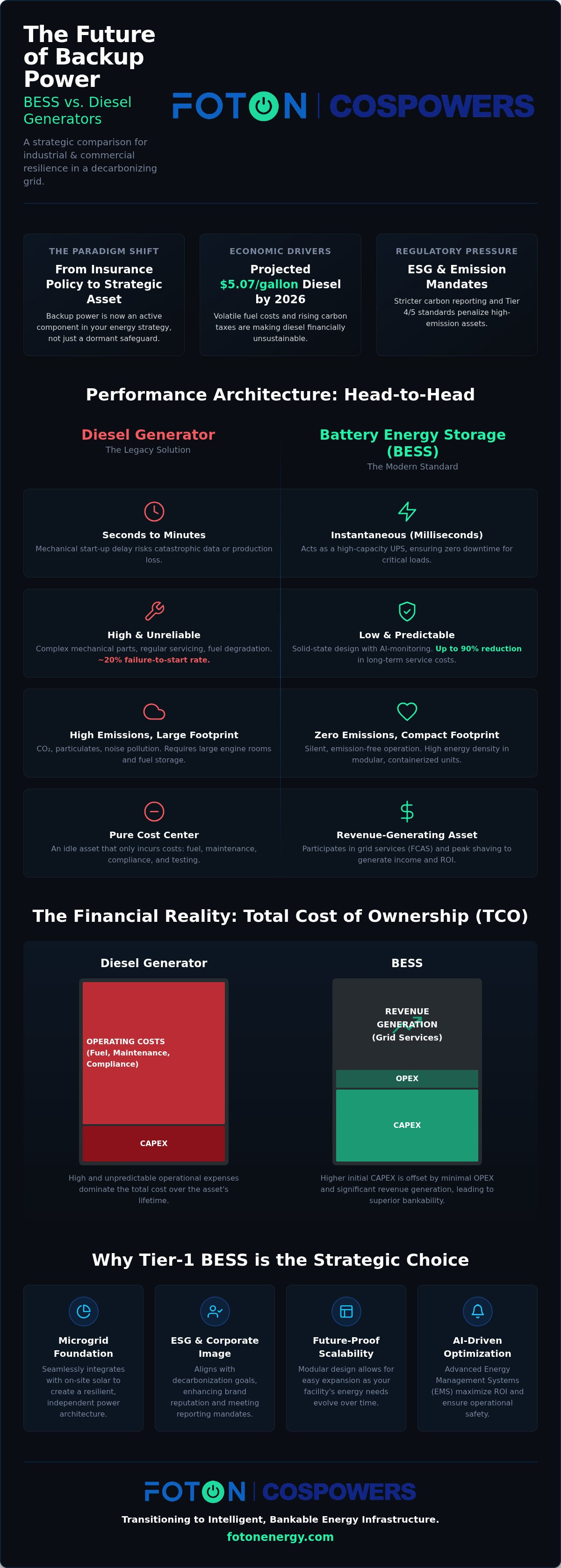
Diesel generators are mechanical. They rely on complex moving parts, precise fuel chemistry, and consistent thermal management to function effectively under stress. Industry maintenance records suggest that approximately 20% of standby generators fail to start when called upon, often due to lead-acid battery failure or fuel degradation. Beyond mechanical risk, owners face several hidden operational burdens:
- Fuel Shelf Life: Diesel requires expensive chemical stabilization and periodic "polishing" to remain viable over long periods.
- Environmental Compliance: Stricter Tier 4 and emerging California "Tier 5" standards increase the cost of exhaust after-treatment systems.
- Site Restrictions: In urban industrial zones, noise pollution regulations and strict particulate matter limits make internal combustion engines difficult to permit.
BESS as the Modern Infrastructure Standard
The transition to solid-state storage offers a performance profile that diesel cannot match. BESS provides an instantaneous response, effectively serving as a high-capacity uninterruptible power supply (UPS) that bridges the gap between grid failure and full system activation. This speed is critical for data centers and precision manufacturing where even a five-second delay causes catastrophic data loss. When analyzing battery storage vs diesel generator for backup power, the ability to integrate with on-site solar is a significant differentiator. Modern commercial and industrial BESS solutions allow facilities to maintain power indefinitely during daylight hours, creating a microgrid architecture that isn't just a backup plan, but a foundation for long-term operational resilience.
Performance Architecture: Comparing Technical Operational Dynamics
When evaluating battery storage vs diesel generator for backup power, the physical and operational footprint often dictates the final investment decision. A traditional 1 MW generator setup requires a dedicated engine room, complex ventilation, and massive fuel storage tanks that occupy significant real estate. In contrast, containerized BESS solutions offer superior energy density, packing several megawatt-hours of capacity into a standard shipping container footprint. This modularity allows for rapid deployment and scalability that internal combustion systems simply can't match.
Maintenance represents another critical divergence. Diesel engines are subject to mechanical wear, requiring oil changes, filter replacements, and regular load-bank testing every 200 to 300 hours of operation. BESS operates as a zero-emission, solid-state asset. Maintenance is primarily focused on software updates and cooling system integrity, which can reduce long-term service costs by up to 90%. AI-driven thermal management systems now play a pivotal role in operational safety. These systems use predictive algorithms to monitor individual cell temperatures in real-time, preemptively adjusting cooling cycles to prevent hotspots. This intelligent oversight ensures that the safety architecture of advanced BESS modules remains robust even under high-stress discharge scenarios.
LFP vs Sodium-ion for Backup Applications
LFP (Lithium Iron Phosphate) remains the industrial standard for high-cycle applications, offering durability and a proven safety record. However, the sodium-ion battery for data centers has emerged as the 2026 safety breakthrough. Sodium-ion chemistry is inherently more stable than lithium-based alternatives, significantly reducing the risk of thermal runaway. It also maintains superior discharge rates in cold-weather environments where LFP performance might lag. Our engineering consulting team can help you determine which chemistry aligns with your site's specific thermal profile and safety requirements.
Response Time and Power Quality
The most profound technical advantage of BESS is its response time. While a diesel generator takes several seconds to reach full load, modern inverters respond in milliseconds. This eliminates the 'gap' that traditionally required a separate UPS system. BESS provides active frequency control and voltage regulation, ensuring that sensitive electronic equipment receives high-quality power without the harmonic distortion common in older generators. With grid-forming capabilities, Tier-1 BESS architecture can stabilize a local microgrid independently of the primary utility feed, providing a level of autonomy that legacy systems cannot provide.
The Financial Reality: Total Cost of Ownership (TCO) and Bankability
Financial viability in 2026 requires looking far beyond the initial invoice. While diesel generators often present a lower upfront CAPEX, they represent a "dead asset" that depreciates while consuming capital through relentless maintenance and fuel requirements. When analyzing battery storage vs diesel generator for backup power, the Total Cost of Ownership (TCO) reveals a fundamental shift in value. BESS is a proactive financial tool. It enables aggressive demand charge reduction and peak shaving, which can significantly lower monthly utility bills by discharging stored energy during high-tariff periods. This turns a traditional cost center into a strategic asset that contributes to the bottom line every day, not just during an outage.
Bankability has become a primary concern for institutional investors and facility owners alike. Financiers look for "bankable" infrastructure backed by rigorous testing and international certifications. Utilizing Tier-1 components with a 30-plus year manufacturing heritage, such as Cospowers modules, ensures that your investment is protected by a legacy of reliability. This level of stability is critical for securing project financing and meeting the stringent ESG reporting requirements that now dominate the industrial sector.
Revenue Generation via Grid Services
BESS doesn't just sit idle waiting for a blackout. It actively participates in the energy market to generate a return on investment. By utilizing AI driven energy management systems, facilities can automate participation in Frequency Control Ancillary Services (FCAS) markets. These systems detect grid imbalances and respond in milliseconds, earning revenue for the facility. Energy arbitrage adds another layer of value. You charge the system on low-cost off-peak power or surplus on-site solar and discharge it when market prices spike. This automation ensures ROI is maximized without requiring manual intervention from your operations team.
The Hidden Costs of Diesel
Diesel's operational expenses are increasingly volatile. With the average retail price of diesel forecasted at $5.07 per gallon in 2026, the cost of long-duration outages is rising. Beyond the fuel itself, owners must manage complex logistics, including storage compliance, spill containment infrastructure, and environmental permits. Quarterly load-bank testing and engine overhaul schedules add a layer of recurring labor costs that BESS simply avoids. Insurance premiums also reflect the risk. Storing thousands of liters of flammable fuel carries a higher liability profile than a solid-state LFP system, which is reflected in the long-term cost of ownership for legacy systems.
Sector-Specific Implementation: Selecting the Right Infrastructure
Selecting the ideal architecture for your facility is a multi-stage engineering process that balances immediate resilience with long-term operational flexibility. When comparing battery storage vs diesel generator for backup power, the decision often hinges on the specific load profile and site-specific constraints of the project. A methodical implementation strategy ensures that your backup system isn't just functional, but optimized for your specific industry requirements. Our engineering consulting team can guide you through this process to ensure full grid-code compliance.
- Step 1: Load Profile Study. Conduct a comprehensive analysis of your peak demand and base load to determine the exact power and energy requirements.
- Step 2: Duration Evaluation. Evaluate whether your site requires short-duration bridge power (2-4 hours) or multi-day autonomy, which may necessitate a hybrid approach.
- Step 3: Site Assessment. Assess physical constraints including floor loading capacity, required ventilation, noise abatement needs, and available footprint.
- Step 4: Compliance Review. Determine local grid-code requirements and interconnection standards to ensure a seamless commissioning process.
Data Centres and Telecommunications
In environments where 24/7 uptime is the baseline, the latency of a diesel generator start-up is often unacceptable without a massive secondary UPS. Modern hyperscale facilities are increasingly replacing traditional VRLA batteries and diesel units with sodium-ion technology. This shift is driven by the superior fire safety profile of sodium-ion and its ability to operate across wider temperature ranges without the risk of thermal runaway. Modular BESS architecture allows these facilities to scale their backup capacity in lockstep with their server density, providing a future-proof solution that simplifies fire suppression and cooling requirements.
Utility and Large-Scale Industrial
For utility providers, the focus has shifted toward stabilizing the grid as more renewable assets come online. Strategic utility-scale BESS procurement allows operators to mitigate the intermittency of wind and solar while providing a robust backup for critical infrastructure. In remote industrial sites where fuel logistics are complex and expensive, zero-fuel BESS infrastructure eliminates the risk of supply chain disruptions. While multi-day outages may still benefit from a hybrid system that includes a minimal diesel component, the primary reliance on BESS significantly reduces the carbon footprint and operational complexity of remote energy hubs.
Strategic Procurement: Why Tier-1 BESS Architecture Wins
Strategic procurement in 2026 demands a shift from transactional purchasing to long-term partnership. When you evaluate battery storage vs diesel generator for backup power, the hardware's reliability is tied directly to the manufacturer's heritage. Foton Energy's exclusive global partnership with Cospowers provides access to over 30 years of manufacturing excellence. This heritage isn't just a historical footnote. It's a critical component of project bankability. Financiers and EPCs require the assurance that the technology provider will remain a stable pillar throughout the asset's 15 to 20-year lifespan. A proven track record reduces the perceived risk of large-scale infrastructure investments, making it easier to secure favorable financing terms.
Future-proofing your infrastructure means preparing for 2030 grid standards today. Modern backup systems must do more than respond to outages. They need to be ready for advanced grid-forming requirements and bi-directional energy flows. This complexity is why BESS engineering consulting services are indispensable. Hardware is the foundation, but engineering expertise ensures that the system is properly sized, commissioned, and integrated into the broader industrial ecosystem. It's about ensuring your backup power is an active, profitable participant in the energy market.
Safety Architecture and Certifications
Safety is the non-negotiable metric for modern energy storage. Tier-1 architecture is defined by rigorous international certifications including UL, IEC, and DNV verification. These standards ensure that every module can withstand extreme operational stress without compromising site safety. Our systems utilize multi-level fire suppression and sophisticated thermal management protocols to mitigate risk proactively. The Foton assurance extends beyond the initial sale. We provide comprehensive engineering support from the initial commissioning phase through to long-term asset management, ensuring your backup power remains a reliable, high-performance asset for the next decade.
Next Steps for Energy Developers
The transition from legacy diesel to a modern, high-performance BESS model requires a methodical approach. Whether you're looking to implement a hybrid system or move toward a pure-BESS architecture, the first step is a technical consultation. We invite you to engage with our team to explore how our Tier-1 solutions can enhance your facility's resilience and profitability. For those looking to expand their own service offerings, we also encourage you to join Foton's channel partner programme. Let's collaborate to build the resilient, zero-emission infrastructure that the 2030 grid demands.
Securing Your Industrial Energy Future
The transition from legacy combustion to solid-state storage has evolved from an environmental initiative into a core strategic move for operational excellence. When evaluating battery storage vs diesel generator for backup power, the primary advantage is the ability to transform a dormant cost center into a dynamic, revenue-generating asset. Your facility can now achieve near-instantaneous response times while simultaneously reducing demand charges and participating in high-value grid services. This shift ensures that your infrastructure is no longer just a safeguard but a foundational pillar of profitability.
Success in this transition requires a partner with a deep manufacturing heritage and specialized technical oversight. As the exclusive strategic partner of Cospowers, Foton Energy combines Tier-1 global manufacturing standards with specialized engineering consulting for C&I and utility projects. We invite you to Partner with Foton Energy for Tier-1 BESS Infrastructure to ensure your backup power is bankable, resilient, and ready for the 2030 grid. Together, we'll build a more stable and profitable energy foundation for your enterprise.
Frequently Asked Questions
Is battery storage more expensive than a diesel generator for backup power?
While the initial purchase price of a BESS is typically higher, the total cost of ownership is often lower over a ten-year period. Diesel generators are subject to volatile fuel prices, which reached a national average of $5.26 per gallon in August 2026. When comparing battery storage vs diesel generator for backup power, you must account for the 80% to 90% reduction in maintenance costs that solid-state storage provides compared to internal combustion engines.
Can battery storage provide backup for several days like a generator?
Battery storage can support multi-day outages if it's integrated with a sufficiently sized on-site solar array. Standalone systems are generally optimized for two to four-hour durations to cover the most frequent grid interruptions. For facilities requiring indefinite backup without renewable generation, a hybrid configuration is the most resilient approach. This setup uses a smaller BESS for immediate response and a generator only for extended, low-solar periods.
What is the typical lifespan of a commercial BESS compared to a diesel engine?
A Tier-1 commercial BESS using LFP chemistry typically offers an operational lifespan of 15 to 20 years, depending on the cycle depth and frequency. In contrast, a diesel generator's lifespan is measured in operating hours and requires major engine overhauls every few thousand hours. Because BESS is a solid-state technology with no moving parts in the energy storage modules, it avoids the mechanical fatigue that eventually degrades internal combustion infrastructure.
Do I need a diesel generator if I have a large-scale solar and battery system?
You don't necessarily need a generator if your solar and battery system is engineered for grid-forming capabilities. Modern Tier-1 inverters can create a stable microgrid that operates independently of the primary utility feed. However, for critical facilities in regions with low winter solar yield, keeping a small standby generator as a tertiary backup can provide an extra layer of security during rare, multi-day weather events that deplete the battery storage.
How does Sodium-ion battery safety compare to traditional diesel fuel storage?
Sodium-ion technology offers a superior safety profile because it's inherently non-flammable and operates stably across a wider temperature range. Unlike diesel fuel, which requires complex spill containment systems, fire-rated storage tanks, and strict environmental permits, sodium-ion modules don't pose a significant leakage or soil contamination risk. This makes them an ideal choice for data centers and telecommunications hubs where fire safety and environmental compliance are top priorities for facility managers.
What are the maintenance requirements for an industrial BESS?
Industrial BESS maintenance is significantly less intensive than the requirements for internal combustion engines. You won't need oil changes, fuel polishing, or quarterly load-bank testing. The primary tasks involve periodic software updates for the AI-driven EMS and routine inspections of the HVAC or liquid cooling systems. This solid-state architecture eliminates the mechanical failure points that cause approximately 20% of standby generators to fail during a real-world power outage.
Can I use my backup battery to make money when the grid is stable?
Yes, this is the primary financial advantage of choosing battery storage vs diesel generator for backup power. While a generator is a "dead asset" that only provides value during an outage, a BESS generates daily ROI. You can use it for peak shaving to reduce demand charges or participate in grid services like Frequency Control Ancillary Services (FCAS). These revenue streams often lead to a full project payback within four to seven years.
Is BESS loud enough to require urban planning permits like a generator?
No, BESS units are considerably quieter and don't produce the localized exhaust emissions associated with diesel engines. The only noise comes from the integrated cooling fans, which generally operate at decibel levels comparable to a standard commercial HVAC unit. This makes BESS much easier to permit in dense urban industrial zones or near residential areas where strict noise ordinances and air quality regulations often prohibit the installation of large-scale generators.


