

LFP chemistry commanded approximately 90% of new utility-scale battery storage installations in 2025, signaling a permanent shift in how the world powers its infrastructure. You likely recognize that securing wholesale lfp battery modules for 2026 projects is no longer a simple transactional purchase. It's a high-stakes strategic decision where supply chain volatility and the risk of non-bankable hardware can derail even the most ambitious energy targets.
We understand that your goal is to secure long-term pricing while mitigating thermal runaway risks and hardware integration gaps. This guide offers a comprehensive framework to master high-capacity procurement by focusing on Tier-1 manufacturing heritage and AI-driven optimization. You'll learn how to evaluate the technical architecture necessary to ensure 6000+ cycle life reliability and seamless grid compliance. Let's explore how to build a resilient energy ecosystem that transforms industrial storage from a capital expense into a bankable, high-performance asset.
Key Takeaways
- Understand why LFP remains the definitive chemistry for utility-scale and C&I storage projects in 2026, offering unmatched thermal stability and cost efficiency.
- Learn to evaluate the technical architecture of wholesale lfp battery modules, focusing on the critical integration between cell geometry and intelligent Battery Management Systems.
- Discover how to verify Tier-1 bankability by leveraging manufacturing heritage and global supply chain resilience to secure project financing.
- Master a structured procurement framework that moves seamlessly from technical feasibility and grid-code analysis to final commissioning.
- Explore the synergy between high-capacity hardware and AI-driven EMS to optimize cycle life and maximize the long-term ROI of your energy assets.
The Evolution of Wholesale LFP: Beyond Commodity Hardware in 2026
The global energy transition has reached a critical maturity point where the procurement of storage assets is no longer a simple transactional exchange. Wholesale lfp battery modules are modular, scalable building blocks for high-capacity BESS deployments. In 2026, the industry has moved decisively past viewing these components as mere commodities, shifting instead toward a model defined by "Energy-as-a-Service" support and long-term asset performance. This evolution demands that EPC partners and developers look beyond the price per kilowatt-hour to evaluate the entire engineering ecosystem surrounding the hardware.
LFP chemistry represented approximately 90% of new utility-scale battery storage installations in 2025, and its dominance continues to expand. This market share is driven by a fundamental requirement for systems that can withstand the rigors of grid stabilization while maintaining absolute safety. As global EV battery deployment approaches 3 TWh by 2030, the established supply chains for LFP battery technology provide the necessary scale to support massive industrial infrastructure projects without the geopolitical volatility associated with alternative chemistries.
Why LFP Dominates the 2026 Energy Landscape
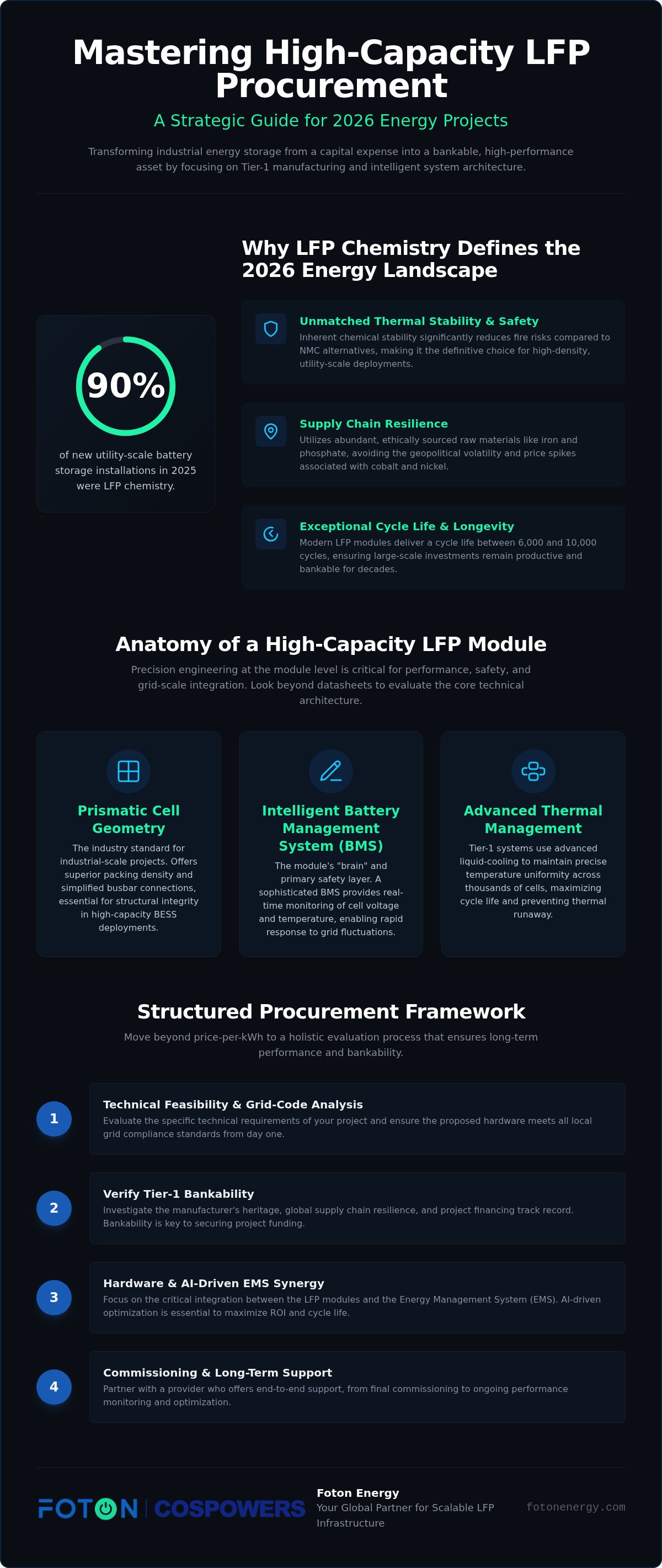
Safety is the foundational pillar of the 2026 energy landscape. The inherent thermal stability of lithium iron phosphate reduces fire risks significantly compared to high-density NMC alternatives, making it the preferred choice for high-density deployments. Beyond safety, the economic longevity of these systems is unparalleled. Modern wholesale lfp battery modules now offer a cycle life reaching between 6,000 and 10,000 cycles, ensuring that large-scale investments remain productive for decades. This durability is coupled with the abundance of raw materials like iron and phosphate, which secures the supply chain against the price spikes often seen in cobalt and nickel markets.
The Role of the Strategic Partner in Wholesale Sourcing
Procurement success in the current market requires moving beyond the traditional middleman toward an engineering-led distribution model. Foton Energy (Foton Pty Ltd) serves as the strategic link, leveraging deep industry expertise to connect developers with established Tier-1 manufacturing and address the complex requirements of local project execution. We bridge the gap by providing more than just hardware; we deliver end-to-end support that encompasses initial design, AI-driven optimization, and strict grid-code compliance. This collaborative approach ensures that the hardware is not only bankable but also perfectly integrated with intelligent software for maximum grid optimization. Partnering with a foundational pillar of the industry allows developers to navigate technical architecture and international certifications with total confidence. For those seeking specialized high-end solar hardware outside of utility-scale bulk orders, macsell.store provides access to premium equipment.
Technical Architecture of High-Capacity LFP Modules
High-performance energy storage relies on precision engineering at the module level. Wholesale lfp battery modules in 2026 are defined by their internal architecture, where the choice between prismatic and cylindrical cell integration dictates the system's thermal behavior and physical footprint. While smaller applications often utilize cylindrical cells for their manufacturing consistency, industrial-scale projects have shifted decisively toward prismatic cells. These cells offer superior packing density and simplified busbar connections, which are essential for maintaining structural integrity in high-capacity deployments.
The intelligence of the module resides in its Battery Management System (BMS). A sophisticated, module-level BMS acts as the primary safety layer, monitoring individual cell voltages and temperatures in real-time to ensure the entire string operates within its optimal window. This granular level of control is what allows for the seamless integration of hardware with grid-scale software. When evaluating commercial and industrial BESS solutions, technical partners must prioritize modules that feature high-speed data sampling and robust communication protocols. This technical foundation ensures that the hardware can respond to grid fluctuations in milliseconds without compromising the safety of the asset.
Thermal Management and Safety Architecture
Modern thermal management has evolved from passive air cooling to advanced liquid-cooled systems that maintain temperature uniformity across thousands of cells. Tier-1 thermal management systems utilize advanced insulation and active cooling to isolate individual cells, effectively preventing cell-to-cell thermal propagation during an event. This architecture is typically paired with module-level fire suppression and aerosol-based extinguishers. By maintaining a consistent internal temperature, these systems prevent the localized "hot spots" that traditionally lead to accelerated degradation, ensuring the module meets the stringent UL and IEC safety standards required for project bankability.
Cycle Life and Degradation Factors
Securing long-term ROI for utility-scale projects requires a deep understanding of cycle life and degradation. High-quality wholesale lfp battery modules are engineered to handle 1C or higher discharge rates without significant capacity fade, provided the architecture maintains thermal equilibrium. Developers can further optimize performance by managing the Depth of Discharge (DoD); limiting discharge to 80% or 90% can push the effective cycle life toward the 10,000-cycle threshold. This strategic focus on technical architecture directly reduces field maintenance costs and ensures the system remains a productive asset for over two decades. To ensure your next project utilizes these advanced architectural standards, we recommend reviewing our comprehensive guide to bankable energy storage.
Evaluating Tier-1 Bankability and Supply Chain Resilience
In the 2026 energy market, "bankability" has evolved from a financial buzzword into a rigorous technical requirement. For EPCs and energy developers, it represents the assurance that a project’s hardware will perform as modeled for its entire 20-year lifespan. Financiers now demand deep-dive audits into manufacturing history and third-party performance data before approving capital for large-scale storage. Securing wholesale lfp battery modules from a vendor with a proven track record isn't just about quality; it's about ensuring the project is eligible for low-interest debt and long-term insurance coverage.
Technical transparency is the cornerstone of this process. We provide global partners with a clear view into the manufacturing process, ensuring that every component meets the highest international standards. This includes rigorous adherence to UL 9540A for thermal runaway testing, IEC 62619 for industrial safety, and UN38.3 for transport compliance. By grounding procurement in these certifications, we eliminate the ambiguity that often stalls project financing in the due diligence phase.
The Cospowers & Foton Strategic Partnership
Reliability is built over decades, not quarters. Cospowers brings a 30-year manufacturing heritage to the table, having operated as a foundational pillar in the battery industry since 1993. Through an exclusive global strategic partnership, Foton leverages this Tier-1 manufacturing scale to offer competitive pricing without sacrificing the "bankable" assurance that financiers require. We act as the critical link, providing local engineering support and technical consulting that bridges the gap between massive manufacturing output and specific project execution needs.
Supply Chain Risk Mitigation for Large Projects
Supply chain volatility remains a significant pain point for 2026 developments. To counter this, Foton implements a sophisticated inventory management strategy that supports "just-in-time" delivery for utility-scale sites. This approach mitigates the "solar/battery cowboy" risk by ensuring that wholesale lfp battery modules come from a verified, stable supply chain rather than opportunistic resellers. Our process ensures that hardware arrives on-site exactly when needed, reducing storage costs and preventing project delays.
By integrating these safety standards and logistical efficiencies into a cohesive utility scale BESS procurement strategy, we provide the resilience needed to protect large-scale infrastructure investments. This engineering-led approach ensures that your assets are not only compliant with 2026 regulations but are also optimized for long-term grid participation and revenue generation.
Strategic Procurement Framework: From Feasibility to Commissioning
Execution of large-scale energy storage projects requires a methodical transition from financial modeling to operational reality. Unlike retail transactions, the acquisition of wholesale lfp battery modules involves a multi-phase framework designed to mitigate technical risk and ensure long-term asset performance. This journey begins with rigorous engineering validation and concludes with a grid-compliant commissioning process that secures the project's revenue potential. By following a structured procurement path, developers can avoid the integration bottlenecks that frequently delay industrial deployments.
Engineering Consulting: The Foundation of Wholesale Success
Project feasibility studies are non-negotiable for financiers who require proof of technical viability before releasing capital. During Phase 1, engineering teams analyze specific load profiles and environmental conditions to customize module configurations. This step ensures that the selected hardware isn't just a generic component but a precision-engineered solution for the site's unique demands. Leveraging BESS engineering consulting services allows developers to bridge the gap between Tier-1 manufacturing and local site requirements, ensuring that every rack is optimized for its intended duty cycle.
Once feasibility is confirmed, Phase 2 focuses on sourcing Tier-1 hardware through verified channels. Sourcing wholesale lfp battery modules through a strategic partner like Foton provides the technical documentation and supply chain transparency needed to satisfy institutional investors. This engineering-first approach prevents the "hardware-first" trap, where components are purchased before their compatibility with Power Conversion Systems (PCS) is fully verified.
Grid Code Compliance and Regulatory Navigation
Integration and commissioning represent the final hurdles in the procurement framework. Phase 3 involves the seamless alignment of hardware with intelligent Energy Management Systems (EMS) and Power Conversion Systems. In 2026, grid stability standards have become increasingly stringent, requiring hardware that can provide rapid frequency response and voltage support. A strategic distributor acts as more than a supplier; they provide the essential technical documentation for permits and ensure the hardware meets regional grid-code requirements from the outset.
Phase 4 centers on commissioning and long-term performance monitoring. By utilizing pre-integrated hardware and software solutions, EPCs can significantly streamline the on-site testing process. This reduces the time between physical installation and commercial operation, allowing the asset to begin generating ROI immediately. To begin your technical feasibility analysis and secure high-capacity hardware for your next project, contact our engineering team today for a comprehensive consultation.
Foton Energy: Your Global Partner for Scalable LFP Infrastructure
Foton Energy represents the strategic convergence of manufacturing heritage and digital intelligence. While many providers treat wholesale lfp battery modules as simple commodity hardware, we view them as the foundation of a sophisticated energy ecosystem. Our exclusive global partnership with Cospowers allows us to deliver Tier-1 hardware backed by three decades of manufacturing excellence. This stability is enhanced by our proprietary AI-driven Energy Management System (EMS), which bridges the gap between raw hardware performance and long-term grid optimization. We act as a foundational pillar for your projects, ensuring that every deployment is both technologically advanced and commercially stable.
AI-Driven Optimization for Wholesale Deployments
Predictive maintenance is no longer a luxury for utility-scale BESS; it's a financial necessity. Our AI driven energy management system provides real-time monitoring that identifies potential cell-level imbalances before they impact system uptime. This intelligent software layer actively manages charge and discharge cycles to mitigate degradation, effectively extending the cycle life of our LFP modules. By optimizing grid participation based on real-time market signals, our EMS ensures that your assets deliver maximum value while minimizing operational and maintenance costs. The result is a high-performance system that remains stable under the most demanding grid conditions.
Next Steps for EPCs and Energy Developers
Building a resilient energy future requires more than just high-capacity hardware. It requires a partner with a global marketing network that spans over 70 countries and understands the nuances of local grid-code compliance and regional safety standards. We invite EPCs and resellers to join the Foton Channel Partner Programme. This collaborative platform is designed to provide the technical support, priority inventory access, and supply chain transparency needed for large-scale project success. We work alongside you to ensure your infrastructure investments are protected by rigorous testing and international certifications.
Requesting a wholesale technical consultation is the first step toward securing your 2026 project pipeline. Whether you are developing a C&I storage project or a massive utility-scale site, our engineering team is ready to assist in customizing your wholesale lfp battery modules to meet specific load profiles. We provide the end-to-end consulting and bankable hardware needed to transform visionary energy goals into operational infrastructure. Partner with Foton to gain a steady, guiding hand in the complex world of high-capacity storage. Let's work together to build a smarter, more resilient grid that stands the test of time.
Securing the Future of Grid-Scale Energy Infrastructure
Successful energy storage deployments in 2026 require a transition from simple purchasing to strategic engineering alignment. You've seen how technical architecture and Tier-1 bankability form the bedrock of a reliable project. By integrating high-capacity hardware with intelligent software, you ensure your infrastructure remains grid-compliant and profitable for decades. This shift from viewing hardware as a commodity to seeing it as part of a bankable ecosystem is what defines the most successful utility-scale developments.
Choosing the right wholesale lfp battery modules is only the first step. True resilience comes from a partner who offers extensive manufacturing heritage and end-to-end engineering support. Foton stands as the exclusive global partner of Cospowers, bringing a Tier-1 manufacturing legacy since 1993 to every project. With engineering support active in over 70 countries, we provide the stability and expertise needed for large-scale infrastructure investments. It's time to move beyond simple procurement and build for long-term reliability.
Partner with Foton Energy for Your Next Utility-Scale BESS Project. We're ready to help you navigate the complexities of high-capacity storage and secure a cleaner, more resilient energy future.
Frequently Asked Questions
What defines a Tier-1 LFP battery module for wholesale procurement?
A Tier-1 module is defined by its manufacturing heritage, bankability, and rigorous safety certifications. Cospowers, with its 30-year history, exemplifies this through vertically integrated production and high-volume capacity. For those sourcing wholesale lfp battery modules, Tier-1 status ensures the hardware is recognized by global financiers. This reduces project risk and facilitates smoother debt financing for large-scale energy infrastructure through proven operational excellence.
How do LFP modules compare to Sodium-ion for industrial storage in 2026?
LFP remains the dominant choice for high-density energy applications due to its proven cycle life and established supply chains. Sodium-ion is emerging as a viable alternative for specific use cases like telco backup or extreme temperature environments where raw material abundance is prioritized over energy density. Foton provides both Tier-1 LFP and Sodium-ion solutions. This allows developers to choose the chemistry that best aligns with their project's technical goals.
Can Foton provide engineering support for grid-code compliance in Australia?
Yes, Foton is an Australian-based company that offers specialized engineering consulting for local grid-code requirements. Our team assists with the complex technical documentation needed for AEMO compliance and regional network approvals. We ensure that your wholesale lfp battery modules are configured to meet strict Australian standards for frequency response and voltage support. This localized expertise streamlines the path from initial design to final utility-scale commissioning.
What is the typical cycle life of a wholesale Cospowers LFP module?
Cospowers LFP modules are engineered to provide a robust cycle life typically ranging from 6,000 to 10,000 cycles. This longevity depends on operational factors such as depth of discharge and thermal management. By utilizing Foton's AI-driven EMS, developers can actively monitor cell health and optimize discharge rates to maximize the lifespan of their assets. This ensures the hardware remains a high-performance pillar of your energy infrastructure for over two decades.
How does Foton’s EMS integrate with wholesale hardware for peak shaving?
Foton’s intelligent EMS uses AI algorithms to analyze load patterns and forecast energy demand in real-time. The software communicates directly with the module-level BMS to trigger discharge during peak pricing periods. This seamless integration allows C&I and utility-scale operators to reduce demand charges and improve ROI through automated peak shaving. By optimizing how hardware interacts with the grid, we transform static battery modules into dynamic, revenue-generating assets.
What certifications are required for utility-scale battery modules in 2026?
Utility-scale modules must adhere to a stringent set of international safety and performance standards. Key certifications include UL 9540A for thermal runaway testing, IEC 62619 for industrial safety, and UN38.3 for transport compliance. These standards are essential for project bankability and insurance eligibility. Foton ensures that all Cospowers hardware meets or exceeds these 2026 requirements. This provides developers with the documented proof needed for institutional financing and regulatory approval.
How does Foton manage global logistics for large-scale LFP shipments?
Foton leverages a global marketing network spanning over 70 countries to coordinate complex logistics for large-scale infrastructure. We manage the entire supply chain from manufacturing facilities to the final project site. Our team ensures compliance with international shipping regulations, including the 30% state-of-charge requirement for air transport. This end-to-end oversight reduces lead times and prevents the logistical bottlenecks that can often delay utility-scale commissioning and project activation.
Is there a minimum order quantity for wholesale LFP procurement?
Minimum order quantities are structured to align with the requirements of commercial, industrial, and utility-scale projects. While we focus on high-capacity infrastructure, we work closely with EPC partners and resellers to accommodate various project scales through our channel partner programme. Foton provides tailored technical consultations to determine the most efficient procurement path for your specific deployment. This collaborative approach ensures that every project receives the necessary Tier-1 hardware support.


