

A battery container in 2026 is no longer just a hardware purchase. It's a sophisticated infrastructure asset where bankability depends on AI-orchestration and rigorous safety standards. You've likely seen the industry shift as 20-foot units now reach densities of 6.9 MWh, yet this leap in performance brings intense scrutiny regarding fire safety and grid-code alignment. It's understandable to feel the pressure of navigating the sixth edition of UL 9540A while weighing the long-term viability of LFP against emerging Sodium-ion alternatives for specialized applications.
This strategic guide empowers you to master the technical, financial, and operational requirements for deploying bankable containerized bess solutions at scale. We'll provide a clear procurement framework that validates Tier-1 manufacturing standards and leverages AI-driven EMS for real-time optimization. Let's explore how to de-risk your utility-scale investments by aligning with the latest NFPA 855 hazard mitigation mandates. By the end of this analysis, you'll possess the roadmap needed to secure a resilient, future-ready energy footprint that meets the stringent commercial and technical demands of the 2026 global market.
Key Takeaways
- Understand the transition from bespoke onsite builds to modular, factory-tested energy infrastructure that ensures rapid deployment and operational reliability.
- Evaluate the 2026 battery landscape to determine whether LFP or Sodium-ion chemistries provide the optimal balance of energy density and thermal safety for your project.
- Master the technical and manufacturing criteria that define bankable containerized bess solutions, ensuring your assets meet the rigorous requirements of global financiers.
- Navigate the complexities of grid-code compliance through a structured deployment framework that prioritizes comprehensive feasibility studies and site precision.
- Discover how the synergy between Tier-1 manufacturing heritage and AI-driven EMS can optimize long-term asset performance and de-risk utility-scale investments.
Why Containerized BESS is the Standard for Utility and C&I Scale
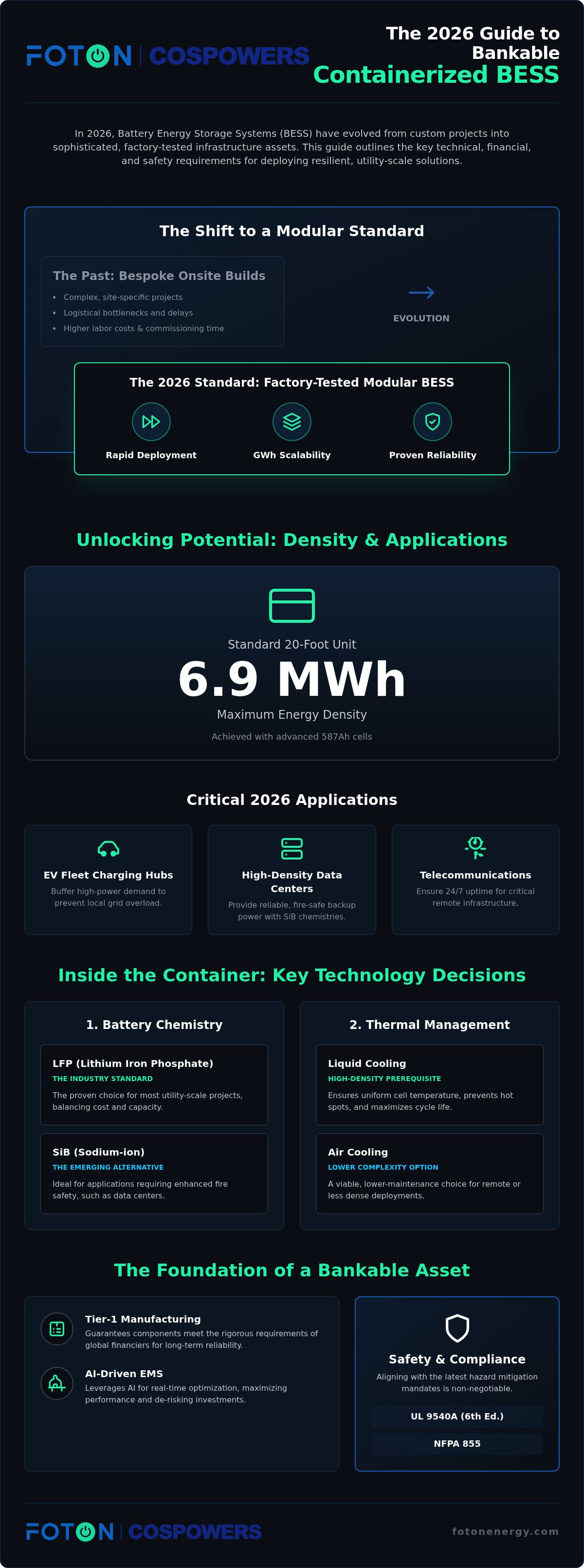
Standardization is the bedrock of modern grid resilience. Containerized BESS solutions represent the evolution of the battery energy storage system (BESS) from complex, site-specific construction projects into streamlined, factory-tested industrial products. We've moved beyond the era of bespoke onsite assembly. By consolidating inverters, thermal management, and fire suppression into a single ISO-certified enclosure, developers can bypass the logistical bottlenecks of traditional builds. This shift is driven by the reality of 2026: grid congestion is rising, renewable intermittency is a constant, and demand charge management is now a primary financial lever for heavy industry. Standardized 20ft and 40ft form factors dominate the global supply chain because they offer predictable lead times and simplified shipping logistics, ensuring that infrastructure can keep pace with rapid energy transitions.
The Rise of Modular Energy Storage Architecture
Scalability is no longer a hurdle; it's a design feature. Modern modular energy storage architecture allows engineers to move from MWh to GWh through parallel container deployment with clinical precision. It's a plug-and-play integration model that significantly reduces onsite commissioning time and labor costs. In 2026, a standard 20-foot container can reach densities up to 6.9 MWh using advanced 587Ah cells. This high-density approach facilitates rapid project rollout, allowing developers to activate assets faster and begin generating revenue or reducing operational expenses without the delays typical of custom electrical rooms. Foton leverages this modularity to ensure that every deployment is both scalable and strategically aligned with long-term capacity requirements.
Critical Applications in 2026: Beyond Grid Support
The utility of these systems has expanded far beyond simple frequency regulation. Utility-scale front-of-the-meter (FTM) storage is now essential for firming wind and solar farms, while heavy industrial behind-the-meter (BTM) applications prioritize aggressive demand charge reduction. We see emerging roles in several high-impact sectors:
- EV Fleet Charging Hubs: Buffering high-power charging demand to prevent local grid overloads.
- High-Density Data Centers: Using Sodium-ion (SiB) chemistries for reliable, fire-safe backup power where LFP constraints may exist.
- Telecommunications: Ensuring 24/7 uptime for critical infrastructure in remote or unstable grid environments.
Strategic procurement of containerized bess solutions ensures that every project, whether it's a massive utility array or a sensitive data center, benefits from Tier-1 manufacturing standards. We invite you to align your infrastructure with a partner like Foton, who delivers manufacturing excellence and strategic solutions tailored to your specific operational goals.
Engineering the Interior: Chemistry Options and Thermal Management
The interior architecture of containerized bess solutions has reached a critical technological inflection point in 2026. Choosing the right electrochemical foundation is no longer a binary decision between cost and capacity. It's a strategic calculation involving safety margins, thermal resilience, and site-specific environmental factors. While Lithium Iron Phosphate (LFP) maintains its role as the industry standard, Sodium-ion (SiB) alternatives have moved from pilot phases to commercial deployment. Foton facilitates this transition by providing chemistry-agnostic container designs that integrate Cospowers’ Tier-1 modules into a unified safety and control framework.
Thermal management is the silent partner in battery performance. As energy densities in 20-foot containers push toward 6.9 MWh, the choice between liquid and air cooling becomes decisive. Liquid cooling is now the prerequisite for high-density assets. It provides a more uniform temperature distribution across cells, which is vital for preventing local hot spots and maximizing cycle life. For remote deployments where maintenance access is limited, air cooling remains a viable, lower-complexity option, but for urban utility-scale projects, the precision of liquid-based systems is essential for bankability and long-term asset health.
LFP Containers: The Workhorse of Utility-Scale Projects
LFP remains the preferred chemistry for large-scale energy shifting. The extended LFP battery cycle life for utility projects makes it the most cost-efficient choice for long-duration energy storage (LDES). These systems utilize a multi-level Battery Management System (BMS) that monitors cell-level health in real time. Combined with integrated aerosol or gas fire suppression systems, LFP containers meet the stringent requirements of the 2026 NFPA 855 standards, providing a secure foundation for infrastructure investments.
Sodium-Ion Containers: The 2026 Strategic Alternative
The landscape is shifting as sodium-ion battery commercial availability disrupts sectors with specific environmental or supply chain constraints. SiB technology offers significant performance advantages in extreme temperatures, maintaining discharge rates in cold climates where lithium-based systems might struggle. Because Sodium-ion relies on abundant raw materials, it reduces exposure to the price volatility of lithium and cobalt. This makes it an attractive option for data center backup and telecommunications infrastructure. You can consult with our engineering team to determine if a Sodium-ion configuration offers the resilience your specific application requires.
Defining Bankability: Tier-1 Manufacturing and Safety Standards
Bankability is the ultimate filter for large-scale infrastructure. In 2026, financiers and insurers don't just look at energy density; they scrutinize the entire lifecycle risk profile of containerized bess solutions. A system is bankable when its technical performance is backed by a manufacturer with the financial stability and heritage to honor long-term warranties. This is why Cospowers' 30-year manufacturing track record is a critical asset. It provides the "bankable" assurance that a project will remain operational and insurable for its intended 15 to 20-year lifespan. Without this heritage, even the most advanced specifications struggle to secure competitive financing rates.
Verification must move beyond the module level. While cell-level data is foundational, the 2026 edition of NFPA 855 and the sixth edition of UL 9540A mandate system-level fire testing. Investors now require DNV verification or similar third-party audits to confirm that the integrated container behaves safely under extreme stress. We prioritize these global standards because they represent the intersection of engineering excellence and financial security. Complying with IEC 62933 isn't just a regulatory checkbox; it's a strategic move to de-risk the asset for all stakeholders involved in the capital stack.
Tier-1 Certification and Quality Assurance
Independent Engineering (IE) reports serve as the bridge between technical specs and financial approval. These reports provide a neutral validation of performance claims, which is essential for securing non-recourse project debt. At Foton, we ensure that our commercial and industrial BESS solutions undergo rigorous Factory Acceptance Testing (FAT) before they ever leave the Cospowers facility. This is followed by exhaustive Site Acceptance Testing (SAT) to verify that the containerized bess solutions integrate perfectly with local grid requirements, ensuring the project is "revenue-ready" from day one.
Advanced Safety Architecture and Fire Suppression
Safety is engineered into the very structure of the enclosure. We employ a multi-layered thermal runaway mitigation strategy that begins at the cell level and extends to active container-wide suppression. Key safety features include:
- Explosion Venting: Structural panels designed to release pressure safely in the unlikely event of gas buildup.
- Proprietary Fire Suppression: Systems that utilize aerosol or gas-based agents, triggering automatically upon detection of specific off-gas signatures.
- Structural Integrity: High-density deployments require reinforced frames that maintain their shape under thermal stress, protecting adjacent units in a parallel array.
By integrating this proprietary safety architecture into existing energy networks, we provide a steady, guiding hand for investors who prioritize resilience. It's about building a foundation of trust that supports your long-term infrastructure goals through proven, operational excellence.
Deployment Strategy: From Feasibility to Grid Code Compliance
Successful execution of containerized bess solutions requires a methodical progression from conceptual modeling to energized operation. It isn't a simple "plug-and-play" exercise. It's a rigorous engineering journey that demands precision at every stage. We begin with a BESS project feasibility study to validate economic assumptions and technical constraints. This phase ensures the project is grounded in reality before capital is committed. Once the project is greenlit, site selection and civil works focus on foundation stability, grounding, and maintaining strict safety clearances. Grid interconnection modeling, specifically PSS/E and PSCAD simulations, then ensures compliance with utility standards. The final step is the configuration of the AI-driven EMS for optimized revenue stacking.
Achieving Renewable Energy Grid Code Compliance
Achieving compliance in 2026 demands more than basic connectivity. Modern containerized bess solutions must offer sophisticated Frequency Control and Voltage Support to stabilize the local network. Depending on the grid's location, you may need grid-forming inverters to provide synthetic inertia and black-start capabilities. These systems differ from traditional grid-following inverters by actively supporting the grid's voltage and frequency during disturbances. Our engineering consulting services help you navigate these complex requirements, ensuring your system meets every local mandate without unforeseen hardware upgrades or delays during the utility approval phase.
AI-Driven Energy Management Systems (EMS)
Maximizing returns depends on the intelligence of your control layer. An AI driven energy management system enables real-time market participation across multiple revenue streams that manual controls simply cannot match. Whether you're targeting arbitrage, peak shaving, or Frequency Control Ancillary Services (FCAS), the AI optimizes the discharge schedule to protect the battery's State of Health (SOH). Predictive maintenance further de-risks the investment by identifying cell degradation patterns early. This level of technical oversight is essential for long-term asset management and ensuring the system performs as promised over its 20-year lifespan.
Strategic deployment is the key to unlocking your project's full potential. Consult with Foton's engineering experts to start your feasibility analysis and secure your path to grid-code compliance.
Scaling with Foton: Global Procurement and Engineering Support
Scaling a project from a single site to a global portfolio requires more than just hardware. It demands a strategic partner. Foton serves as the critical link between Tier-1 manufacturing and global project execution. As the exclusive strategic partner for Cospowers, we provide a direct channel to high-performance energy infrastructure that is both technologically advanced and commercially stable. Our role extends far beyond distribution. We act as a steady, guiding hand for resellers, EPCs, and energy developers who need to scale containerized bess solutions across diverse regulatory landscapes. With a support network spanning 70+ countries in 2026, we ensure that Tier-1 hardware is backed by local expertise and a resilient supply chain.
Wholesale Hardware Procurement and Supply Chain
Securing high-capacity LFP and Sodium-ion modules requires a partner who can manage the inherent volatility of the global energy market. Foton provides direct access to Cospowers’ 30-year manufacturing heritage, ensuring that every component meets the highest standards of durability and efficiency. By leveraging our strategic distribution channels, you can mitigate supply chain risks and secure predictable lead times for your utility-scale or C&I projects. This bankable assurance is vital for maintaining project momentum and satisfying the rigorous requirements of institutional financiers. We prioritize transparency and reliability, ensuring your procurement strategy is aligned with long-term value.
Technical Consulting and Lifecycle Services
Operational excellence doesn't end at the factory gate. It begins with professional engineering services that cover everything from initial system design to final commissioning. Foton’s consulting team de-risks your deployment by ensuring that every containerized bess solutions configuration is optimized for its specific environment and grid-code requirements. We provide comprehensive lifecycle support, including long-term Operations and Maintenance (O&M) strategies that prioritize asset longevity and performance stability. Our goal is to ensure your infrastructure remains a high-performing asset for its entire operational life.
Our collaborative approach invites you to participate in a shared vision of a cleaner, more resilient energy future. Whether you're an EPC managing a complex grid-scale installation or a developer looking to expand your portfolio, we offer the technical architecture and global reach to support your growth. We provide the stability of a foundational industry pillar, allowing you to focus on execution while we manage the complexities of hardware integration and strategic procurement. It's time to build with confidence.
Contact Foton Energy to discuss your containerized BESS requirements.
Securing the Future of Global Energy Infrastructure
The transition to a resilient, modular grid is no longer a future prospect; it's a present necessity. We've explored how true bankability is forged through the intersection of Tier-1 manufacturing heritage and rigorous, system-level safety certifications. Deploying containerized bess solutions at scale requires a strategic alignment between hardware excellence and AI-driven operational intelligence. Success in 2026 hinges on navigating complex grid codes and selecting the optimal chemistry, whether you prioritize LFP for long-duration shifting or Sodium-ion for specialized industrial backup.
As the exclusive global partner of Cospowers, Foton bridges the gap between 30 years of manufacturing expertise and project execution across 70+ countries. Our DNV and UL verified safety architectures, combined with strategic engineering support, ensure your investment remains protected and high-performing. Partner with Foton Energy for Tier-1 BESS Solutions to de-risk your utility or C&I deployment. Together, we can build a stable foundation for the next generation of energy infrastructure.
Frequently Asked Questions
What is the typical lifespan of a containerized BESS in 2026?
Most industrial systems are designed for an operational life of 15 to 20 years. This duration depends heavily on the daily cycling profile and the effectiveness of the integrated thermal management system. LFP cells in these configurations often achieve between 6,000 and 10,000 cycles before reaching 80% of their original capacity. Foton's partnership with Cospowers ensures that every module is built for this long-term stability, supported by three decades of manufacturing heritage.
How do Sodium-ion containerized solutions compare to LFP in cost?
Sodium-ion systems generally offer a more stable bill-of-materials cost due to the abundance of sodium compared to lithium. While LFP remains the volume leader for utility-scale shifting, Sodium-ion technology is closing the gap in sectors like telco and data center backup. Because sodium-ion doesn't rely on expensive cobalt or lithium, it provides a hedge against commodity market volatility, though the specific financial profile depends on the project's scale and discharge requirements.
Are containerized BESS units suitable for extreme weather conditions?
Modern containerized bess solutions are engineered with NEMA 3R or IP55 rated enclosures to withstand harsh environments. These units feature advanced liquid cooling or specialized HVAC systems that maintain optimal cell temperatures in desert heat or arctic cold. To ensure these systems function without interruption, remote monitoring from inTouch R&B provides critical alerts for thermal management hardware. For coastal deployments, high-grade anti-corrosion coatings are applied to the ISO containers. This ruggedized design ensures operational continuity regardless of external ambient conditions or the geographical location of your infrastructure.
Tier-1 systems utilize multi-layered safety architectures that include early-warning smoke and gas detection. Standard suppression usually involves aerosol or clean-agent gas systems designed to extinguish fires without damaging sensitive electrical components. These systems are integrated with the BMS to trigger automatic isolation of affected modules. Compliance with UL 9540A and NFPA 855 ensures that these safety protocols are verified through rigorous, large-scale fire and explosion testing.
Can containerized BESS be used for both FTM and BTM applications?
Containerized systems are highly versatile and serve both front-of-the-meter (FTM) and behind-the-meter (BTM) sectors. FTM applications typically focus on grid-scale solar firming and frequency regulation services. BTM installations are used by heavy industrial facilities for demand charge reduction and peak shaving. The modular nature of these containers allows developers to scale capacity for massive utility arrays or compact industrial yards, providing a flexible solution for diverse energy requirements.
How long does the onsite installation of a modular BESS container take?
Onsite installation for a modular unit typically takes between two to four weeks, provided the civil works and foundations are completed in advance. Because these systems are factory-assembled and pre-tested, the onsite workload is limited to positioning the containers, completing electrical interconnects, and final commissioning. This "plug-and-play" approach significantly reduces labor costs and site disruption compared to traditional builds, allowing for rapid project energization and revenue generation.
What certifications are required for a BESS project to be considered bankable?
A bankable project requires a suite of international certifications including UL 9540, IEC 62933, and UN 38.3 for transport. Financiers also prioritize projects backed by the sixth edition of UL 9540A fire test reports and DNV verification. Beyond hardware, the manufacturer's Tier-1 status and a proven track record, such as the 30-year heritage of Cospowers, are vital. These credentials provide the insurance and financial security necessary to secure competitive lending rates.
How does an AI-driven EMS improve the ROI of a containerized BESS?
An AI-driven EMS maximizes ROI by enabling complex revenue stacking that manual systems cannot achieve. It orchestrates real-time participation in arbitrage, peak shaving, and frequency control markets simultaneously. By using predictive algorithms, the software optimizes charging cycles to minimize cell degradation, effectively extending the productive life of the containerized bess solutions. This intelligent oversight ensures the system captures the highest market value while protecting the long-term health of the battery modules.


