

A fire suppression canister is no longer a safety strategy; it's a liability. As global energy markets transition toward massive scale, the definition of protection has shifted from reactive containment to proactive, holistic architecture. You understand that the stakes for Commercial and Industrial projects have never been higher. With the 2026 release of NFPA 855 and the 6th Edition of UL 9540A, meeting C&I BESS fire safety standards is no longer just about compliance. It's about protecting your brand reputation and securing the long-term bankability of your energy assets.
This guide provides the strategic framework you need to master these complex architectural principles and ensure operational resilience. You'll gain a deep understanding of how to leverage AI-driven predictive monitoring to detect off-gas events up to 20 minutes before thermal runaway occurs. We'll also examine the transition to performance-based testing and how Tier-1 safety proofing accelerates project financing. By the end of this article, you'll be equipped to design and deploy energy storage systems that aren't just safe, but are fundamentally engineered for stability and progress.
Key Takeaways
- Understand how the 2026 updates to NFPA 855 and UL 9540 mandate a shift from reactive suppression to holistic, performance-based safety architecture.
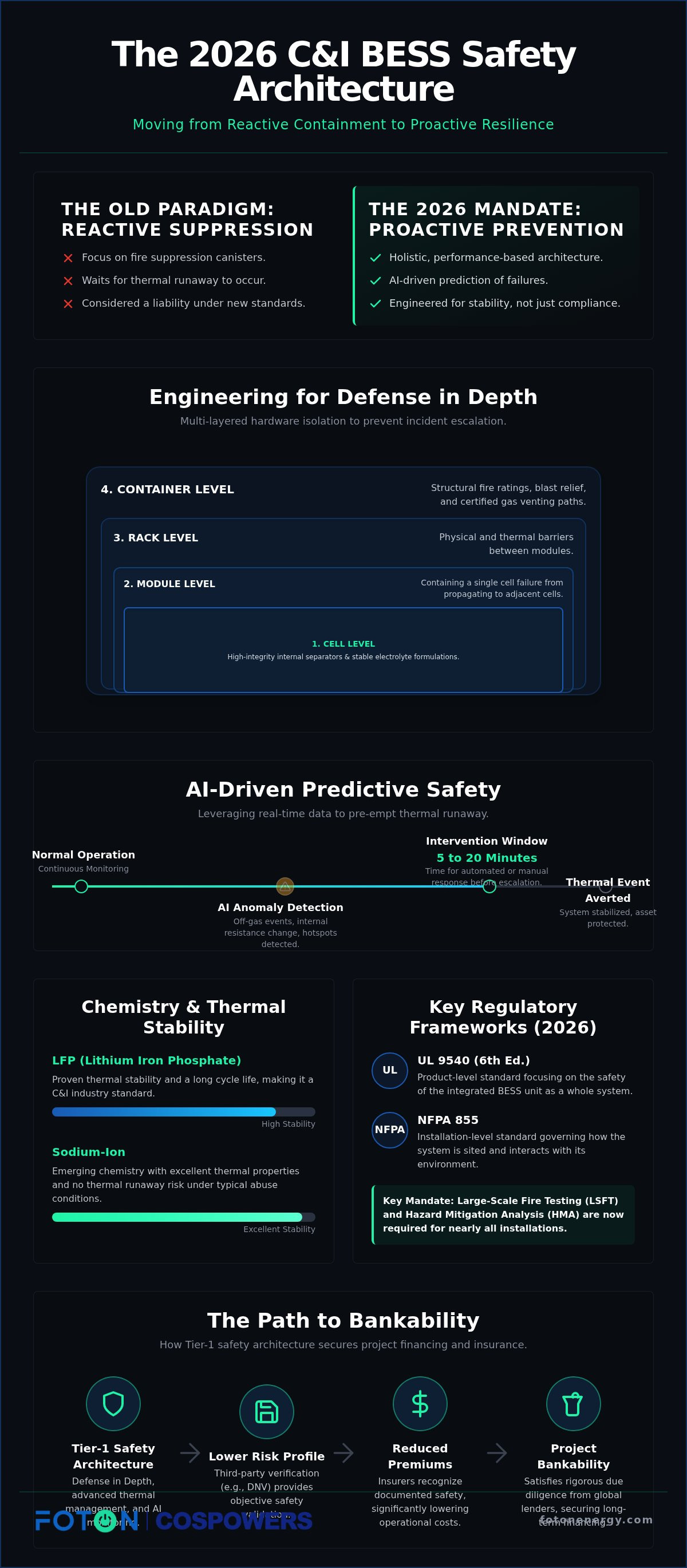
- Discover the "Defense in Depth" engineering strategy that utilizes multi-layered hardware isolation to prevent cell-level incidents from escalating.
- Compare the thermal stability of LFP and Sodium-Ion chemistries to align your project with the latest C&I BESS fire safety standards and operational requirements.
- Learn how AI-driven Energy Management Systems provide a critical early warning window by monitoring real-time data like internal resistance and off-gas indicators.
- Integrate Tier-1 manufacturing standards with expert engineering consulting to secure project insurance and long-term asset bankability.
Global Regulatory Landscape: BESS Fire Safety Standards in 2026
Safety is no longer a checklist item. In 2026, BESS fire safety architecture is defined as an interconnected ecosystem of physical containment and digital intelligence. As the global energy transition accelerates, the 2026 updates to NFPA 855 and the 6th Edition of UL 9540 have redefined the baseline for C&I BESS fire safety standards. We've moved past simple reactive suppression. Today's leading systems prioritize proactive explosion prevention and sophisticated gas venting strategies. This shift reflects a deeper understanding of thermal runaway dynamics, where managing hazardous gases is as critical as cooling the cells. For developers, Tier-1 certification isn't just a badge of quality; it's the essential prerequisite for grid-scale bankability.
Key Regulatory Frameworks: UL 9540 vs. NFPA 855
UL 9540 serves as the product-level standard, ensuring the integrated system is safe as a whole. Conversely, NFPA 855 governs the installation, focusing on how that system interacts with its environment. In 2026, these standards have converged, particularly in the Australian and North American markets. A Battery energy storage system overview reveals that while chemistry matters, the interaction between components determines safety. The 2026 edition of NFPA 855 now mandates Large-Scale Fire Testing (LSFT) and a comprehensive Hazard Mitigation Analysis (HMA) for almost all installations. This removes the threshold-based exemptions of the past. Third-party verifiers like DNV now play a critical role, providing the objective data EPCs need to validate manufacturer safety claims before a single unit is deployed.
The Economic Impact of Safety on Project Insurance
Insurers have become the de facto regulators of the BESS industry. They don't just look for certifications; they demand evidence of multi-layered safety architecture. Documented thermal management and advanced off-gas detection can significantly lower insurance premiums by reducing the probability of catastrophic loss. These systems provide a critical window for intervention, often detecting anomalies 5 to 20 minutes before a fire occurs. In this context, bankability is the measure of how effectively a project's safety certifications and risk mitigation strategies satisfy the rigorous due diligence of global lenders and insurers. Consistently meeting C&I BESS fire safety standards is the primary lever for reducing these financial risks and ensuring long-term operational viability.
Multi-Layered Hardware Architecture: Engineering for Defense in Depth
Resilient energy storage is built on the principle of isolation. While reactive fire suppression has historically been the focus, modern C&I BESS fire safety standards now prioritize a "Defense in Depth" strategy. This architectural approach ensures that if a single cell fails, the incident is physically and thermally contained before it can propagate to adjacent modules. Tier-1 manufacturing achieves this through high-integrity internal separators and stable electrolyte formulations that raise the threshold of thermal runaway. According to Energy storage safety research conducted by EPRI, these hardware-level safeguards are the primary line of defense against large-scale failure.
At the rack and container level, structural fire ratings and blast relief venting provide the final physical barrier. Containerized systems are engineered to withstand internal pressure build-up, using certified venting paths to direct hazardous gases away from critical infrastructure. This multi-layered containment strategy transforms a potentially catastrophic event into a manageable, localized incident, protecting both the asset and the surrounding facility.
Thermal Management and Cooling Systems
Maintaining temperature uniformity is vital for long-term cell health and safety. High-density utility-scale projects increasingly favor liquid cooling over traditional air-cooled systems. Advanced utility scale battery cooling systems provide superior heat dissipation, ensuring that temperature variance across thousands of cells remains within a narrow window. This precision prevents localized hotspots, which are often the silent precursors to thermal instability. For developers seeking to optimize performance, our team offers specialized engineering consulting to align cooling architecture with specific site conditions.
Detection and Active Suppression Technologies
Early intervention depends on speed. Modern safety architecture incorporates off-gas detection sensors that identify volatile organic compounds released during the initial stages of cell venting. This provides a critical 5 to 20-minute window for automated shutdown before temperatures reach the point of no return. While aerosol suppression systems offer compact, weight-efficient protection, clean agent systems are often preferred for their ability to suppress fire without leaving residue on sensitive electronics. Secondary water-based cooling systems may also be integrated to provide external exposure protection, ensuring the system remains compliant with the most rigorous C&I BESS fire safety standards globally.
Chemistry and Safety: Comparing LFP and Sodium-Ion Thermal Stability
Chemistry is the bedrock of any resilient energy architecture. While structural containment and AI monitoring provide critical layers of protection, the inherent stability of the battery cell determines the system's baseline risk. In 2026, meeting C&I BESS fire safety standards starts with selecting the right chemical formulation for the specific application. Lithium Iron Phosphate (LFP) remains the industry benchmark for utility-scale projects, but Sodium-Ion technology has emerged as the next frontier for mission-critical environments where safety is the non-negotiable priority.
LFP cells typically reach thermal runaway at approximately 270°C, a significantly higher threshold than the Nickel Manganese Cobalt (NMC) chemistries used in earlier deployments. However, Sodium-Ion offers even greater thermal stability and a safer failure mode during high-stress events. This makes a sodium-ion battery for data centers an increasingly attractive option for operators managing the intense power demands of AI infrastructure. By choosing chemistries with higher onset temperatures, developers can fundamentally reduce the probability of an incident before it ever begins.
LFP Safety: The Industry Gold Standard for Utilities
Utilities favor LFP because its strong phosphorus-oxygen covalent bond resists oxygen release even during overcharge or internal short-circuits. This chemical stability directly contributes to the exceptional LFP battery cycle life for utilities, allowing assets to operate safely for decades. When you choose LFP, you're investing in a proven chemistry that simplifies compliance with global safety codes. It's the balance of energy density and thermal resilience that has made LFP the dominant force in current C&I BESS fire safety standards.
Sodium-Ion: Non-Flammable Potential and Cold-Weather Safety
Beyond thermal onset temperatures, Sodium-Ion's physical resilience is a game-changer for high-risk installations. These cells maintain stability during physical puncture or extreme short-circuit tests, failing without the explosive energy release often associated with lithium-based chemistries. The sodium-ion battery commercial availability in 2026 is largely driven by safety mandates in urban or cold-weather environments. Because sodium batteries are less prone to dendrite formation, they offer a safer profile for high-discharge applications and perform reliably in sub-zero temperatures where lithium ions might struggle.
AI Predictive Safety: EMS to Pre-empt Thermal Runaway
Proactive intelligence is the final frontier of containment. While physical barriers provide essential defense, the integration of AI driven energy management systems (EMS) allows operators to move from reactive suppression to predictive prevention. These systems harvest high-fidelity data across thousands of cells, monitoring minute fluctuations in voltage, temperature, and internal resistance. By applying machine learning algorithms to this data, it's possible to identify rogue cells exhibiting anomalous behavior weeks before a potential failure occurs. This level of foresight is becoming a core requirement for modern C&I BESS fire safety standards, ensuring that operational risks are mitigated long before they escalate into thermal events.
Data from industry reports indicates that AI-powered predictive maintenance can reduce battery failure rates by 30% to 50% (Anern Store, April 2026). When the EMS detects a trend toward instability, it triggers automated safety protocols. These may include the remote disconnection of specific strings or the targeted activation of localized cooling systems. This digital layer of protection creates a responsive environment that adapts to real-time stress, providing a level of reliability that traditional hardware alone cannot match. To see how these systems integrate with your infrastructure, you can explore our intelligent EMS solutions.
BMS vs. EMS: The Two Layers of Digital Protection
Reliability requires a hierarchical approach to digital safety. The Battery Management System (BMS) operates at the millisecond level, providing critical hardware protection against overcharge and short-circuits. However, the EMS provides the strategic layer, coordinating site-wide safety and conducting cloud-based analytics. By integrating thermal management control directly into the EMS logic, the system can optimize cooling cycles based on both current load and predicted ambient conditions. This synergy ensures that the hardware remains within its optimal safety envelope at all times.
Digital Twins and Safety Modeling
Digital twins have transformed how we evaluate BESS resilience. By creating a virtual replica of the physical asset, engineers can simulate extreme stress tests and model thermal propagation patterns without risking actual hardware. Cloud-based fleet monitoring further enhances this by identifying safety trends across global deployments, allowing for the rapid rollout of firmware updates that address emerging risks. AI also plays a vital role in reducing false positives in fire suppression triggering, ensuring that active measures are only deployed when a genuine threat is detected. This sophisticated modeling is essential for maintaining the high performance and durability expected under current C&I BESS fire safety standards.
Engineering for Bankability: Integrating Foton’s Safety Architecture
Safety is the foundation of bankability. For investors, the long-term ROI of commercial and industrial BESS solutions depends on the asset's ability to remain operational without catastrophic interruption. A system that meets C&I BESS fire safety standards is more than a compliant unit; it's a de-risked financial instrument. Foton Energy bridges the gap between Tier-1 manufacturing and local project requirements. By leveraging our extensive experience in energy storage and our Australian-based engineering expertise, Foton Energy provides a holistic solution built on high-quality components that satisfies the most rigorous due diligence processes.
EPCs must look beyond marketing brochures during procurement. Verifying safety claims requires a deep dive into Large Scale Fire Testing (LSFT) data and third party certifications. A bankable manufacturer provides transparent access to these results, proving that their hardware and software layers work in unison to prevent propagation. This transparency is the cornerstone of trust in grid scale infrastructure. It ensures that every component performs as expected under extreme conditions.
The Foton Engineering Consulting Approach
Site-specific hazards demand tailored architectural responses. Whether your project faces seismic risks, corrosive coastal environments, or extreme desert heat, our engineering consulting team ensures the system design is resilient. We don't just supply hardware. We integrate Foton's safety architecture into your existing energy network, managing everything from initial feasibility studies to final commissioning. This hands on approach guarantees that your asset meets the C&I BESS fire safety standards required by local grid codes and insurers, securing your investment for the next 20 years. We act as a steady, guiding hand through the complexities of grid connection and safety assurance.
Future-Proofing Safety Architecture
Technology moves fast, and your safety systems should too. Designing for modularity allows for the seamless upgrade of detection and suppression components as new innovations emerge. We emphasize the role of wholesale procurement in securing only certified, high performance components that align with your long term safety goals. This foresight prevents your infrastructure from becoming obsolete before its lifecycle ends. If you're ready to deploy a system built on proven experience and visionary pragmatism, partner with Foton Energy for bankable, safe infrastructure. Our team is ready to guide your project toward operational excellence and long term resilience.
Securing the Future of Energy Infrastructure
The transition toward integrated safety architecture marks a defining moment for the energy storage sector. Success in 2026 requires moving beyond simple containment into a landscape where hardware isolation, stable chemistries, and AI-driven predictive monitoring work in perfect unison. Adhering to the latest C&I BESS fire safety standards is no longer just a regulatory hurdle. It's a strategic advantage that ensures project bankability while providing the security necessary for large-scale infrastructure investments.
By combining the 30 year manufacturing heritage of Cospowers with our authoritative engineering consulting, Foton Energy provides the stability you need for mission-critical deployments. Our AI-driven safety architecture offers real-time optimization that transforms risk management into a core performance metric. It's time to build with visionary pragmatism and technical excellence. We invite you to Partner with Foton Energy for bankable BESS engineering and Tier-1 procurement to lead the transition toward a more resilient energy future.
Frequently Asked Questions
What is thermal runaway in a BESS and how is it prevented?
Thermal runaway is a self-accelerating chemical reaction where a battery cell's internal temperature rises uncontrollably. Prevention requires a multi-layered approach, starting with high-quality Tier-1 cells that resist internal short-circuits. Advanced Battery Management Systems (BMS) provide millisecond-level hardware protection, while intelligent cooling systems ensure uniform temperature distribution. By maintaining cells within a strict thermal envelope, these systems prevent the initial venting that leads to catastrophic propagation across modules.
Is Sodium-Ion safer than Lithium Iron Phosphate (LFP) for BESS?
Sodium-Ion batteries offer superior thermal stability compared to Lithium Iron Phosphate (LFP) in extreme conditions. While LFP is the current industry gold standard, Sodium-Ion chemistry is less prone to dendrite formation and maintains stability even during physical puncture or deep discharge. This makes it an ideal choice for safety-sensitive applications like data centers. However, both chemistries must adhere to rigorous C&I BESS fire safety standards to ensure long-term operational resilience.
What fire safety certifications are mandatory for utility-scale BESS in 2026?
In 2026, the primary mandatory standards are the 2026 edition of NFPA 855 and the 6th Edition of UL 9540. These regulations now require Large-Scale Fire Testing (LSFT) and a formal Hazard Mitigation Analysis (HMA) for most utility-scale installations. Compliance with UL 1973 for battery stacks remains a foundational requirement. These certifications provide the technical proof points that financiers and insurers demand before approving grid-scale energy storage projects.
How does an AI-driven EMS improve BESS fire safety?
An AI-driven EMS improves safety by identifying rogue cells weeks before they reach a failure state. By harvesting real-time data on internal resistance and voltage fluctuations, predictive algorithms can detect anomalies that traditional systems might miss. Research suggests that AI-powered predictive maintenance can reduce battery failure rates by 30% to 50%. This creates a critical early-warning window, allowing for remote disconnection and targeted cooling activation before thermal runaway can occur.
Can BESS fires be extinguished with water?
Water is primarily used as a cooling agent to prevent fire from spreading to adjacent units rather than an extinguishant for the battery cells themselves. While clean agents or aerosols suppress active flames, water is often necessary for long-term thermal management during an incident. EPCs must design site-specific drainage systems to manage the volume of water required by local fire authorities while ensuring it doesn't cause secondary electrical hazards within the containerized system.
What is the role of blast relief venting in containerized BESS?
Blast relief venting is a passive safety feature designed to manage internal pressure build-up during a gas venting event. If a cell fails and releases hazardous gases, these vents provide a controlled path for the pressure to escape, preventing a structural explosion of the container. By directing gases away from critical infrastructure and personnel, blast relief venting ensures that an internal cell failure remains a contained incident rather than a site-wide disaster.
How does BESS fire safety architecture affect project insurance premiums?
Robust safety architecture is a primary driver of project bankability and lower insurance premiums. Insurers favor systems that exceed basic C&I BESS fire safety standards by integrating multi-layered hardware isolation and documented gas detection. By proving that a project can detect and mitigate a thermal event within the critical 5 to 20-minute off-gas window, developers can secure more favorable terms and protect the long-term ROI of their energy assets.
What are the environmental impacts of a BESS fire incident?
A BESS fire can release toxic gases such as hydrogen fluoride and carbon monoxide, posing risks to local air quality and first responders. The large volumes of water used for cooling can also lead to soil and water contamination if runoff is not properly contained. Modern safety architecture focuses on preventing these incidents entirely through proactive monitoring and containment, minimizing the potential for environmental damage and protecting the operator's brand reputation.


