

In 2026, the success of a commercial energy project no longer hinges solely on hardware delivery; it depends on the strategic bankability of the manufacturer and the intelligence of the integration. Procuring c&i battery storage systems has evolved into a high-stakes search for long-term reliability where lead-time delays and supply chain volatility can derail even the most robust financial models. You're likely feeling the pressure to balance strict grid-code compliance with the need for immediate operational resilience.
We understand that navigating the technical divide between Sodium-Ion and LFP performance while ensuring system safety is a complex challenge for any developer or EPC. This guide provides a masterclass in sourcing Tier-1 infrastructure that satisfies both engineering rigor and project financing requirements. We'll examine how to leverage AI-driven energy management systems to maximize arbitrage revenue and peak shaving, ensuring your procurement strategy delivers a future-proof asset rooted in a 30-year manufacturing heritage.
Key Takeaways
- Learn how to transition from simple backup power to treating C&I storage as a multi-layered infrastructure asset that ensures long-term energy resilience.
- Compare the performance profiles of LFP and Sodium-Ion chemistries to match your project's specific thermal and cycle life requirements.
- Master the criteria for procuring c&i battery storage systems that meet the strict bankability standards required by global project financiers and insurers.
- Discover how AI-driven Energy Management Systems (EMS) prevent stranded assets by optimizing real-time energy arbitrage and peak shaving revenue.
- Streamline your path from feasibility to commissioning by leveraging a strategic partnership rooted in a 30-year manufacturing heritage.
The Strategic Shift in Procuring C&I Battery Storage Systems
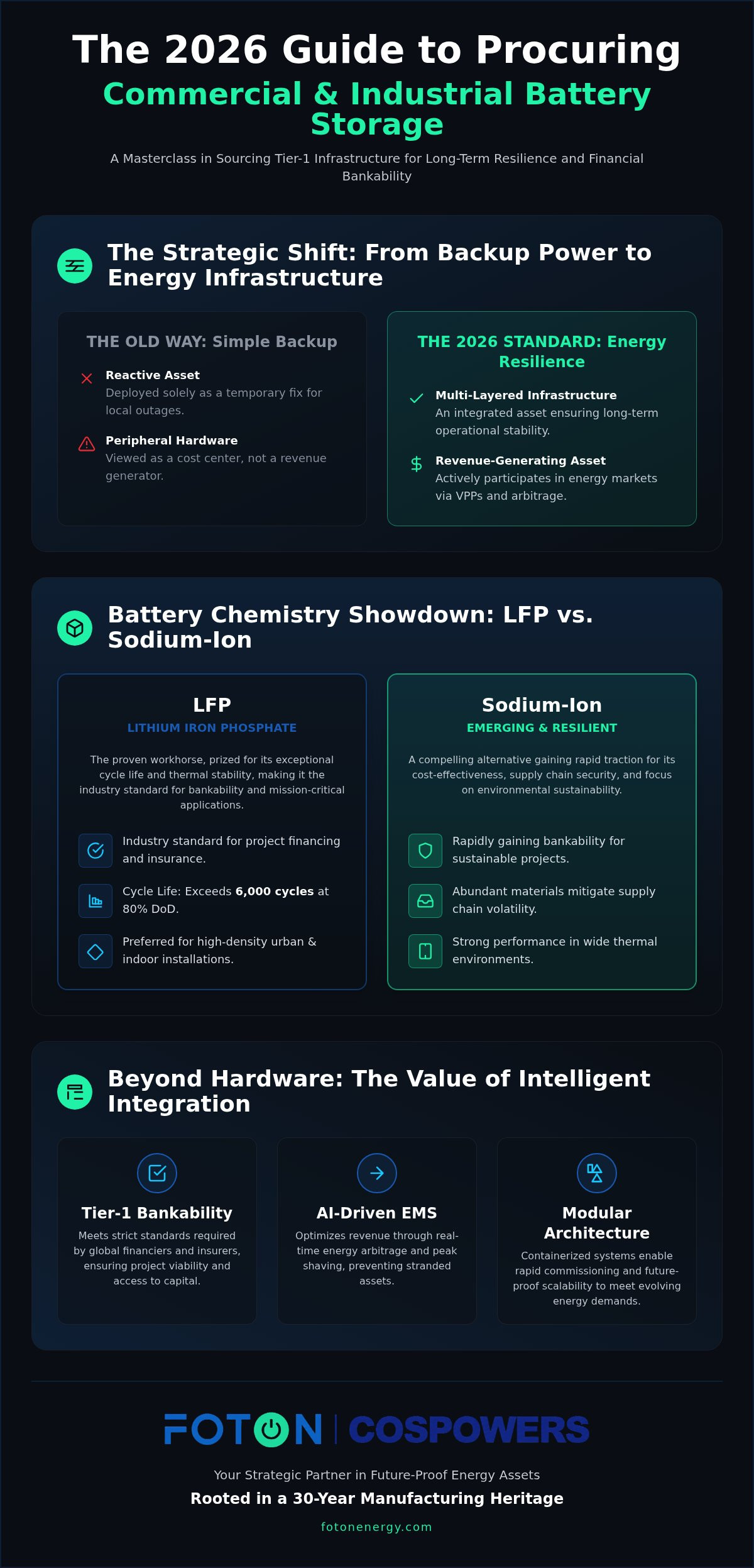
Energy storage is no longer a peripheral backup solution. In 2026, procuring c&i battery storage systems represents a transition toward securing a multi-layered infrastructure asset. This shift is driven by a fundamental change in how businesses view energy. It's an evolution from simple "back-up power" to comprehensive "energy resilience." As grid volatility increases and corporate green mandates become more stringent, the focus has moved toward systems that can provide long-term stability and operational flexibility.
Success in this landscape requires more than just a purchase order. It demands a strategic partnership. You need a collaborator who can navigate the complexities of the global supply chain while ensuring your infrastructure is built on a foundation of bankability. This ensures that your investment remains a high-performance pillar of your industrial operations for decades, not just a temporary fix for local outages.
Defining Commercial and Industrial (C&I) Storage
C&I storage is defined by its placement and the scale of its impact. Behind-the-meter (BTM) applications sit on the customer's side of the utility meter, focusing on demand charge management and onsite resilience. In contrast, front-of-the-meter (FTM) deployments serve the broader grid. These systems typically range from 50kWh for light commercial use to multi-MWh deployments for heavy manufacturing. A sophisticated battery energy storage system (BESS) is a complex integration of battery modules, a high-efficiency Power Conversion System (PCS), advanced thermal management, and an intelligent Energy Management System (EMS).
The 2026 Procurement Landscape
The current market is defined by intelligence and speed. AI-driven market participation through Virtual Power Plants (VPPs) is now a standard requirement, turning storage assets into active revenue generators. When procuring c&i battery storage systems, you must evaluate the software's capacity for real-time optimization. We've also seen a significant shift due to sodium-ion battery commercial availability, which offers a compelling alternative for specific thermal environments and cost-sensitive projects. Most developers now prioritize containerized, modular architectures. These systems allow for rapid commissioning and provide the scalability needed to adapt to future energy demands without requiring a complete system overhaul.
Evaluating Battery Chemistries: LFP vs. Sodium-Ion for C&I
The choice of chemistry defines the financial and operational ceiling of your project. When procuring c&i battery storage systems, you aren't just selecting a battery; you're choosing a chemical profile that must align with your site's specific thermal demands and discharge requirements. In 2026, the market has bifurcated into two dominant paths: the established reliability of Lithium Iron Phosphate (LFP) and the emerging, cost-effective resilience of Sodium-Ion. Both technologies have achieved the manufacturing scale necessary for industrial deployment, yet they serve distinct strategic roles in a modern energy portfolio.
Bankability remains the ultimate filter for large-scale infrastructure investments. While LFP is the industry standard for project financing due to decades of performance data, Sodium-Ion has rapidly gained traction with insurers and financiers. This is particularly true for projects where supply chain security and environmental sustainability are prioritized. For a deeper technical dive into how these components integrate into a total solution, refer to this Guide to Commercial and Industrial Battery Storage Systems. Choosing between them requires a balance of CAPEX goals and long-term cycle life expectations.
Lithium Iron Phosphate (LFP): The Proven Workhorse
LFP continues to dominate the C&I sector because of its exceptional thermal stability and safety architecture. It's the preferred choice for indoor industrial installations where fire safety regulations are most stringent. With cycle life expectations often exceeding 6,000 cycles at 80% depth of discharge, LFP provides the long-term ROI required for heavy-duty applications. It's especially suited for high-density urban environments and mission-critical sodium-ion battery for data centers applications where space is at a premium and reliability is non-negotiable.
Sodium-Ion: The Sustainable Alternative
Sodium-Ion has emerged as a powerful alternative for remote C&I sites and regions with extreme temperature fluctuations. Unlike lithium-based systems, sodium-ion batteries maintain high performance in extreme cold, significantly reducing the energy load required for thermal management. They offer a more resilient supply chain, utilizing abundant raw materials that de-risk procurement from global volatility. For developers looking to reduce CAPEX without compromising on safety standards, sodium-ion provides a compelling case for outdoor, large-scale storage arrays.
Foton Energy serves as your strategic bridge to these Tier-1 technologies. Through our exclusive partnership with Cospowers, we leverage a 30-year manufacturing heritage to provide bankable solutions in both LFP and Sodium-Ion formats. This dual-track capability ensures that your procurement strategy is never limited by a single chemistry. To determine which technology best fits your load profile, you can consult with our engineering team for a detailed feasibility analysis.
The Hierarchy of Bankability: Tier-1 Manufacturing Standards
Bankability is the primary filter used by project financiers and insurers to separate industrial assets from speculative risks. In 2026, procuring c&i battery storage systems requires a deep audit of the manufacturer's operational history and financial stability. A bankable partner ensures that warranties are enforceable and that technical support remains available throughout the system's entire operational life. This level of assurance is why a 30-year manufacturing heritage, such as that provided by Cospowers, is a critical de-risking factor. It demonstrates a proven track record of navigating market cycles and evolving technical standards across 70 countries.
Exclusive distribution partnerships strengthen this hierarchy. By maintaining a direct strategic link to a Tier-1 manufacturer, Foton Energy ensures consistent hardware quality and streamlined communication. This eliminates the uncertainty often found in fragmented supply chains, providing investors with the confidence that every component meets rigorous global standards. It's about building a bridge between elite manufacturing and local project requirements.
What Makes a BESS Manufacturer Tier-1?
When you are procuring c&i battery storage systems, understanding what qualifies a manufacturer as Tier-1 is essential. True Tier-1 status is defined by more than just market share; it requires complete vertical integration and fully automated production lines to minimize human error. High-performance manufacturing involves:
- Vertical integration from cell chemistry development to final enclosure assembly.
- Advanced robotic automation in clean-room environments to ensure cell-to-cell consistency.
- Comprehensive Factory Acceptance Testing (FAT) to verify every module before it leaves the facility.
Cospowers' established heritage supports our global supply chain, ensuring that every BESS deployment benefits from three decades of manufacturing refinement. This stability is vital for securing the long-term financing that large-scale commercial projects demand.
Navigating Certifications and Compliance
Compliance is the non-negotiable gateway to grid connection. In 2026, global markets demand adherence to strict grid codes, such as the AS/NZS 4777.2 standards in Australia, to ensure system stability. Procurement teams must verify essential certifications, including UL 9540 for system safety, IEC 62619 for industrial lithium batteries, and DNV verification for long-term reliability. These aren't just badges; they're proof of rigorous testing.
Safety architecture is equally paramount. Modern systems must include integrated fire suppression technology and multi-level thermal management to satisfy insurance requirements. Navigating these regulatory layers can be daunting, which is why many developers utilize BESS engineering consulting services to ensure their projects are fully compliant from the feasibility stage through to final commissioning. This proactive approach de-risks the investment and accelerates the timeline to operational status.
Beyond Hardware: Procuring AI-Driven EMS and Software
Hardware without intelligent software is a stranded asset. In the 2026 energy market, the physical battery container is merely a vessel for potential energy; the real value lies in the software's ability to dispatch that energy with surgical precision. When you are procuring c&i battery storage systems, you must evaluate the software stack with the same rigor as the cell chemistry. A system lacking sophisticated control logic cannot react to the volatile price signals of modern grids, effectively capping your return on investment from day one. Intelligence is the bridge between a dormant battery and a high-performance financial asset.
The integration of AI driven energy management systems ensures that your infrastructure doesn't just sit idle. These systems must seamlessly interface with existing building management systems (BMS) to synchronize onsite load with storage capacity. This interconnectedness allows for a holistic approach to energy consumption, where the battery acts as a dynamic buffer that stabilizes both your operational costs and the local grid. It's about building an ecosystem that is both resilient and responsive.
Real-Time Optimization and Revenue Stacking
Modern EMS platforms utilize predictive analytics to anticipate demand spikes before they occur. By analyzing historical load profiles and weather data, the AI maximizes peak shaving efficiency, ensuring the battery discharges at the exact moment it provides the most significant cost offset. Beyond cost savings, these systems enable participation in Frequency Control Ancillary Services (FCAS) and other grid-balancing markets. This creates a "revenue stack" where a single asset generates value through multiple streams simultaneously. The EMS is the digital brain that converts raw chemical energy into measurable financial ROI.
Thermal Management and Safety Software
Safety in 2026 is a software-driven discipline. While high-quality liquid cooling hardware provides the foundation for stability, it's the monitoring software that prevents critical failures. Predictive AI monitors thousands of data points across the system, identifying subtle signs of cell degradation that human operators might miss. This proactive approach identifies potential thermal runaway risks long before they become hazardous. At Foton Energy, we provide integrated software-hardware solutions that ensure your safety architecture is always active, protecting your personnel and your capital investment. To see how our intelligence-first approach can de-risk your project, explore our integrated EMS solutions and discover the power of optimized storage.
The Procurement Roadmap: From Feasibility to Commissioning
Successful execution requires a methodical transition from data analysis to physical commissioning. Procuring c&i battery storage systems is a multi-stage journey that begins long before a container arrives on site. It starts with a rigorous feasibility study and load profile analysis. By examining at least 12 months of interval data, we can determine whether your facility requires a high-power system for peak shaving or a high-energy configuration for arbitrage. This data-first approach ensures the hardware is sized correctly for your operational reality, preventing both under-performance and unnecessary CAPEX.
Once the technical requirements are defined, the focus shifts to selecting a Tier-1 partner with a proven supply chain. This selection process leads directly into engineering and grid-code compliance verification. In 2026, the complexity of grid integration means your engineering team must work in lockstep with the manufacturer to ensure the Power Conversion System (PCS) and EMS meet local utility standards. Following approval, the project moves into the logistics and installation phase, culminating in Site Acceptance Testing (SAT) to verify that the system performs as designed under real-world conditions.
De-Risking the Sourcing Process
Managing lead times is a critical component of modern procurement. For containerized BESS, shipping logistics and port clearances can introduce significant delays if not managed by an experienced partner. We address this through the Foton Channel Partner Programme, which provides EPCs and installers with a streamlined path to Tier-1 hardware. This program offers local engineering support that is essential during the commissioning and troubleshooting phases. Having experts on the ground who understand the nuances of the Cospowers manufacturing heritage ensures that technical hurdles don't become project roadblocks.
Securing Your Supply Chain for 2026
Exclusive manufacturer partnerships are the most effective way to reduce the risk of hardware substitution. In a volatile market, some suppliers may swap components mid-production, which can compromise both performance and insurance coverage. Our strategic alignment with Cospowers guarantees that the "bankable" documentation required for project financing is accurate and consistent. This documentation is the foundation upon which financiers and insurers build their trust in your asset. To ensure your project is backed by 30 years of manufacturing excellence and AI-driven intelligence, contact Foton Energy to discuss your strategic BESS procurement needs.
Securing Your Energy Future in 2026
Success in the modern energy landscape requires a shift from transactional purchasing to strategic investment. You've seen how procuring c&i battery storage systems involves balancing the proven stability of LFP with the emerging resilience of Sodium-Ion. It's clear that hardware alone isn't enough; the true value of your infrastructure is unlocked through AI-driven energy management and a deep manufacturing heritage that ensures long-term bankability.
By prioritizing Tier-1 standards and rigorous engineering compliance, you de-risk your capital and maximize operational ROI. Foton Energy acts as your strategic bridge to Cospowers' 30-year manufacturing expertise, providing the global engineering consulting needed to navigate complex grid requirements. We're ready to help you integrate intelligent, high-performance storage into your industrial ecosystem. Partner with Foton Energy for Tier-1 BESS Procurement and take the first step toward a more resilient, optimized energy future. Your journey toward energy independence starts with a partner you can trust.
Frequently Asked Questions
What is the typical lead time for procuring C&I battery storage in 2026?
Lead times for containerized BESS in 2026 typically range from 24 to 40 weeks depending on system scale and customization requirements. While global supply chains have stabilized, high demand for Tier-1 components means early engagement is vital. We recommend starting the process for procuring c&i battery storage systems at least nine months before your target date to account for shipping logistics and site preparation.
How does Sodium-Ion BESS compare to LFP in terms of procurement cost?
Sodium-Ion systems generally offer a lower CAPEX compared to LFP due to the abundance of sodium as a raw material. While LFP remains the benchmark for energy density and cycle life in heavy industrial use, sodium-ion provides a cost-effective solution for long-duration storage and extreme temperature environments. When procuring c&i battery storage systems, you should evaluate the total cost of ownership rather than just the initial purchase price.
What certifications are required for BESS bankability in Australia?
Grid-code compliance in Australia requires systems to meet AS/NZS 4777.2 standards for inverter safety and performance. Additionally, bankability depends on international safety certifications such as IEC 62619 for industrial lithium batteries and UL 9540 for the total integrated system. These standards ensure the BESS is eligible for grid connection and satisfies the rigorous risk assessments performed by local insurers and project financiers during the procurement phase.
Can C&I battery storage be integrated with existing solar PV systems?
Yes, C&I battery storage can be seamlessly integrated with existing solar PV through either AC-coupled or DC-coupled configurations. AC-coupling is often preferred for retrofitting established solar arrays because it allows the storage system to operate independently of the existing solar inverters. This setup enables your facility to store excess generation during the day and discharge it during peak price windows, significantly improving your project's overall ROI and energy independence.
What is the role of an Energy Management System (EMS) in BESS procurement?
The Energy Management System (EMS) acts as the operational intelligence layer that dictates when the battery charges and discharges. In the procurement phase, the EMS specification is critical because it determines your ability to participate in revenue-generating programs like FCAS or VPPs. Without a sophisticated, AI-driven EMS, even the highest quality hardware becomes a passive asset that can't react to real-time grid price signals or demand spikes.
How do I choose between containerized and modular BESS architectures?
Your choice depends on the available footprint and the required energy capacity of your site. Containerized systems are ideal for large-scale, multi-MWh deployments where rapid onsite installation is a priority. Modular architectures offer greater flexibility for smaller sites or indoor installations where space is constrained. Both options leverage the same Tier-1 manufacturing heritage, ensuring that your procurement choice aligns with your specific operational requirements and spatial limitations.
What are the fire safety requirements for industrial battery installations?
Industrial installations must adhere to strict fire safety standards, including the integration of multi-level thermal management and active fire suppression systems. Compliance with UL 9540A testing is essential for understanding how a system behaves during a thermal event. These safety features are mandatory for obtaining insurance and ensuring the protection of your facility. Modern BESS designs utilize non-flammable enclosures and real-time software monitoring to identify hazards before they escalate.
Does Foton Energy provide engineering support for grid-code compliance?
Foton Energy provides comprehensive engineering consulting to ensure every project meets local grid-code and safety regulations. Our team assists with feasibility studies, protection setting reports, and the technical documentation required for utility approval. By bridging the gap between Cospowers' 30-year manufacturing expertise and local regulatory demands, we de-risk the commissioning process for our partners. This support is a core component of our commitment to delivering bankable energy infrastructure.


