

In 2026, the success of a grid-scale asset is no longer determined by simple arbitrage; it's won or lost in the technical architecture of bankability. You recognize that balancing volatile energy markets with evolving grid codes is a high-stakes endeavor. The complexity of managing battery degradation while orchestrating multiple revenue streams often creates a landscape of uncertainty for even the most seasoned infrastructure developers. This guide provides the strategic clarity needed to master utility scale bess roi, offering a rigorous framework for financial modeling that prioritizes long-term asset health and investor confidence.
We'll analyze the impact of Tier-1 hardware certification on project financing, evaluate the performance trade-offs between LFP and Sodium-ion technologies, and detail how AI-driven EMS optimizes revenue stacking in an increasingly competitive grid environment. By aligning proven manufacturing heritage with intelligent optimization, you can transform technical risks into predictable, high-performance financial outcomes. This methodical approach ensures your storage assets remain resilient and profitable throughout their entire operational lifecycle, providing the stability required for large-scale infrastructure investment.
Key Takeaways
- Transition from simple energy shifting to sophisticated grid-support portfolios to capture multiple, simultaneous revenue streams.
- Construct a comprehensive financial model that integrates CAPEX, OPEX, and the specific variables driving utility scale bess roi in the 2026 market.
- Understand how Tier-1 hardware certification reduces financing costs by improving debt-to-equity ratios and securing favorable loan interest rates.
- Discover how AI-driven energy management systems and advanced thermal controls prevent "ROI bleed" by predicting market spikes and mitigating battery degradation.
- Leverage the strategic advantage of Tier-1 manufacturing heritage and end-to-end engineering consulting to ensure long-term asset bankability.
The 2026 Utility-Scale BESS Landscape: Beyond Energy Arbitrage
In 2026, the global energy transition has reached a critical inflection point. As renewable energy penetration surpasses 40% in many developed markets, the role of stationary storage has shifted from a niche balancing tool to a foundational grid requirement. Consequently, utility scale bess roi is no longer a simple calculation of energy arbitrage. It's a sophisticated, multi-variable performance metric that reflects an asset's ability to provide high-speed grid services while maintaining long-term hardware integrity. Developers don't just look at price spreads anymore; they look at a portfolio of revenue streams that include frequency regulation, synthetic inertia, and capacity reserve payments.
This evolution makes 2026 the definitive "year of the grid-scale battery." The rapid decommissioning of coal and gas plants has left a stability gap that only large-scale storage can fill. For developers, this creates a landscape of both immense opportunity and technical complexity. Success requires a move away from "energy shifting" toward managing a complex grid-support portfolio. This strategic shift ensures that assets remain profitable even when traditional arbitrage margins tighten due to market saturation.
Front-of-the-Meter (FTM) Dynamics in 2026
Front-of-the-Meter assets differ significantly from their behind-the-meter counterparts in terms of revenue complexity and operational scale. These projects interface directly with transmission networks, acting as a critical link in the utility-scale BESS landscape. Unlike smaller systems, FTM deployments must adhere to stringent grid-code requirements that vary by region. In Australia, the National Electricity Market (NEM) demands sub-second response times for frequency control. In the US and EU, similar trends are emerging as grid operators prioritize assets that can provide black-start capabilities and voltage support. These high-stakes requirements mean that the hardware's reliability and response speed are directly tied to the asset's financial performance.
Key Financial Metrics: ROI vs. IRR vs. LCOE
While ROI offers a general overview, institutional investors and infrastructure funds prioritize the Internal Rate of Return (IRR) as the ultimate measure of project health. IRR accounts for the time value of money, which is essential when modeling a project with a 15 to 20 year lifespan. Another vital metric is the Levelized Cost of Storage (LCOS). This represents the total cost of building and operating the system per unit of energy discharged. Achieving a competitive utility scale bess roi requires balancing these metrics carefully. A project might have a low LCOS but a poor IRR if the revenue stacking strategy isn't optimized or if degradation accelerates faster than expected. Long-term profitability is secured by selecting bankable, Tier-1 hardware that maintains performance across thousands of cycles, ensuring the asset remains a productive component of the grid for decades.
Decoding the ROI Equation: CAPEX, OPEX, and Revenue Stacking
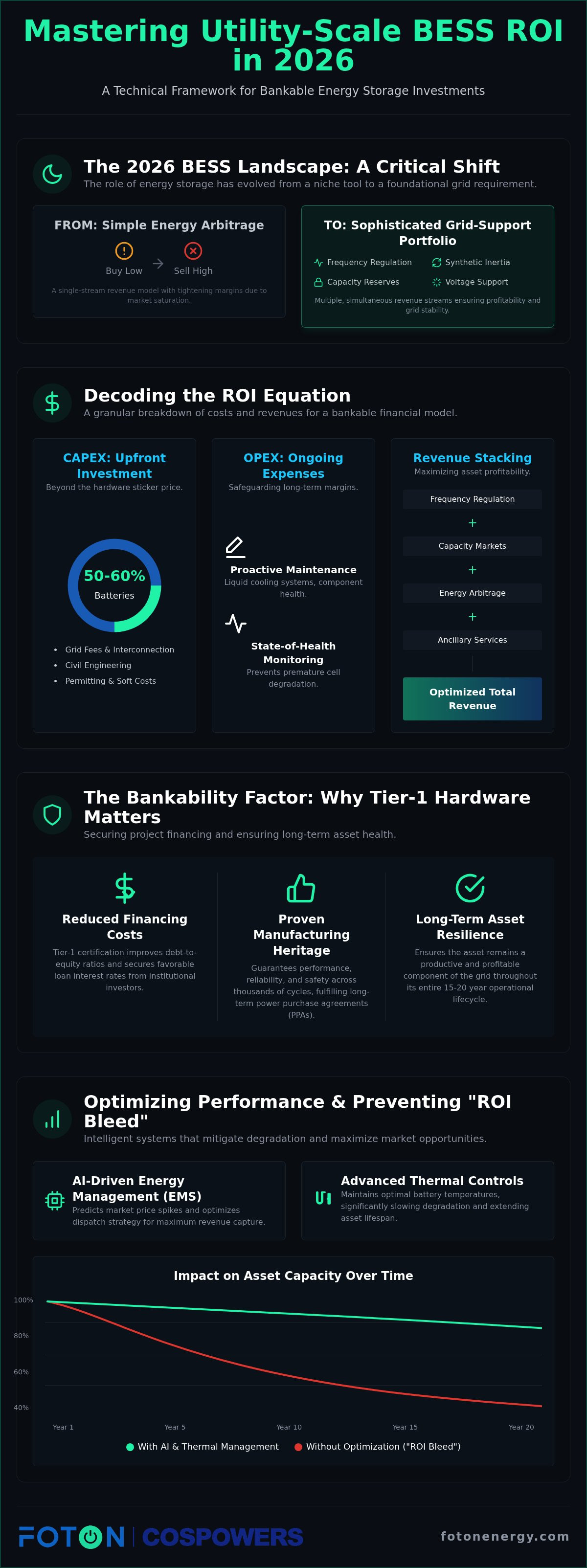
Precision in financial modeling is the bridge between a theoretical project and a bankable asset. Calculating utility scale bess roi requires a granular understanding of how upfront Capital Expenditure (CAPEX) and ongoing Operating Expenditure (OPEX) interact with shifting market signals. While battery modules typically account for 50% to 60% of the total investment, the remaining balance is highly sensitive to local grid fees, civil engineering, and the "soft costs" of permitting that can fluctuate based on regional jurisdiction. Developers must look beyond the sticker price of hardware to account for the full integration and commissioning timeline, which often dictates the project's early-stage cash flow.
Operating Expenditure (OPEX) acts as a safeguard for your long-term margins rather than just a cost center. Proactive maintenance, particularly focused on liquid cooling systems and state-of-health monitoring, prevents the "ROI bleed" associated with premature cell degradation. If thermal management is neglected, the loss of capacity in the later years of a 15 to 20 year project lifespan can significantly erode the asset's terminal value. Modern assets must also leverage revenue stacking to remain competitive. This strategy maximizes the economic value of storage by ensuring the battery is never idle, constantly switching between high-value grid support and energy market participation.
Primary Revenue Streams for Utility Assets
In the 2026 market, the most resilient projects utilize at least four simultaneous income streams. Wholesale arbitrage remains a staple, allowing operators to buy low and sell high during periods of price volatility. However, the highest margins often come from Ancillary Services, such as Frequency Control Ancillary Services (FCAS) or synthetic inertia, which stabilize the transmission network. Capacity payments provide a steady baseline of revenue for ensuring resource adequacy during peak stress events. Finally, renewable firming eliminates curtailment penalties for wind and solar farms, allowing for a more predictable utility scale bess roi even as grid penetration grows.
The Hidden Costs of Utility-Scale BESS
Successful financial modeling must account for costs that don't appear on a standard hardware quote. Grid connection and interconnection study fees can be substantial in congested territories, often requiring multiple iterations before approval. Furthermore, developers must plan for "augmentation" around year 10. This involves installing new battery racks to maintain the contracted capacity as original cells naturally degrade. Insurance and regulatory compliance in high-safety environments also add to the complexity, requiring dedicated resources for ongoing auditing. To refine these projections, many developers utilize BESS engineering consulting services to ensure their financial models are grounded in technical reality.
The Bankability Factor: How Tier-1 Hardware Secures Project Financing
Bankability in 2026 is defined by a manufacturer's ability to survive the 20-year project lifecycle. It is the financial industry's litmus test for risk. For developers, the choice of hardware is the single most significant factor in determining the cost of capital. Tier-1 certification acts as a strategic gatekeeper; it allows projects to transition from high-cost equity to low-cost debt. When a project uses Tier-1 hardware, lenders perceive lower technical risk, which translates into reduced interest rates and more aggressive debt-to-equity ratios. These financial maneuvers directly amplify the utility scale bess roi, making the difference between a marginal project and a highly profitable grid asset.
Financing partners prioritize hardware backed by extensive manufacturing heritage. This includes manufacturers with decades of proven experience in battery production, offering the foundational reliability that institutional investors demand. Such longevity suggests that the chosen manufacturer will be present to honor warranties and provide technical support well into the 2040s, a timeframe that aligns with the operational reality of utility-scale storage. By choosing partners with proven stability and a deep history in the industry, developers protect the terminal value of their assets against the risk of hardware orphanhood.
Why Financiers Demand Tier-1 Hardware
Financiers require independent validation through DNV-GL or Bloomberg Tier-1 lists to mitigate technical uncertainty. This validation ensures the hardware meets global standards for safety and performance, such as the UL 9540A mandate for fire propagation safety. High-quality hardware also lowers project insurance premiums, as insurers view Tier-1 systems as less prone to thermal runaway or catastrophic failure. Foton plays a critical role here by providing bankable energy storage for financiers, ensuring that every component of the system is optimized for long-term financial stability.
Sodium-Ion ROI: The New Frontier
As the market evolves, developers are increasingly analyzing sodium-ion battery commercial availability for utility-scale applications. While Lithium Iron Phosphate (LFP) remains the dominant choice with a cycle life of 6,000 to 10,000 cycles, Sodium-ion offers a compelling alternative for specific ROI profiles. Sodium-ion typically features lower CAPEX due to more abundant raw materials, though it currently operates at a different cycle life than LFP. Its superior safety architecture and performance in extreme temperatures can also lead to lower site-permitting and thermal management costs, potentially offering a faster payback period for projects in harsh environments where LFP might require more intensive cooling.
Optimizing Performance: AI-Driven EMS and Thermal Management
Intelligent orchestration is the difference between a static battery and a high-yield grid asset. While Tier-1 hardware provides the structural foundation, the active generation of utility scale bess roi is increasingly driven by sophisticated software layers. An AI driven energy management system (EMS) functions as the project's central nervous system, processing thousands of data points to predict market spikes and grid-code requirements in real time. By shifting from reactive monitoring to predictive optimization, developers ensure their assets are always positioned for the highest-value dispatch opportunities, whether that involves wholesale arbitrage or millisecond-response frequency services.
Thermal management serves as the primary defense against "ROI bleed." Excessive heat's the leading cause of accelerated cell degradation, which directly erodes the long-term financial modeling of a utility project. Advanced liquid cooling systems have become the industry standard for high-density containers, offering superior round-trip efficiency compared to traditional air-cooled units. In extreme environments, such as the Australian outback or the American Southwest, these systems are critical. They maintain optimal operating temperatures, ensuring the 15 to 20 year lifespan projected in the initial financial model remains a technical reality rather than a theoretical hope.
Software-Driven Revenue Optimization
Algorithmic trading engines now dominate the dispatch logic of modern storage. These AI models decide when to charge, discharge, or hold capacity for Ancillary Services based on price volatility and grid stability signals. Precise State of Charge (SoC) management's equally vital; it balances immediate revenue needs with the long-term health of the battery cells. Industry data suggests that even a 1% gain in round-trip efficiency can translate into millions of dollars in additional utility scale bess roi over the life of a 100MW project. This highlights the massive impact that software optimization has on the Internal Rate of Return (IRR).
Thermal Management and Safety Architecture
Safety architecture's an integral part of the financial protection strategy. Integrated fire suppression technology and cabinet-level propagation testing, such as UL 9540A, do more than just ensure compliance; they protect the physical asset from catastrophic loss. Predictive maintenance schedules, powered by AI, identify potential cell failures before they cause an outage, maximizing availability payments. Real-time grid-code compliance also prevents costly penalties and unexpected outages during peak demand. For developers looking to de-risk their next deployment, partnering with a provider that integrates these intelligence layers is essential. Discover how Foton Energy's intelligent EMS can protect and enhance your grid-scale investments.
Partnering for Profitability: The Foton and Cospowers Advantage
Strategic alignment between engineering expertise and manufacturing heritage is the ultimate catalyst for financial performance. The alliance between Foton Energy and Cospowers provides a unique convergence that directly addresses the complexities of utility scale bess roi. Cospowers brings over 30 years of Tier-1 manufacturing experience to the table, ensuring that every battery module is built for the long-term resilience required by grid-scale assets. Foton then provides the strategic engineering layer, transforming these high-performance components into bankable energy systems that meet the rigorous demands of modern infrastructure funds and global lenders.
Supply chain excellence is a critical variable in the ROI equation. By leveraging this strategic partnership, developers gain access to wholesale procurement benefits that significantly reduce the initial CAPEX burden. This direct link to Tier-1 manufacturing eliminates the unnecessary costs and risks associated with multi-layered distribution networks. When these procurement efficiencies are combined with Foton's engineering oversight, the result's a project that's optimized for both immediate commissioning and a 20-year operational lifespan. Scaling these advantages across large portfolios allows developers to achieve a more competitive Internal Rate of Return while maintaining the highest safety standards.
Engineering Consulting for Bankable Outcomes
Reliability begins long before the first container arrives on site. Foton provides comprehensive BESS engineering consulting services designed to produce feasibility studies that financiers actually trust. We focus on custom system designs that account for site-specific grid requirements, local thermal profiles, and evolving grid codes. This end-to-end support ensures that every technical decision is grounded in commercial reality. By providing technical support throughout the entire asset lifecycle, we help developers mitigate the risks of hardware orphanhood and technical obsolescence, protecting the project's terminal value.
Global Reach, Local Expertise
Our global network spans over 70 countries, providing a broad perspective on the technological and regulatory trends shaping the future of energy storage. This international reach is complemented by deep localized expertise, particularly in the Australian market, where we provide the hands-on engineering support needed to navigate complex interconnection processes. We understand that the right partner is the most important variable in your financial modeling. We invite you to consult with Foton on your utility-scale BESS procurement to ensure your next grid asset is built on a foundation of stability, intelligence, and proven manufacturing excellence.
Securing the Future of Grid-Scale Infrastructure
The path to a resilient and profitable energy future is built on technical precision and strategic partnership. As you navigate the complexities of the 2026 grid, remember that utility scale bess roi is a product of both hardware bankability and software intelligence. High-performance assets require more than just capacity; they need the security of Tier-1 manufacturing and the foresight of predictive energy management. By integrating these elements, you transform technical challenges into stable, long-term financial victories. This methodical approach ensures your projects remain competitive as market dynamics and grid requirements continue to evolve.
Foton Energy provides the strategic architecture needed to master this landscape. Our exclusive partnership with Cospowers leverages over 30 years of manufacturing heritage to deliver systems that financiers trust and the grid depends on. From AI-driven EMS optimization to comprehensive engineering support, we ensure your storage projects are optimized for maximum performance and durability. Optimize your utility-scale ROI with Foton's Tier-1 BESS solutions and lead the transition toward a more stable, renewable-powered future. We're ready to support your vision for the next generation of grid infrastructure.
Frequently Asked Questions
What is the typical payback period for a utility-scale BESS in 2026?
The typical payback period for a commercial battery storage plant in 2026 ranges from 5 to 8 years. Government subsidies and tax credits can shorten this timeframe to under 5 years. This duration depends heavily on the project's ability to participate in high-value ancillary services markets alongside traditional energy arbitrage, ensuring a diverse revenue mix that accelerates capital recovery.
How does revenue stacking improve the ROI of large-scale battery storage?
Revenue stacking improves utility scale bess roi by allowing a single asset to capture multiple income streams simultaneously. By diversifying across energy arbitrage, frequency regulation, and capacity markets, operators reduce their exposure to price volatility in any single sector. This multi-layered approach ensures the battery remains productive during periods of low market spreads, maximizing the total value extracted from each cycle.
What is the impact of battery degradation on BESS financial models?
Battery degradation acts as a predictable reduction in the asset's available capacity, typically requiring technical augmentation around year 6. Financial models must account for this capacity fade to ensure the system can still meet its contracted obligations for grid support. Neglecting degradation leads to significant "ROI bleed" as the system's ability to participate in lucrative peak-shaving or frequency control events diminishes.
Is Sodium-ion battery technology ready for utility-scale ROI requirements?
Sodium-ion technology is commercially available in 2026 as a viable alternative for specific utility-scale applications, particularly where lower CAPEX is prioritized over energy density. While it offers superior safety and performance in extreme temperatures, its current cycle life differs from Lithium Iron Phosphate (LFP). Developers often choose Sodium-ion for long-duration storage projects where lower material costs provide a faster path to profitability.
How does Tier-1 bankability affect the cost of capital for BESS projects?
Tier-1 bankability significantly reduces the cost of capital by allowing developers to access more favorable debt-to-equity ratios and lower interest rates. Lenders and infrastructure funds view Tier-1 hardware as a lower technical risk, which simplifies the due diligence process. This status provides the bankable assurance needed to secure long-term financing, directly improving the overall utility scale bess roi through reduced financing overheads.
Can AI-driven EMS significantly increase the IRR of a BESS asset?
AI-driven energy management systems can increase the Internal Rate of Return (IRR) by optimizing dispatch logic based on real-time grid signals and market predictions. These systems use machine learning to identify the most profitable moments to charge or discharge, often outperforming manual strategies. By minimizing idle time and maximizing participation in high-value ancillary services, AI-driven EMS ensures the asset operates at its peak economic potential.
What are the primary OPEX costs for a grid-connected battery system?
Primary Operating Expenditure (OPEX) costs include scheduled maintenance of cooling systems, software licensing for the EMS, insurance premiums, and site security. Regulatory compliance and ongoing grid-connection audits also represent significant recurring expenses. Developers must budget for augmentation costs mid-lifecycle to compensate for natural capacity degradation and maintain the performance standards required by grid operators and off-takers.
How does thermal management influence the Levelized Cost of Storage (LCOS)?
Thermal management directly influences LCOS by determining the system's round-trip efficiency and total cycle life. Advanced liquid cooling systems maintain optimal cell temperatures, which reduces the energy consumed by the system's internal balance-of-plant. By preventing overheating, these systems extend the battery's operational life, spreading the initial investment over a larger volume of discharged energy and lowering the overall cost per megawatt-hour.


