

What if the most strategic path to a high-density energy storage project in 2026 isn't found through the largest integrators, but through partners who control the entire manufacturing lineage? You likely recognize that while the Fluence Gridstack has set a high bar for modularity, the current market landscape is fraught with supply chain bottlenecks for Tier-1 LFP cells and a rigid lack of chemistry options for specialized environments. Many developers are now actively seeking Fluence Gridstack alternatives that provide the same bankability without the typical lead-time constraints or the inflexibility of a single-chemistry approach.
This article compares the leading high-density energy storage options, focusing on bankability, chemistry diversification, and deployment speed. You'll discover how to identify a Tier-1 partner with a direct manufacturing heritage that can secure better technical support for complex grid-code compliance. We will examine how a shift toward vertically integrated partnerships and emerging technologies like Sodium-Ion can de-risk your utility-scale investments and ensure your infrastructure is future-ready for the next decade of grid demands. By the end of this guide, you will have a clear framework for selecting an integrator that balances elite performance with grounded, bankable assurance.
Key Takeaways
- Analyze the global shift toward 4-hour and 8-hour storage requirements and learn how to bypass the lead-time bottlenecks inherent in traditional integrator models.
- Benchmark gravimetric and volumetric energy density while ensuring your project meets the latest UL 9540A 6th Edition safety standards.
- Discover why Sodium-Ion is emerging as a strategic choice for cold climates and data centers where LFP chemistry faces operational limitations.
- Compare the most reliable Fluence Gridstack alternatives by using a bankability checklist focused on direct-from-factory procurement and O&M support.
- Learn how to secure localized engineering depth and grid-code compliance by partnering with a manufacturer that offers a 30-year industrial heritage.
Evaluating the Utility-Scale BESS Landscape in 2026
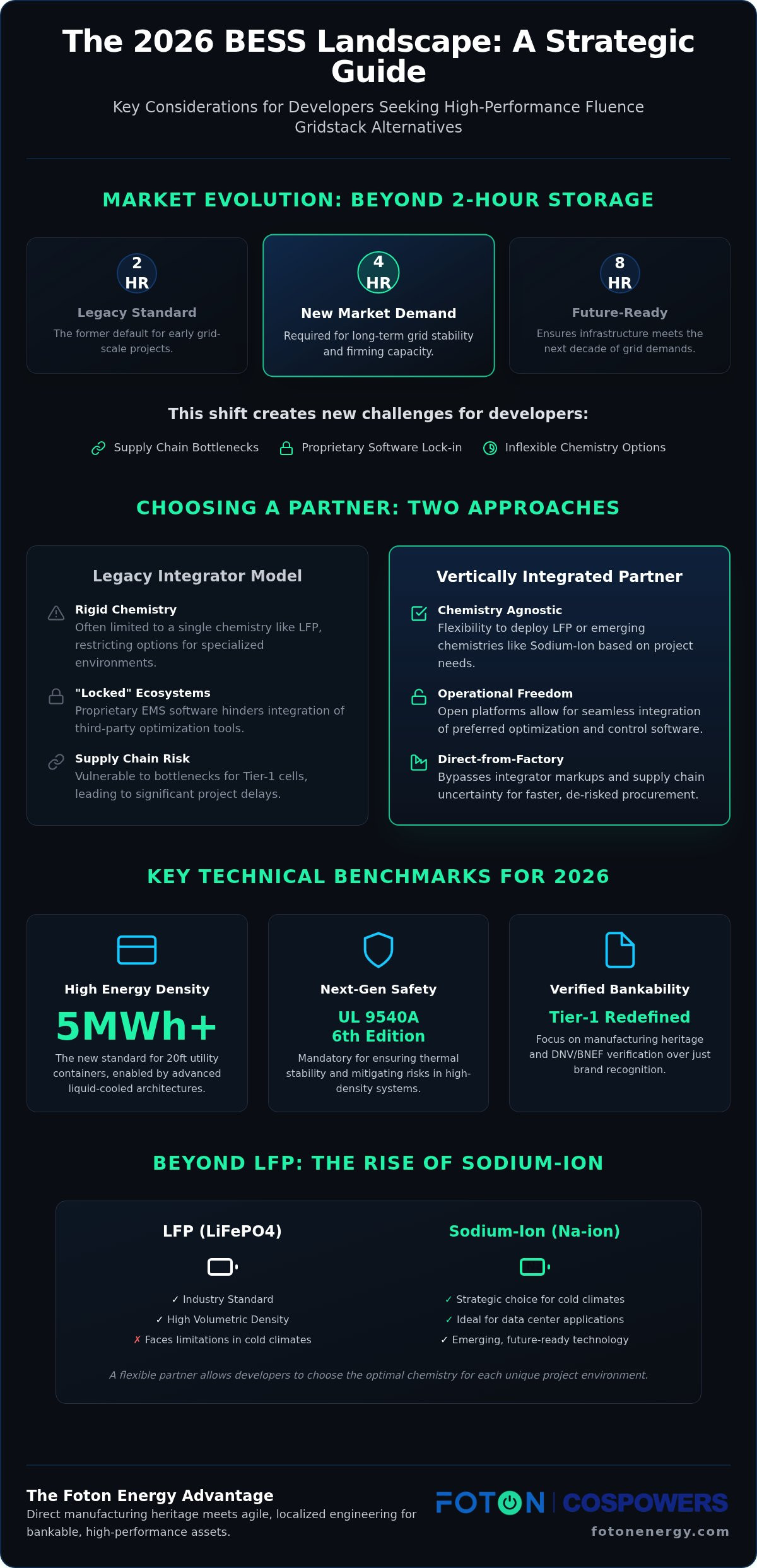
The global energy transition has reached a critical inflection point where 2-hour storage is no longer the default requirement for grid-scale projects. Markets now demand 4-hour and 8-hour durations to ensure long-term grid stability and firming capacity. This evolution has increased the technical complexity of every Battery Energy Storage System (BESS) deployment. While legacy integrators dominated the early market, developers in 2026 are facing a "Bankability Gap." Financiers are looking past brand names to demand granular transparency in supply chains and a proven manufacturing heritage. With utility-grade LFP cell pricing stabilizing between $55 and $75/kWh in early 2026, the differentiator is no longer just the cost of hardware. It's the reliability of the asset over a 20-year lifecycle.
Why Developers Seek Gridstack Alternatives
Project owners are increasingly wary of "locked" ecosystems that limit operational freedom. Many are searching for Fluence Gridstack alternatives to avoid proprietary EMS software-lock, which can hinder the integration of third-party optimization tools. Flexibility is paramount. Developers need chemistry-agnostic platforms that can accommodate LFP or Sodium-Ion modules depending on the specific site requirements. This flexibility must be paired with localized support to manage renewable energy grid code compliance. Relying on a remote, global integrator often leads to delays when local grid operators require specific technical adjustments during the commissioning phase.
Defining Tier-1 in the 2026 Market
Tier-1 status in 2026 is defined by more than just high volume; it requires a synthesis of manufacturing capacity, financial stability, and rigorous R&D. Verification from bodies like DNV and BloombergNEF remains the gold standard for global project financing. Foton Energy bridges this gap through an exclusive partnership with Cospowers, a manufacturer with over 30 years of industrial heritage. This relationship provides developers with a direct line to Tier-1 hardware, bypassing the layers of third-party markup and integration risk. By combining this manufacturing depth with agile, local engineering, Foton offers one of the most robust Fluence Gridstack alternatives for developers who prioritize technical precision and long-term asset performance. Reliability isn't just a claim. It's a measurable outcome of controlled manufacturing and verified bankability.
Technical Benchmarks: Density, Safety, and Intelligence
Engineering excellence in 2026 is measured by the ability to maximize capacity without compromising thermal stability or safety protocols. As the industry moves toward massive Giga-watt scale deployments, the benchmarks for energy density have shifted. Top-tier systems now routinely exceed the 5MWh threshold for 20ft utility containers, a feat that requires sophisticated volumetric density management. According to the latest Energy Storage Market Outlook, this drive for density is accelerating the adoption of liquid-cooled architectures over traditional HVAC systems. For developers evaluating Fluence Gridstack alternatives, the choice often hinges on whether an integrator can deliver this density while maintaining a manageable footprint and long-term reliability.
High-Density Containerized Solutions
The 5MWh+ threshold represents the new frontline for 20ft utility containers. Achieving this requires a modular architecture that scales seamlessly from commercial and industrial (C&I) applications to massive utility projects. High volumetric density reduces civil engineering costs and land use, but it also places immense pressure on the internal thermal management system. Foton’s approach to utility scale BESS procurement focuses on optimizing this density through vertically integrated manufacturing. By controlling the cell-to-pack integration, we ensure that every module contributes to the overall system efficiency without creating localized hotspots that could lead to premature degradation.
Next-Gen Safety and Thermal Management
Safety standards have evolved rapidly, with the UL 9540A 6th Edition, published on March 13, 2026, introducing more rigorous large-scale fire testing. Passive fire suppression is no longer sufficient for high-density LFP or Sodium-Ion systems; active, multi-stage suppression is now the industry standard. Liquid cooling has become essential for maintaining high Round Trip Efficiency (RTE), as it provides more uniform temperature control across the battery string than air cooling. This precision allows for string-level intelligence, where modern Energy Management Systems (EMS) can monitor and optimize individual battery strings rather than relying on blunt, block-level controls. If you are looking to de-risk your next project, exploring Foton’s utility-scale storage solutions provides a path to both high performance and technical security. Safety architecture serves as the primary barrier to securing project insurance in the current regulatory environment.
Beyond LFP: The Rise of Sodium-Ion BESS Alternatives
Lithium Iron Phosphate (LFP) currently accounts for nearly 95% of new utility-scale battery awards globally, yet it isn't a universal solution for every application. While LFP offers a proven safety profile and falling prices, its performance often degrades in extreme cold, and its reliance on volatile lithium supply chains remains a strategic risk. Developers searching for Fluence Gridstack alternatives are increasingly turning to sodium-ion technology to mitigate these vulnerabilities. Sodium-ion chemistries provide a robust hedge against material scarcity while offering superior operational stability in thermal extremes that would otherwise require intensive HVAC energy consumption.
The strategic shift toward sodium is particularly evident in high-stakes environments. Using a sodium-ion battery for data centers allows operators to maintain mission-critical backup power in high-density facilities without the same thermal runaway risks associated with lithium. As the sodium-ion market is projected to reach $2.14 billion in 2026, the technology is moving from the laboratory to large-scale deployment. These systems align perfectly with tightening ESG mandates, as they eliminate the need for cobalt and rely on abundant raw materials, significantly reducing the environmental footprint of the storage asset.
Sodium-Ion for Mission-Critical Infrastructure
Sodium-ion modules excel where traditional lithium chemistries struggle, particularly regarding temperature resilience. They maintain high efficiency in environments ranging from -30°C to +50°C, which makes them the ideal choice for remote, off-grid installations or regions with harsh winters. This temperature range reduces the parasitic load on liquid cooling systems, improving the overall round-trip efficiency of the project. Foton Energy is a key driver in ensuring sodium-ion battery commercial availability for utility projects. We provide a bankable path for developers who need to de-risk their infrastructure from the volatility of the lithium market while maintaining elite performance standards.
Cost-Performance Parity in 2026
Supply chain resilience is the primary driver for the adoption of sodium-based Fluence Gridstack alternatives in 2026. By moving away from cobalt and lithium dependencies, developers can secure more stable Capex for long-duration storage projects. While LFP still holds an advantage in total cycle life for high-cycling applications, sodium-ion’s superior discharge rates and lower raw material costs offer a compelling ROI for specific grid services like frequency regulation and peak shaving. In 2026, sodium-ion modules provide a volumetric energy density that is approximately 80% of current LFP standards, making them highly effective for stationary applications where footprint is less constrained. This balance of cost and resilience allows for a more diversified portfolio, ensuring that energy storage choices are based on technical requirements rather than supply chain bottlenecks.
Navigating BESS Bankability and Supply Chain Risk
Project bankability is the final gatekeeper for utility-scale energy storage. While brand recognition often provides a head start, financiers in 2026 are increasingly prioritizing technical due diligence over legacy names. Developers looking for Fluence Gridstack alternatives must demonstrate that their chosen integrator offers a transparent supply chain and a robust O&M support structure. Direct-from-factory procurement models are gaining traction because they eliminate the risks associated with third-party integration layers. When an integrator controls the manufacturing lineage, they provide a level of security that pure software-based integrators simply can't match. This transparency is vital for long-term asset performance, ensuring that every cell and module can be traced back to its origin; to see an example of this manufacturing precision in modular systems, visit greenSANE.
Securing Project Financing for Non-Fluence Systems
Presenting Tier-1 alternatives to investment committees requires a focus on verified performance data and financial stability. Cospowers, with its 30-year manufacturing heritage, serves as a prime example of how deep industrial experience can satisfy rigorous bankability requirements. Third-party verifications from entities like DNV and TUV are essential for validating safety, energy density, and degradation claims. Successful utility deployments using modular LFP architectures have proven that these systems can match the performance of market leaders while offering better lead times. When evaluating Fluence Gridstack alternatives, investors value the resilience of a partner who isn't just assembling components but is foundational to the manufacturing process itself. A robust bankability checklist for EPCs should include comprehensive warranty terms, guaranteed response times for O&M, and a clear roadmap for future system expansions.
The AI Edge: Energy Management Systems (EMS)
Intelligence is the engine of asset longevity and profitability. Modern AI driven energy management systems have moved beyond simple monitoring to provide real-time grid optimization and revenue stacking. This technology allows assets to participate in complex frequency regulation and capacity markets by integrating directly with global ISOs. String-level monitoring is a critical component of this evolution. By managing individual strings rather than entire blocks, operators can identify potential failures before they occur, significantly reducing downtime and extending the overall battery life. This predictive maintenance approach transforms a passive storage unit into an active, intelligent participant in the energy market, ensuring the system remains optimized for both safety and financial return.
If you're ready to de-risk your next infrastructure investment, request a bankability consultation for our utility-scale storage solutions to see how we align with your project's financial requirements.
Why Foton is the Strategic Choice for Large-Scale Storage
Foton Energy represents a new paradigm in the utility-scale market, bridging the gap between raw manufacturing power and localized technical precision. We operate as the exclusive global partner for Cospowers, a Tier-1 manufacturer with over 30 years of industrial heritage. This relationship allows us to offer one of the most reliable Fluence Gridstack alternatives by providing direct factory access without the typical delays of multi-layered supply chains. We combine this manufacturing depth with a supportive, accessible partnership model that prioritizes your project's specific operational goals. Whether you are deploying a single site or a regional portfolio, our team ensures that your infrastructure is grounded in proven reliability and future-ready intelligence.
Foton’s Engineering and Consulting Advantage
Our engineering consulting services provide a critical advantage for complex grid-connected infrastructure. We don't just supply hardware; we design custom safety architectures and thermal management systems tailored to high-density environments. This technical depth is essential for navigating the evolving requirements of grid-code compliance in Australia and other highly regulated global markets. By participating in every stage from project feasibility to grid-code commissioning, we ensure that your BESS installation meets the most rigorous international certifications. Our engineering-heavy approach de-risks the integration process, allowing you to focus on strategic asset management while we handle the technical complexities of grid synchronization.
Wholesale Procurement for EPCs and Resellers
Flexibility is central to our commercial engagement. We offer wholesale procurement for EPCs and resellers who require direct access to Tier-1 LFP and Sodium-Ion modules and containerized solutions. Our channel partner programs are designed to empower energy developers with the hardware and technical support needed to scale rapidly. If you are evaluating Fluence Gridstack alternatives for a 2026 deployment, we provide the agility to secure hardware that matches your specific density and chemistry requirements. You can choose between wholesale hardware supply or fully integrated turnkey solutions, depending on your internal capabilities and project scope. This direct line to manufacturing ensures that your procurement timeline remains stable, even as global demand for high-density cells continues to surge.
Our commitment to excellence extends from massive utility arrays to commercial and industrial BESS solutions that require the same level of bankable assurance. This scalability ensures that our partners can grow their portfolios across different sectors without switching providers or compromising on safety standards. We invite you to contact Foton for a technical consultation to discuss how our manufacturing heritage and engineering expertise can optimize your 2026 BESS project. By aligning with a partner who is both technologically advanced and commercially stable, you secure a foundational pillar for your long-term energy infrastructure.
Securing the Future of Grid-Scale Infrastructure
Strategic energy storage requires more than integration; it demands a synthesis of manufacturing depth and engineering agility. We've explored how 4-hour and 8-hour storage durations are becoming the global benchmark, necessitating a move toward high-density 5MWh+ containerized solutions. Identifying the most reliable Fluence Gridstack alternatives means looking beyond the brand name to evaluate a partner's ability to navigate complex grid-code compliance and supply chain volatility. By prioritizing chemistry diversification and vertically integrated manufacturing, you ensure your asset remains both high-performing and insurable over its full lifecycle.
Foton stands ready as your foundational pillar in this industrial ecosystem. As the exclusive global partner of Cospowers, we leverage 30+ years of manufacturing heritage to deliver a DNV-verified bankability path for your investments. We invite you to partner with Foton for your next utility-scale BESS project and experience the security of a trusted, technologically advanced partner. Let's build a more resilient and optimized energy future together.
Frequently Asked Questions
What are the most bankable alternatives to Fluence Gridstack in 2026?
Bankable Fluence Gridstack alternatives are defined by their manufacturing lineage and third-party verification. Foton Energy, in partnership with Cospowers, provides a DNV-verified bankability path that meets the rigorous standards of global investment committees. This alternative offers a transparent supply chain and a 30-year industrial heritage, ensuring long-term asset security. Unlike integrators who rely on third-party cells, our vertically integrated model provides the stability required for large-scale infrastructure financing.
How does Foton’s Cospowers partnership compare to other Tier-1 manufacturers?
The partnership provides a direct line to Tier-1 hardware, bypassing the markups and lead-time delays of traditional integrators. While many manufacturers focus solely on volume, the Foton-Cospowers alliance combines high-capacity production with localized engineering depth. This structure allows for more agile technical support and custom safety designs. You receive the reliability of a foundational global pillar alongside the responsive, collaborative partnership needed to navigate complex local regulatory environments.
Can sodium-ion batteries replace LFP for utility-scale energy storage?
Sodium-ion is a strategic complement rather than a direct replacement for LFP in 2026. It's the superior choice for extreme climates where temperatures drop to -30°C or rise to +50°C, as it maintains higher efficiency without intensive parasitic cooling loads. While LFP remains the standard for high-cycle applications, sodium-ion offers a resilient, cobalt-free alternative that de-risks your supply chain from lithium price volatility and meets tightening ESG mandates.
What safety certifications should I look for in a Gridstack alternative?
You must prioritize systems that meet the UL 9540A 6th Edition standards published in March 2026. This updated certification requires more rigorous large-scale fire testing than previous versions. Additionally, ensure your system complies with NFPA 855 for installation safety. These certifications are the primary barriers to securing project insurance. Choosing Fluence Gridstack alternatives with these verified safety architectures ensures your project remains compliant with the latest international fire propagation standards.
Does Foton provide grid-code compliance engineering for Australian projects?
Foton provides end-to-end engineering consulting specifically tailored for Australian grid-code compliance. Our team manages everything from initial feasibility studies to final commissioning with local network service providers. We design custom thermal management and safety architectures that meet specific regional requirements. This localized expertise ensures that your utility-scale storage system synchronizes seamlessly with the grid, avoiding the common delays associated with using remote, non-specialized engineering teams.
What is the energy density of Foton's containerized BESS solutions?
Foton’s LFP containerized solutions achieve a volumetric energy density exceeding 5MWh in a standard 20ft utility enclosure. This high-density architecture is achieved through liquid-cooled thermal management, which maintains uniform cell temperatures. For sodium-ion modules, density is approximately 80% of LFP standards, making them an excellent choice for sites where footprint is less constrained. Our procurement strategies focus on optimizing this density to reduce civil engineering costs and land use requirements.
How does the Foton EMS compare to Fluence OS for grid optimization?
Foton’s AI-driven EMS offers string-level monitoring and optimization, providing more granular control than traditional block-level systems. Unlike proprietary platforms that can create software-lock, our system is designed for open integration with third-party optimization tools and global ISOs. This flexibility allows for better revenue stacking across frequency regulation and capacity markets. The intelligence within our EMS focuses on predictive maintenance to extend battery life and maximize the long-term ROI of the asset.
What are the lead times for Tier-1 BESS procurement in 2026?
Lead times vary based on project scale, but direct factory access through Foton significantly reduces traditional bottlenecks. In the 2026 market, utility-grade LFP cell pricing has stabilized between $55 and $75/kWh, yet supply chain transparency remains the biggest challenge. By bypassing third-party integration layers, we provide more predictable delivery schedules. Early engagement during the feasibility phase allows us to secure manufacturing slots and ensure your project stays on its deployment timeline.


