

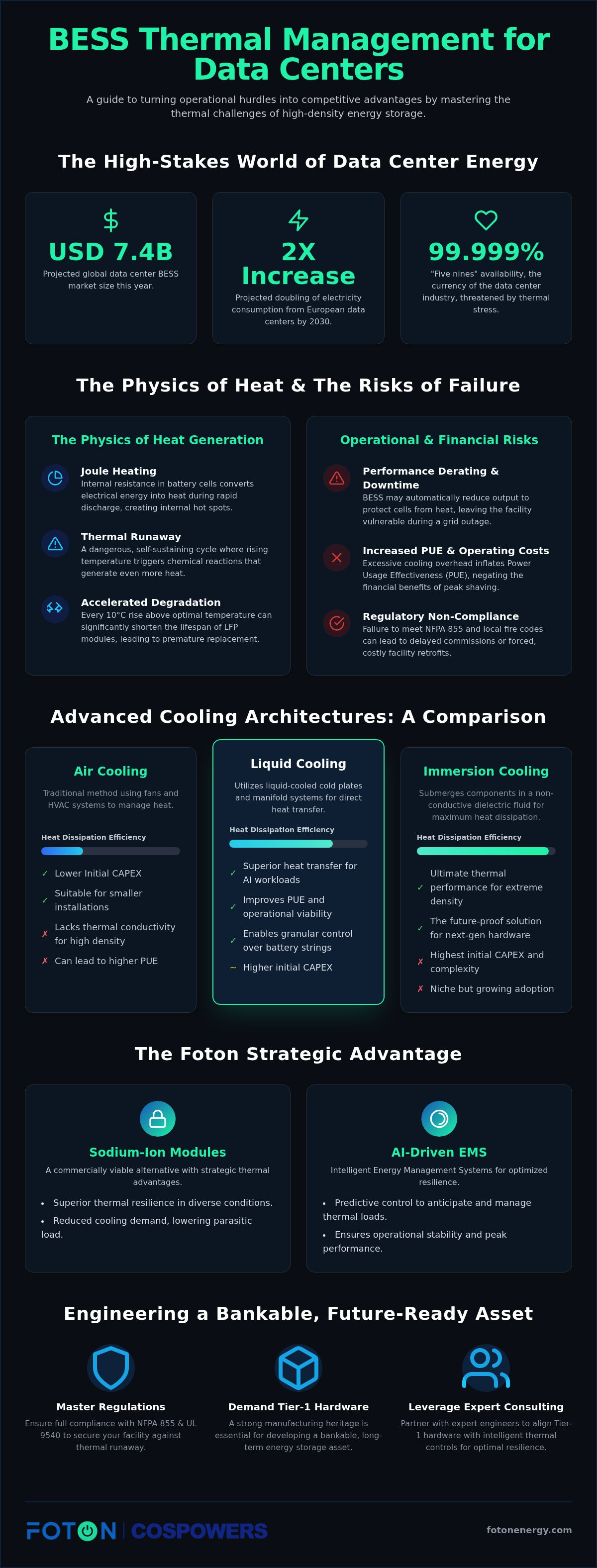
In 2026, the bankability of your infrastructure is no longer measured by uptime alone; it's defined by the sophistication of your BESS thermal management for data centers. With the global data center BESS market projected to reach USD 7.4 billion this year, the pressure to scale without compromising safety has reached a critical peak. You've likely felt the tension between the need for high-density storage and the persistent fear of thermal runaway in mission-critical environments. It's a complex challenge to reduce demand charges through peak shaving while simultaneously managing rising Power Usage Effectiveness (PUE) and navigating the rigorous demands of NFPA 855 compliance.
We're here to help you turn these operational hurdles into competitive advantages. This guide demonstrates how advanced thermal management architectures and AI-driven cooling ensure the long-term safety and performance of your energy storage assets. We'll explore the transition to liquid and immersion cooling, the emergence of sodium-ion batteries as a commercially viable alternative, and how predictive EMS platforms optimize resilience. By aligning Tier-1 hardware with intelligent thermal control, you can secure a future-ready facility that meets both global standards and your own ambitious growth targets.
Key Takeaways
- Master the regulatory requirements of NFPA 855 and UL 9540 to secure your facility against thermal runaway while maintaining full compliance.
- Evaluate the shift from air cooling to liquid and immersion architectures to effectively manage the high-density heat loads generated by modern AI workloads.
- Optimize your BESS thermal management for data centers by integrating AI-driven Energy Management Systems that offer predictive control and operational stability.
- Explore the strategic advantages of Sodium-ion modules, focusing on their superior thermal resilience and reduced cooling demand in diverse environmental conditions.
- Learn why Tier-1 manufacturing heritage and expert engineering consulting are essential for developing a bankable, long-term energy storage asset.
Thermal Management Challenges in High-Density Data Center BESS
High-density computing is fundamentally reshaping the data center floor. As AI workloads drive rack densities toward unprecedented levels, the underlying power infrastructure must evolve to handle the resulting thermal stress. Effective BESS thermal management for data centers is no longer an optional efficiency gain; it's a foundational safety requirement for modern facilities. While server racks benefit from constant forced-air cooling across heat sinks, BESS units generate heat deep within the chemical cells. This internal heat is harder to dissipate and can lead to localized hot spots that compromise the entire battery string.
Inadequate thermal control does more than just threaten safety; it actively erodes your bottom line. Excessive cooling overhead for battery systems directly inflates Power Usage Effectiveness (PUE), which can negate the financial benefits of peak shaving and load shifting. To maintain a bankable asset, operators must bridge the gap between high-performance energy storage and the stringent cooling requirements of mission-critical environments.
The Physics of Heat in Energy Storage
Energy storage systems face unique thermodynamic challenges during rapid discharge events, such as those required for UPS backup. Internal resistance within the cells leads to Joule heating, where electrical energy is converted into heat. A sophisticated battery management system (BMS) must monitor these fluctuations in real time to prevent cell degradation. The thermal runaway chain reaction is a self-sustaining cycle where an initial temperature increase triggers exothermic chemical reactions, which in turn generate more heat, leading to an uncontrollable and rapid rise in temperature. Beyond the immediate safety risks, ambient temperature plays a decisive role in long-term ROI. Industry data suggests that every 10°C rise above the optimal operating temperature can significantly accelerate the degradation of standard LFP modules, leading to premature replacement costs.
Operational Risks of Poor Thermal Control
Uptime is the primary currency of the data center industry. Achieving "five nines" (99.999%) availability requires energy storage that doesn't derate or shut down during periods of thermal stress. When cooling systems fail to keep pace with demand, the BESS may automatically reduce its output to protect the cells, leaving the facility vulnerable during a grid outage. Financial implications extend beyond system failure; they include the hidden costs of accelerated aging and increased insurance premiums. Regulatory pressure is also intensifying. Local fire codes and international standards like NFPA 855 mandate strict thermal boundaries for indoor battery installations. Failure to meet these requirements can lead to delayed project commissions or forced facility retrofits, further impacting the strategic alignment of your infrastructure investments.
Comparing Advanced Cooling Architectures: Liquid vs. Air vs. Immersion
Selecting the right cooling architecture is the most consequential decision in modern system design. While traditional air cooling remains a cost-effective entry point for smaller installations, it often lacks the thermal conductivity required for high-density AI clusters. As electricity consumption from European data centers is projected to double by 2030, the parasitic power load of cooling systems has become a critical metric for operational viability. Effective BESS thermal management for data centers must balance the immediate CAPEX of the cooling hardware against the long-term PUE (Power Usage Effectiveness) gains provided by more efficient heat transfer methods.
Modular cooling architectures are increasingly favored for containerized deployments, allowing for granular control over individual battery strings. In contrast, centralized systems can offer economies of scale but may struggle with localized hot spots. Understanding these trade-offs is essential for engineering a bankable energy storage solution that maintains performance under peak loads. For a deeper technical analysis of these methodologies, this Comparative Review of Thermal Management Systems provides extensive data on heat dissipation rates across different media.
Liquid Cold Plates and Manifold Systems
Liquid cooling has emerged as the industry standard for balancing performance and complexity. By utilizing cold plates and manifold systems, operators can achieve precise temperature control at the cell level. Pumped two-phase cooling is particularly effective, as it leverages the latent heat of vaporization to increase heat transfer efficiency without requiring massive coolant volumes. The integration of Coolant Distribution Units (CDUs) allows for seamless connection to existing data center water loops. While these systems require more rigorous maintenance than air-cooled units, the reduction in battery degradation often justifies the investment. If you are designing a high-capacity facility, our engineering consulting services can help map the ideal manifold layout for your specific site constraints.
Immersion Cooling for Critical Safety
Immersion cooling represents the frontier of BESS thermal management for data centers, especially in multi-story or indoor environments where fire safety is the primary concern. By submerging battery modules in non-conductive dielectric fluids, the system virtually eliminates the risk of cell-to-cell propagation. These fluids act as both a thermal buffer and a fire suppressant. In 2026, EticaAG is launching immersion-cooled BESS products specifically engineered for these mission-critical data center applications. Although the initial CAPEX is higher than air or standard liquid systems, the OPEX is often lower due to significantly reduced fan power and the elimination of complex HVAC ducting. This makes immersion an attractive choice for hyperscale operators who prioritize safety and high-performance density above all else.
Sodium-Ion and AI-EMS: The Foton Strategic Advantage
Strategic hardware selection determines the baseline of your infrastructure's resilience. While Lithium Iron Phosphate (LFP) remains the dominant chemistry for high-density storage, the emergence of sodium-ion technology offers a compelling alternative for mission-critical backup. Foton Energy, as the exclusive global partner of Tier-1 manufacturer Cospowers, provides a dual-pathway approach that integrates advanced cell chemistry with AI-driven software. This synergy is essential for BESS thermal management for data centers, where the goal is to maximize energy density while minimizing cooling-related PUE inflation.
Bridging the gap between hardware and software ensures that your energy storage asset remains bankable over its entire lifecycle. By combining 30 years of manufacturing heritage with modern predictive algorithms, we empower operators to scale their power capacity without the traditional thermal risks. This integrated approach allows for a more granular level of control, transforming the cooling system from a passive utility into an active, intelligent protector of your facility's uptime.
The Thermal Resilience of Sodium-Ion
Sodium-ion cells possess an inherently stable thermal profile. Unlike high-nickel Lithium chemistries that are prone to oxygen release at elevated temperatures, sodium-ion demonstrates a significantly lower risk of thermal runaway. This stability allows for operation across a wider temperature range, which reduces the constant demand on high-performance HVAC systems. It's an ideal solution for non-conditioned environments or remote telco sites where consistent climate control is difficult to maintain. For a deeper look at how this chemistry addresses specific infrastructure needs, explore the benefits of a sodium-ion battery for data centers. By leveraging these modules, operators can design more flexible power architectures that rely less on active cooling and more on inherent chemical safety.
AI-Driven Predictive Cooling Strategies
Software is the intelligence layer that protects your hardware investment. Foton's Energy Management System (EMS) utilizes machine learning algorithms to transition from reactive cooling to intelligent thermal management. By analyzing historical load patterns and real-time sensor data, the system can forecast thermal spikes before they occur. This allows the cooling architecture to pre-cool the environment or adjust discharge rates dynamically, ensuring the cells stay within their optimal performance window. Predictive maintenance is another critical feature; the EMS identifies subtle temperature anomalies in individual cells, flagging potential failures before they reach a critical state. This proactive approach ensures that your BESS thermal management for data centers isn't just about moving heat, but about preventing it through smarter load distribution and system-wide optimization.
Safety Architecture and Compliance for Mission-Critical Sites
Safety in energy storage is a multi-layered discipline that extends far beyond basic cooling. For mission-critical data centers, the integrity of the safety architecture determines whether a facility can be insured and operated within dense urban environments. Effective BESS thermal management for data centers must incorporate robust physical barriers and active suppression systems to mitigate the risks associated with high-density energy modules. This involves a transition from simple temperature monitoring to a comprehensive safety ecosystem that includes gas detection, toxic gas neutralization, and structural containment.
Prevention starts at the cell level, where physical barriers are designed to stop a single cell failure from cascading into a full-scale rack fire. If containment fails, the secondary safety layer must engage immediately. Modern BESS containers utilize specialized gas detection sensors that identify the off-gassing of volatile organic compounds (VOCs) long before a flame is visible. By neutralizing these gases and utilizing emergency exhaust systems, operators can prevent the buildup of explosive atmospheres within the enclosure, protecting both personnel and adjacent server infrastructure.
Navigating UL 9540A and NFPA 855
Understanding the nuances of international safety standards is essential for project bankability. NFPA 855 provides the framework for installation and spacing, while UL 9540 defines the system-level safety requirements. UL 9540A is the gold standard for BESS safety in 2026 because it provides the empirical data required to prove that a thermal runaway event will not propagate beyond the initial unit. Data center operators must review these large-scale fire testing results to ensure their specific site layout remains compliant. To navigate these complex regulatory waters, our engineering consulting services provide the technical expertise needed to align your hardware procurement with local grid codes and fire safety mandates.
Integrated Fire Suppression Technology
Active suppression systems have evolved to protect both the battery assets and the surrounding server infrastructure. Clean agent suppression, such as Novec 1230, is frequently preferred for indoor installations because it's non-conductive and leaves no residue on sensitive electronics. These systems work in tandem with automated thermal shut-off protocols managed at the EMS level. If the BESS thermal management for data centers detects a critical temperature breach, the EMS can instantly isolate the affected string to stop the flow of current. Additionally, integrated ventilation systems are designed for emergency gas venting, ensuring that any smoke or toxic byproducts are safely directed away from the data center's primary air intakes.
Strategic Procurement: Engineering a Bankable BESS Solution
Procuring a high-performance energy storage system requires a shift from viewing hardware as a commodity to viewing it as a long-term strategic asset. In 2026, the success of a project isn't just determined by energy density; it's defined by the reliability of the supply chain and the technical depth of the integration. Effective BESS thermal management for data centers serves as a primary risk mitigation tool, ensuring that your facility remains operational during peak AI workloads while protecting the physical integrity of the battery cells. By prioritizing sophisticated cooling architectures during the procurement phase, you're not just buying equipment; you're securing a 20-year revenue stream.
Evaluating the Total Cost of Ownership (TCO) is vital for maintaining data center bankability. While advanced liquid or immersion cooling systems may carry a higher initial CAPEX than traditional air-cooled alternatives, they significantly reduce long-term OPEX through lower Power Usage Effectiveness (PUE) and extended battery cycle life. Foton Energy supports EPC partners by bridging the gap between Tier-1 hardware procurement and complex site-specific engineering. This collaborative approach ensures that every thermal management decision is grounded in operational excellence and global safety standards.
Tier-1 Assurance and DNV Verification
Financiers and insurers prioritize stability, which is why a Tier-1 manufacturing heritage is non-negotiable for large-scale infrastructure. Our exclusive partnership with Cospowers leverages over 30 years of manufacturing excellence, providing the rigorous testing and DNV-verified reliability that mission-critical sites demand. This heritage ensures that the LFP and sodium-ion modules you install today will perform as expected for decades. To maximize the value of these assets, our BESS engineering consulting services offer the strategic guidance needed to navigate grid-code compliance and optimize system integration from the earliest stages of project feasibility.
End-to-End Implementation Support
Successful deployment requires a partner who understands the entire lifecycle of the asset, from initial feasibility studies to final commissioning. Foton's global channel partner programme, active in over 70 countries, provides the local expertise and logistical support necessary for seamless implementation. We don't just deliver hardware; we provide the engineering intelligence to ensure your BESS thermal management for data centers is perfectly matched to your facility's unique power profile. For operators looking to future-proof their energy architecture, the next step is a comprehensive thermal review. Contact our technical team today to request a site-specific architecture assessment and discover how we can enhance the safety and bankability of your next energy storage project.
Securing the Future of Data Center Power Architecture
The landscape of energy storage is shifting toward high-density, AI-driven environments where thermal stability is the ultimate metric of long-term success. We've explored how transitioning from traditional air cooling to advanced liquid and immersion architectures provides the heat transfer efficiency required to maintain aggressive PUE targets. Simultaneously, the adoption of Sodium-ion chemistry and AI-driven Energy Management Systems offers a more resilient, self-optimizing profile for mission-critical facilities. It's clear that sophisticated BESS thermal management for data centers has evolved into a foundational pillar of project bankability and operational security.
By aligning your infrastructure with a partner that provides Tier-1 manufactured LFP and Sodium-ion modules, you ensure your facility is backed by a 30-year manufacturing heritage. We're here to help you navigate the complexities of NFPA 855 compliance and predictive thermal control through our expert engineering consulting. Partner with Foton Energy for Tier-1 BESS Solutions and take the next step in optimizing your facility's energy resilience. We look forward to building a stable and high-performance future with you.
Frequently Asked Questions
What is the best thermal management system for a data center BESS?
Liquid cooling is currently the optimal choice for high-density hyperscale environments due to its superior heat transfer coefficients. While air cooling remains viable for smaller, low-density installations, it struggles to manage the intense thermal loads of AI-driven computing. Immersion cooling represents the high-performance frontier for indoor multi-story sites where fire safety is the absolute priority. Selecting the right architecture depends on your facility's power density and your site's specific safety requirements.
Is liquid cooling safer than air cooling for Lithium-ion batteries?
Liquid cooling offers enhanced safety by providing more precise temperature control at the cell level, which prevents the localized hot spots that lead to runaway. By using cold plates or dielectric fluids, these systems can absorb significantly more heat than air ever could. This superior heat dissipation reduces the thermal stress on Lithium Iron Phosphate (LFP) modules. It's a critical component of BESS thermal management for data centers that prioritize long-term asset security and operational uptime.
How does BESS thermal management affect a data center's PUE?
Cooling overhead from energy storage systems directly impacts the Power Usage Effectiveness (PUE) by increasing non-IT power consumption. Inefficient air-cooled systems can lead to a higher PUE due to the massive fan power required to move heat. Advanced liquid-cooled architectures typically operate with lower parasitic loads. By optimizing the cooling strategy, you can maintain a lean PUE while still benefiting from the peak shaving and grid services that a bankable BESS solution provides to your facility.
What are the NFPA 855 requirements for data center battery storage?
NFPA 855 mandates strict standards for the installation, spacing, and fire protection of stationary energy storage systems. Key requirements include a maximum of 50 kWh per unit and a minimum of three feet between units, unless large-scale fire testing proves otherwise. Operators must also implement sophisticated gas detection and toxic gas neutralization systems. Compliance ensures that your facility meets the rigorous safety expectations of local fire marshals and international insurance underwriters for mission-critical sites.
Can Sodium-ion batteries eliminate the need for active cooling in data centers?
Sodium-ion batteries don't eliminate the need for cooling entirely, but they do significantly reduce the operational demand on thermal management systems. Their inherent chemical stability allows them to operate safely across a much wider temperature range than traditional chemistries. This resilience means that in some telco or remote edge environments, you can rely on passive or simplified cooling. This makes them a strategic choice for reducing cooling-related energy costs while maintaining high-performance safety standards.
What happens if a BESS thermal management system fails?
A failure in the thermal management system typically triggers an automated safety protocol that derates or completely shuts down the battery string. This protective measure prevents cells from reaching critical temperatures that lead to thermal runaway. However, a shutdown can compromise your facility's "five nines" reliability and uptime. Using redundant cooling loops and AI-driven monitoring ensures that thermal issues are flagged and mitigated before they result in a system-wide outage or premature battery degradation.
How does AI-driven EMS improve BESS safety and longevity?
AI-driven Energy Management Systems use predictive machine learning to forecast thermal spikes based on historical load patterns and real-time sensor data. By identifying subtle temperature anomalies early, the EMS can adjust discharge rates or engage cooling systems before heat reaches dangerous levels. This proactive approach to BESS thermal management for data centers prevents accelerated degradation caused by chronic overheating. It ultimately extends the cycle life and bankability of your Tier-1 manufactured modules.
What is the difference between UL 9540 and UL 9540A for BESS?
UL 9540 is the standard for the entire energy storage system, certifying its safety and integration as a whole unit. In contrast, UL 9540A is a specific test method used to evaluate fire propagation in the event of a thermal runaway. While UL 9540 is a certification, UL 9540A provides the empirical data required by engineers and fire marshals to determine safe spacing. Both are essential for demonstrating the bankability and resilience of your infrastructure.


