

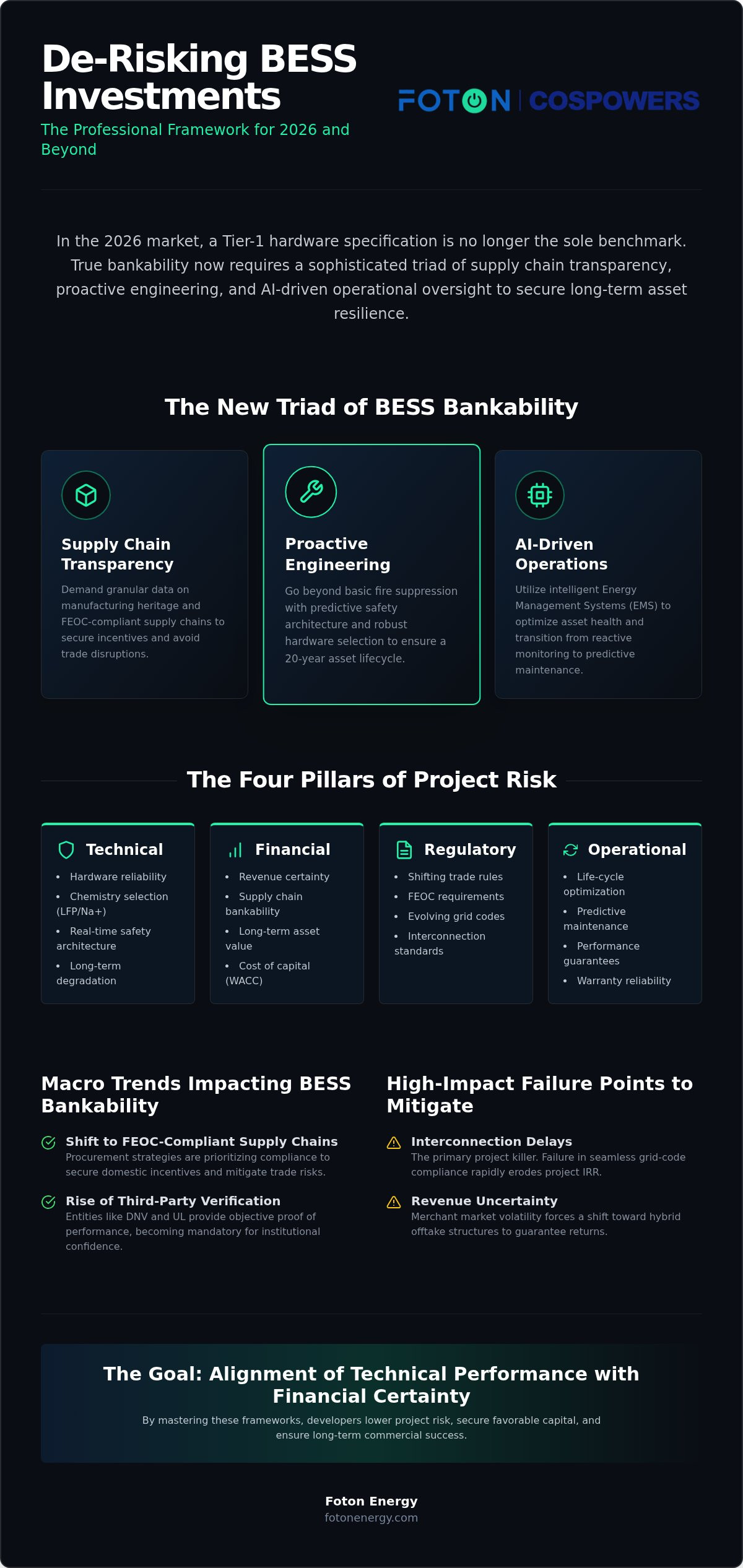
A Tier-1 hardware specification is no longer the sole benchmark for a successful battery energy storage system (BESS) investment. In the 2026 market, bankability requires a sophisticated triad of supply chain transparency, proactive engineering, and AI-driven operational oversight. You've likely recognized that de-risking energy storage projects is no longer just about meeting a legal checklist. It's about navigating the complexities of FEOC rules and ensuring that your thermal runaway safeguards go beyond basic fire suppression to include predictive safety architecture.
We understand that the path to a lower cost of capital feels increasingly narrow as grid-code requirements tighten and supply chain uncertainties persist. This guide reveals the professional frameworks and technical safeguards required to ensure the long-term resilience of large-scale energy storage investments. We'll explore how Foton Energy utilizes 30 years of manufacturing heritage and DNV-verified standards to secure your assets. From the strategic selection of Sodium-ion for risk-averse applications to the implementation of intelligent EMS for seamless grid interconnection, you'll gain the clarity needed to transform technical stability into commercial success.
Key Takeaways
- Evaluate the 2026 risk landscape to move beyond basic performance metrics and address complex regulatory and supply chain hurdles effectively.
- Implement a technical triad of Tier-1 hardware, AI-driven oversight, and proactive engineering to ensure your project remains bankable for global financiers.
- Master the process of de-risking energy storage projects by selecting chemistries like Sodium-ion or LFP that align with specific safety and resilience requirements.
- Leverage AI-driven Energy Management Systems to optimize asset state-of-health and transition from reactive monitoring to predictive maintenance.
- Streamline grid-code compliance and secure favorable investment terms through recognized third-party certifications and DNV-verified standards.
The Shifting Risk Landscape for BESS Projects in 2026
The 2026 energy storage market has matured beyond simple performance metrics. Early projects focused primarily on round-trip efficiency and degradation rates, but today's investors face a much broader spectrum of volatility. Effectively de-risking energy storage projects now requires a holistic view of the entire industrial ecosystem. Capital has become increasingly selective. Financiers are no longer satisfied with generic Tier-1 labels; they demand granular data on manufacturing heritage and long-term asset resilience. This shift reflects a disciplined investment environment where quality is prioritized over sheer volume.
By addressing risk proactively, developers can significantly lower their weighted average cost of capital (WACC). A project backed by rigorous technical proof points and clear regulatory alignment presents a lower risk profile to lenders, unlocking more favorable interest rates and higher leverage. This financial optimization is only possible when developers master the four pillars of project risk:
- Technical: Hardware reliability, chemistry selection like Sodium-ion for high-security applications, and real-time safety architecture.
- Financial: Revenue certainty, bankability of the supply chain, and long-term residual asset value.
- Regulatory: Compliance with shifting trade rules, FEOC requirements, and evolving grid codes.
- Operational: Life-cycle optimization through intelligent energy management and predictive maintenance.
Macro Trends Impacting BESS Bankability
Procurement strategies are shifting toward Foreign Entity of Concern (FEOC) compliant supply chains to secure domestic incentives and avoid trade disruptions. Transparency is the new currency for 2026 investors. We're seeing BESS transition from standalone speculative assets to critical components that stabilize broader renewable portfolios. As a result, late-stage acquisitions now hinge on rigorous third-party verification from entities like DNV or UL. These certifications provide the objective proof required for institutional confidence and long-term asset security.
Identifying High-Impact Failure Points
Interconnection delays remain the primary project killer in the current market. Without seamless grid-code compliance, even the most advanced hardware sits idle, which rapidly erodes internal rates of return. Revenue uncertainty also complicates the landscape, as merchant market volatility forces a shift toward hybrid offtake structures that blend fixed payments with sophisticated market participation. Bankability is the alignment of technical performance with financial certainty. Identifying these failure points early allows for a more resilient engineering approach that protects the investor's bottom line.
Ensuring Hardware Reliability: Tier-1 Manufacturing and Chemistry Selection
Hardware selection is the first line of defense in de-risking energy storage projects. While software optimizes performance, the physical durability of the battery cells determines whether an asset can actually survive its 20-year financial lifecycle. Investors in 2026 are looking beyond simple labels. They're scrutinizing manufacturing heritage and technical architecture to ensure that initial capital expenditures translate into long-term operational stability. Selecting hardware isn't just about procurement; it's about securing a multi-decade performance guarantee.
The Tier-1 Standard: Beyond the Manufacturer List
A Tier-1 designation is often treated as a binary checkbox, but true bankability is found in manufacturing lineage. Foton’s exclusive global partnership with Cospowers brings over 30 years of industrial heritage to every installation. This longevity is critical for warranty reliability. If a manufacturer hasn't existed as long as the warranty they offer, the paper guarantee is essentially worthless. High-performance projects rely on fully automated production lines that minimize cell-level defects, ensuring that every containerized unit performs with the uniformity required for large-scale utility and C&I applications. This depth of experience ensures supply chain continuity even in volatile markets.
LFP vs. Sodium-Ion: A Strategic Risk Comparison
Choosing the right chemistry is a vital part of de-risking energy storage projects. Lithium Iron Phosphate (LFP) remains the industry standard for high-density, high-cycle utility applications due to its proven track record and energy density. However, 2026 has seen the rise of Sodium-ion as a strategic alternative for specific risk-averse environments. Sodium-ion excels in cold climates where LFP performance might dip, and its inherent safety profile makes it ideal for data centers and telecommunications backup. For a deeper dive into these applications, consult our Strategic Guide to Commercial and Industrial BESS Solutions.
Maintainability is often overlooked during the procurement phase. Modular architecture in containerized systems allows for seamless component replacement without decommissioning the entire unit. This design philosophy protects your 20-year financial assumptions by ensuring that degradation rates remain within expected bounds and that maintenance doesn't become a bottleneck. By prioritizing modularity and proven cycle life, you secure the physical integrity of your investment. If you're looking to fortify your next infrastructure project, our team can provide a detailed technical consultation on hardware selection to align with your specific risk profile.
Mitigating Operational Risk with AI-Driven Management Systems
The operational integrity of a BESS asset in 2026 depends entirely on the sophistication of its Energy Management System (EMS). While hardware provides the physical foundation, the "brain" of the system is what ultimately protects your investment from long-term degradation and safety hazards. De-risking energy storage projects now requires a transition from passive data logging to AI-driven predictive oversight. This evolution ensures that minor technical variances are corrected before they escalate into systemic failures or costly downtime.
Predictive Maintenance and Asset Longevity
AI-driven systems provide a granular view of battery health that human monitoring simply cannot match. By analyzing millions of data points across the system architecture, these platforms identify cell-level anomalies, such as voltage drift or internal resistance changes, weeks before a physical failure occurs. This proactive approach is essential for maintaining state-of-health (SoH) over a 20-year horizon. Intelligent EMS platforms also optimize discharge cycles to fulfill lucrative offtake agreements while simultaneously minimizing excessive degradation. For a deeper technical analysis of these capabilities, see our AI Driven Energy Management Systems: The 2026 Strategic Guide.
Safety Architecture and Thermal Oversight
Fire safety architecture has evolved into a multi-layered technical triad. While integrated fire suppression remains a regulatory requirement, AI-monitored cooling loops offer a superior method of prevention. Advanced thermal management systems utilize AI-monitored cooling loops to detect localized heat spikes and modulate coolant flow before a cell reaches the critical threshold for thermal runaway. This real-time oversight is a significant factor in de-risking energy storage projects, as it provides the documented safety data that insurers demand. Projects that can prove active thermal oversight often secure more favorable insurance premiums and lower overall operational expenditures.
Cybersecurity has also become a non-negotiable pillar of BESS bankability. As grid-connected assets become more integrated with utility networks, they face increasing digital vulnerabilities. Protecting these systems involves end-to-end encryption and robust firewall protocols within the EMS to prevent unauthorized access or market manipulation. By integrating hardware safety with digital resilience, developers create a high-performance asset that is both physically secure and financially stable. This comprehensive approach to operational risk is what separates speculative ventures from truly bankable infrastructure.
Navigating Regulatory and Financial De-risking Frameworks
Bankability in 2026 isn't just a technical achievement; it's a regulatory one. For an asset to be truly financeable, every component must align with a complex web of trade rules and grid requirements. Achieving grid-code compliance is often the most significant hurdle to commercial operation. Without it, your project remains a stranded asset. De-risking energy storage projects at this level requires rigorous adherence to third-party certifications such as Bloomberg Tier-1 and DNV verification. These standards provide the objective proof points that institutional lenders require before releasing capital.
Trade risk has also moved to the forefront of the investment thesis. Diversifying the global supply chain is no longer optional. The implementation of 'FEOC' (Foreign Entity of Concern) rules has fundamentally changed the ROI calculation for many developers. These regulations impact tax credit eligibility, meaning that a project's financial viability often hinges on the geographic origin of its battery cells. Navigating these hurdles successfully ensures that your project captures maximum incentives while avoiding costly tariff penalties.
The Road to Grid-Scale Bankability
A robust EPC contract is the primary tool for risk allocation. It clearly defines who bears the burden of performance during construction and commissioning. Tier-1 hardware agreements should include specific liquidated damages and performance guarantees to protect the investor's interests. Long-term O&M bankability is another essential factor. Lenders need to see a stable maintenance plan backed by a partner with a proven manufacturing heritage. This ensures the asset remains operational and revenue-generating for its entire intended lifespan. To secure your project's financial future through expert engineering consulting and hardware procurement, contact our team today.
Partnering for Resilience: Foton’s End-to-End De-risking Strategy
Strategic alignment between technical engineering and hardware procurement is the ultimate differentiator in the 2026 BESS market. Foton Energy doesn't just supply equipment; we act as the foundational pillar for your project's long-term success. By integrating specialized engineering consulting with wholesale access to Tier-1 technology, we eliminate the friction often found between design and deployment. This dual-track approach is central to de-risking energy storage projects, ensuring that every technical specification is grounded in both commercial reality and manufacturing capability.
The advantage of an exclusive partnership becomes clear when navigating a volatile global market. Our collaboration with Cospowers provides access to 30 years of manufacturing heritage, offering a level of stability that newer market entrants simply cannot match. This connection allows us to deliver customized safety and thermal architecture for mission-critical applications such as data centers and hospitals. In these environments, failure isn't an option. Our engineering teams design systems that prioritize fire safety and operational continuity, moving projects from initial feasibility to final commissioning with a significantly reduced risk profile.
Integrated Engineering and Supply Chain Support
Grid-code compliance and system integration are no longer secondary concerns. They're the primary determinants of a project's commercial success. Foton manages these technical complexities by leveraging a global network built for resilience. We provide the end-to-end oversight needed to ensure that your system meets the specific requirements of local operators without the typical delays associated with fragmented procurement. For a detailed look at our specialized support, explore our BESS Engineering Consulting Services: 2026 Guide. This proactive management is a vital component of de-risking energy storage projects in a complex regulatory environment.
The Foton Advantage for EPCs and Developers
Speed to market is a critical metric for developers facing 2026 deadlines. Foton’s modular, pre-commissioned containerized solutions reduce project timelines by streamlining the on-site installation and testing process. Once your asset is live, our AI-driven Energy Management Systems provide ongoing technical support, ensuring that asset health is maintained at peak levels for the duration of the offtake agreement. We invite you to collaborate with a partner who understands the high-performance demands of modern infrastructure. Contact Foton Energy to de-risk your next utility-scale project and secure a bankable future for your energy investments.
Securing the Future of Grid-Scale Infrastructure
The 2026 energy market demands a shift from speculative investment to rigorous technical certainty. Success in this sector is no longer defined by simple capacity. It's defined by the depth of a project's technical and regulatory alignment. By prioritizing Tier-1 hardware, advanced AI-driven management, and strict compliance frameworks, developers secure the long-term bankability required to attract institutional capital. Effectively de-risking energy storage projects is the only path to achieving a lower cost of capital while ensuring asset resilience in a volatile global market.
Foton Energy stands as your strategic partner in navigating these complexities. As the exclusive global partner of Cospowers, we leverage 30+ years of manufacturing heritage to provide the stability your investors demand. Our team provides full grid-code compliance engineering support and deploys intelligent EMS to protect your mission-critical infrastructure. It's time to transform technical potential into commercial reality and sustainable growth.
Partner with Foton Energy for bankable BESS solutions and build a resilient energy future today.
Frequently Asked Questions
What are the primary risks involved in utility-scale energy storage projects?
Primary risks include technical failure, revenue volatility, and shifting regulatory landscapes. Effectively de-risking energy storage projects at this scale requires a multi-layered approach to address hardware reliability and grid-code compliance. Investors also face supply chain risks, particularly concerning Foreign Entity of Concern (FEOC) rules that impact tax credit eligibility. Operational risks such as excessive cell degradation can erode long-term financial returns if not managed by sophisticated energy management systems and predictive maintenance protocols.
How does Tier-1 certification affect BESS project financing?
Tier-1 certification acts as a critical signal of manufacturing stability and financial durability for institutional lenders. It ensures that the hardware provider has the bankability to support 20-year warranties and long-term service agreements. Financiers use these lists to filter out speculative manufacturers, reducing the perceived risk of project default. Without Tier-1 status, developers often face higher interest rates or more restrictive debt covenants, which can significantly impact the overall project internal rate of return.
Can Sodium-ion batteries help de-risk projects in extreme climates?
Sodium-ion batteries provide a superior safety profile and operational stability in environments where traditional Lithium Iron Phosphate (LFP) might struggle. Their chemistry is naturally resistant to thermal runaway and maintains high discharge efficiency in sub-zero temperatures. This makes them an excellent tool for de-risking energy storage projects in remote high-altitude sites or extreme desert climates. For mission-critical applications like data centers, the enhanced safety and temperature tolerance of Sodium-ion systems offer a bankable layer of protection.
What role does an Energy Management System (EMS) play in de-risking?
An Intelligent Energy Management System (EMS) transitions an asset from passive monitoring to proactive risk mitigation. It optimizes the state-of-health (SoH) by managing discharge cycles and identifying cell-level anomalies before they lead to hardware failure. Additionally, the EMS serves as the primary gateway for cybersecurity, protecting grid-connected assets from digital vulnerabilities. By integrating real-time thermal oversight and predictive maintenance, the software ensures the physical and financial longevity of the entire battery energy storage system.
How do 2026 tariff regulations impact energy storage procurement?
Current tariff regulations emphasize supply chain transparency and domestic content requirements to qualify for lucrative tax incentives. Procurement strategies must now account for 'FEOC' rules, which restrict hardware sourced from specific entities to protect national energy security. These regulations can shift project ROI overnight if the supply chain isn't properly diversified. Developers must partner with providers who offer transparent, compliant hardware solutions to ensure their projects remain eligible for federal support and avoid unexpected customs duties.
What is DNV verification and why is it important for BESS bankability?
DNV verification is an independent technical assessment that validates the performance, safety, and reliability claims of a BESS manufacturer. It provides a bankable assurance that the system meets rigorous international standards, which is essential for securing large-scale project finance. Lenders rely on this third-party data to verify that the hardware will perform as promised over its intended lifecycle. Achieving this standard demonstrates a commitment to operational excellence and significantly reduces the technical due diligence burden for financiers.
How can I minimize the risk of fire in a large-scale BESS deployment?
Minimizing fire risk requires a combination of high-quality hardware and active safety architecture. Investors should prioritize Tier-1 systems with 30 years of manufacturing heritage, as these products undergo extensive testing for thermal stability. Integrating AI-monitored cooling loops allows for real-time detection of heat anomalies, preventing thermal runaway before it starts. Documenting these safety layers and using chemistries like Sodium-ion where appropriate can also help reduce insurance premiums and ensure long-term site security for large-scale deployments.
What should be included in a BESS project feasibility study?
A comprehensive feasibility study must include detailed technical system design, grid-code compliance analysis, and robust economic modeling. It should evaluate the specific site conditions, such as climate and interconnection availability, to determine the most effective battery chemistry. The study also needs to address the regulatory landscape, including tariff impacts and environmental permitting. By identifying potential hurdles early, developers can create a clear roadmap for bankability that satisfies the rigorous diligence requirements of institutional investors and project lenders.


