

Static backup power is no longer an acceptable capital sink for modern mission-critical facilities. Upgrading legacy UPS systems with BESS transforms idle, depreciating capacity into an active resilience hub that safeguards operational uptime while delivering bankable value. If you manage high-density data halls or critical power infrastructure, you already understand the relentless friction of traditional VRLA installations. Short replacement intervals, heavy structural floor loading constraints, rising cooling energy overhead, and strict indoor fire protection codes continually drain technical bandwidth and operational budgets.
Critical facilities can't afford stranded capital sitting purely as standby capacity when escalating power demands require flexible, high-density assets. Discover how upgrading legacy UPS infrastructure with advanced BESS mitigates risk, cuts footprint, and unlocks dynamic revenue stacking through peak shaving and active grid participation. Ahead, we outline the definitive 2026 engineering guide to hardware retrofits, covering Tier-1 chemistry selection, NFPA 855 hazard mitigation compliance, and integration strategies designed to preserve absolute uptime.
Key Takeaways
- Eliminate structural floor loading constraints, recurring replacement cycles, and high cooling overhead by replacing legacy VRLA blocks with compact, high-density battery architectures.
- Evaluate the operational profiles of Tier-1 LFP and commercial sodium-ion chemistries to meet stringent thermal safety standards, cold-weather demands, and UL 9540A compliance.
- Execute precision DC bus voltage matching and live cutover procedures when upgrading legacy UPS systems with BESS to safeguard critical facility uptime without replacing existing inverters.
- Unlock dynamic revenue stacking and peak shaving by integrating intelligent EMS platforms, turning idle standby capacity into a high-yield dispatchable asset.
- Deploy a structured engineering roadmap from initial feasibility to grid compliance to de-risk electrical integration, permitting, and multi-tier hazard mitigation.
The Operational Limits of Legacy UPS: Why VRLA Demands BESS Modernization
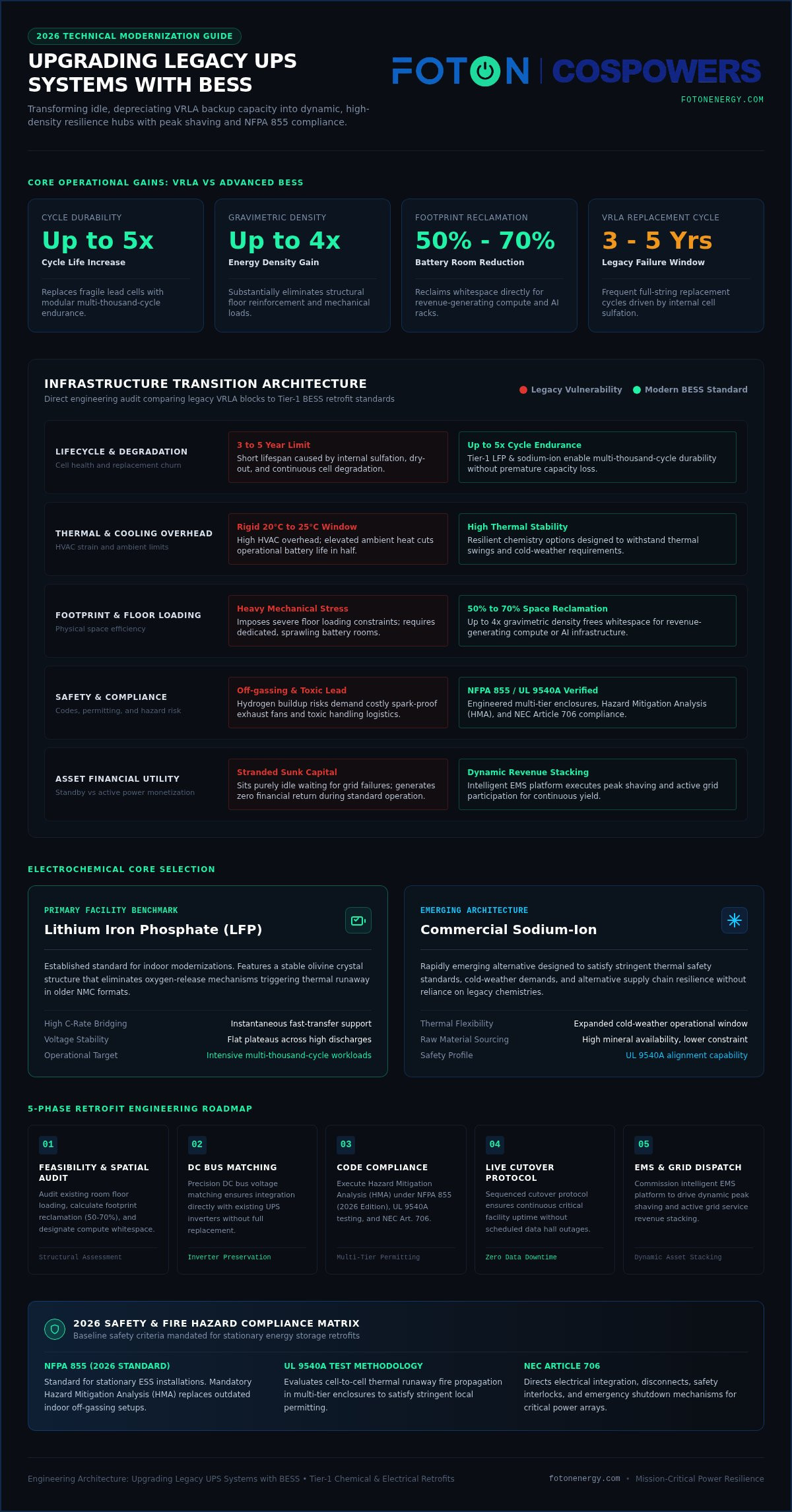
Valve-regulated lead-acid (VRLA) batteries remain a persistent vulnerability in critical power architectures. While legacy systems historically provided basic failover protection, today's high-density operational profiles expose their severe physical and economic constraints. Upgrading legacy UPS systems with BESS bypasses these bottlenecks, replacing fragile electrochemical cells with resilient, modular storage that delivers up to five times the cycle life of traditional setups.
The Hidden Total Cost of Ownership in Aging Lead-Acid Arrays
Lead-acid blocks demand aggressive capital churn. Operating lifespans rarely exceed three to five years before internal sulfation, dry-out, and cell degradation force full-string replacements. Beyond recurring procurement cycles, VRLA strings require rigid climate regulation around 20°C to 25°C; elevated ambient heat cuts their operational life in half. Factor in continuous manual impedance audits, hazardous materials disposal logistics, and the administrative overhead of toxic lead handling, and the true cost of legacy standby capacity quickly escalates.
Spatial Constraints, Structural Loads, and Power Density Pressures
Density drives modern computational facilities. Legacy battery banks occupy massive physical footprints while imposing extreme mechanical stress on multi-story data centres and urban enterprise facilities. Modern battery energy storage systems (BESS) deliver significant volumetric advantages:
- Drastic load reduction: Advanced battery modules achieve up to four times the gravimetric energy density of lead-acid, eliminating structural floor reinforcement mandates.
- Footprint reclamation: Concentrated power architectures slash battery room footprint by 50% to 70%.
- Whitespace expansion: Reclaimed square footage converts directly into revenue-generating compute whitespace or high-density AI infrastructure.
Regulatory Safety Mandates and Thermal Management Standards
Facility compliance mandates are tightening rapidly. The 2026 edition of NFPA 855 establishes rigorous baseline criteria for stationary energy storage installations, making a Hazard Mitigation Analysis (HMA) a standard requirement across commercial properties. Outdated lead-acid configurations introduce persistent off-gassing and hydrogen accumulation hazards, requiring costly dedicated exhaust pathways and spark-proof ventilation systems.
Executing an intentional strategy for upgrading legacy UPS systems with BESS resolves these audit risks. Engineered multi-tier enclosures integrate cell-level monitoring and advanced safety protections, aligning installations with UL 9540A test methodologies and modern NEC Article 706 guidelines. This modular engineering approach simplifies local permitting while shielding mission-critical assets from unmitigated thermal failure.
Evaluating Next-Generation Battery Chemistries: Advanced LFP vs Sodium-Ion
Selecting the optimal electrochemical core determines the operational success of your retrofit. When upgrading legacy UPS systems with BESS, engineering teams must weigh thermal profiles, cycle durability, and raw material availability. Moving past obsolete nickel-manganese-cobalt (NMC) blends and maintenance-heavy lead plates, modern critical facilities rely primarily on Lithium Iron Phosphate (LFP) alongside rapidly emerging sodium-ion architectures.
Lithium Iron Phosphate (LFP) for High C-Rate Discharge and Cycle Stability
LFP stands as the established benchmark for indoor facility modernization. Its stable olivine crystal structure resists structural breakdown during repeated fast charging and high-rate bridging discharges, effectively eliminating the oxygen-release mechanisms that trigger rapid thermal runaway in older lithium formats. For facilities targeting intensive, multi-thousand-cycle operations, pairing Tier-1 cells with robust commercial and industrial BESS solutions ensures stable voltage plateaus during instantaneous power transfers without premature capacity loss.
Sodium-Ion Storage for Extreme Climates and Inherent Fire Safety
Sodium-ion is reshaping mission-critical installations by offering distinct physical advantages. The chemistry allows full discharge to zero volts for completely safe transport and storage, drastically reducing warehouse logistics risks. Beyond handling extreme sub-zero temperatures without supplementary heating loads, sodium relies on abundant precursor materials that insulate enterprise supply lines from mineral market volatility. Deploying a dedicated sodium-ion battery for data centers provides an inherently non-combustible alternative for sites facing strict municipal zoning restrictions or severe environmental extremes.
Sourcing Bankable Tier-1 Hardware with Proven Manufacturing Provenance
Hardware bankability hinges on manufacturing heritage and international compliance. Facility engineers evaluating cell suppliers must verify stringent benchmarks to secure insurance underwriting and regulatory approvals:
- Proven manufacturing lineage: Prioritize hardware backed by established manufacturing ecosystems and extensive decades-long production heritage dedicated to advanced cell manufacturing.
- UL 9540A unit testing: Validate that module assemblies prevent cell-to-cell thermal propagation under induced thermal failure conditions.
- Multi-tier BMS telemetry: Enforce real-time monitoring of current, cell voltage, and module temperatures to enable automated circuit isolation before internal faults escalate.
Rigorous hardware testing is essential when transitioning UPS from sunk cost to revenue asset, ensuring that secondary cycling duties never compromise primary backup reliability. If your engineering team is evaluating chemistry trade-offs, consulting with a trusted partner like Foton Energy (Foton Pty Ltd) can streamline hardware selection and project modeling.
Engineering the Retrofit: Electrical Integration, DC Coupling, and Cutover Protocol
A cost-effective modernization does not require ripping out operational power electronics. In brownfield facilities, the core rectifier-inverter blocks and switchgear represent major past capital investments that often remain fully functional. Successfully upgrading legacy UPS systems with BESS centers on decoupling the aging electrochemical array from the DC link, directly retrofitting advanced battery racks into existing bus architecture without necessitating total switchgear replacement.
Matching DC Bus Voltage Windows and Rectifier Float Profiles
Precision calibration between the battery management system (BMS) and existing rectifiers ensures smooth electrical compatibility. Engineers must align the BESS operating window with the inverter's maximum DC input threshold and inverter low-voltage cut-off limit. Unlike lead-acid strings that demand perpetual trickle charging to counteract self-discharge, modern LFP and sodium-ion cells degrade under sustained high float voltages. Rectifier firmware must be reprogrammed from float-and-equalize charging algorithms to a two-stage constant-current and constant-voltage profile, completely terminating current flow once cells hit optimal state-of-charge.
Protective Device Coordination and Arc-Flash Recalibration
Modern battery chemistries exhibit significantly lower internal resistance than lead-acid, driving available short-circuit currents up sharply. This surge alters site protection mechanics:
- Trip curve recalibration: Standard thermal-magnetic breakers often react too slowly to instantaneous high-fault discharge currents, creating severe arc hazards.
- Semiconductor fuse upgrades: High-speed DC fuses and electronic trip units must be resized to clear prospective short circuits in milliseconds without nuisance tripping under normal transient inrush.
- Arc-flash boundary recalculations: In accordance with updated fault parameters, technicians must recalculate incident energy levels and update physical boundary labeling across all DC disconnect panels.
Phased Cutover Protocols: Maintaining N+1 Redundancy During Installation
Critical loads cannot tolerate planned outages during infrastructure overhauls. Executing a modular cutover protocol ensures continuous site uptime by isolating redundant strings sequentially. In an N+1 architecture, string A is safely disconnected, de-energized, and swapped with the new battery bank while string B carries facility power unassisted. Before rejoining the active DC link, technicians deploy temporary load banks to perform full step-load rejections, acceptance trials, and BMS communication verification. Leveraging expert BESS engineering consulting services guarantees that voltage syncing, protective coordination, and dynamic cutovers execute seamlessly without putting active IT workloads at risk.
Unlocking Dynamic Value: Transitioning UPS from Sunk Cost to Revenue Asset
Traditional UPS arrays sit idle for over 99% of their operating life, acting solely as an expensive insurance policy that generates zero financial return. Modernizing this infrastructure transforms dormant standby capacity into an active, dispatchable energy asset. By upgrading legacy UPS systems with BESS, facilities can dynamically cycle stored power to capture measurable savings and grid revenue while preserving ironclad critical protection reserves.
Behind-the-Meter Peak Shaving and Demand Charge Optimization
Utility billing structures heavily penalize brief, high-demand spikes through steep monthly capacity charges. Advanced BESS architectures resolve this by monitoring incoming site load in real time and automatically discharging stored energy during localized tariff peaks. To ensure primary backup functions remain uncompromised, the system establishes a non-negotiable state-of-charge (SOC) floor. If an enterprise requires a 15-minute emergency ride-through envelope, that capacity remains permanently guarded, while the upper capacity cycles freely to suppress commercial demand thresholds.
Grid Services Participation: Fast Frequency Response and Demand Response
Transmission operators actively compensate industrial facilities that offer sub-second frequency regulation and spinning reserve support. Because Tier-1 battery assets respond to frequency excursions within milliseconds, retrofitted sites can capture lucrative ancillary service contracts. Coordinating these market interactions requires sophisticated orchestration via AI driven energy management systems. These platforms anticipate tariff spikes, process grid dispatch signals, and optimize power flow without human intervention.
AI-Driven Health Tracking and State of Health (SOH) Longevity Management
Active daily cycling demands vigilant degradation management to safeguard asset longevity. Modern telemetry systems continuously monitor cell-level internal resistance, temperature gradients, and capacity fade across individual modules:
- Predictive thermal balancing: Smart controls modulate active cooling to balance localized hot spots, preventing accelerated cell aging.
- Automated anomaly detection: Real-time impedance tracking flags anomalous cell behavior weeks before a failure can impact system availability.
- Cycle-life preservation: AI algorithms dynamically adjust depth-of-discharge boundaries to guarantee multi-year performance agreements remain intact.
Dynamic asset utilization significantly accelerates project payback, turning a mandatory power safeguard into an operational value driver. If you are planning an infrastructure overhaul, partner with Foton Energy to deploy intelligent BESS solutions engineered for mission-critical uptime and maximum revenue stacking.
Implementation Roadmap: Feasibility, Procurement, and Deployment
Executing an infrastructure modernization requires a disciplined project delivery methodology. Because brownfield industrial environments present tight spatial constraints and active operational demands, an ad-hoc battery replacement risks unscheduled downtime and expensive engineering revisions. Successfully upgrading legacy UPS systems with BESS demands an end-to-end implementation roadmap covering pre-design audits, rigorous hardware verification, and systematic energization.
The Site Feasibility Audit: Electrical, Spatial, and Thermal Baselines
Engineering accuracy begins on-site. Field engineers must verify whether legacy battery halls, raceways, and mechanical infrastructure can support modern electrochemical hardware before initiating procurement:
- Thermal and ventilation modeling: Evaluate existing HVAC sensible heat removal capacity and airflow patterns against prospective BESS heat dissipation metrics.
- Dynamic load log analysis: Interrogate site telemetry to chart historical power peaks, minimum emergency autonomy durations, and anticipated cycling duty profiles.
- Structural and pathway audits: Inspect existing DC bus ducting, cable tray clearances, and slab loading tolerances to confirm seamless physical integration.
Procurement Due Diligence: Verifying Bankability and Tier-1 Lineage
Procuring battery assets for critical infrastructure requires strict validation of the supplier's commercial stability and manufacturing provenance. Facility leaders should verify that original equipment manufacturers provide balance-sheet bankability, enforceable warranty commitments, and multi-decade supply chain continuity. Safety documentation must include complete UL 1973 module listings, full UL 9540 system certifications, and valid CE declarations. Partnering with established entities backed by decades of cell fabrication heritage ensures global availability of certified field technicians, firmware updates, and replacement components throughout the system's operating lifespan.
Commissioning, Energization, and Long-Term Asset Management
Final energization follows standardized test protocols to transition the facility safely onto its modern energy core. Technicians conduct point-to-point communication checks between the BMS, central building management systems, and upstream SCADA networks to confirm automated trip mechanisms function under all fault scenarios. Commissioning teams run simulated utility failover scenarios under partial and full load steps before signing off on final facility handoff.
Post-commissioning success relies on clear operating protocols, periodic preventative maintenance, and cloud-based telemetry reviews. Take the next step in modernizing your critical infrastructure and partner with Foton Energy for bankable BESS retrofits built on Tier-1 hardware, advanced thermal safety engineering, and comprehensive consulting support.
Transform Standby Power into an Active Capital Engine
Modern critical facilities can't afford to let legacy lead-acid systems drain operating budgets, consume whitespace, and introduce regulatory compliance friction. By upgrading legacy UPS systems with BESS, you eliminate recurring replacement churn while unlocking multi-layered financial returns through peak shaving and dynamic grid services. Retaining your functional inverter switchgear while modernizing the electrochemical core turns an idle insurance policy into an active, high-performance resilience hub.
Success hinges on bankable hardware and precision execution. Backed by our strategic partnership with Cospowers and over 30 years of manufacturing heritage, Foton Energy supplies UL 9540A tested Tier-1 LFP and sodium-ion safety architectures tailored to your facility's exact thermal demands. Combined with full-lifecycle engineering consulting and proprietary AI-driven EMS deployment, our technical teams ensure flawless live cutovers and long-term asset optimization. Accelerate your UPS modernization with Foton Energy's Tier-1 BESS solutions and build a resilient, revenue-generating power foundation today.
Frequently Asked Questions
Can I replace VRLA batteries with BESS using my existing UPS inverter?
Yes, brownfield facilities can retain existing UPS inverters by retrofitting modern BESS hardware directly to the DC bus. Success requires verifying that the battery bank's operating voltage window matches the inverter's DC input boundaries. Rectifier charging profiles must also be reprogrammed, transitioning away from continuous lead-acid float charging to an automated multi-stage profile that stops charging once cells reach full capacity.
What is the primary difference between LFP and sodium-ion for UPS systems?
Lithium Iron Phosphate (LFP) offers superior volumetric energy density and established high-rate discharge stability, making it ideal for dense data halls with strict space constraints. Sodium-ion delivers exceptional thermal resilience across extreme temperature ranges, lower raw material volatility, and zero-volt transport capability. While LFP remains the proven baseline for compact footprints, sodium-ion provides an inherently safe alternative for harsh ambient environments.
How does upgrading to BESS affect data center fire safety compliance?
When upgrading legacy UPS systems with BESS, facilities transition from archaic battery room venting rules to modern NFPA 855 and NEC Article 706 standards. Modern BESS installations eliminate chronic hydrogen off-gassing and acid leakage risks common to lead-acid arrays. Tier-1 hardware verified under UL 9540A protocols demonstrates that thermal propagation remains contained within individual modules, streamlining local municipal permitting and commercial insurance approvals.
Can a modernized UPS battery system be used for peak shaving?
Yes, modern BESS architectures easily handle daily cycling without the rapid capacity degradation seen in lead-acid cells. By pairing hardware with an intelligent EMS, facilities can automatically discharge stored energy during peak utility tariff intervals. The software establishes a protected state-of-charge threshold, ensuring non-negotiable emergency backup runtimes remain fully intact while monetizing upper battery capacity through peak shaving.
How much floor space can a facility save by switching to BESS?
Most commercial facilities and data centres reduce their battery room footprint by 50% to 70% after switching to modern storage. Advanced battery modules pack significantly higher energy density into compact cabinet designs. This volumetric efficiency also slashes structural floor-loading pressures, allowing operators to convert previously occupied, reinforced battery space into productive server whitespace or technical infrastructure.
What happens during cutover if our facility cannot afford any downtime?
Zero downtime is achieved by executing a phased cutover that preserves existing N+1 redundancy. When upgrading legacy UPS systems with BESS, engineers isolate and de-energize one battery string at a time while parallel strings maintain facility power. Temporary load banks test the newly installed BESS for step-load acceptance and BMS communication before re-energizing the DC link, guaranteeing critical workloads never drop power.
What certifications should facility managers look for in UPS battery upgrades?
Facility managers should require UL 1973 for cell and module safety, UL 9540 for complete system-level integration, and detailed UL 9540A test reports verifying unit-level thermal propagation resistance. Installations must also comply with NFPA 855 guidelines, NEC Article 706 standards, and relevant IEEE benchmarks. Selecting Tier-1 hardware backed by documented manufacturing pedigree ensures these certifications satisfy rigorous third-party building audits and insurance criteria.


