

Battery cell defects account for just 11% of energy storage failure incidents. The primary threat to system uptime isn't an unpredictable chemical anomaly; it's balance-of-plant integration, loose busbar torque, and unaddressed hardware drift that routine walkthroughs overlook. Implementing disciplined BESS maintenance best practices for technicians is the most reliable defense against catastrophic pack failures. Working inside high-voltage DC environments, managing arc flash boundaries, and inspecting pressurized liquid cooling loops requires uncompromising procedural discipline.
You already know that keeping multi-megawatt installations online demands far more than basic visual checks and filter swaps. You'll master field-tested preventive protocols, thermal diagnostics, and electrical safety workflows designed to maximize asset uptime and extend battery operational lifespan. The following 2026 field guide delivers a definitive, step-by-step checklist spanning pre-entry isolation, coolant system diagnostics, and telemetry-driven BMS calibration to guarantee total site reliability.
Key Takeaways
- Establish uncompromising pre-entry safety by verifying NFPA 855 standards and NFPA 70E Arc Flash PPE categories before breaching energized high-voltage enclosures.
- Master advanced BESS maintenance best practices for technicians to detect micro-ohm busbar resistance faults and subtle cell capacity drift before balance-of-plant failures occur.
- Protect thermal integrity across liquid-cooled enclosures through systematic glycol quality testing, loop pressurization checks, and proactive leak diagnostics.
- Optimize site availability by integrating automated EMS telemetry reviews into routine preventive and predictive inspection cadences.
- Preserve asset bankability and OEM warranty coverage by maintaining rigorous, audit-ready digital service logs aligned with Tier-1 engineering standards.
Pre-Maintenance Protocols: Safety Standards and Site Mobilization for BESS Technicians
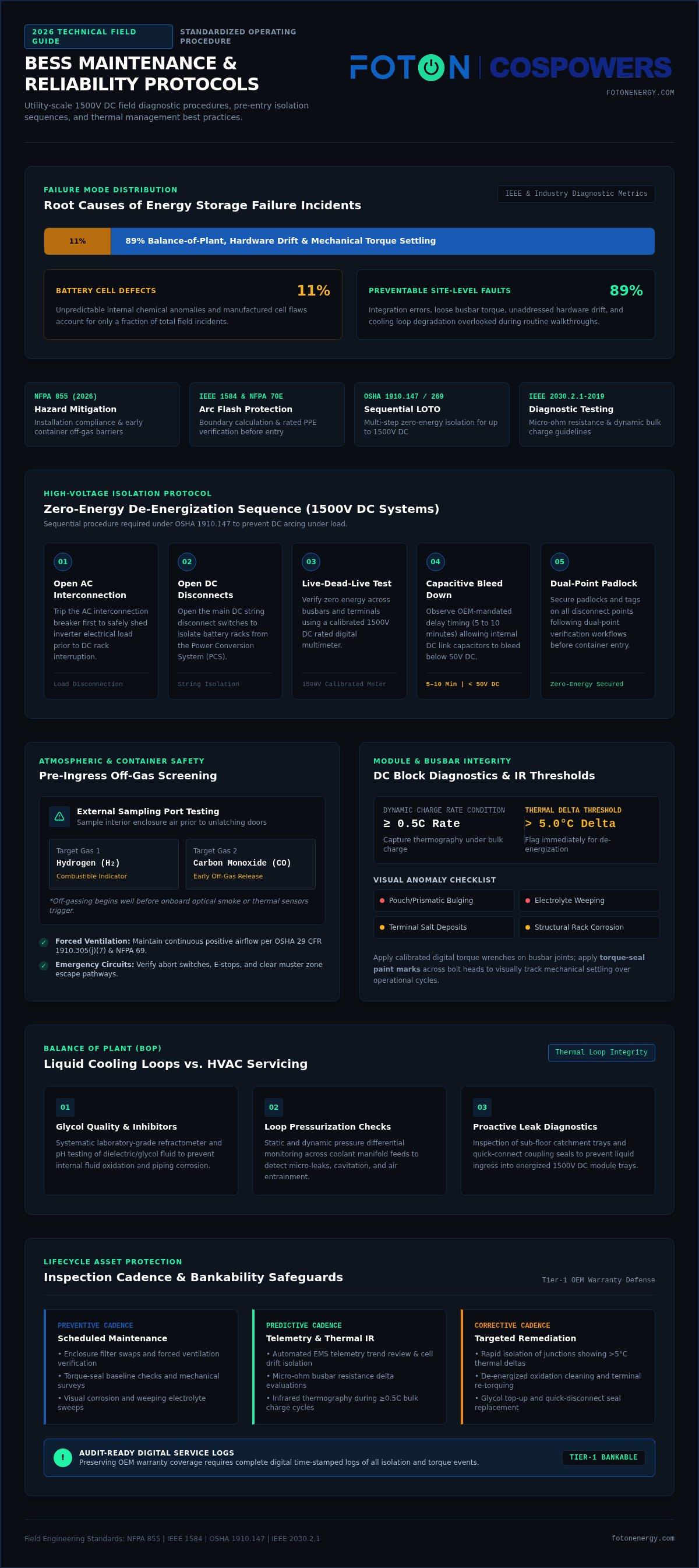
Field servicing on an industrial Battery energy storage system demands uncompromising safety compliance long before opening an enclosure door. Modern utility-scale and commercial architectures operate up to 1500V DC; a single procedural misstep risks severe arc flash or catastrophic thermal runaway. Establishing robust BESS maintenance best practices for technicians begins with strict adherence to NFPA 855 (2026 edition) hazard mitigation criteria and IEEE 1584 arc flash boundary calculations. Technicians must confirm site-specific NFPA 70E Arc Flash PPE Category ratings, verifying that voltage-rated rubber gloves, arc-rated face shields, and flame-resistant apparel match the calculated incident energy levels across all switchgear enclosures.
High-Voltage Isolation and Lockout/Tagout (LOTO) Discipline
Zero-energy verification requires methodical isolation to control hazardous electrical energy under OSHA 1910.147 and 1910.269 standards. Field hands must execute isolation sequentially to avoid pulling DC arcs under load:
- Open the AC interconnection breaker first to shed inverter load safely.
- Open the main DC string disconnect switches to isolate battery racks from the power conversion system.
- Perform live-dead-live testing across all busbars and terminals using a calibrated 1500V DC rated multimeter to verify zero voltage state.
- Observe OEM-mandated delay timing standards, often 5 to 10 minutes, allowing internal capacitive energy in DC link filters to bleed down below 50V DC.
- Secure physical padlocks and safety tags on energy storage disconnect switches following dual-point verification workflows.
Atmospheric Monitoring and Container Ingress Precautions
Entering an enclosed containerized BESS requires vigilant atmospheric monitoring. Off-gassing events from failing cells release combustible hydrogen (H2) and carbon monoxide (CO) well before smoke or thermal sensors engage. Technicians must calibrate multi-gas detectors and sample interior air through external sampling ports before unlatching containerized BESS access doors. If early off-gas thresholds exceed OEM baseline levels, keep enclosures sealed and initiate emergency protocols.
Maintain active forced ventilation during all internal maintenance tasks in compliance with OSHA 29 CFR 1910.305(j)(7) and NFPA 69 explosion prevention guidelines. Finally, confirm the functional readiness of fire suppression abort switches, inspect emergency stop circuits, and verify clear evacuation escape paths toward designated personnel muster boundaries before starting hands-on diagnostics. Implementing these disciplined pre-entry checks into foundational BESS maintenance best practices for technicians protects field personnel and preserves mission-critical infrastructure.
DC Block Diagnostics: Module-Level Inspection and Battery Health Maintenance
Precision diagnostics at the module level ensure high-voltage battery racks maintain targeted efficiency across thousands of operational cycles. Field hands must execute comprehensive visual surveys across every rack tier, checking specifically for pouch or prismatic casing bulging, electrolyte weeping, terminal salt deposits, and structural rack corrosion. Routine micro-ohm resistance tests across inter-module busbars isolate loose terminations before micro-arcing degrades internal cell chemistry. Standardizing these detailed checks embodies core BESS maintenance best practices for technicians adhering to the testing guidelines set out in IEEE 2030.2.1-2019.
Busbar Torque Verification and Thermal Imaging Inspection
Electrical resistance creates localized thermal hotspots that accelerate balance-of-plant failures. Technicians should verify bolted mechanical connections using calibrated digital torque wrenches, applying torque-seal paint marks across bolt heads to track mechanical settling over time:
- Capture high-resolution thermographic imagery during dynamic bulk charging cycles at 0.5C or greater to pinpoint elevated joint impedance.
- Flag and document any thermal delta exceeding 5°C between adjacent cell terminals or busbar junctions.
- De-energize the affected string, clean oxidized contact surfaces, and apply specified dielectric terminal grease before re-torquing hardware to OEM torque values.
BMS Data Interrogation and Cell Balancing Analysis
Extracting raw battery management system (BMS) logs provides actionable visibility into localized state-of-health (SoH) metrics and internal cell drift. Interrogate slave BMS boards to evaluate individual cell voltages during the final stages of constant-current, constant-voltage charging. Trailing cells that display sharp voltage drop-offs under peak discharge loads reveal internal degradation or premature pack balancing failures. Technicians must initiate active cell-balancing routines or manual cell-level conditioning whenever voltage spreads drift beyond 20 millivolts.
Field data shouldn't remain isolated on local handheld diagnostic tools. Seamlessly integrating field telemetry with advanced commercial and industrial BESS solutions allows predictive analytics to track pack drift automatically across the asset lifecycle. When high-capacity sites encounter complex cell divergence across large battery arrays, consulting with experienced infrastructure specialists at Foton Energy ensures field workflows align directly with certified Tier-1 engineering standards.
Thermal Management and Balance of Plant: Liquid Cooling vs. HVAC Servicing
Thermal management directly governs cell degradation rates and fire safety margins across commercial and utility-scale installations. With industry reports indicating that 75% of BESS sites exhibit early HVAC-related risk signals, thermal inspection cannot be treated as an afterthought. Mastering thermal subsystem servicing is central to advanced BESS maintenance best practices for technicians, especially as deployments shift rapidly from forced-air enclosures to closed-loop liquid thermal plates. Field technicians must systematically evaluate both fluid chemistry and airflow mechanics, applying validated Predictive Maintenance Practices for BESS Safety to maintain balanced operating envelopes.
Liquid-Cooled Loop Integrity and Chiller Maintenance
Liquid cooling provides superior heat extraction for high C-rate cycling, but it introduces hydraulic failure points. Technicians must service chillers and distribution circuits methodically to prevent thermal starvation:
- Sample closed-loop coolant using an optical refractometer to verify water-glycol concentration percentages against manufacturer freeze-protection curves.
- Measure fluid pH neutrality and test for suspended particulate contamination or corrosion inhibitor depletion.
- Audit system static pressure gauges, check expansion tank bladders for correct nitrogen pre-charge, and bleed trapped air pockets from high-point auto-bleed valves.
- Examine dry-break quick-connect couplings and internal rack distribution manifolds for weeping, micro-crystallization, or localized pressure drops.
- Record variable-speed circulation pump operating amperage to confirm normal motor load against baseline commissioning data.
Air-Cooling HVAC and Environmental Ingress Controls
Air-cooled installations rely on sustained volumetric airflow and strict envelope sealing. Technicians must wash external condenser coils quarterly to clear salt crust, industrial dust, and biological debris that degrade heat exchange efficiency. Replace clogged intake filters with fresh high-efficiency particulate air (HEPA) media to prevent convective restriction across internal rack pathways.
Technicians must also measure HVAC blower motor vibration profiles using handheld spectrum analyzers to detect early bearing wear before sudden fan seizure. Inspect door compression gaskets, cable gland pass-through seals, and louver dampers to verify enclosure IP ratings remain intact against blowing rain and fine dust. Clear condensate drain lines and verify internal relative humidity sensors operate correctly, preventing dew point convergence and dangerous internal condensation pooling near live electrical switchgear.
BESS Maintenance Schedule: Preventive, Predictive, and Corrective Inspection Cadence
Preventing system downtime requires a disciplined calendar that shifts your team from reactive emergency calls to structured lifecycle preservation. A calendar-based maintenance program provides clear, predictable intervention points across the asset lifetime. By structuring operational rhythms across daily, monthly, quarterly, and annual intervals, technicians can intercept balance-of-plant drift before minor deviations lead to string outages. Embedding these timelines into standard operating procedures establishes dependable BESS maintenance best practices for technicians managing high-density industrial assets.
Daily and Monthly Routine Field Inspections
Daily routines focus heavily on digital telemetry checks, while monthly schedules require hands-on physical enclosure audits:
- Daily Telemetry Review: Check centralized alarm logs, internal container temperature deltas, DC bus insulation resistance values, and inverter operational metrics every morning.
- Perimeter and Housing Walkthrough: Check external enclosure walls monthly for physical damage, vandalism, corrosion, or pest ingress around cable entry conduits.
- Vegetation and Clearances: Verify vegetation clearance complies with NFPA 855 setbacks, keeping at least 3 feet of clear space around container walls, louvers, and service doors.
- Fire Safety Status: Inspect clean agent fire suppression storage cylinders to confirm pressure gauges remain in the green operational zone and control heads show normal status without trouble lights.
- Passive Ventilation: Clean outdoor intake louvers, brush away accumulated debris, and verify internal rodent-proofing wire mesh screens remain intact.
Quarterly and Annual High-Level Servicing Workflows
Quarterly maintenance centers on dynamic electrical testing and thermal sweeps under full charge-discharge cycles. Technicians must conduct thermographic scans while the system runs under high industrial loads to catch mechanical connection resistance early. At this stage, compare local field logs with predictive cloud algorithms from AI driven energy management systems to spot hidden cell degradation before automated balancing fails.
Annual shutdowns demand full-spectrum electrical and chemical verifications. Technicians must de-energize DC blocks to calibrate ground-fault detection relays, test rapid DC shunt trip response times, and measure insulating oil levels on step-up transformers. Technicians also evaluate secondary backup power systems by testing auxiliary uninterruptible power supply (UPS) batteries under load. Implementing these comprehensive BESS maintenance best practices for technicians keeps industrial energy plants running efficiently year after year. To design and deploy resilient high-capacity storage engineered for streamlined field servicing, partner with Foton Energy's engineering team.
Ensuring Long-Term Bankability: Technical Support and Engineering Integration
Asset bankability extends far beyond financial modeling; it depends heavily on the verifiable quality of your field maintenance records. Institutional investors and underwriters require definitive proof that balance-of-plant components and cell blocks operate within strict OEM warranties. Unplanned downtime or improperly logged servicing interventions can quickly jeopardize equipment guarantees and raise insurance premiums, which typically sit between 0.3% and 1.2% of total project value. Upholding rigorous BESS maintenance best practices for technicians ensures that daily, monthly, and annual interventions stand up to rigorous financial and operational audits.
Warranty Validation and Digital Record-Keeping Discipline
Modern warranty preservation requires verifiable, immutable documentation rather than paper checklists. Technicians must upload diagnostic data directly into centralized Computerized Maintenance Management Systems (CMMS) after completing site work:
- Log precision torque wrench calibration certificates alongside mechanical audit values across all high-current busbar connections.
- Archive baseline thermal imaging files, identifying localized temperature deltas to prove joints remain within safe operating thresholds.
- Record glycol concentration tests, filtration swap dates, and system pressure logs to validate continuous chiller health.
- Submit standardized field service reports immediately following corrective interventions to keep OEM degradation warranties fully valid.
Accessing Tier-1 Engineering Expertise and Genuine Spares
Complex field issues require specialized engineering support when internal balancing routines or recurring PCS inverter faults exceed standard site protocols. Working alongside seasoned specialists through dedicated BESS engineering consulting services gives field technicians the root-cause diagnostics needed to solve chronic cell drift. Sourcing factory-certified replacement modules and balance-of-plant hardware through a verified utility scale BESS procurement channel prevents uncertified components from compromising system safety or invalidating UL 9540 listings.
As an Australian infrastructure specialist and exclusive global partner of Cospowers, Foton Energy combines over 30 years of manufacturing heritage with deep Tier-1 LFP and sodium-ion modular expertise. When project operators face brownfield expansions, challenging inverter retrofits, or advanced telemetry integration across multi-megawatt fleets, tapping into Foton Energy engineering solutions delivers the high-level technical guidance and genuine spare pipelines necessary to guarantee long-term operational resilience. Integrating this engineering expertise into your team's ongoing BESS maintenance best practices for technicians protects long-term capital investments and maximizes revenue generation across the entire system lifecycle.
Advancing Operational Excellence in Modern Energy Storage
Disciplined field execution transforms battery energy storage from a high-voltage operational risk into a resilient, bankable asset. Establishing standardized BESS maintenance best practices for technicians ensures your team isolates electrical hazards safely, rectifies cell voltage drift before string trips occur, and maintains closed-loop thermal integrity under heavy cycling demands. Methodical digital documentation further safeguards capital investments, ensuring warranty protection and underwriting compliance across every operational year.
True operational resilience starts with robust hardware architecture and proven manufacturing pedigree. As the exclusive global partner of Cospowers, backed by over 30 years of energy storage manufacturing heritage, Foton Energy delivers high-performance modular systems alongside specialized engineering consulting across more than 70 countries. Whether you require advanced commissioning assistance, brownfield system integration, or AI-driven EMS telemetry optimization, our engineers stand ready to assist your operational crews. Partner with Foton Energy for Tier-1 hardware and engineering support to secure maximum uptime and asset longevity across your storage fleet.
Frequently Asked Questions
How often should field technicians inspect commercial and industrial BESS installations?
Field technicians should conduct daily automated telemetry reviews, monthly physical and environmental walkthroughs, quarterly dynamic thermal inspections, and annual de-energized shutdowns. Following this structured cadence embodies essential BESS maintenance best practices for technicians. Monthly visits prioritize exterior containment integrity, emergency stop controls, and louver filters. In contrast, quarterly and annual workflows address deep electrical connections, relay calibration, and complete system capacity tests under peak cycling loads.
What personal protective equipment (PPE) is mandatory when servicing 1500V DC battery enclosures?
Mandatory PPE includes NFPA 70E Arc Flash Category 2 or Category 4 apparel depending on site-specific incident energy calculations. Technicians must wear Class 2 insulating rubber gloves with leather protectors, an arc-rated face shield or hood, safety glasses, and steel-toe dielectric footwear. OSHA regulations also require having an emergency eyewash station within 25 feet when servicing liquid coolant systems or handling exposed battery terminals under energized conditions.
What are the earliest indicators of thermal runaway that a technician can detect during routine maintenance?
The earliest physical indicators are trace off-gassing of volatile organic compounds, hydrogen, and carbon monoxide detected via calibrated multi-gas sniffers prior to enclosure entry. At the rack level, technicians will observe abnormal cell delta voltages exceeding 20 millivolts during float charging, localized casing swelling, or sudden temperature spikes exceeding 5°C on adjacent cell terminals during thermal imaging scans. These early indicators precede smoke, flames, or thermal detector activation by hours.
How does liquid cooling maintenance differ from standard HVAC servicing in modern energy storage?
Liquid cooling requires hydraulic and chemical management rather than simple filter replacements and refrigerant sweeps. Technicians must test closed-loop water-glycol mixtures using optical refractometers, verify pH neutrality, bleed trapped air, and inspect quick-disconnect fittings for micro-crystallization. While air-cooled HVAC units focus primarily on coil cleaning, blower motor vibration diagnostics, and intake filter replacements, liquid thermal loops require ongoing pressure audits, expansion tank checks, and pump amperage monitoring to ensure uniform cell heat dissipation.
Why is busbar torque verification essential, and how frequently should it be performed?
Busbar torque verification prevents micro-arcing and resistive heating caused by thermal expansion and mechanical settling under heavy charge-discharge cycling. Technicians should audit mechanical torque quarterly using calibrated digital torque wrenches and apply witness mark paint to visually track loose hardware over time. Loose busbars generate excessive contact resistance, creating localized thermal hotspots that can damage cell terminals, degrade BMS sensing accuracy, and trigger premature inverter trips if left unchecked.
How do technicians verify that a battery cell has drifted beyond acceptable balancing thresholds?
Technicians verify cell drift by interrogating slave BMS boards during the final stage of constant-voltage charging and reviewing maximum cell delta voltages. Integrating BESS maintenance best practices for technicians involves flagging any cell showing a variance greater than 20 to 30 millivolts compared to the pack average. Trailing cells that collapse prematurely during high-rate discharge cycles are isolated for individual impedance testing, localized conditioning cycles, or physical module replacement.
What documentation is required during maintenance visits to maintain OEM warranty validity?
Preserving OEM warranties requires digital maintenance logs submitted through an authorized CMMS platform immediately following any inspection. Technicians must record calibrated torque values, baseline infrared thermography images, coolant concentration readings, and detailed BMS error logs. In addition, field records must prove that preventative servicing intervals matched OEM manuals and that any corrective part replacements utilized factory-certified Tier-1 components to satisfy underwriter and insurer compliance requirements.


