
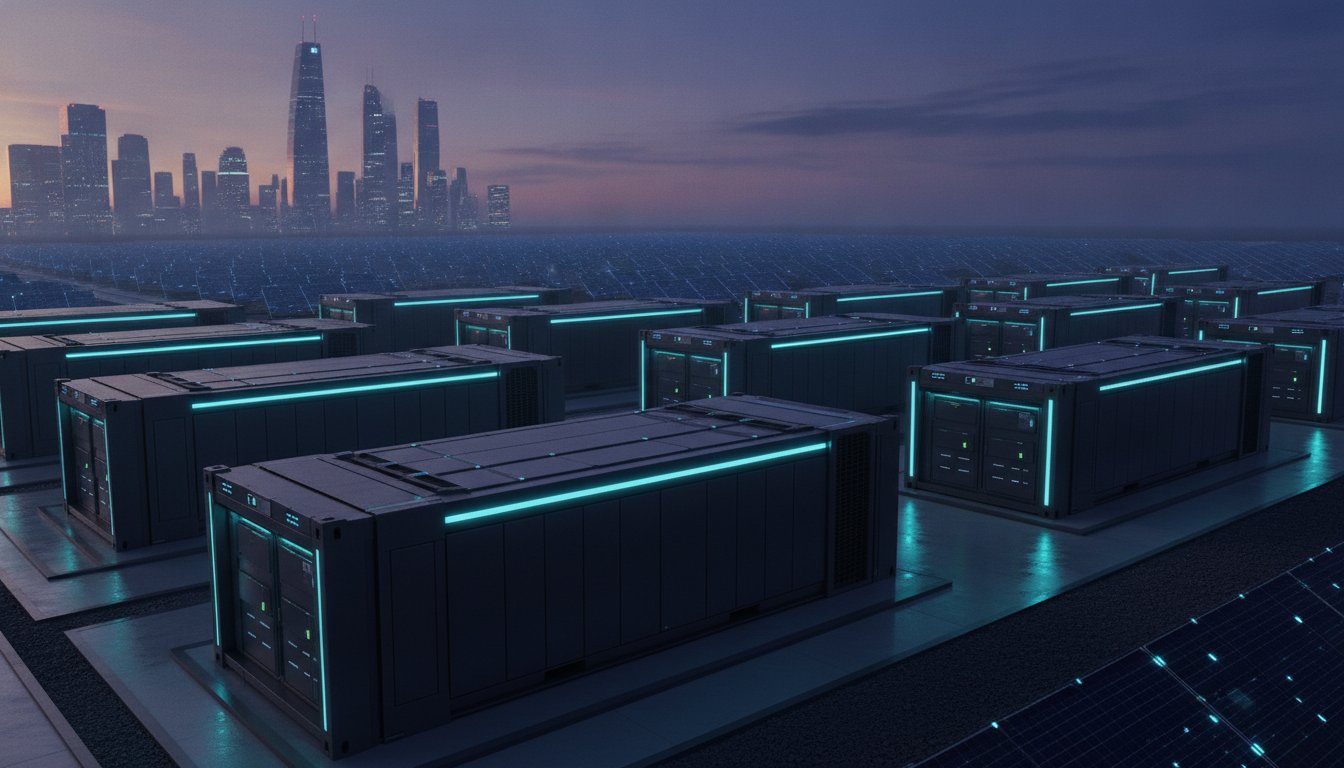
Relying on a single brand for utility-scale storage is no longer a strategic advantage; it's a supply chain bottleneck. As developers face the 2026 reality of multi-year lead times and rigid integration requirements, the search for Tesla Megapack alternatives has shifted from a cost-saving exercise to a core requirement for project viability. You're likely managing the pressure of rising CAPEX and the 25% tariff on imported cells while striving to meet the 55% domestic content threshold required by the One Big Beautiful Bill Act.
This strategic guide helps you identify top-tier alternatives and provides the technical framework necessary to evaluate their bankability, safety, and long-term ROI. We'll explore the shift toward high-density architectures, including the 14.5 MWh BYD Haohan and the 30 MWh CATL TENER Sodium-Ion system, while establishing a roadmap for grid-code compliance. By the end of this analysis, you'll understand how to leverage Tier-1 manufacturing heritage and AI-driven EMS to secure your energy infrastructure against future volatility. We invite you to participate in this shift toward a more resilient, optimized, and bankable energy ecosystem.
Key Takeaways
- Identify why the 2026 energy market is transitioning toward multi-vendor procurement strategies to circumvent supply chain delays and the "Tesla premium."
- Compare technical specifications for high-density Tesla Megapack alternatives, focusing on MWh-per-container efficiency and advanced thermal management protocols.
- Assess the emerging business case for Sodium-ion vs. LFP, specifically regarding safety profiles and lifecycle performance in urban data center environments.
- Build a robust framework for project financing by prioritizing manufacturers with 30+ years of heritage and third-party DNV-verified reliability reports.
- Discover how the strategic partnership between Foton and Cospowers bridges the gap between global manufacturing scale and localized engineering expertise.
The 2026 BESS Landscape: Why Developers Seek Tesla Megapack Alternatives
The energy transition is accelerating, but the reliance on a single hardware provider has become a strategic liability for utility-scale developers. In 2026, the grid-scale market is definitively moving toward multi-vendor strategies to ensure project completion. This shift isn't just about cost; it's about de-risking project timelines against the "Tesla Premium" and the bottleneck of concentrated supply chains. Developers are increasingly evaluating battery energy storage system (BESS) options that offer comparable bankability without the rigid integration requirements or opaque supply chains of the market leader.
Securing "Tier-1" status is now the non-negotiable benchmark for any viable competitor. This designation implies a manufacturer has the financial stability and manufacturing heritage, often exceeding 30 years, to support warranties over a 20-year project life. With the U.S. Section 301 tariff on imported cells reaching 25% in January 2026, the race for local content and supply chain transparency has forced a diversification. We're seeing the rise of non-lithium alternatives, such as Sodium-ion, for industrial use cases where safety and wide operating temperatures are prioritized over raw energy density.
To better understand this concept, watch this helpful video:
Supply Chain Resilience and Lead Time Optimization
Geographic manufacturing concentration remains a primary friction point for deployment. Projects aiming for the full Investment Tax Credit (ITC) under the One Big Beautiful Bill Act must now navigate the 55% domestic content threshold to maximize returns. Strategic partnerships are the solution. By aligning with partners like Foton, who leverage Cospowers' Tier-1 manufacturing scale and 30-year heritage, developers gain wholesale hardware priority. This modular procurement approach allows for faster commissioning and reduced deployment friction, especially as developers aim to add 24 GW of utility-scale capacity to the U.S. grid this year. Choosing Tesla Megapack alternatives with diversified manufacturing footprints is no longer optional; it's a requirement for resilience.
Beyond Energy Density: The Total Cost of Ownership (TCO)
Evaluating a Tesla Megapack alternative requires looking past initial CAPEX to the total cost of ownership (TCO). While energy density is a headline metric, the long-term value lies in verified degradation rates and thermal management efficiency across varying climates. Claims of high-cycle lifespans or capacity retention at extreme temperatures must be backed by independent DNV or PVEL reports to be considered valid by institutional financiers. In the context of 2026 financial markets, BESS bankability is defined as the measurable certainty that a system will meet its performance guarantees and revenue projections over its entire operational life without manufacturer insolvency.
Tier-1 BESS Comparisons: CATL Tener, BYD, and Cospowers Architecture
Selecting Tesla Megapack alternatives in 2026 requires a transition from evaluating raw battery chemistry to analyzing fully integrated system architectures. The industry has moved decisively beyond the 3 MWh container standard. Tier-1 manufacturers now deliver high-density blocks that drastically reduce the physical footprint and complexity of utility-scale projects. BYD’s Haohan system, for example, integrates the BESS, Power Conversion System (PCS), and MV transformer into a single 14.5 MWh unit. Meanwhile, CATL’s TENER Sodium-Ion architecture pushes boundaries with a rated capacity exceeding 30 MWh per unit, designed for a 15,000-cycle lifespan.
Thermal management has emerged as the primary differentiator in maintaining these high densities. While older systems relied on air cooling, the 2026 standard for utility-scale deployments is advanced liquid cooling. This technology ensures uniform cell temperatures, which is critical for preventing thermal runaway and minimizing capacity degradation over time. Systems from partners like Cospowers utilize proprietary safety architectures that include multi-level fire suppression and cell-level monitoring. These features ensure that high-density LFP modules remain stable even under aggressive cycling profiles. For developers managing complex wind or solar portfolios, choosing between AC-coupled and DC-coupled integrations is a vital strategic decision; DC-coupling offers superior efficiency for new builds, while AC-coupled systems provide the flexibility needed for rapid grid-connection retrofits.
High-Capacity LFP Modules: The New Industry Standard
Containerized solutions exceeding 5 MWh are the baseline for modern procurement. These systems prioritize high Depth of Discharge (DoD) and extended cycle lives to maximize long-term project viability. When evaluating these assets, developers should reference a utility scale BESS procurement guide to understand how different LFP architectures handle 100% DoD over thousands of cycles. Reliability isn't just a hardware claim; it's a financial necessity backed by decades of manufacturing heritage. If you're looking to de-risk your next deployment, we recommend you consult with our engineering team to align these specifications with your specific site requirements.
AI-Driven EMS: The Software Differentiator
Software is where the most significant gains in project Internal Rate of Return (IRR) are found. Modern Tesla Megapack alternatives must include AI driven energy management systems that offer more than just basic monitoring. These platforms utilize machine learning for predictive maintenance, identifying potential cell failures before they cause downtime. They also play a critical role in grid-code compliance, managing frequency regulation and peak shaving with millisecond precision. In an era of increasing cyber threats, utility-scale software must also meet rigorous international cybersecurity standards to ensure the resilience of the wider energy industrial ecosystem.
Technology Diversification: Sodium-Ion vs. LFP as Strategic Alternatives
Diversification is the key to infrastructure resilience. While LFP remains the dominant chemistry for bulk energy storage, Sodium-ion has emerged as a high-safety alternative for urban data centres and mission-critical telecommunications. This shift is driven by the need to reduce reliance on lithium supply chains and improve safety profiles in densely populated areas. As developers evaluate Tesla Megapack alternatives, the choice between chemistries now depends on environmental constraints and specific discharge requirements rather than just cost per kilowatt-hour. We're seeing a strategic pivot toward chemistries that offer independence from rare-earth minerals while maintaining the high performance required for the 2026 grid.
Safety profiles are the primary driver for Sodium-ion adoption in urban environments. These batteries possess a significantly higher thermal runaway threshold than traditional LFP cells, making them ideal for indoor installations where fire suppression requirements are stringent. Operating temperature ranges also favor Sodium-ion in extreme climates. For instance, the CATL TENER Sodium-Ion system retains over 92% of its capacity at -20°C. This provides a level of reliability that LFP struggles to match without intensive and energy-consuming thermal management systems. Sustainability mandates are also pushing developers to look at Sodium-ion as a way to meet ESG goals by utilizing abundant, non-toxic materials.
Sodium-Ion for Data Centres and Telecom
The surge in AI-driven power demand has created a critical need for high-safety, high-rate discharge storage. Sodium-ion is uniquely suited to address the AI power crunch because it supports the rapid discharge rates required for Uninterruptible Power Supply (UPS) applications. Our detailed sodium-ion battery for data centers analysis highlights how these systems offer a more stable safety profile for high-density server environments. They charge faster than LFP counterparts, ensuring that backup systems are ready for consecutive grid disturbances without long recovery periods.
The 2026 Commercial Availability of Sodium-Ion
Commercial scale is finally meeting demand. While international deliveries for the CATL TENER Sodium-Ion system are scheduled for June 2027, domestic deliveries in China begin in September 2026. Developers should consult our report on sodium-ion battery commercial availability to understand how these timelines impact procurement. The cost-curve projections suggest that as manufacturing scale increases, Sodium-ion will eventually underprice LFP for specific grid-scale applications. However, technical constraints remain. Energy density for Sodium-ion is lower than LFP, meaning these Tesla Megapack alternatives may require a larger physical footprint for the same MWh capacity. This trade-off is often acceptable for stationary storage where safety and supply chain stability are the top priorities.
- High discharge rates for UPS applications.
- Retention of 92% capacity at -20°C.
- Reduced reliance on lithium and cobalt.
- 15,000-cycle lifespan for Tier-1 sodium-ion systems.

The Bankability Framework: How EPCs and Financiers Evaluate BESS
Bankability isn't a marketing label. It's a rigorous financial assessment that determines whether a project moves from a spreadsheet to the grid. For EPCs and financiers, evaluating Tesla Megapack alternatives requires looking past the energy density to the manufacturer's balance sheet and operational history. A Tier-1 designation remains the industry's shorthand for reliability, but in 2026, the criteria have evolved. Financiers now prioritize a manufacturing heritage of 30 years or more, such as the foundation provided by Cospowers. This longevity ensures that the entity providing the 20-year performance warranty will actually exist to honor it, providing the security needed for large-scale infrastructure investments.
De-risking a project involves more than just trusting vendor claims. Third-party verification from entities like DNV and PVEL is essential for any bankable BESS. These reports provide independent, empirical data on cell degradation, thermal stability, and round-trip efficiency under real-world conditions. Without these certifications, securing low-cost capital becomes nearly impossible. When we evaluate the long-term solvency of a manufacturer, we also assess their global strategic partnerships. These alliances demonstrate a commitment to local markets and ensure that technical support is available throughout the asset's lifecycle.
Technical Consulting and Feasibility
Successful deployment begins long before the first container arrives on site. The necessity of BESS engineering consulting services is paramount for navigating the 2026 regulatory landscape. System design must account for the complexities of grid-connected energy storage engineering, ensuring that fire suppression systems and safety architectures meet international standards like UL 9540A. A generic approach to hardware often fails during the integration phase, leading to costly delays and grid-connection rejections.
Project Feasibility and Grid Integration
Achieving grid-code compliance for front-of-the-meter projects is a multi-step process that requires deep technical expertise. This includes assessing the bankable status of LFP battery cycle life under specific grid conditions, such as frequency regulation or synthetic inertia applications. When selecting Tesla Megapack alternatives, local engineering support is the critical link for commissioning and ongoing asset management, especially in markets with rigid compliance requirements like Australia or Ireland. To ensure your project meets these rigorous financial and technical standards, we invite you to partner with us for your utility-scale BESS deployment.
Foton and Cospowers: A Strategic Partnership for Bankable BESS
The search for viable Tesla Megapack alternatives ends where manufacturing heritage meets local engineering precision. Foton represents the critical link between the high-volume manufacturing scale of Cospowers and the localized technical requirements of global energy markets. As an exclusive global partner for Cospowers, a Tier-1 manufacturer with over 30 years of heritage, Foton provides more than just hardware. We deliver a comprehensive ecosystem of C&I BESS, utility-scale storage, and data centre backup solutions. This partnership ensures that every deployment is backed by a stable supply chain and a deep reservoir of engineering consulting expertise.
Bridging the gap between a factory floor and a grid connection requires a sophisticated understanding of local grid-code compliance. Foton’s role is to translate Tier-1 manufacturing excellence into project-ready infrastructure. By maintaining superior supply chain control, we offer developers a way to bypass the multi-year waitlists and supply chain bottlenecks associated with brand-name premiums. Our intelligent EMS and AI-driven optimization tools are integrated directly into the hardware; this ensures that your asset isn't just a battery, but a high-performance participant in the energy industrial ecosystem.
End-to-End Energy Storage Infrastructure
We provide a full-spectrum approach that covers the entire project lifecycle. From initial feasibility studies to the integration of proprietary AI-driven energy management systems, our process is designed to maximize long-term ROI. For developers focused on the mid-market, our commercial and industrial BESS solutions offer a bankable path to energy independence and operational resilience. System integrators also benefit from our wholesale procurement advantages, gaining access to high-density LFP and Sodium-ion modules without the friction of fragmented supply chains. This end-to-end oversight reduces deployment friction and ensures that Tesla Megapack alternatives meet the same rigorous standards as the market leader.
A Global Network for Resilient Energy
Reliability is a global standard. Foton maintains a presence in over 70 countries, combining the manufacturing power of Cospowers with Australian-led engineering standards. This global network allows us to support large-scale infrastructure investments with the stability and future-readiness that financiers demand. We are currently expanding our channel partner programme and invite EPCs and energy developers to join a vision grounded in operational excellence. If you are ready to secure your energy future, we invite you to Partner with Foton for bankable BESS solutions and discover why we are the trusted partner for the next generation of grid-scale storage.
Securing Project Viability in a Diversified BESS Market
The transition toward a multi-vendor energy strategy is a fundamental requirement for infrastructure resilience. Evaluating Tesla Megapack alternatives in 2026 demands a focus on "bankability" that extends beyond raw hardware specifications. True project security stems from a combination of Tier-1 manufacturing heritage and rigorous third-party verification. By prioritizing DNV-verified safety architectures and integrating AI-driven grid optimization software, developers can ensure their assets remain high-performance pillars of the grid for decades.
Foton acts as your strategic partner in this landscape, bridging the gap between global manufacturing scale and local technical precision. Our partnership with Tier-1 Cospowers provides the stability of a 30-year manufacturing legacy while delivering the flexibility needed to navigate complex regulatory requirements. We invite you to participate in this vision of a cleaner, more resilient future. Explore Bankable Megapack Alternatives with Foton Energy and secure your project's long-term ROI. Let's build a more stable and optimized energy industrial ecosystem together.
Frequently Asked Questions
Who are the primary competitors to the Tesla Megapack in 2026?
Leading Tesla Megapack alternatives in 2026 include the CATL TENER system, the BYD Haohan integrated unit, and Cospowers architecture. These manufacturers have scaled production to meet the 24 GW utility-scale demand in the U.S. market alone. They offer diverse chemistries, including LFP and Sodium-ion, allowing developers to optimize for specific climate conditions or safety requirements. By selecting Tier-1 partners with decades of manufacturing heritage, EPCs can secure hardware without the multi-year waitlists typical of brand-name premiums.
Is CATL Tener a viable alternative to Tesla Megapack for utility-scale projects?
CATL TENER is a highly viable alternative, offering a rated capacity of over 30 MWh per unit and a 15,000-cycle lifespan. This architecture is designed for massive grid-scale deployments where footprint efficiency is critical. It operates effectively between -20°C and 45°C, making it suitable for diverse geographic regions. Its high energy density and proven performance metrics provide the technical assurance required for project financiers seeking stability in large-scale infrastructure investments.
What makes a BESS provider "bankable" for project financing?
Bankability is determined by a manufacturer's financial stability, long-term warranty solvency, and independent third-party verification. Financiers look for Tier-1 status and a manufacturing heritage exceeding 30 years to ensure the company can support the asset's 20-year lifecycle. Verification from entities like DNV or PVEL is essential to de-risk project performance claims. A provider's ability to demonstrate consistent, high-volume production and a resilient global supply chain further solidifies their bankable status.
How does Sodium-ion battery storage compare to Tesla’s LFP Megapack?
Sodium-ion systems provide superior safety and wider operating temperature ranges compared to Tesla's LFP-based Megapack. CATL's TENER Sodium-Ion system retains over 92% of its capacity at -20°C, a significant advantage for projects in extreme climates. While Sodium-ion has a lower energy density than LFP, its independence from lithium supply chains and higher thermal runaway threshold make it a strategic choice for urban data centres and mission-critical backup applications.
What are the current lead times for Tier-1 Megapack alternatives?
Current lead times for Tier-1 Tesla Megapack alternatives typically range from 9 to 14 months, significantly shorter than the multi-year queues often seen with Tesla hardware. These timelines are further optimized through strategic partnerships that grant priority access to manufacturing capacity. By leveraging Foton’s exclusive global partnership with Cospowers, developers can secure hardware delivery and commissioning schedules that align with strict project deadlines and 2026 grid-connection requirements.
Can Cospowers BESS integrate with existing AI-driven energy management systems?
Cospowers BESS units are built with open-architecture protocols specifically designed to integrate with intelligent, AI-driven energy management systems. These systems enable real-time grid optimization, predictive maintenance, and frequency regulation services. By utilizing Foton’s engineering consulting, developers can ensure that the hardware and software layers work in unison to maximize project IRR. This interconnected approach allows for sophisticated energy arbitrage and seamless compliance with complex international grid codes.
What safety certifications are required for grid-scale battery storage in Australia?
Australian grid-scale projects require compliance with AS/NZS 5139:2019 and IEC 62619 standards to ensure electrical and structural safety. Additionally, UL 9540A testing is the benchmark for evaluating thermal runaway fire progression in high-density battery systems. Foton’s engineering consulting services assist developers in navigating these local requirements, ensuring that every BESS deployment meets the rigorous safety and performance criteria set by Australian network service providers and global insurance underwriters.
Does Foton Energy provide direct installation for residential customers?
Foton Energy does not provide direct installation services for residential customers. We specialize in the supply of C&I and utility-scale storage systems, residential storage hardware, and comprehensive engineering consulting for large-scale developers. Our focus remains on supporting EPCs and system integrators with Tier-1 hardware and technical expertise. Residential customers seeking installation should consult with a certified local electrical contractor who specializes in BESS integration and local grid compliance.


