

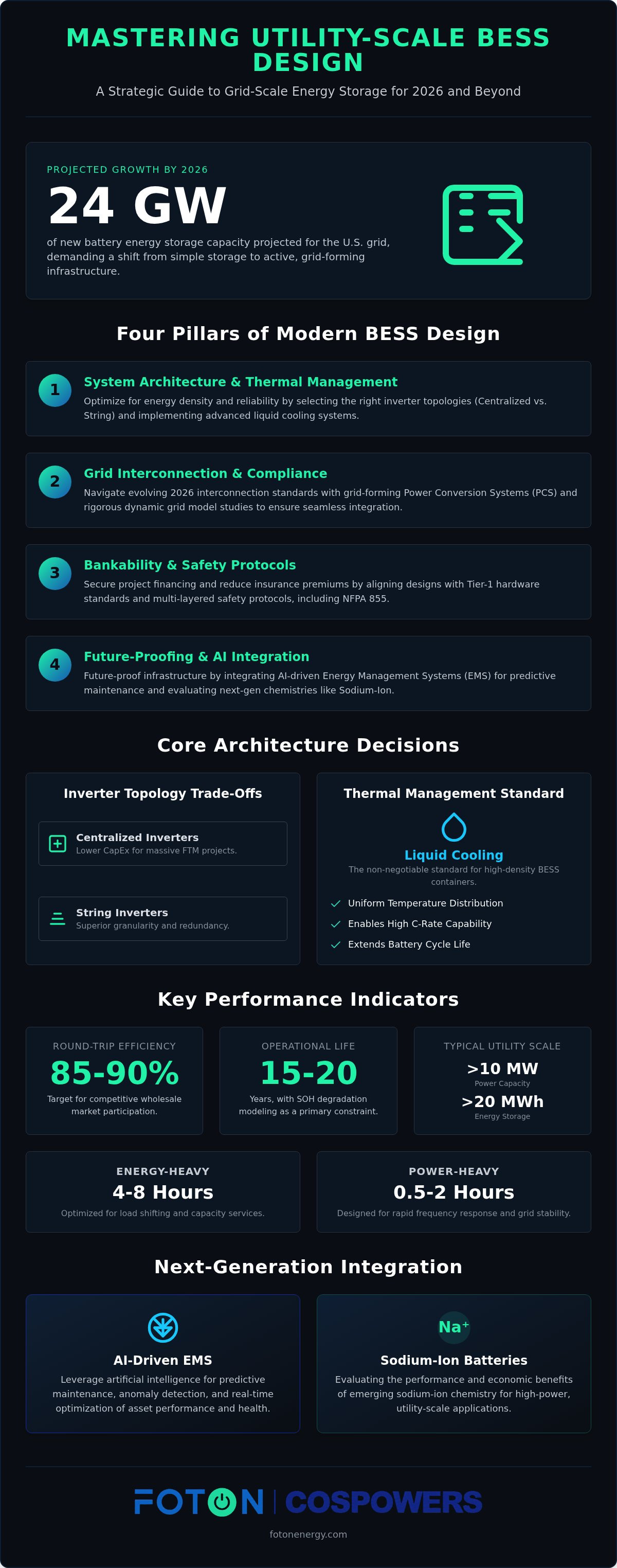
By 2026, the U.S. Energy Information Administration projects that battery energy storage will account for a massive 24 GW of new generating capacity. This surge in deployment means that utility scale bess design is no longer just about storing electrons; it's about engineering active grid-forming infrastructure that can withstand evolving regulatory scrutiny. You're likely already facing the complexities of the updated NFPA 855 fire codes and the need to prove long-term reliability to Tier-1 insurers who demand more than just a standard data sheet.
We're here to help you bridge the gap between ambitious infrastructure goals and technical reality. You'll learn how to master the strategic requirements of modern system design to ensure seamless grid interconnection and maximize the cycle life of your assets. We'll examine the critical role of AI-driven EMS and advanced thermal management in securing project bankability and achieving approval from the world's most rigorous financiers.
Key Takeaways
- Identify the critical trade-offs between centralized and string inverter topologies to optimize thermal management and energy density in large-scale layouts.
- Navigate 2026 interconnection standards by implementing grid-forming Power Conversion Systems and conducting rigorous dynamic grid model studies.
- Secure project financing and reduce insurance premiums by aligning your utility scale bess design with Tier-1 hardware standards and multi-layered safety protocols.
- Future-proof your infrastructure by integrating AI-driven EMS and evaluating the performance benefits of sodium-ion batteries for high-power utility applications.
Defining Utility-Scale BESS Design: Scope and Strategic Objectives
Utility-scale energy storage represents the backbone of the modern energy transition. At its core, utility scale bess design focuses on infrastructure-level assets, typically exceeding 10MW in power capacity and 20MWh in energy storage. These systems serve as the critical interface for transmission and distribution networks, ensuring that power remains available even when primary generation fluctuates. While often categorized as Front-of-the-Meter (FTM) assets owned by utilities or independent power producers, we're seeing a rise in massive behind-the-meter industrial deployments that rival grid-scale projects in complexity.
Designing for this scale requires a shift in perspective. A Battery Energy Storage System (BESS) must do more than just buffer energy; it must support grid stability, facilitate renewable firming, and enable complex merchant revenue stacks. Achieving these objectives depends on bankability. Tier-1 hardware pedigree is not an optional upgrade; it's a fundamental design requirement. By partnering with Tier-1 manufacturers like Cospowers, developers ensure their projects meet the rigorous standards of global financiers and insurers who prioritize long-term asset health over low initial capital costs.
The Shift to Grid-Scale Energy Storage Infrastructure
The global energy mix is moving rapidly from traditional synchronous generation to inverter-based resources (IBR). This transition dictates a new approach to system architecture. Modern BESS units must provide synthetic inertia and spinning reserves to maintain frequency stability where fossil fuel turbines once did. Efficiency is key. We prioritize modular architecture in utility scale BESS procurement because it allows for rapid deployment and simplified maintenance without compromising the integrity of the high-voltage connection. This modularity ensures that if one container requires service, the rest of the facility continues to support the grid.
Key Performance Indicators (KPIs) in Design
Successful engineering begins with clear metrics. In 2026, Round-Trip Efficiency (RTE) targets for utility projects have tightened, often requiring 85% to 90% at the system level to remain competitive in wholesale markets. Designers must choose between energy-heavy configurations, offering 4 to 8 hours of discharge for load shifting, and power-heavy setups designed for 0.5 to 2 hours of rapid frequency response. State of Health (SOH) degradation modeling acts as a primary constraint. We design systems that anticipate capacity fade, ensuring the asset remains profitable throughout its 15 to 20 year operational life by accounting for specific cycling profiles and local environmental factors.
Technical Architecture: DC Link Topology and Thermal Management
Architecture defines performance. The choice between centralized and string inverter topologies represents a pivotal decision in utility scale bess design. Centralized inverters typically offer a lower capital expenditure for massive Front-of-the-Meter projects, yet string inverters provide superior granularity and redundancy. High-capacity Lithium Iron Phosphate (LFP) modules serve as the building blocks of these containerized solutions, engineered for high density and rapid discharge. As the utility-scale battery storage power capacity continues to expand globally, the stability of the DC link becomes paramount. This link maintains voltage equilibrium across thousands of battery cells, preventing circulating currents that could compromise overall system efficiency.
Predictive maintenance isn't just a feature; it's a financial safeguard. By deploying an AI driven energy management system, operators can identify anomalies in cell impedance before they escalate into hardware failures. This intelligence ensures that the physical architecture remains operational under peak stress conditions. If you're looking for guidance on optimizing these configurations, our engineering consulting team can help align your technical specs with project-specific ROI goals.
Thermal Management for High-Density Storage
Liquid cooling is the standard. For 20-foot and 40-foot containerized BESS, liquid systems provide uniform temperature distribution that air-cooled alternatives simply cannot match. This precision is vital for maintaining high C-rate capabilities and extending the cycle life of the battery cells. It directly influences the system's ability to handle rapid frequency response without degrading the underlying chemistry. Modern sensor arrays now utilize multi-point gas and temperature detection to trigger automated suppression protocols at the first sign of off-gassing, effectively neutralizing thermal runaway risks before they manifest. Furthermore, large-scale projects often require specialized industrial bulk liquid storage systems australia to manage the significant volumes of coolant or fire suppression water required for safe operation.
Reliability requires hierarchy. We utilize a three-tier BMS structure where the Slave level monitors individual cell voltage, the Master level aggregates data for the module, and the System level manages the entire array's interaction with the Power Conversion System. Active cell balancing is preferred in utility-scale strings to redistribute energy between cells, minimizing waste compared to passive resistive bleeding. High-speed data logging at every level isn't just for optimization; it's a mandatory requirement for warranty compliance and long-term insurance validity.
Grid Interconnection and Compliance Engineering
Engineering a high-performance utility scale bess design is only half the battle. The other half involves ensuring that the system can successfully "shake hands" with the grid. This process demands a methodical approach to compliance and interconnection logic. Mastering utility scale bess design requires more than just hardware selection; it demands an intimate understanding of the physics of the local network and the specific requirements of the System Operator.
We approach interconnection through five critical phases:
- Dynamic Grid Model Study: We conduct rigorous simulations to ensure the project meets renewable energy grid codes and can withstand transient faults.
- PCS Selection: We evaluate Power Conversion Systems based on the need for grid-forming versus grid-following capabilities, ensuring the hardware matches the grid's strength.
- POI Engineering: The Point of Interconnection is designed with specific protection relays and high-voltage transformers to safeguard both the asset and the network.
- Control Integration: We implement SCADA and EMS interfaces that allow for precise utility dispatch control and real-time telemetry.
- Restoration Services: We finalize black-start capability design, enabling the system to re-energize the grid during total system outages.
Grid-Forming Inverters and Synthetic Inertia
In high-renewable markets like Australia, grid-forming technology is no longer an optional feature; it's a mandatory requirement. Unlike traditional grid-following inverters that rely on a stable external signal, grid-forming systems establish their own voltage and frequency reference. This capability is essential for mitigating 'weak grid' issues often found at the end of long transmission lines where short-circuit ratios are low. Navigating these complexities necessitates specialized BESS engineering consulting services to conduct the necessary studies and ensure your design is compliant from the outset.
AEMO and International Standards Compliance
Compliance is the cornerstone of bankability. For Australian projects, meeting the Australian Energy Market Operator (AEMO) Generator Performance Standards (GPS) is a rigorous hurdle that defines project timelines. Globally, we align our designs with IEEE 1547 and UL 1741 SA to ensure safety and interoperability across diverse markets. We also prioritize third-party DNV verification. This independent validation of our design models provides the security that financiers and insurers require to back large-scale infrastructure investments, ensuring the project remains viable throughout its operational life.
Design for Safety, Longevity, and Bankability
Safety is the primary metric of project viability. In utility scale bess design, a failure in safety protocols is a failure in financial strategy. We implement a multi-layered safety architecture that begins at the cell level with stable Lithium Iron Phosphate (LFP) chemistry and extends through to container-level suppression systems. This rigorous approach is essential because Tier-1 hardware procurement significantly reduces project insurance premiums. Insurers and financiers prioritize assets with a proven manufacturing heritage, such as those from Tier-1 manufacturers like Cospowers, to mitigate the long-term risks associated with thermal runaway and premature degradation.
Modern enclosures must incorporate sophisticated gas detection systems capable of identifying off-gassing events before ignition occurs. We design integrated explosion venting to NFPA 68 standards, ensuring that internal pressure can be safely dissipated during a fault. For utility projects targeting a 15 to 20 year operational life, the bankability of the design depends on maintaining cell health through precision thermal control and managed depth of discharge. If you're ready to secure your infrastructure investment, consult with our utility-scale engineering team today to align your technical specifications with long-term ROI goals.
Fire Suppression and Safety Standards
Compliance with NFPA 855 and UL 9540A is the baseline for 2026 deployments. We evaluate the trade-offs between aerosol suppression and clean-agent systems, selecting the optimal solution based on site-specific environmental risks. For developers who need specialized hardware for these hazardous zones, you can learn more about ExSafe and their Ex-certified ventilation and lighting solutions. Our utility scale bess design also utilizes 'fail-safe' isolation zones. These provide physical spacing between containers to prevent fire propagation, ensuring that an isolated incident doesn't escalate into a site-wide catastrophe.
Maximizing Asset Bankability
Financiers demand certainty. Choosing a Tier-1 manufacturer like Cospowers provides the stability required for large-scale infrastructure loans. We reinforce this bankability through comprehensive Performance Guarantees and Capacity Maintenance Agreements (CMA) that ensure the system meets energy delivery targets year after year. For those managing complex portfolios, our strategic guide to bankable energy storage offers deeper insights into aligning C&I and utility-scale requirements with investor expectations.
The Future of Design: Sodium-Ion and AI Integration
The technological horizon for energy storage is shifting rapidly. In 2026, utility scale bess design must account for a diversifying battery chemistry landscape that moves beyond a single-chemistry approach. While Lithium Iron Phosphate (LFP) remains the industry standard for energy density, the sodium-ion battery commercial availability has reached a critical tipping point for utility-scale deployment. This shift allows engineers to consider 'Hybrid BESS' architectures, where LFP and sodium-ion strings coexist within a single asset. This combination leverages the high energy density of LFP for load shifting while utilizing sodium-ion for rapid, high-power frequency response and enhanced safety. Success in these complex configurations depends entirely on the intelligence of the system; an AI-driven EMS is required to dynamically optimize the dispatch of different chemistries to maximize both ROI and asset longevity.
Sodium-Ion: The New Utility Standard?
Sodium-ion technology offers distinct operational advantages that are reshaping utility scale bess design. One of its most compelling features is its superior performance in extreme temperatures. Unlike LFP, which requires significant HVAC energy to maintain optimal temperature ranges, sodium-ion remains efficient in both freezing and high-heat environments. This resilience reduces parasitic loads and simplifies containerized thermal management. Sustainability is also a driving factor for GW-scale projects, as sodium is abundant and avoids the supply chain volatility associated with lithium. From a safety perspective, sodium-ion chemistries demonstrate an inherently lower risk of thermal runaway because they can be safely discharged to zero volts for transport and exhibit greater stability during high-stress cycling.
AI-Driven Optimization and Predictive Design
Intelligence is now embedded in the design phase itself. We utilize advanced AI models to simulate 20-year degradation curves with 98% accuracy, allowing developers to plan capacity augmentation with surgical precision. This predictive capability is further enhanced by 'Digital Twins'—virtual replicas of the utility BESS that allow for real-time performance stress-testing against volatile market signals. These tools ensure that the physical design is robust enough to handle the actual operational stresses of the 2026 energy market. Foton's engineering consulting serves as the critical bridge to these advanced technologies, ensuring that your project isn't just built for today's grid, but is engineered for the next two decades of energy evolution.
Engineering the Future of Grid-Scale Infrastructure
Successful utility scale bess design in 2026 requires a synergy between hardware pedigree and intelligent software integration. Tier-1 manufacturing heritage from partners like Cospowers secures project bankability, while AI-driven EMS and grid-forming inverters ensure long-term stability in high-renewable environments. The shift toward hybrid chemistries and automated thermal management reflects a move toward active, grid-forming infrastructure that supports the transition to a cleaner energy mix.
Foton Energy serves as the strategic link between Tier-1 manufacturing excellence and project-specific engineering requirements. As an exclusive strategic partner of Tier-1 manufacturer Cospowers, we provide the stability and technical expertise required for large-scale infrastructure investments. Whether you're navigating complex grid-code compliance or integrating advanced sodium-ion and LFP solutions, our team offers end-to-end engineering consulting to move your project from feasibility to commissioning.
Partner with Foton Energy for your next Utility-Scale BESS project. Let's build a more resilient and sustainable energy future together.
Frequently Asked Questions
What is the difference between AC-coupled and DC-coupled utility BESS design?
AC-coupled systems integrate at the AC bus, which is ideal for retrofitting existing solar plants or wind farms. DC-coupled systems share a single inverter, reducing conversion losses and enabling more efficient energy clipping capture. Most utility scale bess design projects in 2026 favor AC-coupling for its flexibility and ease of interconnection with diverse renewable assets across the transmission network.
How do I ensure my utility BESS design is bankable for international financiers?
Bankability depends on hardware pedigree and independent verification. Financiers prioritize Tier-1 manufacturers like Cospowers due to their 30 year manufacturing heritage and proven stability. Ensuring your design includes DNV-GL verification and adheres to the latest IEEE standards will build the necessary trust for large-scale infrastructure loans. It's vital to show a clear path to long-term reliability and performance.
What are the primary fire safety standards for utility-scale battery storage in 2026?
The 2026 edition of NFPA 855 is the current benchmark. It mandates a comprehensive Hazard Mitigation Analysis (HMA) for almost all utility installations, regardless of energy capacity. Compliance with UL 9540A testing is also critical. These standards require rigorous large-scale fire testing and explosion prevention systems to be integrated into the enclosure design from the earliest feasibility stages.
Can sodium-ion batteries be used in utility-scale energy storage today?
Sodium-ion batteries are fully commercially available for utility-scale projects in 2026. This technology offers a cost-effective alternative to LFP, particularly for high-power applications and extreme environmental conditions. While LFP remains the standard for energy density, sodium-ion's safety profile and raw material sustainability make it an increasingly attractive component of a diversified storage portfolio for forward-thinking developers.
How does liquid cooling compare to air cooling in large-scale BESS containers?
Liquid cooling provides significantly better thermal uniformity than forced-air systems. In high-density 20-foot and 40-foot containers, liquid plates maintain stable cell temperatures, which directly extends cycle life and supports higher C-rates. Air cooling is often insufficient for the rapid discharge requirements of modern grid-forming services, leading to accelerated degradation and higher parasitic HVAC loads that reduce overall project efficiency.
What is a grid-forming inverter, and why is it necessary for utility BESS?
A grid-forming inverter establishes its own internal voltage and frequency reference instead of relying on an external grid signal. This technology is essential for providing synthetic inertia and frequency response in grids with high levels of inverter-based resources. It allows a utility scale bess design to stabilize weak sections of the network where traditional synchronous generation is absent or retiring.
How long is the typical lifespan of a utility-scale LFP battery system?
A typical utility-scale LFP system is designed for an operational lifespan of 15 to 20 years. This longevity is achieved through careful State of Health (SOH) modeling and precision thermal management. Proper design ensures the battery retains sufficient capacity to meet its performance guarantees even after thousands of cycles in challenging wholesale energy markets where rapid ramping is frequently required.
What role does an Energy Management System (EMS) play in BESS design?
The EMS is the intelligence layer that manages the entire system's interaction with the grid. It optimizes charging and discharging strategies to maximize revenue from merchant stacks while protecting the physical health of the cells. Modern AI-driven EMS solutions provide predictive maintenance by identifying potential hardware issues before they lead to costly downtime or site-wide safety events.


