

Relying on a legacy industrial name is no longer the safest path to securing high-performance energy infrastructure in 2026. While established giants offer a familiar footprint, the modern grid demands a level of agility and technical sophistication that rigid, LFP-only architectures often struggle to provide. You likely recognize that project viability depends on more than just a brand name; it's about evaluating General Electric Reservoir storage alternatives that can navigate complex grid-code compliance while offering a resilient, modular supply chain. Securing a partner who bypasses the multi-year lead times of traditional manufacturers has become a strategic necessity for utility-scale success.
In this analysis, we examine the most competitive Tier-1 modular systems that bridge the gap between bankable assurance and cutting-edge innovation. You'll discover how the strategic integration of Sodium-ion and LFP chemistries, managed by AI-driven Energy Management Systems, can optimize your asset's performance and revenue potential. We provide a comprehensive look at how localized engineering support and a 30-year manufacturing heritage are redefining what it means to be a foundational pillar of the energy transition. This guide outlines the path to identifying a reliable, future-ready BESS partner that prioritizes operational excellence and strategic alignment over legacy constraints.
Key Takeaways
- Identify why leading grid operators are transitioning toward specialized infrastructure partners to ensure supply chain resilience and project agility.
- Evaluate the critical certifications and manufacturing heritage required to secure Tier-1 bankability for large-scale energy investments.
- Examine the technical advantages of Sodium-ion versus LFP chemistries when assessing General Electric Reservoir storage alternatives for diverse environmental conditions.
- Follow a structured procurement framework to verify grid-code compliance and manufacturer stability before committing to long-term utility-scale deployments.
- Learn how AI-driven Energy Management Systems optimize performance and maximize revenue potential across modular BESS architectures.
Beyond the Reservoir: Why Grid Operators Seek BESS Alternatives
Strategic energy infrastructure requires a balance of reliability and adaptability. While legacy industrial giants once dominated the landscape with "all-in-one" solutions, 2026 grid operators are increasingly exploring General Electric Reservoir storage alternatives. This shift is driven by a need for specialized infrastructure partners who prioritize supply chain resilience and technical agility over conglomerate brand recognition. The modern battery energy storage system (BESS) must be more than just a container of cells; it must be a dynamic asset capable of evolving with grid demands.
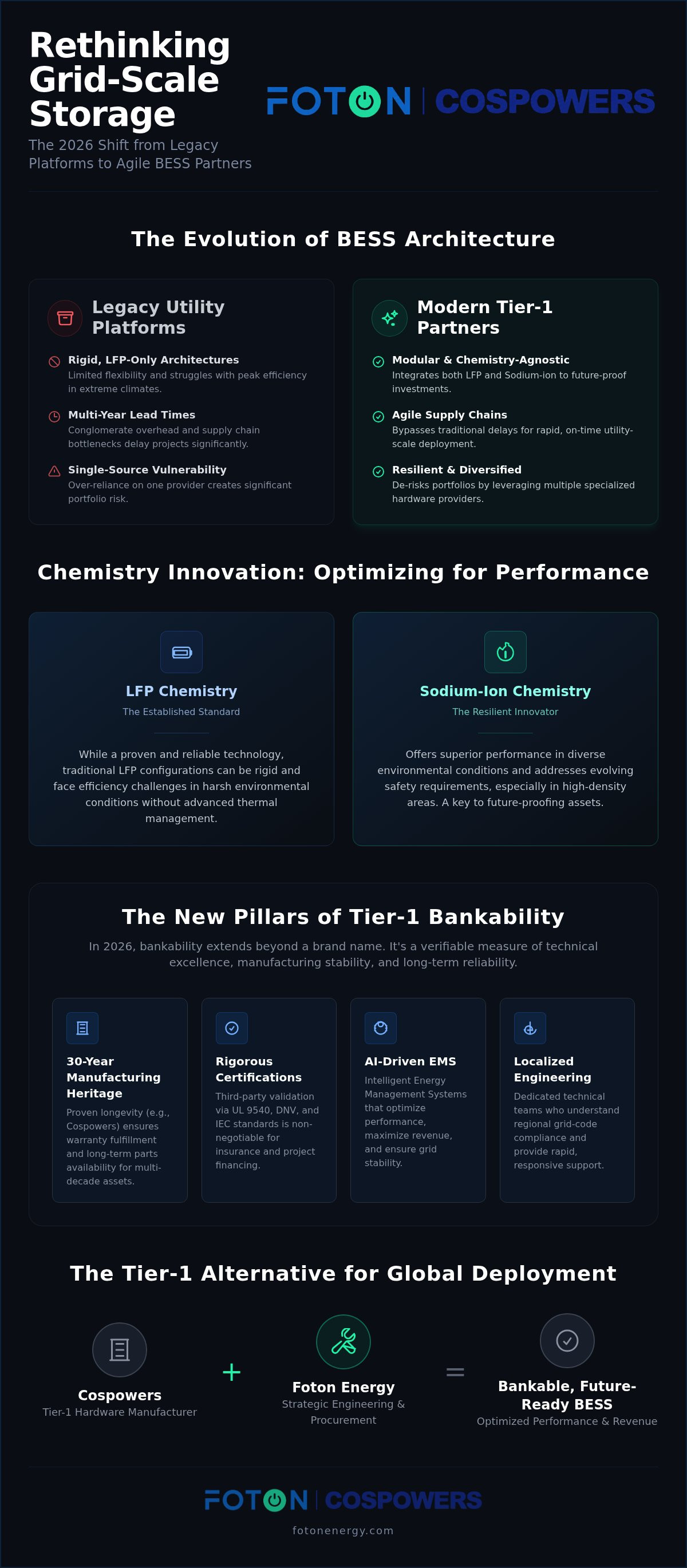
Modern BESS architectures have successfully replicated the integrated promise of legacy systems while introducing a level of modularity that traditional platforms often lack. Developers now prioritize chemistry-agnostic platforms that allow for the seamless integration of both LFP and Sodium-ion technologies. This flexibility ensures that projects remain viable despite fluctuating raw material costs or changing safety requirements in high-density urban environments. By moving away from rigid, single-chemistry architectures, operators can future-proof their investments against the rapid pace of technological innovation.
The Limitations of Legacy Utility Platforms
Rigid LFP configurations often struggle to maintain peak efficiency in extreme climates, creating operational bottlenecks for global developers. The massive overhead of industrial conglomerates frequently results in significant lead time disparities that can delay utility-scale projects by years. These delays are often compounded by a lack of localized engineering support, which is essential for achieving complex grid-code compliance. General Electric Reservoir storage alternatives from focused Tier-1 manufacturers solve these issues by providing dedicated technical teams that understand regional regulatory nuances and can respond with the speed required for modern project timelines.
The 2026 Shift to "Bankable" Agility
Bankability in the current market is no longer defined by a household brand name. It's built on rigorous certifications like UL 9540 and a proven 30-year manufacturing heritage. Engineering, Procurement, and Construction (EPC) firms are actively de-risking their portfolios by diversifying their hardware providers to avoid the vulnerabilities of a single-source supply chain. Foton Energy serves as a strategic link in this transition, facilitating utility scale BESS procurement for developers who require the commercial stability of a Tier-1 partner alongside the technical precision of AI-driven management systems. This collaborative approach ensures that large-scale infrastructure remains both elite in performance and dependable in operation.
Evaluating Tier-1 Bankability in the 2026 BESS Market
Strategic procurement requires verifying that a manufacturer can honor 20-year warranties. In the search for General Electric Reservoir storage alternatives, bankability acts as the primary filter for risk mitigation. This validation isn't just about financial balance sheets; it's about technical verification through DNV, UL, and IEC standards. These certifications ensure that utility-scale deployments meet the rigorous safety and performance benchmarks required by global insurers and grid operators. Without these third-party validations, even the most sophisticated hardware remains a liability for long-term project financing.
Manufacturing Heritage and Tier-1 Status
Cospowers' 30-year manufacturing history provides a foundational assurance that few competitors can match. This longevity is critical because energy storage assets are intended to be multi-decade investments. A manufacturer's established scale directly correlates with their ability to provide consistent long-term warranty support and spare parts availability. Foton serves as a strategic bridge, offering engineering consulting that aligns this Tier-1 hardware with specific grid-scale infrastructure needs. This partnership ensures that projects leverage the latest innovative battery chemistry while remaining grounded in proven manufacturing excellence.
Intelligent Safety and Thermal Architecture
Safety architecture in 2026 has evolved beyond passive liquid cooling. Leading General Electric Reservoir storage alternatives now utilize AI driven energy management systems to predict thermal anomalies before they escalate. These systems monitor cell-level data in real-time, shifting the paradigm from reactive fire suppression to proactive thermal optimization. This intelligence significantly extends BESS longevity by maintaining optimal operating temperatures across varying load profiles. Foton's safety architecture integrates these predictive tools to offer a more robust security profile than legacy modular systems. This level of oversight is vital for utility-scale projects where unplanned downtime directly impacts long-term revenue. For developers looking to de-risk their next project, consulting with a Tier-1 BESS partner ensures access to the most advanced safety protocols in the industry.
Chemistry Innovation: LFP and Sodium-Ion Alternatives
Selecting the optimal electrochemical foundation is a decisive factor in long-term asset performance. While legacy platforms have historically relied on Lithium Iron Phosphate (LFP) as the sole standard, the 2026 landscape demands a more nuanced approach. Modern General Electric Reservoir storage alternatives provide a broader spectrum of options, allowing grid operators to match chemistry to specific environmental and economic constraints. This flexibility is essential for future-proofing investments against the inherent volatility of lithium markets and the evolving safety requirements of high-density infrastructure.
The Emergence of Sodium-Ion Storage
Strategic developers are increasingly prioritizing sodium-ion battery commercial availability for mission-critical applications. This technology offers distinct advantages in safety and cold-climate performance, maintaining reliable discharge rates even in temperatures that would degrade LFP efficiency. In 2026, sodium-ion cell costs are projected to reach the $55 to $70 per kWh range, providing a bankable hedge against lithium price spikes. The sharp decline in hard carbon anode costs, which fell to approximately RMB 35,000 per tonne this year, further stabilizes the supply chain for large-scale utility projects. For data centers and telco backup systems, the superior safety profile and lack of thermal runaway risk make sodium-ion a compelling choice over traditional architectures.
High-Density LFP for Commercial and Industrial Use
LFP remains the dominant chemistry for projects where energy density and cycle life are the primary metrics for success. Optimizing commercial and industrial BESS solutions requires Tier-1 LFP modules that balance high-capacity discharge with rigorous thermal stability. Modular, containerized systems allow for rapid scalability across wind and solar farms, ensuring that storage capacity can expand alongside renewable generation. When evaluating General Electric Reservoir storage alternatives, developers should look for systems that utilize advanced liquid cooling and AI-driven monitoring to preserve LFP health. This combination of proven chemistry and intelligent management ensures that large-scale deployments maintain peak performance throughout their operational lifespan. By integrating these high-density modules, operators can achieve the footprint efficiency required for urban storage without compromising on safety or bankability.
Strategic Procurement Framework for Large-Scale Storage
Navigating the complexities of utility-scale energy storage requires more than just technical specifications. It demands a systematic approach to risk mitigation and asset lifecycle management. When evaluating General Electric Reservoir storage alternatives, project developers must look beyond the initial hardware cost to assess the long-term viability of the partnership. A robust procurement framework ensures that the selected system isn't just a collection of batteries, but a bankable asset capable of meeting the stringent demands of 2026 power markets.
Feasibility and Grid Integration
The first stage of any successful deployment is a comprehensive project design phase. Utilizing professional BESS engineering consulting services is essential for identifying potential bottlenecks before they impact project timelines. This process includes a deep dive into grid-code compliance, particularly in regions like Australia where AS/NZS 5139:2019 standards dictate strict installation and safety parameters. Engineering partners ensure that the hardware-software synergy is optimized for seamless grid connection, preventing the costly delays often associated with generic, non-localized platforms.
Supply Chain and Partner Selection
Market volatility in 2026 has made supply chain transparency a critical procurement metric. With Section 301 tariffs on imported BESS cells reaching 25% this year, securing priority allocation through exclusive global partnerships is a significant competitive advantage. Wholesale hardware procurement models allow EPCs to avoid traditional middleman markups while ensuring direct access to Tier-1 manufacturing capacity. When comparing General Electric Reservoir storage alternatives, you should prioritize partners who offer localized support and transparent supply chains. This de-risks the project against international logistics disruptions and ensures that technical support is available in your timezone. Evaluating reseller programmes can also reveal which partners provide the necessary field engineering support for complex grid-scale integrations. To begin your procurement journey with a proven Tier-1 partner, you can consult with Foton Energy for strategic hardware allocation today.
Finally, the framework must account for the intelligence of the system. An AI-driven Energy Management System (EMS) is the core differentiator that enables real-time grid optimization and revenue stack maximization. By analyzing these steps collectively, developers can secure a storage solution that balances immediate operational needs with 20-year bankability. Long-term asset management fees should be assessed alongside technical support capabilities to ensure the manufacturer remains a supportive partner throughout the asset's lifecycle.
Foton Energy & Cospowers: The Tier-1 Alternative for Global Deployment
Foton Energy occupies a unique position in the 2026 market as the exclusive strategic partner for Cospowers. While legacy industrial conglomerates often present rigid structures and extended lead times, our collaboration offers a more agile, technically superior path for global infrastructure. We provide end-to-end BESS solutions that span from high-performance residential systems to massive utility-scale blocks. This partnership represents a fusion of AI-driven management intelligence and three decades of manufacturing excellence, positioning us as a definitive choice among General Electric Reservoir storage alternatives. By choosing a partner with a focused energy storage heritage, developers can avoid the bureaucratic overhead of multi-sector giants.
A Global Network for Smarter Energy
Cospowers' manufacturing heritage is built on a foundation of operational excellence across more than 70 countries. This extensive footprint ensures that our hardware isn't just technologically advanced, but also battle-tested in diverse environmental conditions. Foton’s Australian-based engineering expertise acts as a bridge for this global capacity, providing the localized technical support required for complex grid-code compliance. We deliver strategic support for critical sectors, including:
- Hyperscale data centers requiring the enhanced safety profiles of Sodium-ion.
- Mission-critical telco backup infrastructure designed for durability.
- Utility-scale wind and solar farms utilizing high-density, modular LFP.
- Commercial and industrial assets focused on AI-driven revenue stack optimization.
Partnering for a Resilient Future
Reliability is the cornerstone of any large-scale energy investment. Developers and EPCs can de-risk their portfolios by joining the Foton channel partner programme, which grants priority access to Tier-1 manufacturing allocation. This collaborative model bypasses the typical markups found in legacy procurement routes, ensuring that your project remains both commercially viable and technically elite. We don't just supply hardware; we provide the engineering consulting necessary to ensure your asset is bankable for its entire 20-year lifecycle. Our approach strikes a balance between being a global industry leader and a supportive, accessible partner.
Initiating your next project begins with a rigorous feasibility study. Our team evaluates grid-code requirements, chemistry suitability, and AI-driven EMS integration to build a customized roadmap for your deployment. Securing bankable energy storage infrastructure for 2026 and beyond requires a partner who is both a bold innovator and a steady, guiding hand. Contacting Foton Energy for a technical consultation is the first step toward achieving a resilient, high-performance energy future. We invite you to participate in this shared vision of a cleaner, more optimized grid where performance and stability are never compromised.
Securing a Resilient Foundation for the 2026 Energy Transition
Success in the 2026 utility-scale market requires moving beyond legacy brand recognition toward technically agile and bankable partnerships. We've explored how diversifying chemistry options and prioritizing AI-driven management systems de-risks infrastructure projects against market volatility. Identifying General Electric Reservoir storage alternatives is no longer just about hardware replacement; it's a strategic shift toward localized engineering support and a resilient, Tier-1 supply chain. This transition ensures that your grid-scale assets are optimized for both performance and long-term financial security.
Foton Energy stands as a foundational pillar in this evolving landscape. As the exclusive global partner of Cospowers, we combine a 30-year manufacturing heritage with Tier-1 certified bankability to ensure your asset remains a dependable revenue driver. Our end-to-end engineering consulting provides the guiding hand necessary to navigate complex grid-code compliance and hardware allocation. We invite you to Consult with Foton Energy on your next utility-scale BESS deployment. Let's collaborate to build a smarter, more resilient grid together.
Frequently Asked Questions
What are the primary differences between GE Reservoir and Cospowers BESS?
Cospowers BESS provides greater chemistry flexibility and more agile lead times compared to traditional General Electric Reservoir storage alternatives. While legacy platforms often rely on rigid, single-chemistry architectures, Cospowers integrates LFP and Sodium-ion options within a modular framework. This adaptability is supported by an AI-driven EMS that optimizes performance across diverse grid applications. With a 30-year manufacturing heritage, Cospowers offers a level of focused technical expertise that conglomerates with broader industrial portfolios often struggle to match.
Is Sodium-ion battery storage ready for utility-scale deployment in 2026?
Sodium-ion technology is reaching a critical inflection point for utility-scale applications in 2026. Global shipments are projected to reach at least 25 GWh this year, driven by its superior safety profile and resilience in cold climates. Unlike LFP, sodium-ion maintains high discharge efficiency in sub-zero temperatures, making it a strategic choice for high-latitude projects. This chemistry's inherent safety and lack of thermal runaway risk provide a bankable alternative for mission-critical infrastructure in diverse environmental conditions.
How does Foton Energy ensure grid-code compliance for its BESS solutions?
Foton Energy utilizes dedicated engineering consulting to navigate the specific regulatory landscapes of global markets. In Australia, our teams ensure alignment with AS/NZS 5139:2019, while projects in the US are designed to comply with NFPA 855 standards. This localized approach covers everything from project feasibility to system design, ensuring that the hardware-software synergy meets the rigorous grid-code requirements of regional transmission operators. This specialized oversight prevents the costly commissioning delays associated with generic, non-localized storage platforms.
Can Foton BESS hardware integrate with existing third-party Energy Management Systems?
Yes, Foton BESS hardware is engineered for high interoperability with leading third-party Energy Management Systems. While our proprietary AI-driven EMS provides the most seamless integration for thermal management and revenue stacking, we recognize that many utility-scale projects require compatibility with existing site-wide controllers. Our engineering team provides technical consulting to ensure that communication protocols and safety architectures align perfectly. This flexibility allows developers to integrate Tier-1 hardware into complex, multi-vendor energy networks without sacrificing operational stability.
What is the expected cycle life for LFP battery modules in a utility-scale project?
Modern LFP modules in utility-scale projects typically offer a cycle life between 6,000 and 8,000 cycles when operated at standard parameters. The actual longevity depends heavily on the depth of discharge and the effectiveness of the thermal management system. By utilizing AI-driven monitoring, operators can maintain optimal cell temperatures and prevent degradation caused by thermal stress. This intelligent oversight ensures that the storage asset remains productive for the duration of its 20-year project lifecycle, maximizing the return on investment.
Does Foton Energy provide technical support for BESS commissioning?
Foton Energy provides comprehensive technical support throughout the commissioning phase and into the operational lifecycle. Our services include site-specific engineering fees that cover initial system setup, grid-connection testing, and performance validation. Beyond the initial deployment, we offer long-term asset management support to ensure the system continues to meet its bankability requirements. This end-to-end involvement provides developers with the security of a steady, guiding hand from the first feasibility study through decades of grid-scale operation.
Why is Tier-1 status critical for BESS project financing?
Tier-1 status is a non-negotiable requirement for securing large-scale project financing in 2026. Lenders and insurers use this classification to verify that a manufacturer has the financial stability and manufacturing history required to honor long-term warranties. When evaluating General Electric Reservoir storage alternatives, bankability is the primary metric for risk mitigation. A Tier-1 designation from organizations like BloombergNEF confirms that the manufacturer is a foundational pillar of the industry, capable of supporting infrastructure assets for twenty years.
What fire suppression technologies are used in Foton containerized BESS?
Foton containerized systems utilize a multi-layered safety architecture that moves beyond passive fire suppression. We integrate aerosol or gas-based suppression agents that are compliant with international safety standards like UL 9540. However, the core of our strategy is an AI-driven thermal management system that detects cell-level anomalies before they escalate into thermal runaway. This proactive approach, combined with robust physical containment, ensures the highest level of protection for mission-critical installations in data centers and high-density urban environments.


