

What if the very lithium-ion batteries powering your data center's growth are now the primary threat to its 2026 operational stability? The global AI power demand has reached a critical inflection point where relying solely on traditional supply chains is no longer a strategic advantage, but a systemic vulnerability. This shift has positioned the sodium-ion battery for data centers as the essential hedge against volatile lithium prices and rare mineral scarcity, offering a path to secure, scalable energy storage.
You're likely managing the tension between scaling infrastructure for massive AI workloads and meeting increasingly strict safety and sustainability mandates. It's a difficult balance when supply chains remain fragile and fire safety concerns in high-density facilities keep your risk management teams on high alert. We understand that reliability isn't just a metric; it's the foundation of your global infrastructure strategy.
This article demonstrates why sodium-ion technology has moved from a laboratory concept to a bankable, Tier-1 manufacturing reality that ensures your facility's energy resilience and long-term cost-optimization. We'll provide a technical comparison against LFP, verify current industrial-scale availability, and examine the thermal safety advantages that define the next generation of mission-critical backup.
Key Takeaways
- Understand why the 2026 AI power crunch makes traditional storage systems obsolete and why a sodium-ion battery for data centers is the necessary pivot for high-density server environments.
- Explore the engineering advantages of sodium-ion chemistry, including intrinsic thermal stability and the logistical benefits of zero-volt shipping.
- Compare sodium-ion against LFP technology to see how modern cells match cycle life performance while providing a more resilient supply chain.
- Learn how AI-driven energy management systems optimize state-of-charge and simplify the integration of sodium-ion BESS into existing DC bus architectures.
- Discover how to leverage Tier-1 manufacturing heritage to ensure project bankability and secure your energy infrastructure in an increasingly volatile market.
The 2026 AI Power Crunch: Why Data Centers are Pivoting to Sodium-Ion
The 2026 AI power crunch represents a fundamental shift in how global infrastructure manages energy. This period is characterized by an unprecedented surge in rack densities, often exceeding 50kW per cabinet, which creates extreme cooling requirements and puts immense pressure on traditional backup systems. As AI workloads become more intensive, the thermal loads within these facilities are pushing conventional hardware to its breaking point. Modern operators now require systems that can handle rapid discharge cycles and high ambient temperatures without the risk of catastrophic failure.
A sodium-ion battery for data centers offers the resilience needed for these high-cycle, high-safety environments. Sodium-ion is a salt-based energy storage medium that eliminates lithium-supply volatility. By leveraging Sodium-ion battery technology, operators can transition away from chemistries that are increasingly difficult to source or manage under extreme conditions. This shift isn't just about performance; it's about the security of the entire operational ecosystem. We invite you to consider how this shift in chemistry protects your long-term capital investments against the rising heat of AI innovation.
The Limitations of Legacy UPS Battery Systems
VRLA systems are becoming obsolete. Their massive footprint and high maintenance costs don't align with the efficiency requirements of 2026 facilities. Modern operators are moving away from lead-acid for several key reasons:
- Excessive Weight: The floor loading requirements for VRLA often restrict the rack density allowed in existing footprints.
- Maintenance Overhead: Frequent testing and replacement cycles drain operational budgets and increase the risk of human error.
- Thermal Sensitivity: Lead-acid performance degrades rapidly in the warmer aisles common in AI-heavy facilities.
While lithium-ion has been the standard for several years, high-density deployments now face heightened thermal runaway risks that complicate insurance and safety protocols. We're seeing a decisive shift toward bankable, non-lithium alternatives that can withstand the heat of modern server rooms without compromising facility safety. Reliability is no longer just about uptime; it's about the physical stability of the energy storage medium itself.
Sodium-Ion: The Strategic Supply Chain Hedge
Global markets remain volatile for cobalt and lithium. This instability creates significant risk for multi-MW data center projects that require predictable long-term pricing and guaranteed delivery timelines. Sodium is abundant and geographically diverse. It provides a stable foundation for infrastructure planning that isn't beholden to a handful of regional suppliers or rare earth mineral scarcity.
Foton plays a critical role in this ecosystem by securing sodium-ion battery commercial availability for our global partners. By bridging the gap between Tier-1 manufacturing heritage and project-level bankability, we ensure that your supply chain is as resilient as the hardware powering your racks. Choosing sodium-ion isn't just a technical decision; it's a strategic move toward energy independence and long-term price stability.
Thermal Stability and Safety: The Sodium-Ion Engineering Advantage
Safety is the first priority when designing high-density AI server environments. The intrinsic chemical properties of a sodium-ion battery for data centers offer a distinct advantage over traditional lithium-based systems. Specifically, sodium-ion cells do not form the same dendrites as lithium, significantly reducing internal short-circuit risks. This fundamental engineering difference, combined with a thermal runaway onset temperature of approximately 210°C, provides a wider margin of safety for mission-critical infrastructure. While LFP remains a popular choice, its onset temperature is typically 20 to 30 degrees lower, making sodium-ion the more resilient option for the intense heat generated by modern GPU clusters, such as the high-performance solutions provided by E-Circles LLC.
Safety Architecture in Mission-Critical Facilities
Protecting your assets requires more than just stable chemistry. Integrating these cells into a large scale battery safety architecture ensures that every layer of the BESS, from the module to the container, is optimized for risk mitigation. Because sodium-ion operates reliably between -40°C and +70°C, facility managers can significantly reduce HVAC and cooling costs. Unlike LFP, which often requires aggressive climate control to prevent degradation, sodium-ion maintains over 90% capacity even at -20°C. This thermal robustness simplifies fire suppression requirements and allows for more flexible deployment in unconditioned or semi-conditioned spaces, directly lowering the total cost of ownership.
Zero-Volt Discharge: A Logistics Revolution
Logistics often represent a hidden cost and safety hurdle for data center EPCs. Sodium-ion technology introduces the advantage of "zero-volt" shipping. This allows cells to be fully discharged for transport, effectively eliminating the stored energy risk during transit. It's a revolution for global supply chains. Zero-volt shipping reduces insurance premiums and simplifies the complex regulatory paperwork associated with hazardous materials, such as the UN 3551 and UN 3552 standards that became effective in early 2026. The logistical flexibility of a sodium-ion battery for data centers translates to faster deployment timelines and reduced on-site risk.
During the commissioning of multi-container BESS units, site safety is enhanced because the systems arrive in a chemically inert state. Foton works closely with Cospowers to ensure every shipment follows certified safe-transport protocols, drawing on 30 years of manufacturing heritage. This partnership provides the bankable assurance that your project will meet international safety standards from the factory floor to the data center busbar. If you're looking to optimize your facility's safety profile, our engineering consulting team can provide the strategic guidance needed to integrate these advanced chemistries.
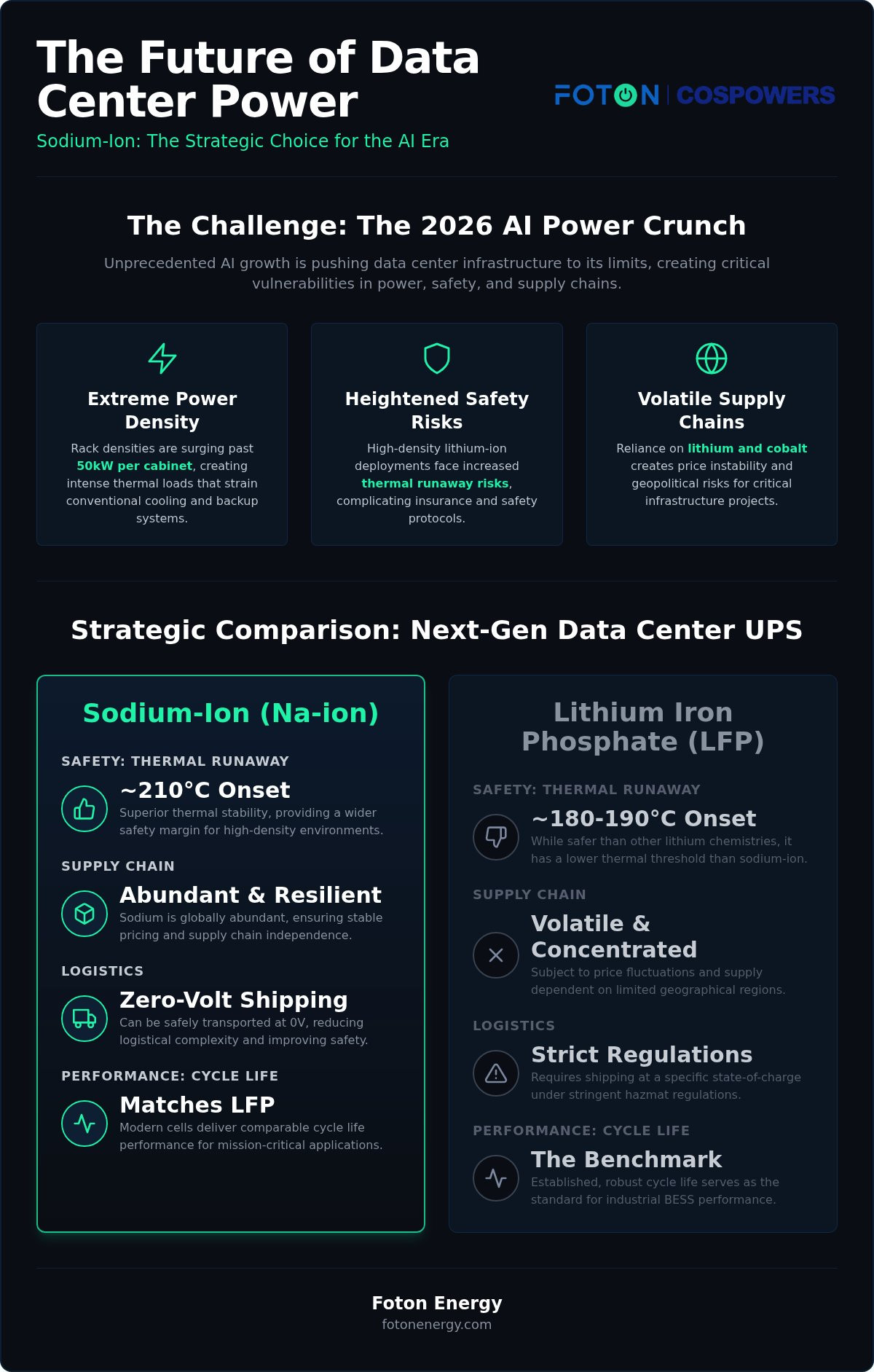
Strategic Comparison: Sodium-Ion vs. LFP for Data Center UPS
Selecting the right chemistry requires a cold-eyed analysis of long-term performance. While Lithium Iron Phosphate (LFP) has historically been the default choice, the 2026 landscape shows that a sodium-ion battery for data centers is effectively closing the gap for stationary applications. Current energy density for sodium-ion cells has reached 160 to 175 Wh/kg, which places it in direct competition with LFP’s 140 to 180 Wh/kg range. For data center operators, this means the previous density penalty associated with salt-based chemistries has largely vanished, allowing for comparable rack-level power support in the same physical footprint.
Cycle life performance is equally impressive. Commercial sodium-ion cells in 2026 now match LFP’s standard of 6,000+ cycles, with some high-performance modules designed for utility-scale applications exceeding 10,000 cycles. When evaluating the 15-minute UPS backup window, sodium-ion’s ability to sustain high C-rates without significant voltage sag is a critical advantage. High discharge rates are mandatory for mission-critical UPS systems. Sodium-ion chemistry excels here, providing consistent power delivery during the sudden transition from grid to battery. Over a 15-year data center lifecycle, the total cost of ownership (TCO) becomes highly attractive, especially when factoring in the reduced cooling needs and lower insurance premiums discussed in previous sections.
Performance Benchmarks in 2026
Analyzing sodium-ion vs lithium energy storage reveals that round-trip efficiency (RTE) for sodium-ion remains stable at approximately 90% to 92% in peak-shaving applications. While LFP might offer a slight edge in raw efficiency, sodium-ion's superior degradation curves at high temperatures provide a more predictable capacity retention profile. EPCs don't need to fear the transition; in 2026, the performance delta has narrowed to the point where supply chain resilience and safety often outweigh marginal efficiency gains. This predictability is vital for long-term power purchase agreements and grid-support services.
Footprint and Power Density Considerations
Urban data centers face strict space constraints. While sodium-ion has a slightly lower volumetric density than high-end LFP, modular containerized solutions allow for rapid scalability and efficient site layouts. These systems are designed to maximize every square meter of the facility. We focus on maximizing the bankability of these projects by utilizing Tier-1 manufacturing standards. Financing partners increasingly view a sodium-ion battery for data centers as a secure asset because it avoids the geopolitical risks inherent in lithium-cobalt supply chains. This strategic alignment ensures that your infrastructure investment remains stable and productive for the next two decades. To support the full lifecycle of your facility's technology, you can discover 億鑫鴻景電子 (Yixin Hongjing Electronics) for professional electronic component recycling and recovery.
Transitioning to a sodium-ion battery for data centers requires moving beyond raw chemistry into precise system orchestration. Integrating these modules into existing DC bus architectures is a methodical process that demands high-performance power electronics and strategic alignment with existing UPS hardware. Unlike traditional retrofits, the 2026 standard for data center energy storage involves bi-directional power flow and seamless grid interaction. This ensures your facility isn't just a consumer of energy but a resilient, intelligent node in a larger industrial ecosystem.
Predictive maintenance serves as the final pillar of this operational transition. By using AI to monitor cell health and thermal gradients in real-time, operators can identify potential issues before they impact facility uptime. This proactive approach to a sodium-ion battery for data centers ensures a 15-year lifecycle with minimal intervention, protecting both your hardware and your data. We focus on providing the technical proof points that allow large-scale investors to move forward with absolute confidence in their infrastructure's durability.
The AI-Driven EMS: The Brain of the BESS
Sophisticated software is the foundation of a reliable installation. The role of AI driven energy management systems is to optimize the unique discharge curves of sodium-ion cells in real-time. Foton's proprietary EMS manages state-of-charge with surgical precision, allowing for aggressive peak shaving and demand response. These capabilities directly reduce data center OPEX by avoiding high-tariff periods and potentially generating revenue through grid-support services. Real-time telemetry and cloud-based monitoring provide a unified view for global fleet management, ensuring every module performs at its peak capacity.
Grid-Code Compliance and Interconnection
Reliability is backed by rigorous international standards. Navigating IEEE and IEC certifications is mandatory for any front-of-the-meter or large-scale behind-the-meter deployment in 2026. Our engineering teams prioritize meeting the technical requirements for grid-forming inverters, which are essential for maintaining stability in data center microgrids. We provide the bankable documentation that EPCs and financiers require to verify project viability. If you're ready to modernize your power architecture with these advanced systems, consult with our engineering team to begin your strategic integration plan.
Securing Your Supply: Foton and the Cospowers Tier-1 Advantage
Reliability in energy infrastructure isn't built overnight. It requires a fusion of manufacturing excellence and strategic engineering. The partnership between Foton and Cospowers represents this synergy, combining a 30-year manufacturing heritage with a global footprint that spans over 70 countries. For developers, securing a sodium-ion battery for data centers means more than just purchasing hardware; it's about partnering with a foundational pillar of the industry. We act as the critical link between Tier-1 production and project-level bankability, ensuring your transition to salt-based chemistry is supported by decades of proven performance in high-reliability telecom and backup sectors.
Wholesale procurement strategies in 2026 have shifted toward long-term supply agreements that mitigate the risks of mineral volatility. Data center developers must look beyond the cell chemistry to the stability of the manufacturer itself. Foton’s role is to provide the end-to-end consulting required to move from initial feasibility studies to final commissioning. We don't just deliver modules; we deliver a comprehensive energy strategy that ensures your sodium-ion battery for data centers is optimized for the specific demands of AI-heavy workloads. This holistic approach protects your capital investment and ensures operational excellence from day one.
Tier-1 Manufacturing at Scale
Bankability depends on consistency. This is why "Tier-1" status is the essential filter for any large-scale BESS deployment. Cospowers utilizes fully automated production lines to ensure that every cell meets the rigorous standards required for mission-critical backup. Since 1993, this heritage of high-reliability manufacturing has served the most demanding telecom environments. Today, that same expertise is applied to sodium-ion technology, providing the scale and quality control necessary to support multi-MW data center projects. When you choose a Tier-1 solution, you're choosing a product that has undergone rigorous testing and international certification, from DNV verification to UL safety standards.
Partnering for the Future of Data Center Power
Success in the 2026 energy market requires a collaborative approach. We invite EPCs, installers, and infrastructure developers to join the Foton channel partner programme. This initiative provides the technical training, marketing support, and priority supply access needed to lead the transition to sustainable storage. Beyond hardware, our engineering consulting services help you navigate the complexities of large-scale energy storage infrastructure, from grid-code compliance to EMS integration. The future of data center power is resilient, salt-based, and strategically managed. Take the next step in your infrastructure evolution and consult with Foton Energy on your next data center BESS project to ensure your facility is ready for the AI age.
Architecting Resilience for the Future of AI
The 2026 energy landscape demands a departure from volatile supply chains and thermal risks. By prioritizing intrinsic safety and superior temperature performance, a sodium-ion battery for data centers provides the foundational security required to scale AI workloads with confidence. You've seen how salt-based chemistry matches LFP's cycle life while offering the logistical advantage of zero-volt shipping and a more resilient mineral supply chain. These technical proof points, supported by AI-driven energy management, ensure your infrastructure remains optimized for the next two decades.
Secure your facility’s future with a partner who bridges the gap between visionary technology and industrial-scale bankability. Foton stands as the exclusive global strategic partner of Cospowers, leveraging a Tier-1 manufacturing heritage that dates back to 1993. Our DNV-verified and AI-optimized energy systems are designed to integrate seamlessly into your mission-critical DC bus architecture, providing the stability your investors expect. It's time to lead the transition toward a safer, more sustainable energy ecosystem. Partner with Foton for Tier-1 Sodium-Ion Data Center Solutions and ensure your power strategy is as advanced as the hardware it supports.
Frequently Asked Questions
Are sodium-ion batteries commercially available for data centers in 2026?
Yes. Foton, as the exclusive global partner of Cospowers, provides Tier-1 manufactured sodium-ion modules ready for 2026 deployment. While some competitors target 2027 for international delivery, our established manufacturing heritage since 1993 allows for immediate integration into mission-critical infrastructure. This availability is vital for operators facing the 2026 AI power crunch who cannot afford to wait for unproven supply chains to mature or experimental technologies to reach the market.
How does the cost of sodium-ion compare to LFP for large-scale backup?
Sodium-ion cells are currently priced between $70 and $120 per kWh, which is becoming increasingly competitive with LFP's $60 to $110 range. The total cost of ownership often favors sodium due to reduced cooling requirements and lower insurance premiums. While initial capital expenditure might vary, the avoidance of volatile lithium and cobalt markets provides long-term price stability for multi-MW data center projects, making it a strategic financial hedge for global developers.
What are the primary safety benefits of sodium-ion in high-density AI environments?
The primary advantage is a significantly higher thermal runaway onset temperature of approximately 210°C. This is 20 to 30 degrees higher than standard LFP chemistries. In high-density AI environments where rack heat is extreme, this margin of safety is critical. Additionally, sodium-ion cells don't form the same dangerous dendrites as lithium, which drastically lowers the risk of internal short circuits during the rapid discharge cycles required for mission-critical backup.
Can sodium-ion batteries be used for peak shaving in data centers?
Yes, sodium-ion batteries are highly effective for peak shaving and demand response. When managed by an AI-driven EMS, these systems can discharge during high-tariff periods to reduce operational expenses. Their ability to maintain over 90% capacity at -20°C and handle high C-rates makes them ideal for the frequent cycling required in grid-support applications. This versatility allows data centers to transform a backup asset into a revenue-generating tool while maintaining facility uptime.
Do sodium-ion batteries require special fire suppression systems?
Sodium-ion systems typically don't require specialized fire suppression beyond the standard protocols used for LFP. Their inherent thermal stability and higher runaway threshold often simplify the safety architecture requirements. However, we always recommend following UL 9540A testing results and consulting with our engineering team to ensure your specific facility meets all local building codes and insurance mandates. Proper integration of thermal management systems remains a standard requirement for all large-scale energy deployments.
What is the expected lifespan of a sodium-ion battery in a UPS application?
You can expect a cycle life between 4,000 and 10,000 cycles for a sodium-ion battery for data centers. This performance is comparable to LFP and ensures a reliable 15-year lifecycle in typical UPS applications. Because sodium-ion chemistry is less sensitive to temperature fluctuations, the degradation curve is more predictable over time. This stability allows EPCs to plan for long-term capacity retention without the aggressive oversizing often required for legacy lead-acid or lithium systems.
Can sodium-ion batteries be shipped at zero volts?
Yes, sodium-ion batteries can be fully discharged to zero volts for transport. This unique capability differentiates them from lithium-ion, which must maintain a minimum state of charge to prevent cell damage. Shipping at zero volts eliminates the risk of fire during transit and simplifies compliance with UN 3551 and UN 3552 regulations. It also reduces insurance costs and improves site safety during the initial commissioning phase for multi-container battery energy storage systems.
Is Foton an authorized distributor for Cospowers sodium-ion batteries?
Foton Energy is the exclusive global strategic partner for Cospowers. This means we are the primary distribution and engineering arm for their Tier-1 manufactured products worldwide. Our partnership ensures that data center developers receive direct access to a manufacturing heritage that began in 1993. We provide the bankable assurance, DNV-verified safety protocols, and technical consulting necessary to implement a sodium-ion battery for data centers at an international scale with full factory support.


