

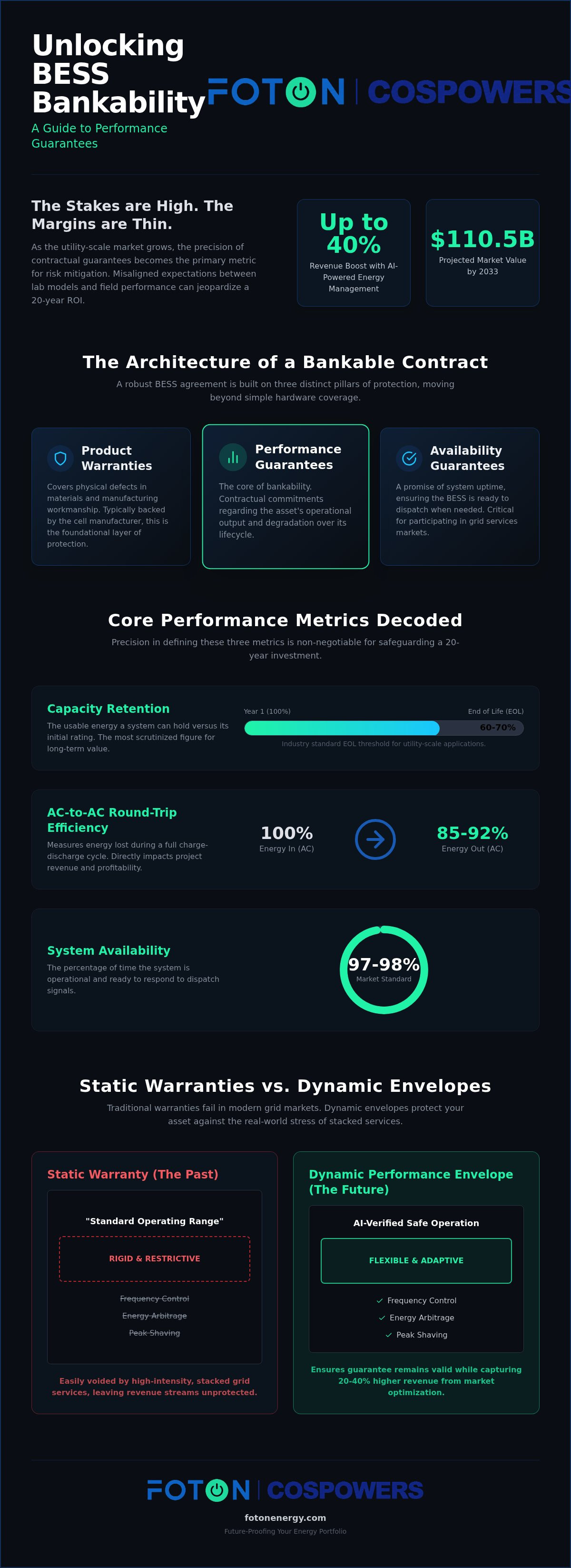
AI-powered Energy Management Systems can boost revenue capture by up to 40%, yet even the most sophisticated software cannot protect an asset tethered to ambiguous contractual language. You understand that as the global utility-scale market targets a $110.5 billion valuation by 2033, the margin for technical error has effectively vanished. It's common to encounter frustrating discrepancies between laboratory degradation models and actual field performance, especially when comparing established LFP systems against emerging sodium-ion technologies. Having BESS performance guarantees explained with absolute precision is no longer just a legal necessity; it's the foundation of project bankability and long-term stability.
This guide ensures you master the technical and commercial nuances required to maintain asset resilience in a volatile energy market. We'll provide a clear checklist for negotiating bankable guarantees and explain how to align these protections with specific grid-service use cases. You'll gain the confidence to verify Tier-1 manufacturing standards, moving beyond static hardware warranties toward dynamic, AI-verified performance envelopes that secure your 20-year ROI and ensure your infrastructure is ready for the 2026 regulatory environment.
Key Takeaways
- Master the foundational architecture of contractual commitments with BESS performance guarantees explained through the lens of long-term project bankability.
- Prioritize AC-to-AC Round-Trip Efficiency and capacity retention thresholds to ensure your asset delivers consistent value across its entire operational lifecycle.
- Bridge the gap between laboratory degradation models and field performance by defining cycling assumptions that align with specific grid-service use cases.
- Secure financing by looking beyond manufacturing volume, focusing instead on independent engineer reports and rigorous international verification standards.
- Future-proof your portfolio by integrating AI-driven Energy Management Systems that offer predictive oversight for both LFP and emerging sodium-ion technologies.
Understanding the Architecture of BESS Performance Guarantees
A bankable BESS project is built on more than just hardware; it's secured by the strength of its underlying contracts. At its core, a performance guarantee is a contractual commitment that ensures a minimum threshold of operational performance over a defined period. As the global utility-scale market targets a $110.5 billion valuation by 2033, the precision of these agreements has become the primary metric for risk mitigation. To have BESS performance guarantees explained properly, you must look past the physical cells and examine the financial security they provide to lenders and investors. These guarantees transform a volatile chemical asset into a predictable financial instrument, providing the "bankability" required to secure large-scale infrastructure capital.
In 2026, we've seen a decisive shift from simple hardware warranties to complex, multi-layered performance envelopes. While a standard product warranty covers defects in materials and manufacturing, it rarely protects your revenue stream against operational degradation. A robust battery energy storage system agreement must distinguish between three critical pillars:
- Product Warranties: Coverage for physical defects and workmanship, typically backed by the cell manufacturer.
- Performance Guarantees: Commitments regarding capacity retention (often 60% to 70% at end-of-life) and round-trip efficiency.
- Availability Guarantees: A promise of system uptime, with 2026 market standards in Europe and North America typically hovering between 97% and 98%.
The Role of the System Integrator vs. the Manufacturer
Determining who actually backs your guarantee is vital for long-term security. While Tier-1 manufacturers provide the foundational warranty for the cells, the system integrator often manages the holistic performance of the entire asset. Foton Energy bridges this gap by combining the 30 year manufacturing heritage of Cospowers with specialized engineering consulting. This strategic partnership ensures that the guarantor isn't just a distant factory, but a collaborative partner capable of aligning technical performance with local grid requirements. Bankability depends as much on the financial stability of these partners as it does on the technical specifications of the hardware.
Why Static Warranties Fail in Dynamic Grid Markets
Traditional, fixed degradation models often crumble when faced with the reality of "stacked services." If your project participates in frequency control (FCAS) while simultaneously performing energy arbitrage and peak shaving, the thermal stress on the cells will deviate significantly from laboratory predictions. Static warranties often include "Standard Operating Range" clauses that can be easily voided by these high-intensity use cases. A performance envelope is a dynamic boundary for safe operation that adjusts based on real-time thermal, electrochemical, and throughput data. By moving toward these dynamic models, you ensure that your guarantee remains valid even as you optimize bids in wholesale markets to capture the 20% to 40% revenue improvements offered by AI-driven dispatch.
The Core Metrics: Capacity, Efficiency, and Availability Decoded
Precision in performance measurement is the only way to safeguard utility-scale investments. When we look at BESS performance guarantees explained in a technical context, three core metrics dominate the commercial discussion: capacity, efficiency, and availability. While these terms are often used interchangeably in casual conversation, they represent distinct contractual obligations that dictate your project's revenue potential. For grid-scale assets, these metrics must be defined with granular detail to prevent "unprotected" degradation that could jeopardize a 20-year lifecycle.
Capacity retention is perhaps the most scrutinized figure. It defines the usable energy the system can hold compared to its original rating. In 2026, the industry standard for the End of Life (EOL) threshold typically sits between 60% and 70%. If the battery drops below this level, it's often considered functionally depleted for high-intensity grid applications. However, availability is equally critical; it measures the "ready-to-serve" status of the system. A battery might have 100% capacity, but if the inverter is offline, the system's availability is zero. For high-speed services like Frequency Control Ancillary Services (FCAS), response times and ramp rates are also codified, ensuring the asset reacts to grid signals within milliseconds.
Capacity Degradation: Throughput vs. Calendar Life
Investors must distinguish between degradation caused by usage and degradation caused by time. MWh throughput limits define how much energy can pass through the cells before the guarantee is affected. It's essential to understand Evaluating LFP Battery Cycle Life for Utility Projects to accurately forecast these limits. Conversely, calendar life guarantees protect you if the battery sits idle, ensuring the chemistry doesn't lose integrity during periods of low market activity. Balancing these two factors requires sophisticated Engineering Consulting to ensure your dispatch strategy doesn't inadvertently void your coverage.
Round-Trip Efficiency (RTE) Guarantees
Energy "leakage" is an invisible ROI killer. Round-trip efficiency (RTE) measures the ratio of energy put into the storage system to the energy retrieved. For a guarantee to be bankable, it must be measured as an AC-to-AC metric at the Point of Interconnection (POI). This accounts for all parasitic loads, including HVAC cooling, inverter conversion losses, and transformer inefficiencies. According to the World Bank's guidelines on Warranties for BESS, measuring at the POI is the only way to capture the true operational cost. In 2026, Tier-1 LFP systems typically guarantee an RTE of 85% to 90%, while emerging sodium-ion systems are beginning to challenge these benchmarks with superior thermal stability in extreme environments.
Navigating Complexity: Why Operational Reality Diverges from Models
The laboratory is a controlled environment; the grid is not. Many developers overlook the fact that a battery begins to degrade the electrochemical moment it leaves the production line. This "storage degradation" often consumes a portion of the guarantee before the system even reaches the site, creating a gap between the modeled performance and the actual state of health at commissioning. When we have BESS performance guarantees explained in a real-world context, we must account for this divergence. Discrepancies often arise from the "Point of Measurement" trap. A guarantee measured at the battery rack level is far more lenient for the manufacturer than one measured at the container level, as it ignores the parasitic losses of auxiliary systems and the subtle inefficiencies that accumulate across the internal architecture.
Commissioning delays present another significant risk to long-term asset resilience. If a project is stalled for six months due to grid connection hurdles, the "calendar life" component of the guarantee continues to tick away while the asset sits idle. It's vital to negotiate "Stop-Clock" provisions or compensation for lost capacity during these periods of forced inactivity. Without these protections, your 20-year asset might only offer 19 years of protected revenue generation.
Addressing the 'Cycling Profile' Discrepancy
Most manufacturers define a "Standard Cycle" as one full charge and discharge per day at a specific C-rate. However, modern utility projects rarely follow such predictable patterns; they engage in high-frequency, shallow cycles for frequency regulation or multiple daily peaks for arbitrage. To protect your investment, your EPC contract must be aligned with the manufacturer’s warranty limits through "Flexible Cycling" clauses. These allow for multi-service grid participation without voiding the overarching capacity retention claims. Your Depth of Discharge (DoD) strategy must be codified as a dynamic limit rather than a static percentage to maintain BESS performance guarantees explained within the bounds of operational reality.
Thermal Management and Performance Security
Temperature is the most aggressive driver of electrochemical aging. If ambient conditions exceed the "Standard Operating Range" specified in the contract, the guarantee often becomes null and void. Sophisticated long-term BESS warranty considerations emphasize the role of active thermal management in preserving asset value. Liquid cooling systems generally offer superior temperature uniformity compared to air cooling, which directly extends the "guaranteed" life of the cells by preventing localized hot spots. Thermal stability is the primary predictor of capacity retention.
Ensuring Project Bankability: Tier-1 Standards and Financial Security
Project finance hinges on the absolute certainty of future cash flows. In 2026, lenders and investors have moved beyond high-level promises, demanding rigorous technical proof before committing capital to grid-scale storage. Financiers look for third-party verification from entities like DNV and comprehensive independent engineer (IE) reports. These documents validate the manufacturer's degradation curves against the project's specific dispatch profile, ensuring that the BESS performance guarantees explained in the contract are rooted in electrochemical reality rather than optimistic marketing models. Without this level of scrutiny, an asset risks being labeled "unbankable," significantly increasing the cost of capital.
The "Tier-1" designation is often misunderstood as a definitive seal of quality. Manufacturing volume is a proxy for market scale, but it doesn't inherently guarantee the solvency of a 20-year warranty. To mitigate this, developers must look at the historical stability of the manufacturer and the strength of their Liquidated Damages (LDs) structure. In the current market, the standard for aggregate performance-related LD caps is approximately 10% of the contract value. Negotiating a cap between 15% and 20% provides much stronger protection for the buyer, though it requires a partner with significant balance sheet strength. You can find a detailed breakdown of these requirements in our guide on Bankable Energy Storage: What Financiers Look For.
The Cospowers Legacy: 30 Years of Bankability
Manufacturing heritage is the most reliable predictor of future performance. Cospowers has maintained a Tier-1 manufacturing legacy since 1993, providing a level of stability that few newer entrants can match. This vertical integration secures the entire supply chain, from cell production to final integration, which simplifies the warranty claim process by eliminating "finger-pointing" between different suppliers. Foton Energy acts as the critical bridge in this ecosystem, providing the "Local Wrap." This ensures that global manufacturing excellence is supported by local Engineering Consulting and rapid-response technical support, making the guarantee actionable in your specific jurisdiction.
Structuring the Performance Bond
Security must extend beyond the life of the manufacturer. If a supplier faces insolvency, your performance guarantee could become an "orphan warranty," leaving the project exposed to unmitigated degradation. To prevent this, large-scale projects increasingly utilize insurance-backed warranties or performance bonds that remain valid regardless of the manufacturer’s corporate status. Developers should also consider escrowing a portion of maintenance funds to ensure operational continuity. This proactive approach to financial structuring ensures that the asset remains resilient, protecting your ROI against both technical failure and market volatility.
To ensure your next infrastructure investment meets these rigorous standards, consult with our utility-scale specialists to structure a bankable performance framework.
Future-Proofing Performance: Sodium-Ion and AI-Driven Oversight
The energy landscape of 2026 is no longer a monoculture of lithium iron phosphate. While LFP remains the dominant chemistry for grid-scale applications, sodium-ion technology is rapidly transitioning from pilot programs to commercial-scale deployment. With cumulative shipments expected to reach 1 GWh by the end of 2026, developers must understand that BESS performance guarantees explained for sodium-ion differ significantly from their lithium counterparts. These systems offer superior temperature resilience and can often operate in extreme environments that would void a standard LFP warranty. However, their discharge profiles and cycle life expectations require a different set of contractual benchmarks. You can explore this transition in our strategic analysis of The 2026 State of Sodium-Ion Battery Commercial Availability.
AI-driven oversight has transformed the Energy Management System (EMS) from a simple dispatcher into a proactive "guarantee protection" layer. By utilizing machine learning algorithms, these systems identify cell-level anomalies before they escalate into a warranty breach. This predictive maintenance is essential for preserving the long-term state of health (SoH) of the asset. Modern AI-powered EMS can improve revenue capture by 20% to 40% compared to static strategies, ensuring that performance optimization never comes at the expense of contractual compliance.
How AI Protects Your Performance Guarantee
Smart systems now provide real-time optimization of the State of Charge (SoC) to minimize electrochemical stress during high-intensity periods. This automated oversight ensures the system stays within the "safe" performance envelope defined in your contract, effectively shielding the asset owner from accidental warranty voiding. Our AI Driven Energy Management Systems: The 2026 Strategic Guide details how these platforms generate transparent, automated reporting for seamless warranty compliance. This creates a digital audit trail that simplifies discussions with manufacturers and insurers alike.
Negotiating the Next Generation of BESS Contracts
Performance guarantees are evolving into "Software-as-a-Service" models where the integrator provides ongoing algorithmic tuning to meet shifting grid requirements. This is particularly vital for data center and telco backup applications, where the transition to sodium-ion is accelerating due to lower costs and higher safety ratings. As you prepare for your next infrastructure investment, ensure your contracts reflect these technological shifts. Aligning with a partner who understands both the 30 year manufacturing heritage of Cospowers and the latest in AI optimization is the only way to secure a truly bankable future. Partner with Foton for Bankable BESS Engineering and Tier-1 Hardware to ensure your project remains resilient through 2026 and beyond.
Securing Long-Term Resilience in a Volatile Energy Landscape
A bankable energy future is built on the intersection of technical rigor and commercial transparency. Managing a grid-scale asset requires a fundamental shift from viewing warranties as simple safety nets to treating them as dynamic financial instruments. We've seen how BESS performance guarantees explained with technical precision can bridge the gap between laboratory models and the demanding operational reality of modern grid services. By prioritizing AC-to-AC efficiency, aligning cycling profiles with specific use cases, and leveraging AI-driven oversight, you transform a chemical storage project into a bankable infrastructure asset.
Success in 2026 demands a partner who combines decades of manufacturing stability with forward-looking intelligence. As the exclusive global partner of Cospowers, a Tier-1 manufacturer with a legacy dating back to 1993 and a presence in over 70 countries, Foton Energy provides the stability required for 20-year investments. Our advanced AI-driven EMS ensures your system operates within its optimal performance envelope, protecting your warranty while maximizing revenue capture.
Secure your project’s future with Foton’s Tier-1 BESS solutions and expert consulting.
The transition to a cleaner, more resilient grid is a shared ambition; we're ready to help you lead it with confidence.
Frequently Asked Questions
What is the difference between a BESS performance guarantee and a product warranty?
A product warranty covers physical defects and manufacturing errors, whereas a performance guarantee ensures the system maintains specific operational outputs like capacity retention and efficiency. While the warranty protects against hardware failure, the performance guarantee secures your revenue stream by promising a minimum state of health over time. Having BESS performance guarantees explained in this way helps investors distinguish between equipment reliability and long-term financial productivity.
How long do BESS performance guarantees typically last in 2026?
In 2026, grid-scale performance guarantees typically range from 10 to 15 years, though 20 year agreements are increasingly common for utility projects. These longer durations often require specific long-term service agreements and periodic battery augmentation to ensure the system meets capacity thresholds throughout its lifecycle. Manufacturers like Cospowers leverage 30 years of heritage to provide the stability required to back these multi-decade commitments.
What happens if my battery storage system doesn't meet its RTE guarantee?
Failure to meet a Round-Trip Efficiency (RTE) guarantee usually triggers liquidated damages or a requirement for the supplier to perform corrective system optimization. Because RTE is measured as an AC-to-AC metric at the Point of Interconnection, any shortfall directly increases operational costs. Contracts often specify a remedy period where the integrator must identify and fix parasitic losses in HVAC or inverter systems before financial penalties apply.
Can using my BESS for FCAS void my performance guarantee?
High-frequency services like FCAS can void a guarantee if the operational profile deviates from the Standard Operating Range defined in the contract. These services often involve rapid, shallow cycles that increase thermal stress. To prevent this, developers should negotiate Flexible Cycling clauses that specifically account for multi-service grid participation, ensuring the performance envelope remains valid even during high-intensity market activity.
Are Sodium-ion battery performance guarantees different from LFP?
Sodium-ion guarantees differ from LFP primarily in their thermal tolerance and discharge characteristics. While LFP is the standard for 2026, sodium-ion systems offer superior performance in extreme temperatures, often requiring fewer restrictive environmental clauses. However, because the technology is newer, the cycle life guarantees might be structured around different throughput limits, making it essential to have these BESS performance guarantees explained by engineering consultants before procurement.
What are 'Liquidated Damages' in the context of BESS underperformance?
Liquidated Damages (LDs) are pre-defined financial penalties that a supplier pays if the system underperforms against contractual benchmarks like availability or capacity. In 2026, the market standard for aggregate performance-related LD caps is approximately 10% of the total contract value. These payments compensate the owner for lost revenue, providing a critical layer of financial security that makes large-scale storage projects attractive to conservative lenders and institutional investors.
How does an Energy Management System (EMS) help in maintaining a performance guarantee?
An Energy Management System acts as a digital guardian by optimizing the battery's State of Charge and managing thermal loads in real-time. By utilizing AI-driven predictive maintenance, the EMS identifies cell-level anomalies before they lead to a breach of guarantee. This proactive oversight ensures the system operates strictly within its safe performance envelope, providing the automated reporting necessary to prove warranty compliance during annual reviews.
Is a Tier-1 rating enough to ensure a BESS is bankable?
A Tier-1 rating indicates high manufacturing volume and past bankability, but it isn't a substitute for project-specific technical due diligence. Financiers also require independent engineer reports and third-party verification to ensure the hardware can handle the project's unique dispatch profile. True bankability stems from a combination of a reputable manufacturer's balance sheet and a robustly structured performance contract that protects against operational reality.


