

The era of passive energy storage is over. As global energy markets accelerate toward 2026, the success of utility-scale projects no longer hinges on simple capacity; it depends on the precision of high-speed orchestration. Grid stabilization battery systems have evolved from secondary backup components into the primary architects of a resilient, renewable-heavy energy landscape. You've likely felt the pressure of navigating complex grid-code compliance while managing concerns over battery degradation and the volatility of Tier-1 hardware supply chains. It's a high-stakes environment where safety and long-term bankability are non-negotiable requirements for any serious infrastructure investment.
This strategic guide provides the clarity you need to master these challenges and secure your project's future. You'll discover how advanced battery energy storage systems (BESS) provide critical grid services that ensure both operational stability and financial performance. We'll explore the vital role of AI in grid optimization, the importance of partnering with manufacturers who possess a deep manufacturing heritage, and the emerging chemistries that define next-generation resilience. By the end of this guide, you'll have a clear roadmap for identifying bankable hardware partners and ensuring your assets deliver value for decades.
Key Takeaways
- Understand the evolution from synchronous to synthetic inertia and how grid stabilization battery systems deliver the millisecond response times required for modern grid health.
- Identify the technical requirements for Frequency Control Ancillary Services (FCAS) and voltage support to ensure strict grid-code compliance across diverse networks.
- Evaluate the strategic advantages of LFP versus emerging sodium-ion chemistries to optimize performance for specific power-heavy or long-duration utility tasks.
- Discover how AI-driven Energy Management Systems and multi-level safety protocols protect your infrastructure investment and extend battery cycle life.
- Learn to mitigate supply chain volatility by aligning with Tier-1 partners backed by decades of proven manufacturing heritage and global certifications.
What are grid stabilization battery systems?
Grid stabilization battery systems are more than just large-scale containers of electricity. They are sophisticated, high-speed energy storage assets engineered to maintain the delicate balance of frequency, voltage, and overall stability within a power network. While traditional storage often focused on time-shifting energy for peak demand, these modern systems operate on a sub-second level to correct deviations before they cascade into grid failures. They serve as the critical interface between variable renewable generation and a stable consumer supply.
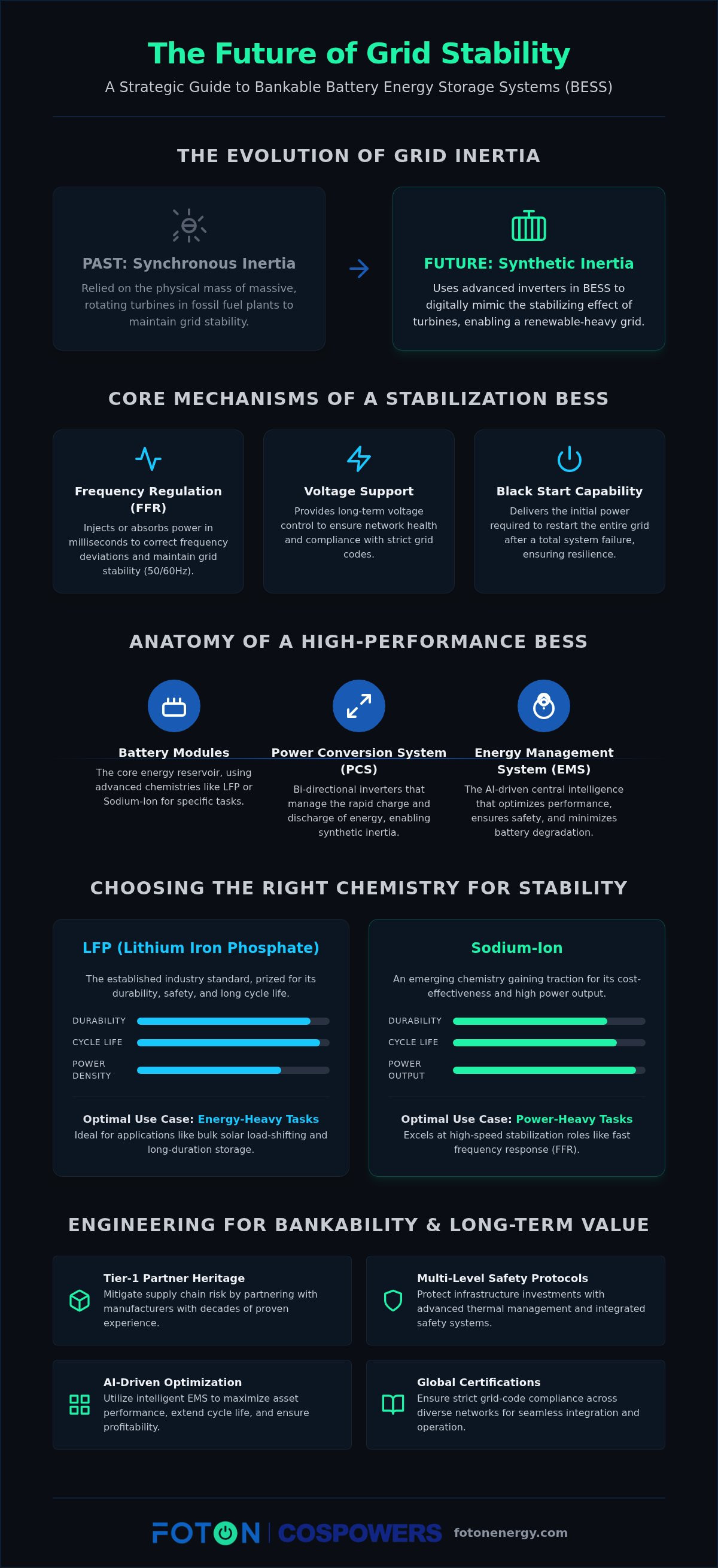
The energy landscape is undergoing a fundamental physical change. We're moving away from the synchronous inertia provided by the massive rotating turbines of coal and gas plants. By 2026, the industry is shifting toward synthetic inertia, where grid stabilization battery systems use advanced inverters to mimic the stabilizing effect of traditional power plants. This transition is essential for mitigating the inherent intermittency of wind and solar, providing the necessary buffer that keeps the grid operational even when the sun sets or the wind dies down.
The evolution of grid-scale energy storage
Grid-scale storage has evolved significantly. Early deployments focused on simple peak shaving, but the requirements for 2026 net-zero infrastructure mandates demand more. Utility-scale BESS now manages complex ancillary services, ensuring that every megawatt hour contributes to grid health. This involves a strategic distinction between power-heavy tasks, like frequency regulation that requires rapid bursts of energy, and energy-heavy tasks, such as shifting bulk solar loads into the evening. Bankability has become the primary prerequisite. Investors and operators seek systems backed by Tier-1 manufacturing heritage, such as the partnership between Foton Energy and Cospowers, to ensure long-term asset resilience.
Key components of a stabilization BESS
A high-performance BESS relies on a trio of critical components. First, high-capacity battery modules provide the foundation. While Lithium Iron Phosphate (LFP) remains the standard for durability, sodium-ion solutions are increasingly used for specific power-heavy stabilization tasks. Second, bi-directional power conversion systems (PCS) handle the rapid exchange of energy. Finally, the AI-driven Energy Management System (EMS) acts as the central intelligence. It orchestrates the entire system, optimizes performance, manages thermal safety, and ensures the asset remains compliant with evolving grid codes while minimizing battery degradation.
Core mechanisms of grid connected energy storage engineering
The technical efficacy of grid stabilization battery systems lies in their ability to perform multi-functional roles with surgical precision. Traditional grids relied on the physical mass of spinning turbines to maintain stability, but modern infrastructure demands a more agile approach. By utilizing bi-directional inverters, utility-scale BESS provides synthetic inertia, effectively mimicking the physical momentum of thermal plants to stabilize frequency during sudden load shifts. This digital orchestration ensures the grid remains resilient without the carbon footprint of legacy fossil fuel assets.
Beyond daily stabilization, these systems provide critical security through black start capabilities. In the event of a total system failure, a bankable BESS provides the initial energization required to restart the grid, acting as a foundational pillar for recovery. This level of reliability is why leading developers prioritize utility-scale storage solutions that meet the rigorous demands of national grid operators. Whether it's correcting frequency deviations in milliseconds or providing long-term voltage support, the engineering must be flawless to ensure project bankability.
Frequency regulation and fast frequency response (FFR)
Frequency deviations occur whenever there's a mismatch between power generation and consumption. Grid stabilization battery systems detect these imbalances and respond within milliseconds to inject or absorb power as needed. This speed is vital for maintaining the standard 50Hz or 60Hz frequency required for equipment safety and network stability. Fast frequency response (FFR) is the primary defense against grid collapse during catastrophic generation losses. By providing sub-second frequency control ancillary services (FCAS), BESS prevents the cascading failures that lead to widespread blackouts.
Voltage control and congestion management
High-penetration solar regions often face voltage instability due to complex bidirectional power flows. Modern BESS units provide reactive power and voltage support to keep distribution networks within safe operating limits. By acting as "virtual power lines," these assets manage local congestion and defer the need for expensive physical infrastructure upgrades. This is where AI-driven Energy Management Systems (EMS) become indispensable. These intelligent platforms analyze real-time data to optimize power flows at critical distribution nodes, ensuring the system remains compliant with strict grid codes. The AI minimizes battery degradation by selecting the most efficient response for every voltage spike, preserving the long-term value of the infrastructure investment.
LFP vs Sodium-ion: Choosing the right chemistry for stability
Selecting battery chemistry isn't just about upfront cost; it's about matching the physical properties of the cell to the specific stability needs of the network. Lithium Iron Phosphate (LFP) has solidified its position as the global benchmark for utility-scale applications. Its high thermal stability and extensive cycle life make it the preferred choice for grid stabilization battery systems where reliability is paramount. However, 2026 marks a turning point as sodium-ion technology reaches commercial maturity, offering a compelling alternative for specific operational profiles that prioritize power density over long-duration energy shifting.
LFP remains the "bankable" industry standard because its degradation patterns are well-documented, allowing for precise financial modeling over multi-decade horizons. For large-scale infrastructure, this predictability translates into lower risk and easier financing for technical partners. In contrast, sodium-ion offers a unique advantage in remote or high-latitude environments. Its superior performance in cold climates allows it to maintain discharge efficiency in freezing conditions where LFP would require energy-intensive heating systems to remain operational. This resilience makes it a strategic asset for stabilizing remote grid nodes where maintenance access is limited and environmental conditions are harsh.
When evaluating these chemistries for your next project, consider these primary factors:
- LFP: Best for high-cycle, long-duration energy storage and proven bankability.
- Sodium-ion: Superior for cold-climate resilience and high-power, short-duration stabilization tasks.
- Thermal Safety: LFP offers a higher threshold for thermal runaway, making it the safer choice for dense urban deployments.
LFP battery cycle life for utility projects
Grid service applications require 24/7 operation, stressing cell chemistry. LFP is uniquely suited for this, offering thousands of cycles before reaching end-of-life. Effective thermal management within the container is the primary factor in extending this window. By maintaining consistent temperatures, operators flatten the degradation curve and ensure the asset meets its 20-year performance targets. For deeper lifecycle cost analysis, consult our Utility-Scale BESS Procurement guide.
The 2026 state of sodium-ion commercial availability
Sodium-ion has entered the supply chain as a viable contender for 2026. Current manufacturing scale allows Tier-1 providers to offer DNV-verified systems for utility deployment. Sodium-ion is particularly effective for power-heavy stabilization tasks, such as providing fast frequency response (FFR) in short bursts. Its chemistry is inherently safer during transport and offers a more resilient supply chain, free from lithium market volatility. The integration of both LFP and sodium-ion will define the most resilient grid stabilization battery systems.
Engineering for bankability: Safety, software, and standards
Bankability in energy infrastructure is the product of rigorous engineering and transparent performance data. For utility-scale projects, grid stabilization battery systems must meet exacting standards that satisfy both technical operators and financial institutions. This requires a multi-level safety architecture that begins at the cell level with continuous monitoring and extends to container-level automated fire suppression systems. Modern deployments also prioritize liquid cooling over traditional air cooling to maintain uniform temperatures in high-density configurations. This choice effectively reduces the risk of thermal runaway while maximizing energy density and extending the operational life of the battery modules.
Compliance with international standards like IEEE and IEC is a foundational pillar of system reliability. These codes ensure that BESS assets can handle the physical and electrical stresses of grid-connected operation, including reactive power support and rapid frequency response. Navigating these requirements, alongside regional grid codes, demands a strategic partner who understands the nuances of local interconnection. When hardware meets these global benchmarks, it simplifies the integration process and reduces the long-term operational risks that can jeopardize a project's financial returns.
The role of AI in BESS asset management
Intelligence is the differentiator in modern storage. AI-driven Energy Management Systems (EMS) provide the predictive capabilities needed to identify cell anomalies before they escalate into hardware failures. This proactive approach to maintenance preserves the physical health of the asset and prevents costly downtime. Beyond safety, AI enables automated revenue stacking. The system can seamlessly pivot between Frequency Control Ancillary Services (FCAS), energy arbitrage, and peak shaving based on real-time market signals. For a deeper look at these technical capabilities, explore our AI Driven Energy Management Systems pillar.
Ensuring project bankability for financiers
Financial security depends on the heritage of the hardware. Investors look for Tier-1 manufacturing credentials and DNV verification to validate performance claims. A partnership with a manufacturer possessing 30 years of heritage, such as Cospowers, provides the "bankable" assurance required for large-scale investments. Robust warranty structures and Long-Term Service Agreements (LTSAs) further insulate owners from technology risks. Success starts with comprehensive engineering consulting to ensure every component is optimized for the specific grid conditions of the site.
Foton and Cospowers: A strategic partnership for grid resilience
Foton Energy (Foton Pty Ltd) leverages a formidable 30 years of manufacturing heritage, bringing it to the forefront of the global energy transition. For developers investing in grid stabilization battery systems, Foton Energy (Foton Pty Ltd) represents a steady, guiding hand in a volatile market. We provide a critical bridge between elite manufacturing capabilities and the complex technical requirements of local energy markets. Our approach integrates wholesale hardware procurement with proprietary, AI-driven EMS to deliver a cohesive, high-performance asset that meets the highest standards of bankability.
Reliability is the cornerstone of our global operations. With a presence in over 70 countries, we combine international scale with the precise local expertise required for strict grid-code compliance. This global marketing network ensures that our DNV-verified and Tier-1 certified systems are accessible to infrastructure investors worldwide. We don't just supply components; we architect resilient energy ecosystems that prioritize long-term value and operational excellence. By managing the end-to-end integration of hardware and software, we eliminate the friction points that often delay utility-scale deployments.
Why C&I and Utility partners trust Foton Energy
Partners across the data centre, telecom, and utility sectors rely on Foton Energy (Foton Pty Ltd) for mission-critical storage. Our track record is built on the successful deployment of both high-capacity LFP modules and future-ready sodium-ion solutions. We use an engineering-led design process to ensure every system is optimized for its specific environment and duty cycle. This technical depth allows us to address the unique challenges of grid stabilization battery systems, from rapid frequency response to complex voltage support, while maintaining rigorous safety protocols. Our partners benefit from a supply chain that is both stable and technologically advanced.
Taking the next step in grid-scale storage
Engaging with us is a streamlined process designed for efficiency and technical accuracy. We offer comprehensive engineering consulting to assist with project feasibility and system design from the earliest stages of development. For EPCs and developers looking to scale their offerings, our channel partner programme provides exclusive access to Tier-1 hardware and deep technical support. This collaborative framework ensures that every project benefits from our combined decades of manufacturing experience and global reach. We invite you to join our shared vision for a more resilient and sustainable energy future.
Partner with Foton Energy for your next utility-scale BESS project.
Securing the Future of Global Energy Infrastructure
The transition to a renewable-dominated grid requires more than simple energy storage; it demands a sophisticated orchestration of hardware and intelligence. We've explored how grid stabilization battery systems provide the synthetic inertia and high-speed frequency response necessary for modern network resilience. Success in 2026 depends on selecting the optimal chemistry for specific operational tasks and ensuring that every component meets rigorous international safety standards. By prioritizing AI-driven optimization and multi-level safety protocols, you can ensure your assets remain both high-performing and financially secure.
Project bankability is ultimately grounded in the strength of your partners. As the exclusive global partner of Cospowers, Foton Energy provides a steady, guiding hand backed by 30+ years of manufacturing heritage and DNV-verified Tier-1 architecture. We invite you to leverage our global expertise to de-risk your deployment and maximize long-term value. Let's work together to build a more resilient energy landscape that's ready for the challenges of tomorrow. The path to a stable, net-zero future is built on proven experience and visionary engineering.
Consult with Foton Energy on Grid-Scale BESS Engineering to start your journey toward bankable energy storage.
Frequently Asked Questions
What is the primary role of BESS in grid stabilization?
BESS acts as a high-speed buffer that balances supply and demand in real-time. It provides synthetic inertia to replace the physical momentum of traditional spinning turbines. By injecting or absorbing power in milliseconds, grid stabilization battery systems maintain the correct frequency and voltage levels. This role is crucial for integrating variable renewable energy sources like wind and solar without compromising network reliability or causing widespread cascading failures across the distribution network.
How does an AI-driven EMS improve BESS performance?
An AI-driven Energy Management System (EMS) optimizes performance by predicting demand patterns and managing cell-level health. It uses machine learning to automate revenue stacking, switching between frequency regulation and energy arbitrage to maximize financial returns. The software identifies potential anomalies before they lead to hardware failure. This predictive maintenance extends the operational life of the system while ensuring it remains compliant with complex grid codes during demanding 24/7 operation cycles.
Is sodium-ion battery storage ready for utility-scale deployment in 2026?
Sodium-ion technology has reached commercial maturity for utility-scale applications as of 2026. While LFP remains the standard for high-density storage, sodium-ion offers a cost-effective and resilient alternative for specific power-heavy tasks. It performs exceptionally well in cold climates and provides a stable supply chain free from lithium market volatility. Leading partners now offer DNV-verified sodium-ion containers for projects requiring rapid discharge and high thermal stability in remote or harsh environments.
What is Frequency Control Ancillary Services (FCAS)?
FCAS is a set of grid services used to maintain the system frequency within a safe range, typically 50Hz or 60Hz. When generation drops or demand spikes, the frequency fluctuates. Grid stabilization battery systems respond to these deviations in milliseconds, providing fast frequency response (FFR) to stabilize the network. This sub-second intervention is far more efficient than traditional thermal plants, making BESS a foundational tool for modern grid operators managing high renewable penetration levels.
How long do utility-scale battery systems last?
Most utility-scale systems are engineered for a 15 to 20 year operational life depending on the duty cycle and thermal management. Lithium Iron Phosphate (LFP) modules typically offer several thousand cycles before reaching their end-of-life capacity. Long-term durability is maintained through active liquid cooling and intelligent software that prevents excessive depth of discharge. Strategic partners often provide Long-Term Service Agreements (LTSAs) to ensure the asset meets its performance targets throughout its lifespan.
What safety standards are required for grid-connected battery systems?
Grid-connected systems must adhere to rigorous international standards including IEC 62619 for cell safety and IEEE 1547 for grid interconnection. These protocols ensure the hardware can withstand electrical stresses and operate safely within the wider network. Modern architectures also include multi-level fire suppression and containerized thermal management systems. Tier-1 certification and DNV verification are essential benchmarks that confirm the system's resilience against thermal runaway and other operational risks in high-density utility deployments.
Can BESS help with grid congestion management?
BESS manages grid congestion by acting as a virtual power line that stores energy locally when transmission lines reach capacity. It absorbs excess renewable generation during peak production and releases it when the network has available headroom. This capability allows operators to defer expensive physical infrastructure upgrades while reducing curtailment of solar and wind assets. By placing storage at critical distribution nodes, utilities can maintain bidirectional power flows more effectively in high-demand regions.
What makes an energy storage system bankable for investors?
Bankability is defined by the combination of Tier-1 manufacturing heritage, proven technical performance, and robust warranty structures. Investors prioritize hardware from established global partners with decades of experience, such as the Foton-Cospowers partnership. Systems that carry DNV verification and comply with international grid codes offer lower risk profiles for financiers. Comprehensive engineering consulting and documented lifecycle cost analysis further strengthen the investment case, ensuring long-term financial returns and operational stability for large-scale projects.


